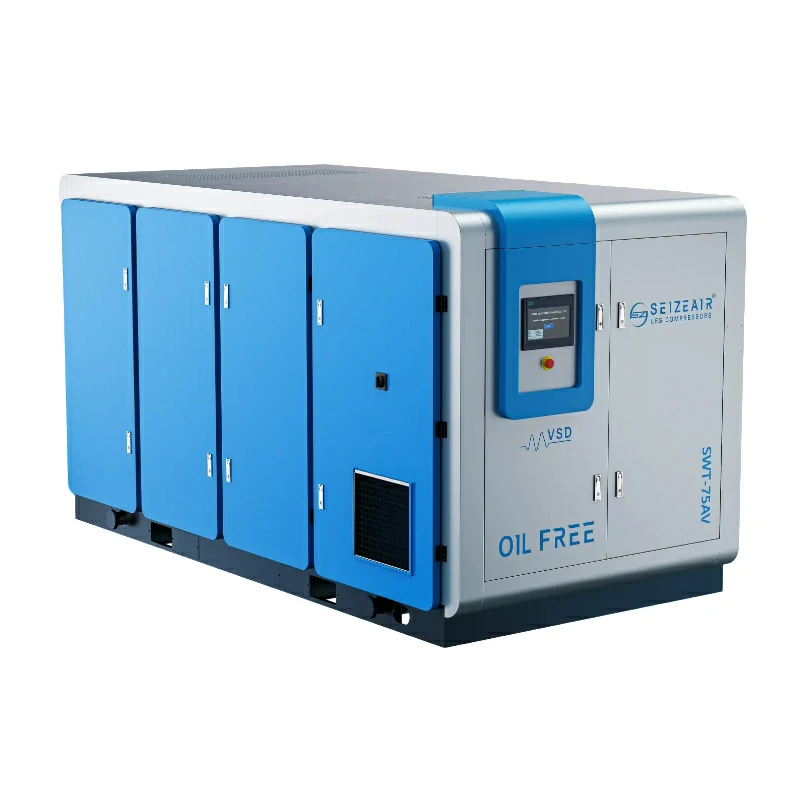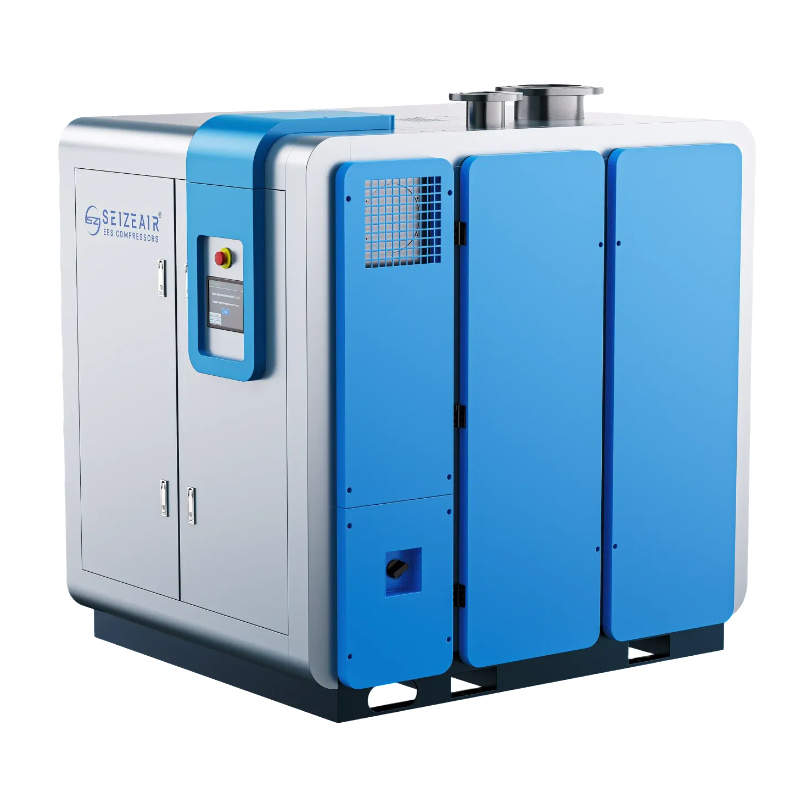


When your industrial operations grow, your air demand doesn’t just increase—it evolves. Standard shop compressors fall short when you’re powering heavy-duty pneumatic tools, massive assembly lines, or continuous sandblasting operations. This is where high volume air compressors become the backbone of your facility.
In this guide, we’ll break down how to choose the right high-flow system, optimize for energy efficiency, and ensure your production never hits a bottleneck.
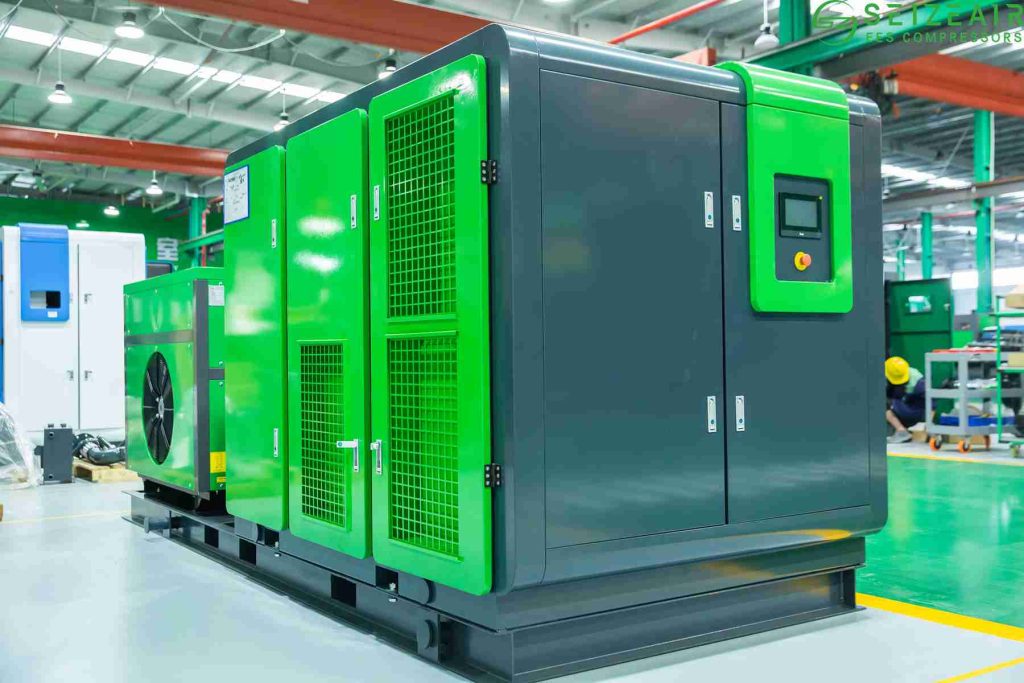
Is a high volume air compressor the same as a high-pressure unit?
In the industrial sector, the term high volume air compressor is often used interchangeably with “high-flow,” referring specifically to the CFM (Cubic Feet per Minute) delivery. It is a common trap for procurement managers to conflate PSI with CFM. While PSI (Pounds per Square Inch) represents the force, CFM represents the mass of air being moved. Think of a fire hose versus a pressure washer: one moves a massive amount of water to do work (High Volume), while the other moves a small amount of water at high speed (High Pressure).
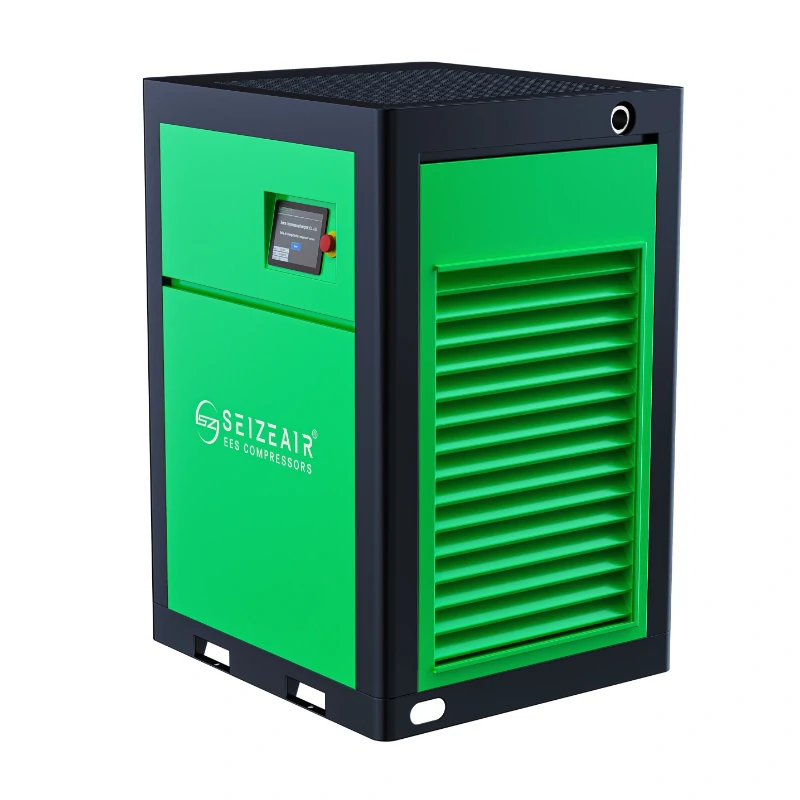
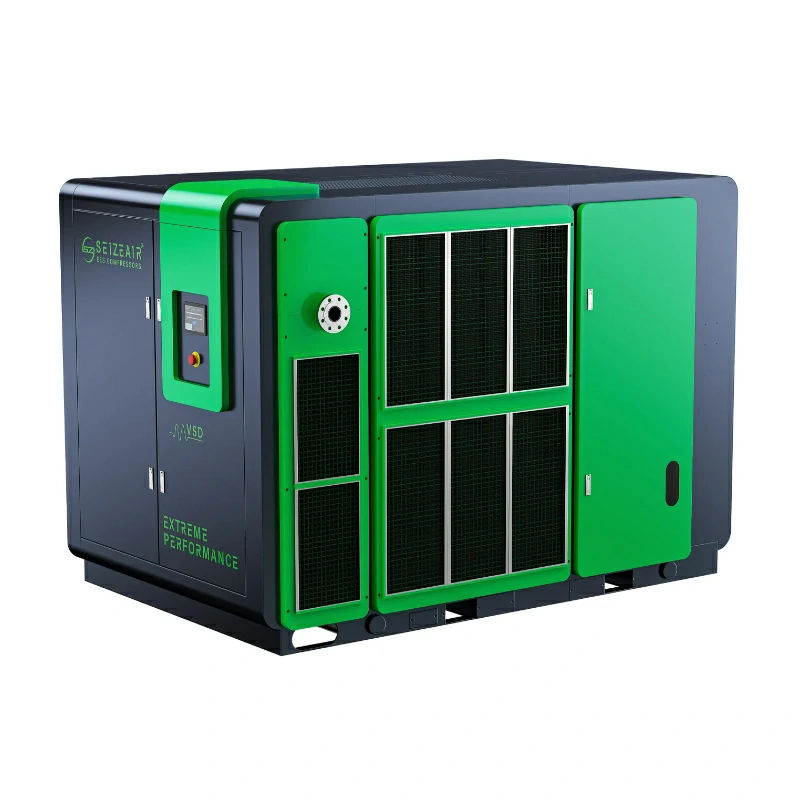
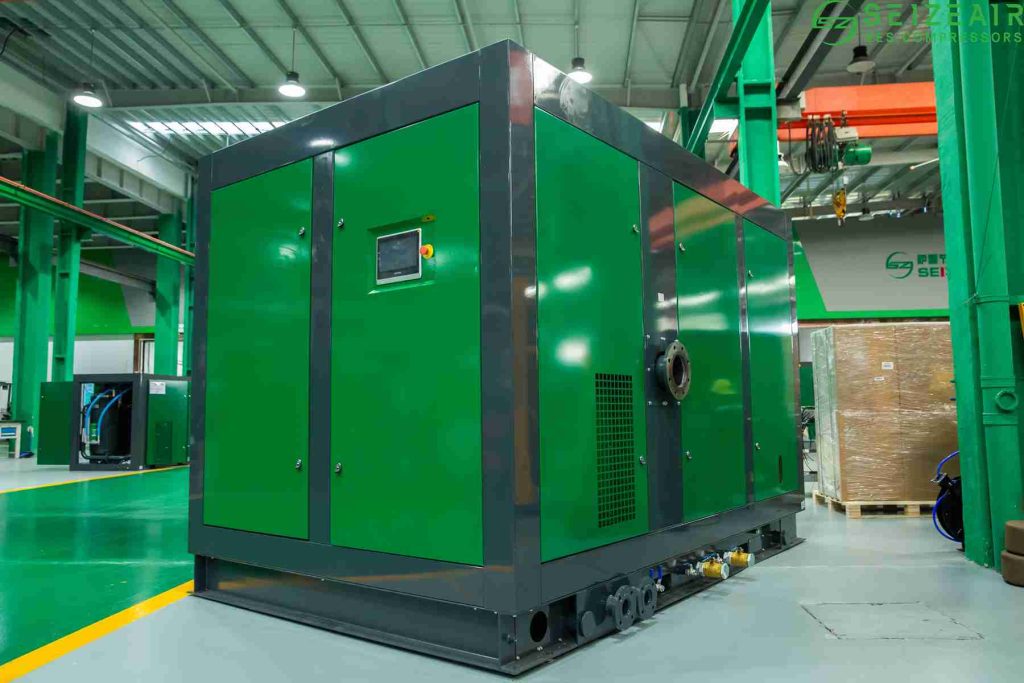
For a high-volume system, the engineering focus shifts toward the continuous air delivery rate. In heavy manufacturing, you are likely looking for a large capacity rotary screw compressor that can maintain 100 to 3,000+ CFM without a drop in system pressure. Brands like Seize Air have pioneered “over-sized air end” designs, which allow the machine to rotate at lower speeds while producing more air, effectively reducing wear while maximizing volume. This approach moves away from the “high-speed friction” model of older units, focusing instead on heavy-duty air displacement for 24/7 cycles.
| Technical Specification | Heavy Industrial Requirement | Impact on Production Floor |
| CFM Range | 100 to 3,000+ CFM | Supports multiple high-draw tools without “pressure sag” |
| Duty Cycle | 100% (Continuous) | Designed to run 3 shifts a day with zero cooling breaks |
| Cooling System | Liquid or Advanced Air-Cooled | Prevents thermal shutdown in 40°C+ factory environments |
| Drive Type | Direct Drive or VSD | Eliminates belt slippage and maximizes torque-to-air conversion |
Which is better: A rotary screw or centrifugal high volume air compressor?
Choosing the internal “engine” of your air system is where most plant engineers spend their time. It’s a balance between upfront CAPEX and the long-term reality of your facility’s load profile.
The Rotary Screw Air Compressor
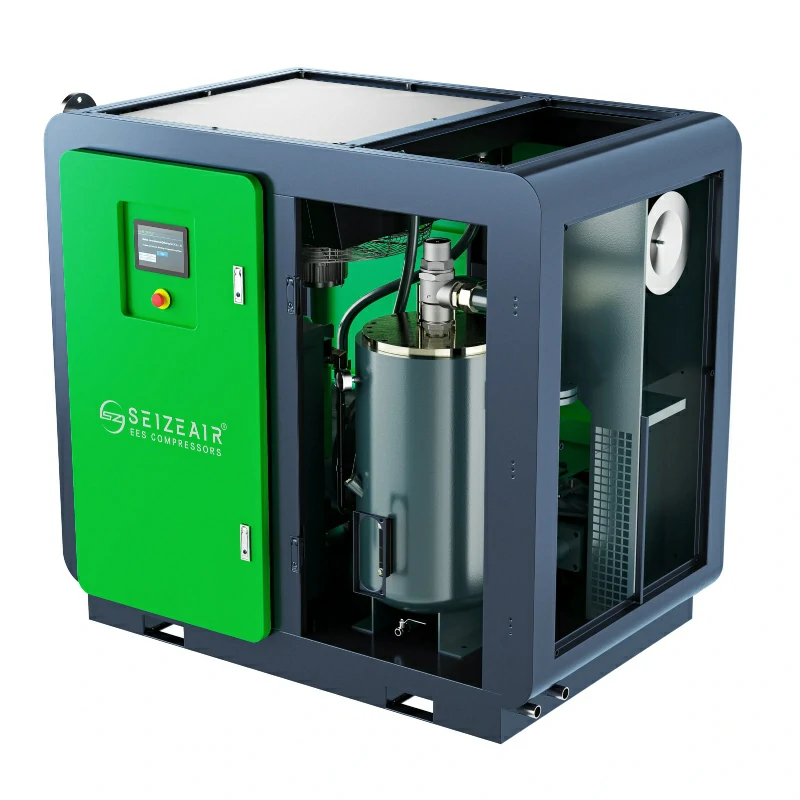
For 90% of industrial applications, the twin-screw rotary compressor is the gold standard for industrial air demand management. These units use two helical rotors to trap and compress air in a continuous motion. Because there are no intake or exhaust valves to cause vibration, these units thrive in high-demand environments. From an integrator’s perspective, a Seize Air rotary screw unit is highly adaptable; whether you are running a single 100HP unit or a synchronized bank of five, the delivery remains pulse-free. This is critical for sensitive automated packaging lines where a “pulse” in air pressure could lead to rejected products or misaligned sensors.
Centrifugal Air Compressor
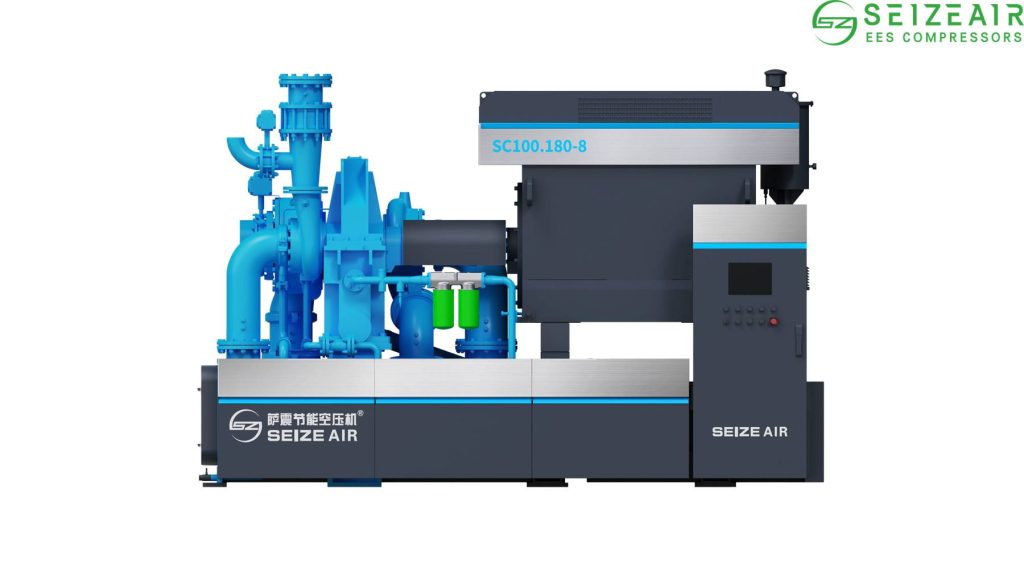
If you are operating a massive textile mill or a chemical processing plant where the air demand never drops below 2,000 CFM, a centrifugal compressor becomes an option. These use high-speed impellers to generate velocity, which is then converted into pressure. They are natively oil-free, but they have a fatal flaw: they cannot “throttle” well. If your factory has spikes and dips in usage, a centrifugal unit will “surge,” causing massive mechanical stress. For facilities with variable shifts, a high-volume VSD rotary screw is almost always the more profitable choice.
How many CFM do I need for high-volume industrial sandblasting and automation?
I’ve walked into dozens of plants where the foreman complains about “low pressure,” so they crank up the PSI on the compressor. This is a mistake that costs thousands in energy. Most tools are regulated to 90 PSI anyway. Cranking the compressor to 125 PSI just to “fix” a pressure drop at the end of the line is a Band-Aid for a volume problem.
The real culprit is almost always insufficient air flow (CFM).
- The “Bottle” Effect: If your pipe diameter is too small or your compressor can’t keep up with the flow, the velocity in the pipe increases, causing friction and a massive pressure drop.
- The Diversity Factor: In a factory with 20 pneumatic stations, they rarely all fire at the exact same millisecond. A Seize Air system with a smart controller can sense this “diversity” and adjust output, preventing the “over-compression” of air that isn’t being used.
Real-World CFM Demand Scenarios:
- Automated Packaging Lines: Usually require 50–150 CFM, but require extremely dry air to prevent solenoid failure.
- Heavy Sandblasting: A single #8 nozzle at 100 PSI consumes roughly 340 CFM. If you have three booths, you need a 1,000+ CFM air system.
- Pneumatic Conveying: Moving 10 tons of flour or plastic pellets per hour can require 500–1,500 CFM of “low-pressure, high-volume” air.
Does a Variable Speed Drive (VSD) really save money on a high-flow system?
If you take away one thing from this guide, let it be this: Stop buying fixed-speed compressors for fluctuating loads. A fixed-speed compressor is like a car that only has two settings: “Engine Off” and “100 MPH.” When the factory only needs 50% of the air, a fixed-speed machine stays at full power and just “unloads”—the motor keeps spinning at 3,000 RPM, consuming about 35% of its full energy just to blow hot air into a vent.
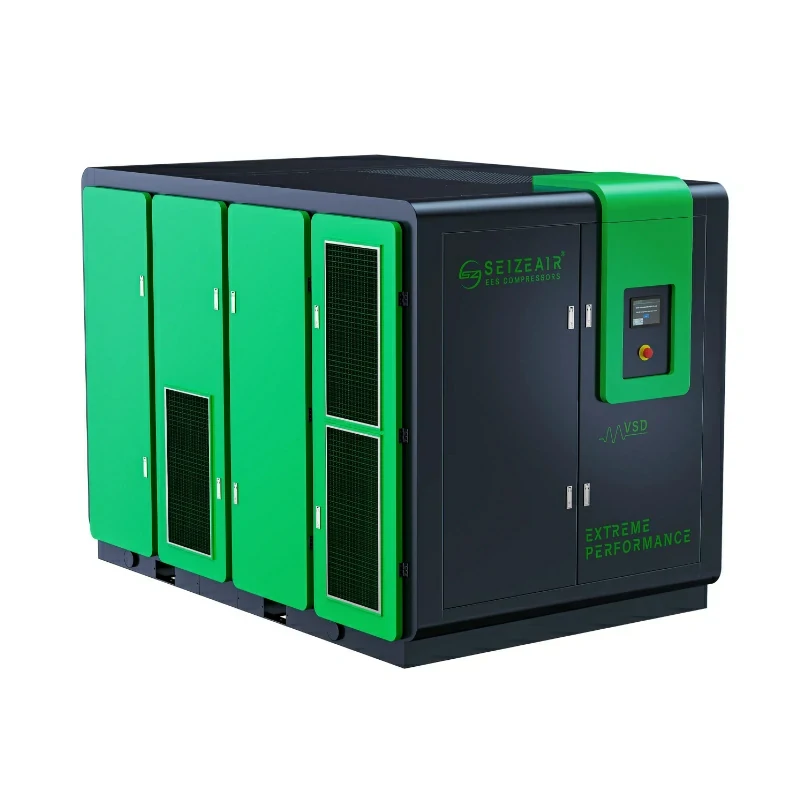
A VSD (Variable Speed Drive) motor acts like a dimmer switch. It slows the motor down to match the exact high volume air demand of the moment. Leading manufacturers like Seize Air have pushed this further with two-stage compression technology. By compressing the air in two steps rather than one, the “heat of compression” is managed more effectively. This allows the machine to produce more CFM per kilowatt of electricity used. In a large factory, switching from a fixed-speed to a VSD two-stage unit often pays for itself in less than 24 months through electricity savings alone.
| Factory Load Profile | Energy Waste (Fixed Speed) | VSD Savings Potential |
| Constant (3-Shift, 24/7) | Minimal | Moderate (VSD still helps with soft-starts) |
| 2-Shift (Day Production) | High (Unloaded run time) | 25% – 35% |
| Highly Variable (Testing Labs) | Extreme | Up to 50% |
What is the best industrial air piping for high volume flow?
You can buy the most efficient Seize Air compressor on the market, but if you hook it up to 1-inch rusted iron piping, you’ve choked the system. High volume requires a “Low Velocity” approach to piping. If the air moves through the pipes at more than 20-30 feet per second, the friction creates heat and pressure loss.
- Ring Main Layout: For high-volume facilities, always install a “Loop” or “Ring Main.” This allows air to reach any point in the factory from two directions. This effectively doubles the pipe capacity and balances the pressure across the entire floor.
- Material Matters: Avoid PVC at all costs—it’s a safety hazard. Black iron is common but scales and rusts over time, clogging your high-flow air filters. Aluminum piping is the modern standard for high-volume systems; it’s leak-proof, lightweight, and has a smooth interior that minimizes friction.
- Storage is a Buffer: A high-volume system is only as good as its air receiver tank. For high-flow applications, we recommend 3–5 gallons of storage for every 1 CFM of compressor output. This acts as a “buffer” so the compressor doesn’t have to “chase” every small tool trigger.
What maintenance is required for a 100% duty cycle compressor?
In a high-flow environment, a small problem becomes a catastrophic failure very quickly. When a machine is moving 500 cubic feet of air every minute, it is also sucking in a massive amount of ambient dust and moisture.
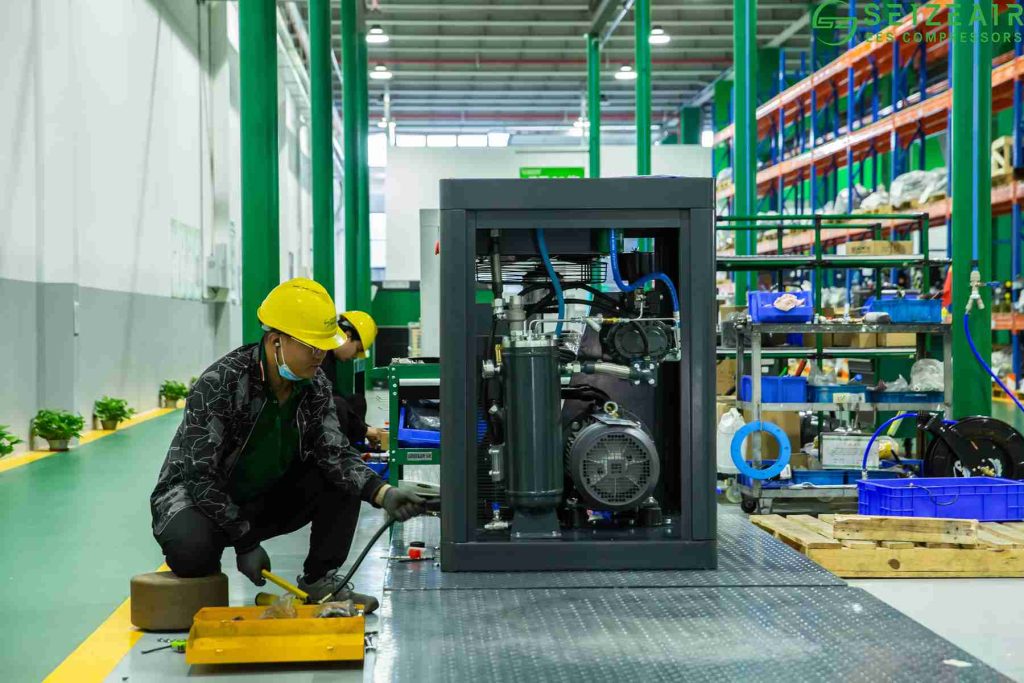
The Intake Filter: If this is 10% clogged, your compressor’s efficiency drops by 10%. In a Seize Air industrial unit, these filters are oversized to extend service intervals, but they must still be monitored via pressure differential gauges.
Moisture Management: High volume air holds a lot of water. If you are moving 1,000 CFM, your system could be pulling 50 gallons of water out of the air every day. If your refrigerated air dryer isn’t sized for the peak flow, that water will end up in your production lines, causing rust and tool failure.
Oil Analysis: For oil-injected screws, the oil is the lifeblood. It cools, seals, and lubricates. In a high volume air compressor, the oil works harder than in any other application. Regular sampling can tell you if a bearing is starting to wear long before the machine seized.
Conclusion
Investing in a high volume air compressor is a pivotal move for any industrial facility. It’s not just about buying a bigger machine; it’s about engineering a system that provides consistent, dry, and energy-efficient power. Whether you are upgrading an existing line or building a new facility, focusing on the CFM-to-kW ratio will ensure your ROI remains positive for years to come. By choosing specialized equipment like that from Seize Air, you’re not just buying air—you’re buying the reliability that keeps your production floor moving.