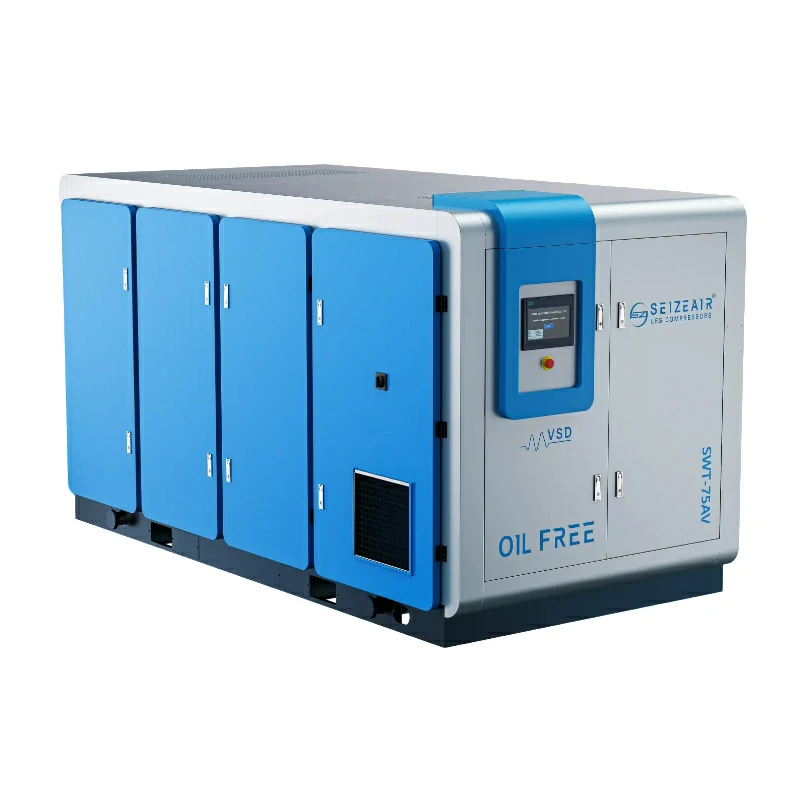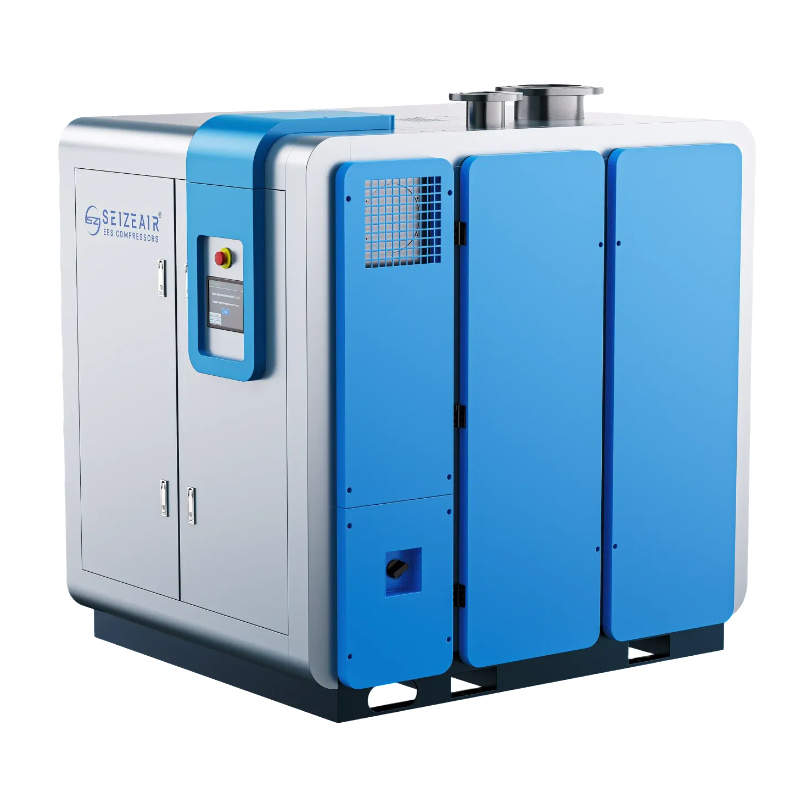


Here’s a hard truth that many plant managers overlook: a standard single-stage screw air compressor running at 10–12 bar typically wastes 15–25% of its energy through internal leakage and unnecessary heat generation. That’s not a theoretical figure—it’s measured in real-world facilities where we’ve conducted energy audits over the past decade.
The mechanical root cause is straightforward. In a single-stage unit, the compression ratio (discharge pressure divided by suction pressure) is high. The rotors must work harder to achieve final pressure in one step, leading to higher internal temperatures, increased oil carryover, and greater mechanical stress on bearings and seals. The result? More downtime, more oil changes, and a shorter service life.
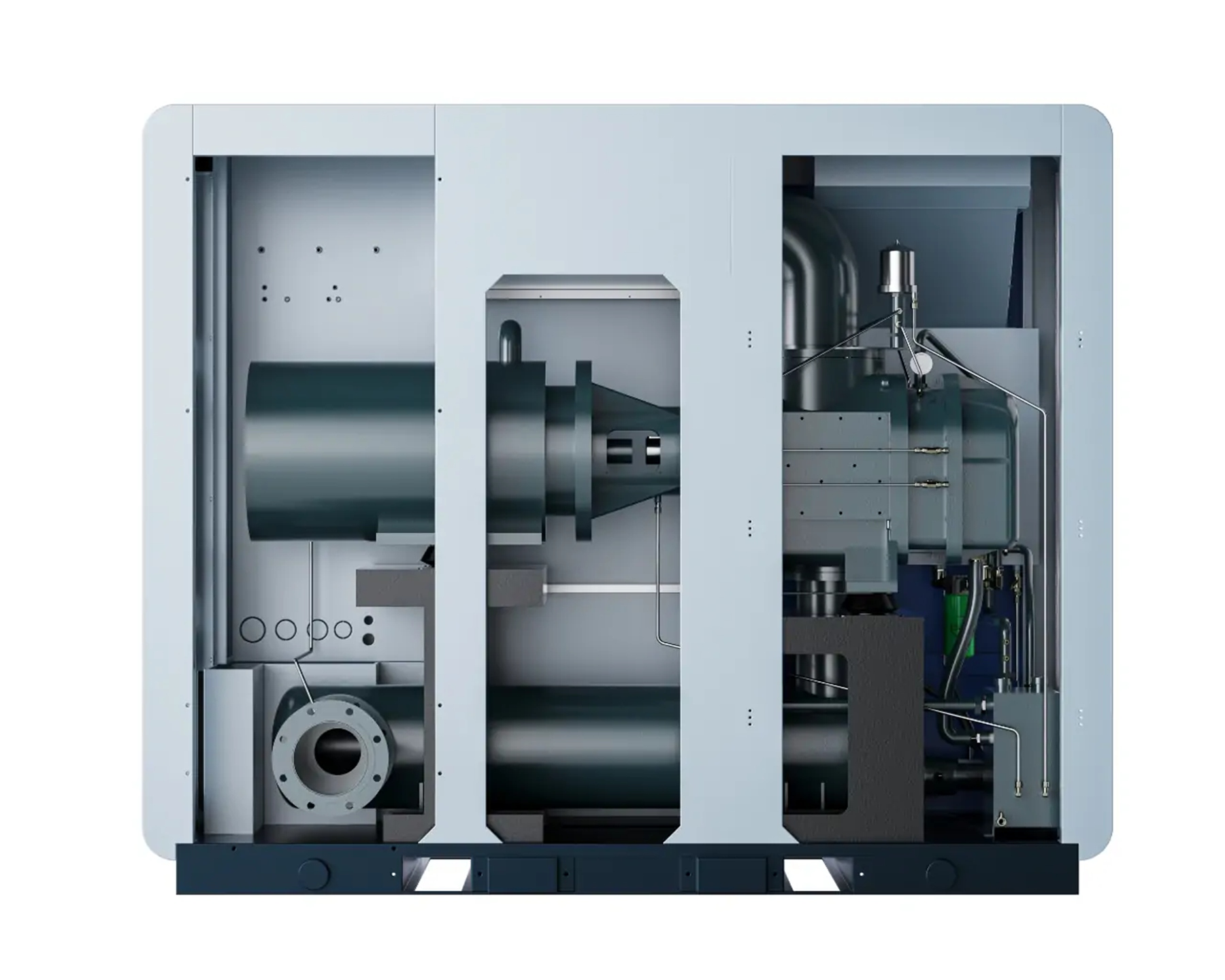
This is precisely where the two-stage screw air compressor shifts the economics of compressed air. By splitting the compression work across two separate stages, you reduce the load on each rotor set, lower discharge temperatures by 30–40°C, and dramatically cut energy consumption—all while making maintenance far simpler.
What Makes a Two-Stage Screw Air Compressor “Easy-Maintainable”
Not all two-stage compressors are created equal when it comes to serviceability. “Easy-maintainable” isn’t a marketing tagline—it’s a design philosophy rooted in engineering choices that affect every technician who opens the machine.
Key design features that define easy maintainability:
| Feature | Why It Matters |
|---|---|
| Separate oil filters for each stage | Prevents cross-contamination; changes can be done independently per stage based on actual wear |
| Bolt-on inlet valve assembly | Removes the need to disassemble entire air end to clean or replace the valve |
| Accessible check valves | Mounted on external piping rather than buried inside the cooler core |
| Large, single-panel access doors | Allows visual inspection of belts, filters, and oil lines without removing panels |
| Centralized grease points | Bearings on motors and fans can be relubricated from one location |
The two-stage architecture itself helps. Because each stage operates at a lower pressure ratio—typically 3:1 to 4:1 instead of 8:1 to 9:1—the air end runs cooler. Lower discharge temperatures mean less thermal cycling on seals and gaskets. Seals last longer. O-rings don’t harden as quickly. That’s not speculation; it’s a direct consequence of the physics inside the compression chamber.
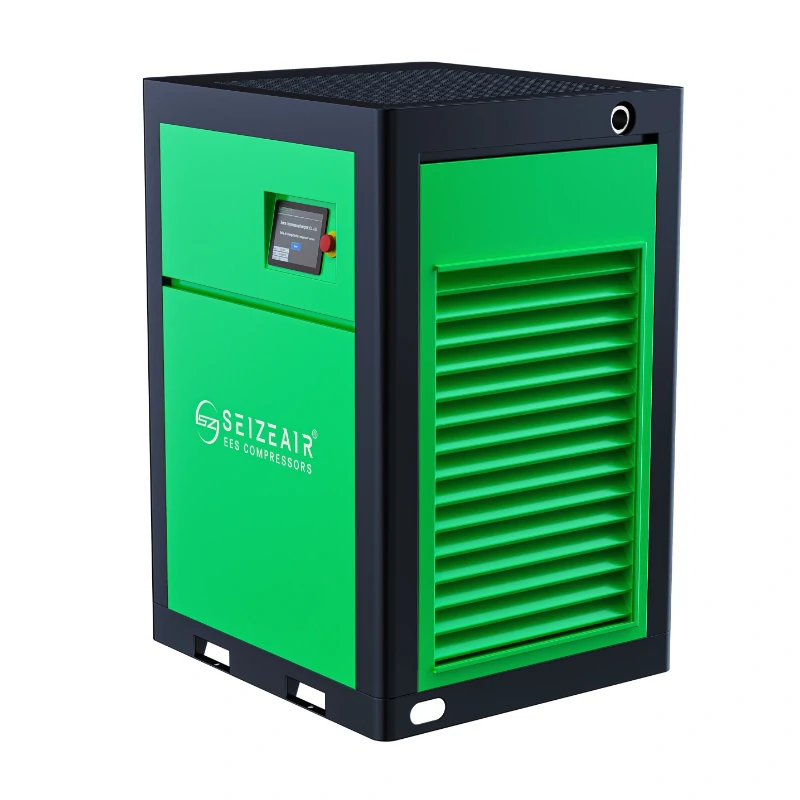
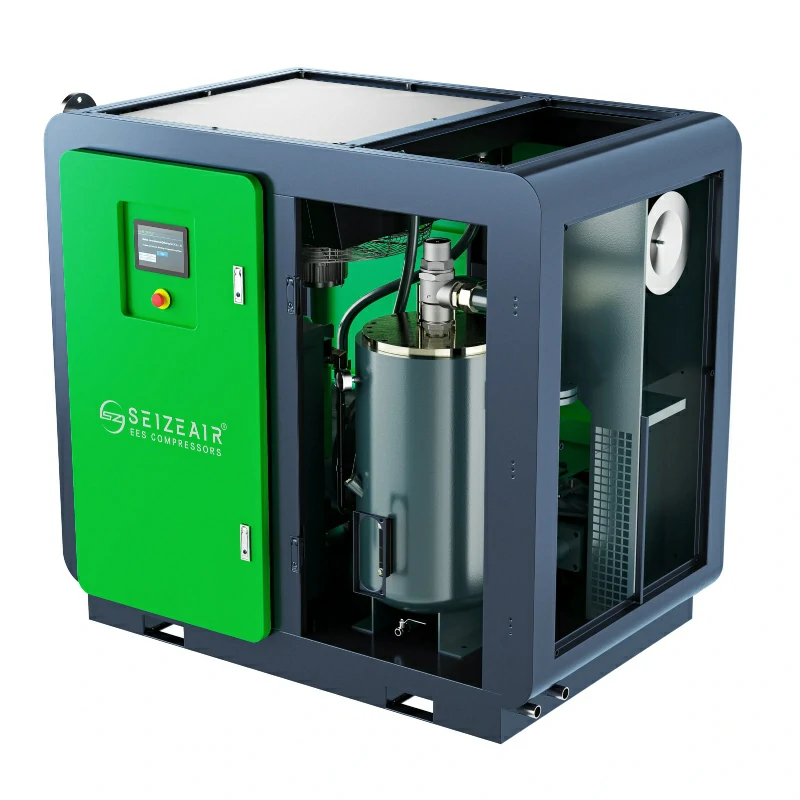
At Seize Air, our two-stage models are engineered with these principles from the ground up. The oil separator tank, for example, is positioned to allow easy access for element replacement without lifting heavy components. The intercooler between the first and second stage is mounted on a hinged frame—swing it open, clean it, swing it back. No alignment tools required.
How Two-Stage Compression Saves Energy
Let’s get specific. A typical Seize Air two-stage screw air compressor operates with the following parameters:First stage discharge: 3.5–4.5 bar (gauge) at 80–90°C
Intercooler drop: Brings temperature down to 40–50°C, condensing moisture before second stage
Second stage discharge: 10.5–12.5 bar (gauge) at 85–95°C
Final oil-injected cooling: Reduces air temperature to 10–15°C above ambient before entering the dryer
Compare this to a single-stage unit compressing from atmospheric pressure to 10 bar in one go. The single-stage discharge temperature often hits 110–130°C. At those temperatures, the oil degrades faster—you’re changing oil every 1,500 hours instead of 4,000 hours. The moisture stays in vapor form through the entire compression cycle, meaning your downstream filtration has to work harder. And the energy penalty? At full load, a two-stage unit consumes roughly 5–8% less kW per m³/min of compressed air produced, measured at the same discharge pressure.
ISO 8573-1 compliance is also easier to achieve with two-stage compression. Because the intercooler removes a significant portion of the water vapor before the second stage, the final air contains fewer liquid droplets. This reduces the load on downstream dryers and filters, especially if you’re targeting Class 2 or Class 1 particulate and moisture levels.
Common User Pain Points That Two-Stage Design Solves
1. Excessive Energy Costs
Every 1°C reduction in discharge temperature saves roughly 0.5% in energy from reduced cooling fan load and less pressure drop across the cooler. In a two-stage unit running at 95°C instead of 125°C, that’s a 15% energy saving on the cooling system alone. Multiply that over 8,000 hours per year at 132 kW—the savings are significant.
2. Oil Contamination Risk
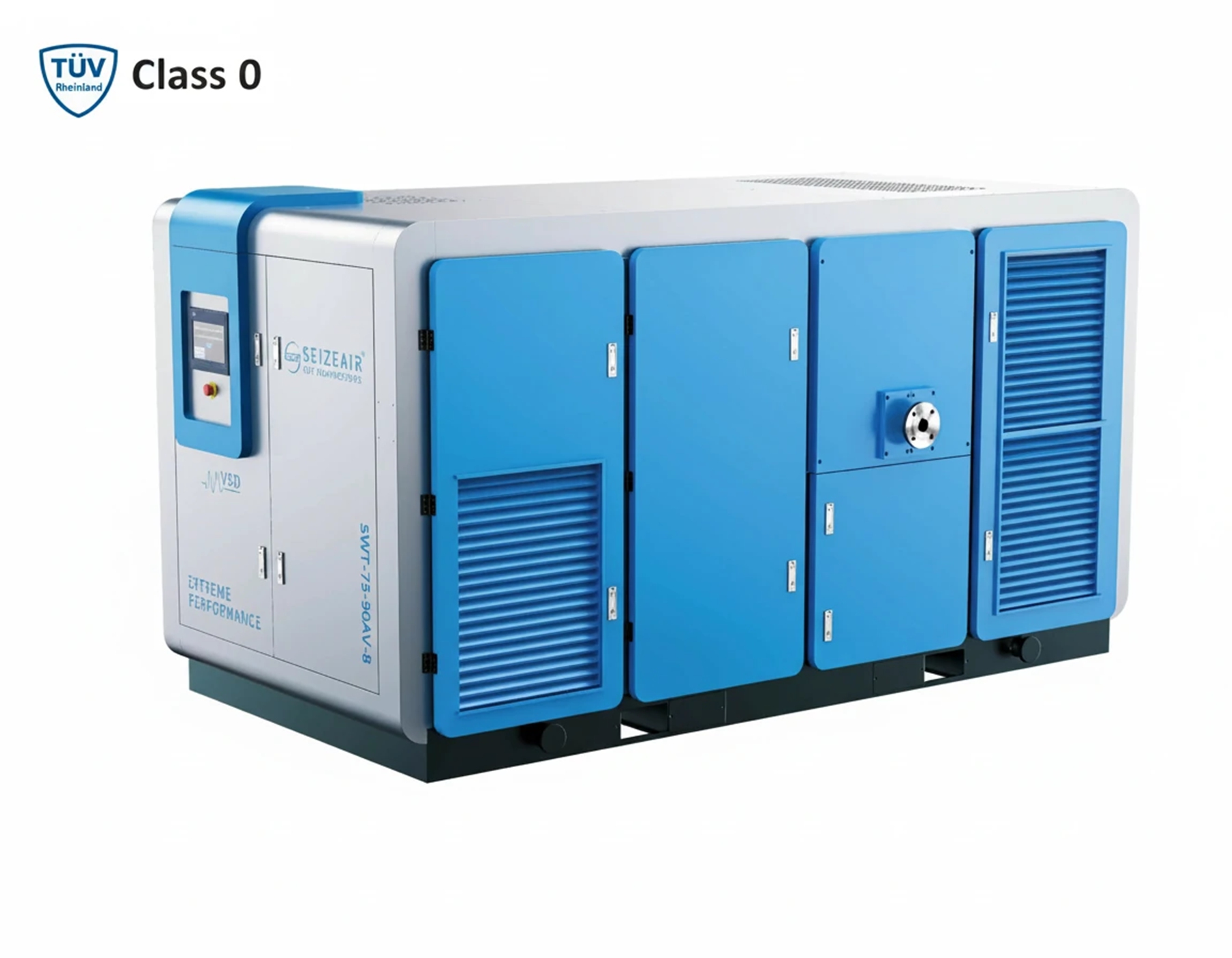
In industries like electronics assembly, pharmaceutical manufacturing, or food processing, even trace amounts of oil vapor in the compressed air can cause product rejection. Two-stage compression inherently produces drier air at the intercooler outlet. When paired with a high-efficiency coalescing filter, the system can consistently deliver ISO 8573-1 Class 0 oil content—less than 0.01 mg/m³.
3. High Maintenance Costs
The parts that fail most often in screw compressors are bearings, seals, and oil separators. Because a two-stage unit runs cooler, bearing L10 life increases by 30–50%. Because the intercooler removes moisture, the oil separator element doesn’t become waterlogged as quickly. And because the pressure ratio per stage is lower, the air-end screws experience less bending stress—fewer shaft repairs.
Oil-Injected vs. Oil-Free Two-Stage: Which One for Your Application?
The choice between oil-injected and oil-free two-stage systems depends on your air quality requirements and budget.
Oil-Injected Two-Stage:Best for general industrial applications where trace oil can be tolerated
Lower initial purchase price (typically 25–40% less than oil-free)
Higher overall efficiency at partial loads due to better oil cooling
Seize Air oil-injected models are equipped with our proprietary dual-stage oil separation system—first by centrifugal force, then by coalescing media—achieving residual oil content of<3 ppm at the outlet
Oil-Free Two-Stage:Mandatory for pharmaceutical, food and beverage, semiconductor, and medical gas applications
Uses either dry PTFE-coated rotors or water-injected cooling (the Seize Air Water-Lubricated Oil-Free series)
Lower discharge temperature due to evaporative cooling—outlet air can be just 5–8°C above ambient
Higher maintenance intervals—bearing and seal replacement every 8,000–12,000 hours, compared to 2,000–4,000 hours for dry oil-free designs
For most industrial users running general automation, packaging, or pneumatic tools, an oil-injected two-stage compressor provides the best balance of efficiency and maintainability. For sensitive environments, our water-lubricated oil-free series is the safer bet—no oil at all in the compression chamber, and easier cleanup if a seal ever fails.
Installation and Preventive Maintenance: Tips From Field Engineers
After deploying over 40,000 units globally, our service team has compiled a set of practical recommendations that directly affect the ease of maintenance for your two-stage compressor.
Installation must-dos:Leave enough clearance—at least 1 meter on the control panel side and 0.8 meters above the air-end housing. Cramped installations are the #1 cause of skipped inspections.
Pipe the drain line to a collection point that’s easy to access. Condensate from the intercooler and aftercooler can accumulate quickly; if the drain valve is hard to reach, it won’t get cleaned.
Use flexible connectors between the compressor and the main air header. Rigid connections transfer vibration to the piping, causing stress fractures over time.
Routine maintenance schedule (for oil-injected models running 8,000 hours/year):
| Interval | Task |
|---|---|
| Daily | Check oil level, inspect condensate drainage, verify discharge temperature is within 10°C of baseline |
| Monthly | Clean intercooler and aftercooler fins with compressed air; inspect all hoses for cracking |
| Every 1,000 hours | Change oil filter; visually inspect air-end for unusual noise or vibration |
| Every 4,000 hours | Replace oil separator element; grease motor bearings; check belt tension |
| Every 12,000 hours | Overhaul air-end (replace bearings, seals, and timing gears); inspect rotors for scoring; replace all coolant hoses |
One tip that our field engineers emphasize: always use genuine Seize Air oil in our two-stage compressors. The oil formulation is specific to our screw profile tolerances. Using generic hydraulic oil will reduce the oil life by at least 30% and accelerate varnish formation on the rotors—leading to seized air-ends.
Why Seize Air Two-Stage Compressors Stand Apart
We don’t claim to be the only option—but we do back our engineering with real numbers.
Seize Air two-stage screw air compressor specifications:Flow range: 5.5–150 m³/min (at 7.5 bar)
Motor power: 37–900 kW
Pressure options: 8, 10, 13 bar standard; custom 15 bar available
Noise level: 68–75 dB(A) at full load (lower than many single-stage units because slower rotor speeds generate less noise)
Efficiency rating: Exceeds the National Level I Energy Efficiency Standard by 3–5%, verified by third-party testing
What makes us different from other two-stage manufacturers?
1. Our patented screw profile geometry minimizes internal leakage between the male and female rotors. In a two-stage unit, leakage losses in the first stage directly reduce the pressure ratio available to the second stage. We’ve optimized the helix angle and rotor tip clearance to maintain volumetric efficiency above 92% at full load.
2. IoT-enabled control as standard. Every Seize Air compressor ships with a built-in controller that tracks discharge pressure, temperature, power consumption, and oil condition in real time. The system sends alerts when a filter is approaching its end of life—not at an arbitrary hour count, but based on actual pressure drop. This eliminates wasted filter changes and prevents the catastrophic failure that comes from running a clogged oil filter.
3. Modular design for faster service. The air-end assembly, oil cooling system, and electrical cabinet are each mounted on separate sub-frames. You can remove the entire air-end for overhaul without draining the oil system or cutting any wires. Our field technicians report that a full air-end replacement takes under 4 hours, compared to 8–12 hours for conventional designs.
Making the Switch
Should you replace your aging single-stage compressor with a modern two-stage unit? Let the numbers decide.
Scenario: Current system: Single-stage, 160 kW, running 8,000 hours/year at 90% load factor
Proposed upgrade: Seize Air two-stage, 150 kW, same duty cycle
Electricity cost: $0.10/kWh
Savings calculation: Energy saved: 10 kW × 0.90 × 8,000 hours = 72,000 kWh/year
Direct electricity savings: 72,000 × $0.10 = $7,200/year
Additional savings: Oil changes reduced from 5/year to 2/year ($1,200 saved), filter replacement savings ($800), reduced maintenance labor ($2,000)
Total annual savings: $11,200
If the new compressor costs $180,000 fully installed, the payback period is approximately 16 months. For most facilities, that’s under the typical capital replacement cycle of 3–5 years.
And that’s before factoring in the production benefits: fewer unscheduled stops, consistent air quality, and the ability to run 24/7 without overheating.
Final Considerations Before Purchasing
A two-stage screw air compressor is not a “set it and forget it” machine. But if you choose a unit designed for easy maintenance, the total cost of ownership is significantly lower than single-stage alternatives.
Before you buy, ask these questions:What is the intercooler approach temperature? (Difference between compressed air outlet and ambient air. Below 10°C is good; below 5°C is excellent.)
Can the oil filter be changed without draining the entire oil circuit? (If not, you’ll be paying more for oil every filter change.)
What is the guaranteed pressure dew point? (For a two-stage unit with proper intercooling, you should expect -20°C to -40°C at the outlet after the dryer.)
Does the manufacturer provide a remote monitoring platform? (If so, you can schedule maintenance based on actual condition, not just running hours.)
At Seize Air, we offer free technical pre-sales support to answer these questions for your specific application. Our engineering team can model your current compressed air system, calculate the savings from a two-stage upgrade, and recommend the exact model that matches your flow and pressure requirements—whether that’s an oil-injected, water-lubricated oil-free, or even a centrifugal configuration.
We don’t just sell compressors. We provide a professional, one-stop energy-saving solution tailored to your specific flow and pressure requirements. Our core product service portfolio includes oil-injected screw, dry oil-free, water-lubricated oil-free, and mobile units—all backed by a global network of 200+ service stations in over 20 countries.
Contact our team for a free energy audit or to schedule a demo at your facility. Your existing compressor may be costing you more than you realize—and the right two-stage upgrade could deliver a return on investment within the first two years of operation.