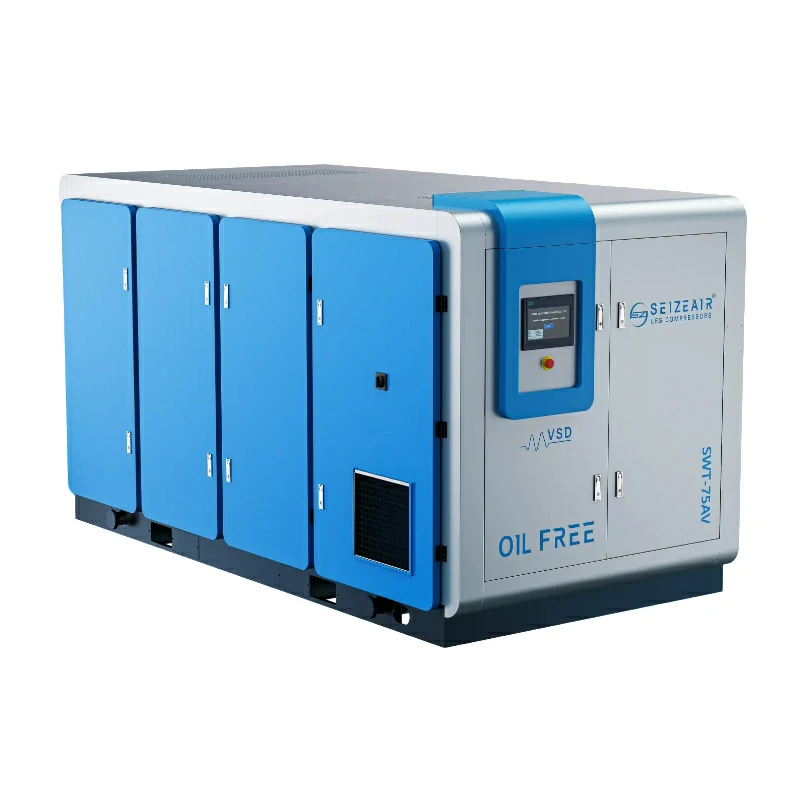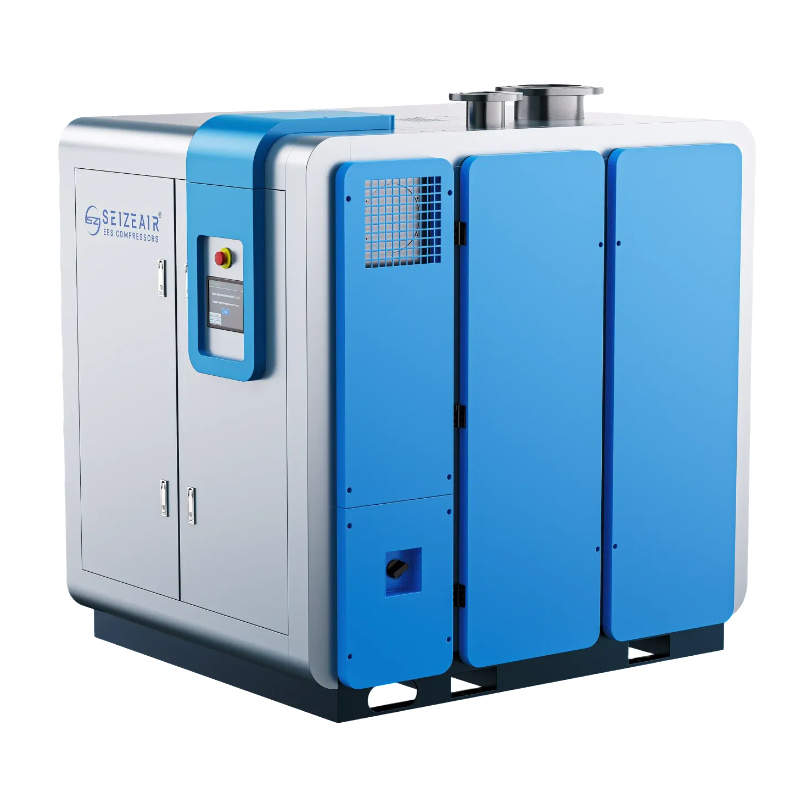


Compressed air is often referred to as the “fourth utility.” However, it is also one of the most expensive. With energy costs accounting for nearly 75% of the total lifecycle cost of an air compressor, the transition to high-efficiency systems isn’t just a trend—it’s a financial and operational necessity.
Whether you are upgrading a textile plant or powering a precision automotive assembly line, selecting the right high-efficiency air compressor determines your facility’s long-term profitability.
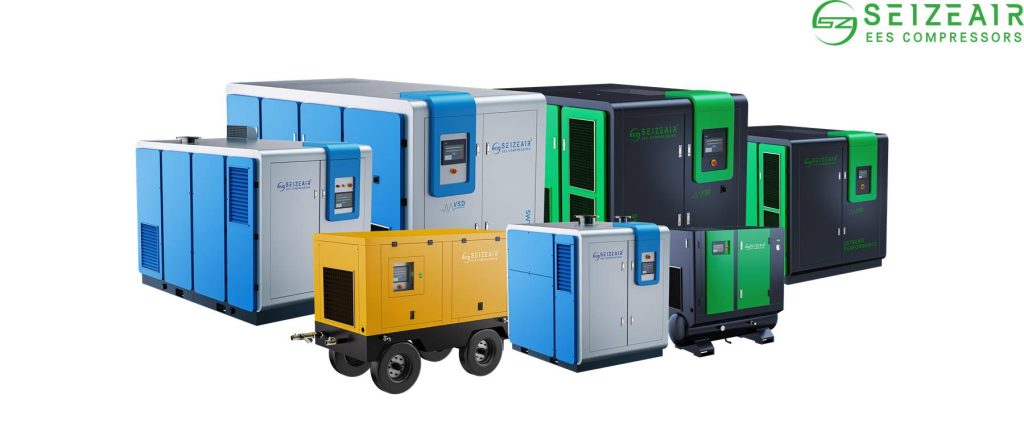
What makes a rotary screw compressor high efficiency?
When we talk about “high efficiency,” most procurement officers look at the motor tag. But as a field engineer will tell you, a high-efficiency motor bolted to a poorly designed air end is like putting a Ferrari engine in a tractor. True efficiency is a systemic achievement involving the specific power consumption of air compressors—the energy used to produce a set volume of air.
The Physics of Specific Power (kW/100 cfm)
Forget horsepower. If you want to compare two machines, look at the Specific Power (kW/100 cfm). This measures how much electricity you actually “burn” to get usable air at your required pressure.
- The “Tolerance” Trap: Be wary of manufacturers who don’t disclose their testing standards (like ISO 1217). A 5% “testing tolerance” in a 250kW machine can hide $10,000 in annual hidden energy costs.
- Airtight Engineering: High-efficiency units utilize precision-machined rotors with micron-level tolerances. If the rotors are too small, internal blow-by occurs; if they are too large, friction takes over.
The Rise of the IPM Motor in Industrial Settings
Standard induction motors lose efficiency when they aren’t running at 100% load. In contrast, Interior Permanent Magnet (IPM) motors maintain incredibly high efficiency across the entire speed range. This is critical because, in the real world, industrial demand is rarely a flat line. By using IPM technology, brands like Seize Air ensure that even when your production slows down, your energy savings don’t evaporate.
Furthermore, searching for a low noise high efficiency air compressor often leads to IPM models, as the lack of motor bearings and the integrated design significantly dampen vibration.
| Motor Type | Efficiency Rating | Performance at 50% Load | Maintenance Need |
| Standard Induction | IE3 (Premium) | Drops significantly | Bearings/Greasing |
| Permanent Magnet | IE4/IE5 (Ultra) | Remains >94% | Minimal (Oil-cooled) |
Is a two-stage air compressor more efficient than a single-stage?
If your facility consumes more than 500 cfm, you should likely be looking at a two-stage rotary screw compressor. From a decision-maker’s perspective, the logic is simple: splitting the work makes the machine last longer and consume less power.
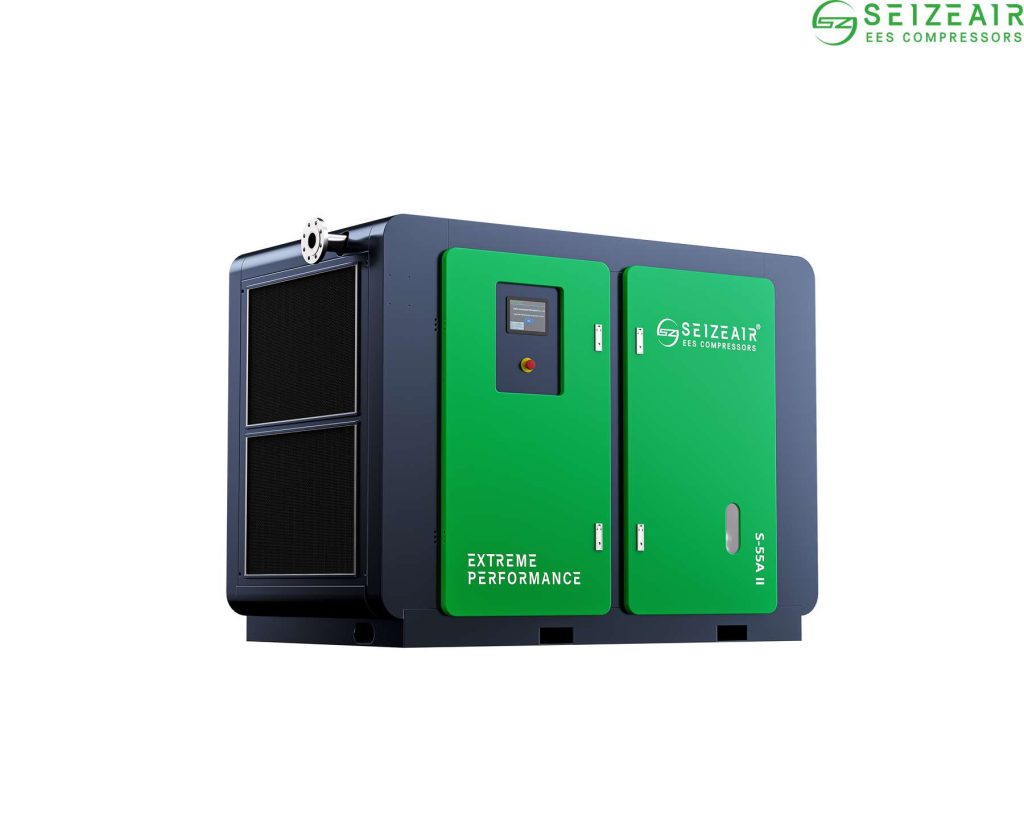
The Thermodynamics of Compression
Compression creates heat. Heat is, essentially, wasted energy. In a single-stage machine, you try to squeeze the air from atmospheric pressure to 100+ PSI in one go. The air gets incredibly hot, making it harder to compress.
In a two-stage system:
- Stage One: Compresses air to an intermediate pressure (typically around 30-40 PSI).
- Intercooling: The air passes through an oil-curtain or intercooler, dropping the temperature significantly. This is where the energy efficient industrial air system gains its edge.
- Stage Two: Compresses the now-dense, cool air to the final pressure.
Longevity Meets ROI
This process approaches isothermal compression, which is the theoretical ideal. On the factory floor, this translates to a 10% to 15% reduction in power consumption for the exact same air output. Because each stage handles a lower pressure ratio, the bearing loads are reduced. It’s why a high efficiency air compressor for 24/7 operation is almost always a two-stage build. It’s not just about the power bill; it’s about preventing unplanned downtime in a 3nd shift.
How much can I save with a VSD air compressor?
From a system integrator’s perspective, the “High Efficiency” label is often earned or lost in how the machine handles fluctuating air demand patterns. This is where VSD air compressor energy savings become the headline of your financial report.
The “Unload” Energy Sink
A standard “Load/Unload” compressor is a binary beast. When the tank is full, it keeps the motor running but closes the intake valve. It’s still consuming roughly 30% of its full power while producing absolutely nothing. This is “vampire power” at an industrial scale. I’ve seen plants where the compressor is “unloaded” for 4 hours a day—that’s thousands of dollars literally disappearing into the heat vents.
Precision Pressure Control
A Variable Speed Drive (VSD) inverter acts as the brain, telling the motor to spin only as fast as necessary.
- Pressure Stability: VSD maintains a steady ±1.5 PSI. Traditional units may swing 10–15 PSI. Why does this matter? For every 2 PSI you can lower your system pressure, you save 1% in energy.
- Soft Starting: No more massive current spikes during startup that trigger “peak demand” charges from your utility provider.
Field experience shows that companies like Seize Air often integrate the VSD directly with the motor cooling system, preventing the electronics from overheating in dusty or humid factory environments—a common failure point in cheaper “hybrid” models. If you are looking for a variable speed air compressor for manufacturing, the integration of the drive is as important as the drive itself.
What are the best ways to reduce compressed air energy costs?
A high efficiency air compressor is only as good as the piping it feeds. As a decision-maker, you must realize that energy efficiency is a “source-to-tool” journey.
The Cost of “Dirty” Efficiency
If your compressor is efficient but your filters are clogged, your machine has to work harder to “push” air through the blockage.
- The 1% Rule: For every 2 PSI of pressure drop caused by undersized piping or saturated filters, your compressor uses 1% more energy.
- Water Management: Inefficient dryers don’t just lead to rusty tools; they cause “slugs” of water that increase the density of the air the compressor has to move. Investing in a high efficiency refrigerated air dryer is a mandatory companion to a high-end compressor.
IoT and Predictive Efficiency
In 2026, a “dumb” compressor is a liability. High-efficiency systems now leverage AI-driven analytics to monitor health in real-time. Instead of waiting for a “High Temp” alarm, modern controllers monitor the Specific Power trend line. By utilizing cloud-based monitoring, Seize Air allows plant managers to view their energy consumption in real-time. When you see exactly how much a weekend air leak costs in dollars, you fix it on Monday.
Engineer’s Note: “I’ve seen plants buy the most expensive IE5 compressor on the market, only to plug it into a 20-year-old piping system with 15 PSI of pressure drop. They literally threw their ROI out the window before the first shift ended.”
How do I choose the right size air compressor for my factory?
Most “off-the-shelf” compressors are designed for a generic average. However, a cement plant in the desert has different needs than a brewery in the mountains. Selecting energy efficient air compressors requires a deep dive into your specific load profile.
Avoid the “Safety Margin” Trap
Consultants often add a 20% “safety margin” to the air demand, and then the salesperson adds another 10% just to be safe. You end up with a machine that is vastly oversized, running at its least efficient point.
- The Sweet Spot: Most high-efficiency screw compressors are designed to be most efficient at 70%–80% load.
- The Multi-Unit Strategy: Sometimes two smaller, high-efficiency units are better than one giant one. This provides redundancy and allows one unit to shut down completely during low-demand periods, which is a classic compressed air system optimization tactic.
Working with an OBM (Original Brand Manufacturer) like Seize Air provides a level of customization—from specialized rotor profiles to custom-tuned VSD parameters—that standard resellers simply cannot offer. This ensures that the industrial screw compressor energy audit you performed actually results in the savings you projected.
Can compressed air heat recovery reduce my factory’s utility bills?
The ultimate secret to a high efficiency air compressor setup isn’t in the air—it’s in the heat. Roughly 94% of the energy consumed by an air compressor is converted into heat. In a standard setup, this is vented into the atmosphere.
The Thermal Synergy
By installing a heat recovery system, you can capture this “waste” energy to:
- Pre-heat boiler feed water: Reducing your natural gas consumption for steam production.
- Factory space heating: Keeping the floor warm in winter using “free” heat.
- Process heating: Ideal for food processing or chemical plants that require constant warm water.
When you factor in the offset cost of other fuels, the “efficiency” of your compressor effectively jumps from 30% to over 90% in terms of total energy utilization. This is the hallmark of a sustainable industrial air solution.
Conclusion
The “best” high-efficiency air compressor is the one that delivers the lowest Total Cost of Ownership (TCO). In 2026, this means looking beyond the purchase price and scrutinizing specific power ratings, motor classes, and maintenance intervals.
By opting for advanced solutions—like the permanent magnet, two-stage systems offered by Seize Air—industrial leaders are not just cutting costs; they are future-proofing their operations against rising energy volatility and stringent carbon regulations. Efficiency is no longer an option—it is your most competitive advantage.