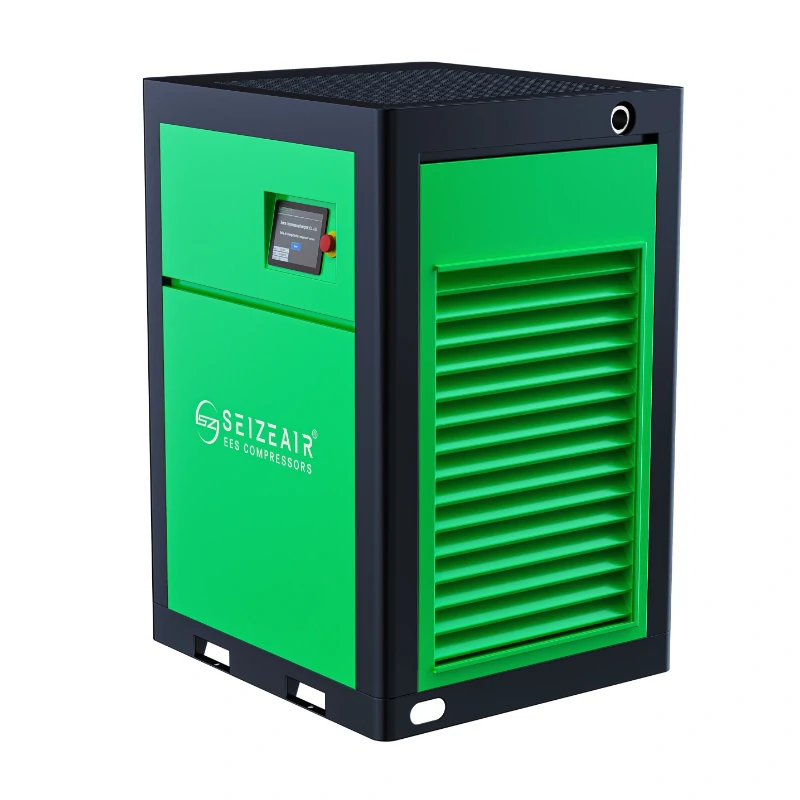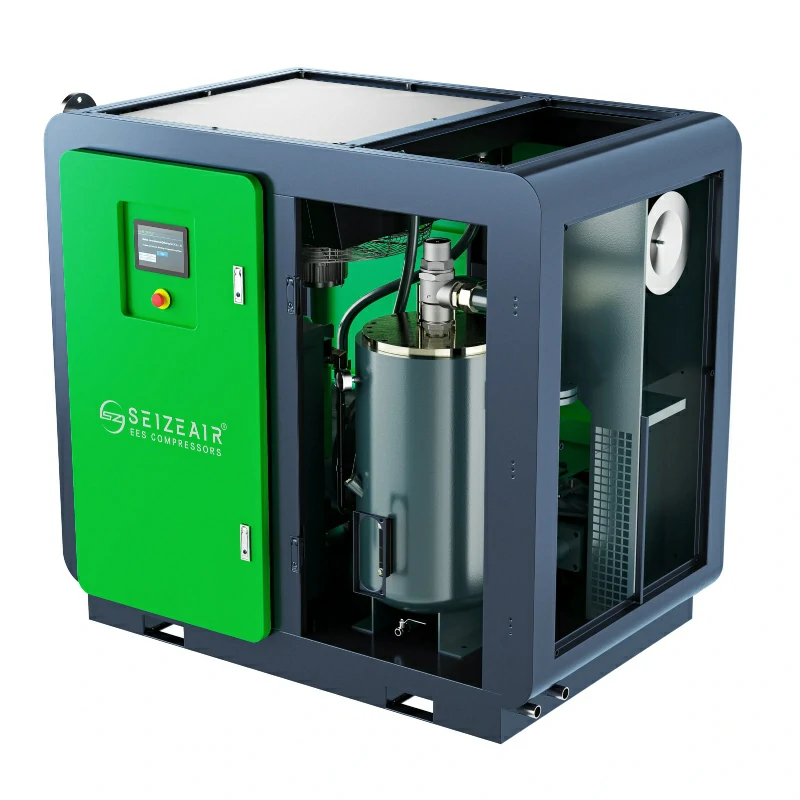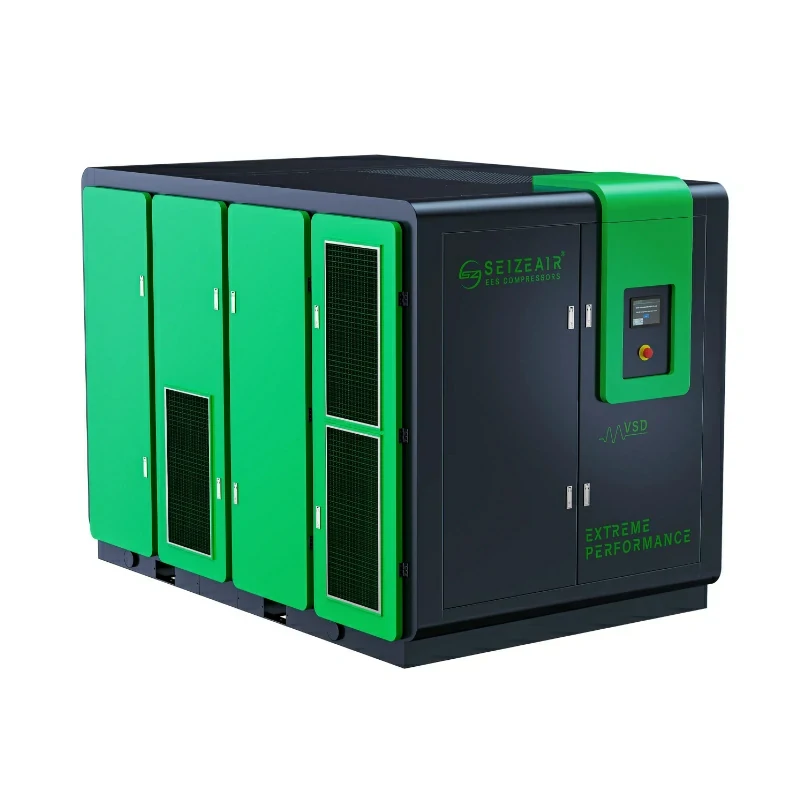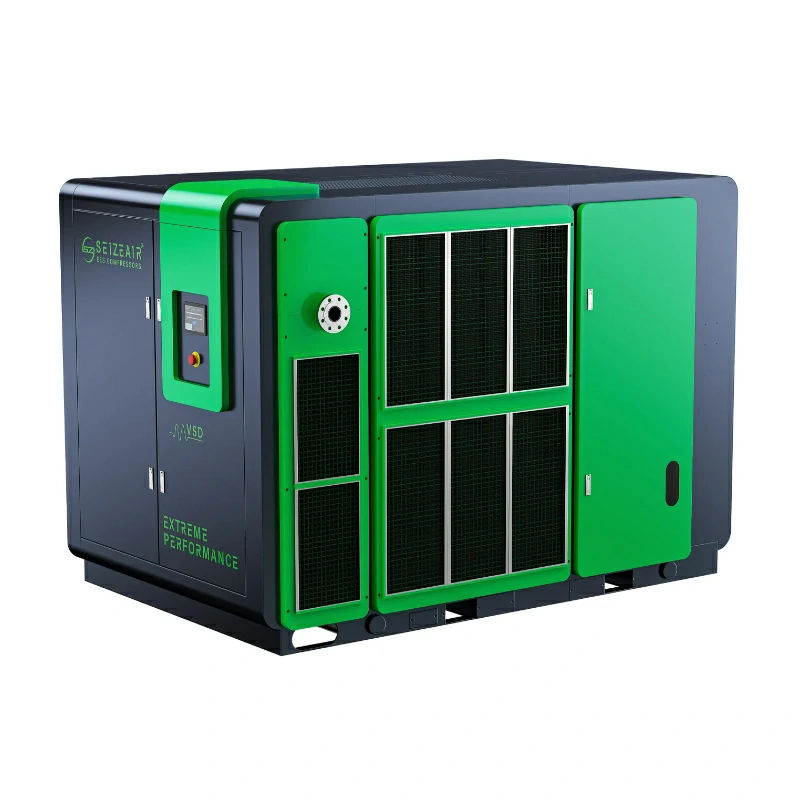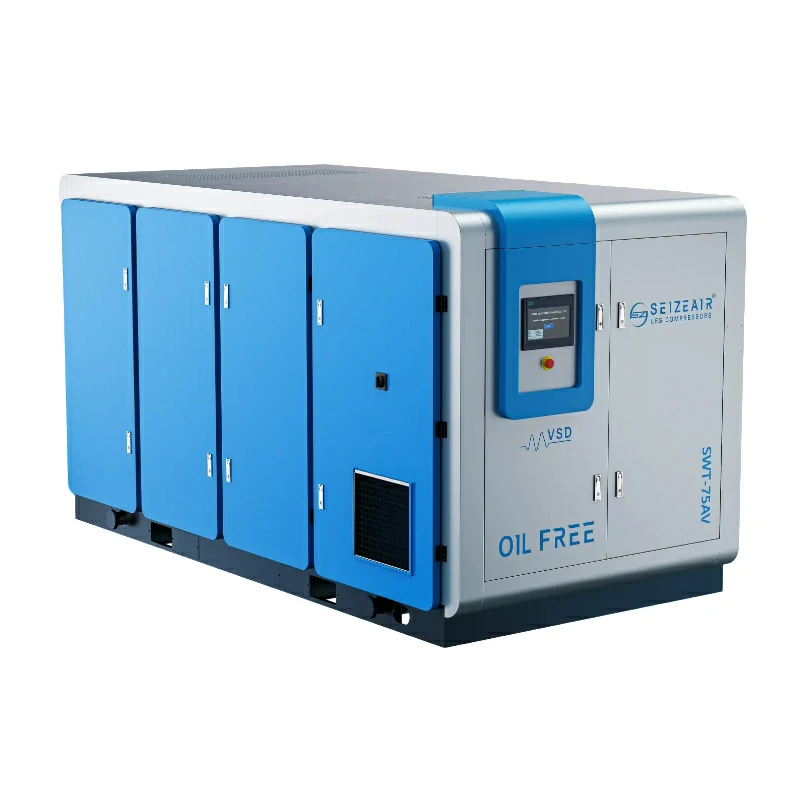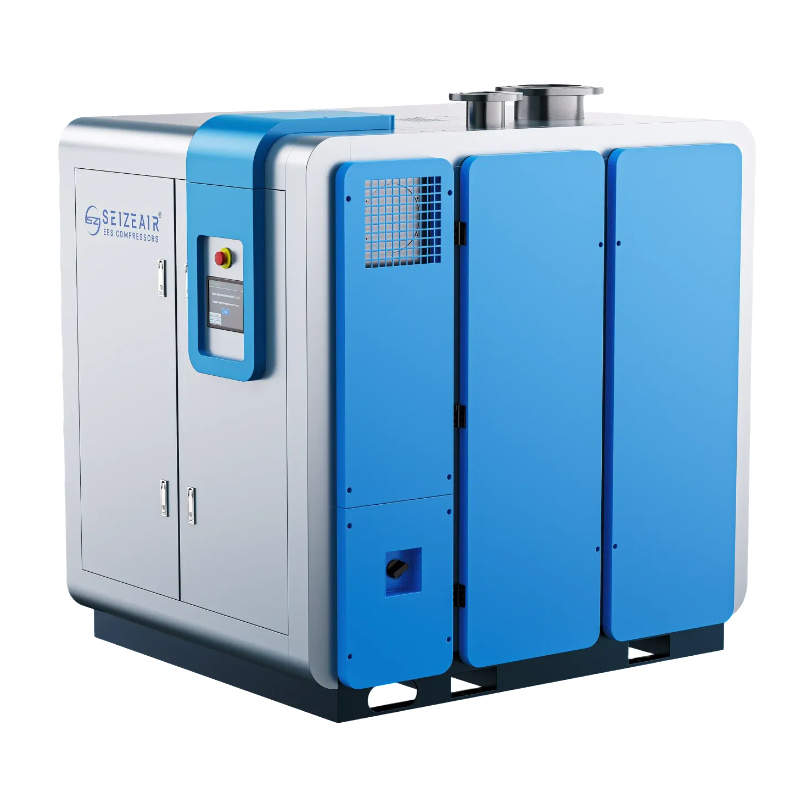


An energy efficient air compressor can cut electric bills by 20% to 50% compared with a conventional fixed-speed unit, depending on duty cycle, pressure settings, and system design. For plants that keep an industrial screw compressor running around the clock, that percentage often translates into tens of thousands of dollars every year. This guide breaks down where the savings come from, how to calculate them, and what to look for when you upgrade.
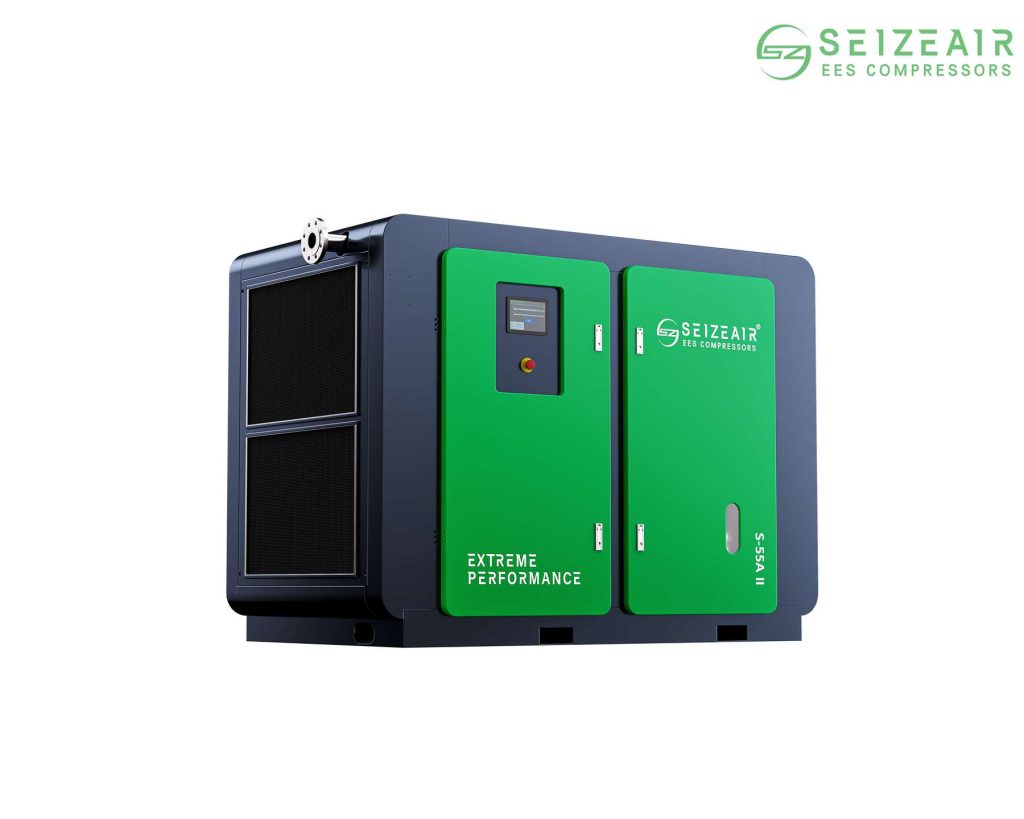
How Much Electricity Does an Air Compressor Use?
Compressed air is often called the fourth utility because it consumes so much electricity. In a typical manufacturing plant, the compressed air system accounts for 10% to 30% of total electric use. In facilities that run pneumatic tools, packaging lines, or process air, the share can climb above 40%.
The amount of electricity an air compressor uses depends on three things: motor power, load factor, and running hours. A 75 kW (100 HP) motor running at full load for 6,000 hours a year will consume 450,000 kWh. At an average industrial electricity rate of $0.12 per kWh, that is $54,000 a year just for the compressor. If the unit is oversized, poorly maintained, or running unloaded for long periods, the real cost is even higher.
Typical motor sizes and annual electricity use
| Motor size | Approximate kW | Full-load kW | Annual hours | Annual kWh | Cost at $0.12/kWh |
| 20 HP | 15 kW | 15 | 4,000 | 60,000 | $7,200 |
| 50 HP | 37 kW | 37 | 5,000 | 185,000 | $22,200 |
| 75 HP | 55 kW | 55 | 6,000 | 330,000 | $39,600 |
| 100 HP | 75 kW | 75 | 6,000 | 450,000 | $54,000 |
| 150 HP | 110 kW | 110 | 7,000 | 770,000 | $92,400 |
| 200 HP | 150 kW | 150 | 8,000 | 1,200,000 | $144,000 |
These numbers assume the motor is running at full load. In practice, most compressors operate at part load, which is why control strategy matters so much. A fixed-speed compressor that unloads but keeps spinning still burns 20% to 35% of full-load power. A variable-speed drive (VSD) compressor slows the motor to match demand, so part-load efficiency is far better.
What Makes an Air Compressor Energy Efficient?
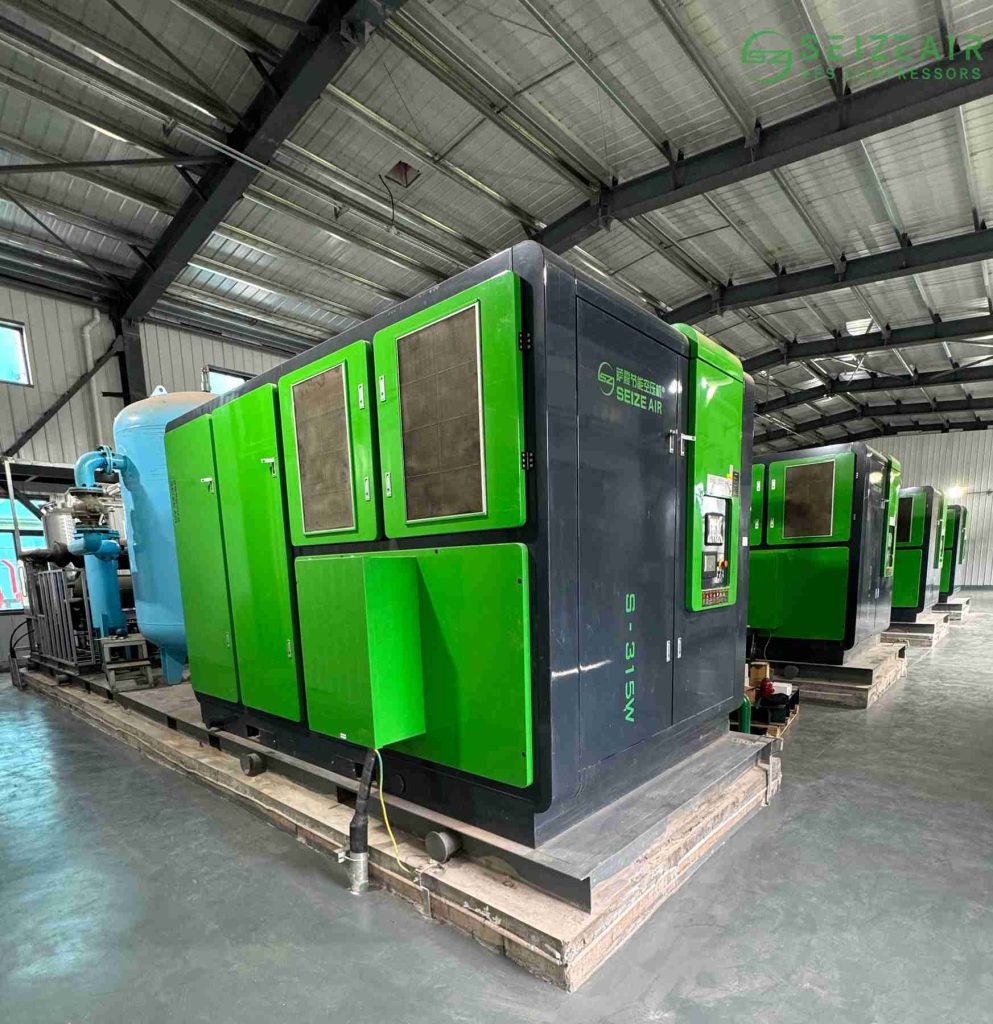
Efficiency is not just a sticker on the motor. It is the result of several design choices working together. The most important ones are:
- **Variable-speed drive (VSD)**. A VSD adjusts motor speed so the compressor produces only the air that is needed. This eliminates the energy wasted during unload cycles.
- **Permanent magnet motor**. A permanent magnet variable frequency screw compressor uses a motor with rare-earth magnets and no rotor windings. It runs cooler, maintains high efficiency at partial speed, and can start under full system pressure. Field data from Seize Air permanent magnet variable frequency screw compressor installations typically shows a 25% to 40% reduction in specific power compared with legacy fixed-speed units.
- **Two-stage compression**. A two-stage screw compressor compresses air in two steps with intercooling between them. This lowers the work needed per unit of air and can improve efficiency by 10% to 15% over a single-stage machine.
- **Low pressure drop**. Efficient air filters, coolers, and piping reduce the pressure drop between the inlet and the discharge. Every 1 bar of unnecessary pressure costs about 7% more energy.
- **Smart controller**. Modern controllers sequence multiple compressors, schedule operation during off-peak rates, and alert operators to leaks or abnormal conditions.
- **Heat recovery**. Up to 90% of the electrical energy used by a compressor leaves as heat. Capturing that heat for space heating or process water can double the effective value of the electricity.
Energy-efficiency features and their typical impact
| Feature | How it saves energy | Typical reduction in electric bill |
| VSD speed control | Matches output to demand, no unload losses | 20% to 35% |
| Permanent magnet motor | Higher efficiency at part load and full load | 3% to 8% |
| Two-stage compression | Lower specific work with intercooling | 10% to 15% |
| Lower pressure setpoint | Reduces power per unit of air | 5% to 7% per 1 bar |
| Heat recovery | Reuses waste heat | Up to 90% of input energy recovered |
| Smart sequencing | Runs the most efficient combination of machines | 5% to 15% |
How Does an Industrial Screw Compressor Cut Electric Bills?
A rotary industrial screw compressor cuts electric bills in three ways: it compresses air more efficiently, it handles part-load conditions better, and it stays efficient over a longer service life.
Unlike a piston compressor, which compresses air in discrete strokes and creates pressure pulsations, a screw compressor uses two interlocking rotors that turn continuously. The airflow is smooth, there is no start-stop cycling, and the machine can run at full load for thousands of hours without a significant drop in efficiency. That makes it ideal for manufacturing plants that need compressed air all day.
When a screw compressor is paired with a variable-speed drive, the savings multiply. The motor slows down during low-demand periods instead of unloading and spinning at full speed. In many factories, demand is below full load more than half the time. A VSD screw compressor turns those idle minutes into direct energy savings. For an industrial screw compressor for manufacturing use, this is usually the single biggest lever available.
Finally, modern screw compressors are built with tighter tolerances, better rotor profiles, and improved bearings. That means the specific power stays close to the original factory rating for many years. Older machines often degrade and consume 5% to 10% more electricity without anyone noticing.
If you combine these features, the total savings can exceed 40%. In some real-world plants, the drop in electricity use has been closer to 55% when the old system was especially inefficient.
How Much Can an Energy Efficient Air Compressor Save?
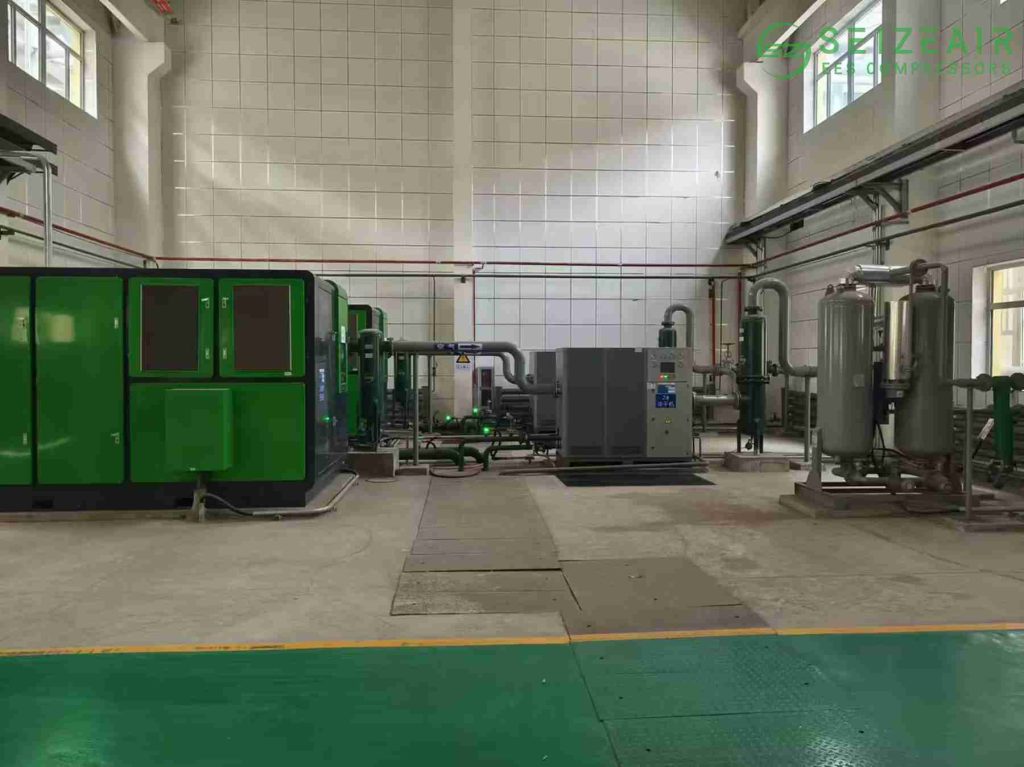
The simplest way to estimate savings is to compare the specific power of the old and new machines. Specific power is the input power divided by the free air delivery, usually expressed as kW per 100 cfm or kW per m3/min. A lower number means the compressor uses less electricity for the same airflow.
The basic formula is:
Annual electricity cost = motor power in kW x load factor x annual running hours x electricity price per kWh
For example, a 75 kW fixed-speed compressor running at 80% load for 6,000 hours a year with electricity at $0.12/kWh costs:
75 x 0.80 x 6,000 x 0.12 = $43,200 per year
If a new energy efficient air compressor uses 30% less electricity, the annual saving is:
$43,200 x 0.30 = $12,960 per year
Over ten years, that is $129,600 in electricity alone, not counting reduced maintenance, longer service intervals, or rebates.
Fixed-speed vs VSD vs two-stage: a specific power comparison
| Compressor type | Typical specific power (kW/100 cfm) | Estimated annual energy use* | Estimated annual cost at $0.12/kWh |
| Older fixed-speed piston | 25 to 30 | 450,000 kWh | $54,000 |
| Fixed-speed single-stage screw | 19 to 23 | 360,000 kWh | $43,200 |
| VSD single-stage screw | 16 to 19 | 300,000 kWh | $36,000 |
| Two-stage screw | 17 to 20 | 315,000 kWh | $37,800 |
| VSD two-stage screw | 14 to 17 | 270,000 kWh | $32,400 |
*Based on a 75 kW class machine producing roughly 400 cfm at full load for 6,000 hours.
The table shows why the biggest wins usually come from replacing an old piston or fixed-speed screw machine with a modern permanent magnet variable frequency screw compressor. The efficiency gap is largest when the existing equipment is oversized or has poor part-load performance.
Is a Variable Speed Compressor Worth It?
A VSD compressor is worth it when your air demand fluctuates. If your plant runs one long shift at steady load, a premium fixed-speed screw compressor can be almost as efficient and costs less upfront. But if your demand goes up and down during the day, or if you have multiple shifts with different air requirements, a VSD will usually pay for itself quickly.
The classic example is a packaging line. During production, the line needs full airflow. During changeovers, breaks, and cleaning, demand drops to 30% or 40%. A fixed-speed machine unloads and keeps spinning, still consuming power. A VSD slows down and uses roughly proportional power. Over a year, the difference is large.
A simple way to think about it is this: the more time your compressor spends below 80% load, the more you will benefit from VSD. If you spend most of your time above 90% load, the savings are smaller and a two-stage fixed-speed machine may be the better investment.
Load profile example
Here is a simplified daily load profile for a factory that runs two shifts:
Time Demand Fixed-speed power VSD power
00:00 20% 35% 22%
06:00 60% 85% 62%
08:00 100% 100% 100%
12:00 45% 70% 48%
13:00 90% 95% 90%
17:00 30% 50% 32%
22:00 10% 35% 15%
The fixed-speed machine wastes energy during every drop in demand. The VSD tracks demand closely. The gap between the two lines is where the savings live. You can read more about this in our dedicated post on VSD air compressor power savings.
Single-Stage vs Two-Stage Screw Compressor: Which Saves More Energy?
A single-stage screw compressor compresses air from atmospheric pressure to the final pressure in one continuous process. A two-stage screw compressor splits the work into two stages and cools the air between them. The intercooling brings the air closer to isothermal compression, which is the most efficient theoretical path.
At discharge pressures above 7 bar (100 psi), the efficiency advantage of two-stage compression becomes significant. For every additional bar of pressure, the savings grow. In continuous-duty applications such as textiles, electronics, or automotive, a two-stage machine can use 10% to 15% less electricity than a single-stage machine of the same capacity.
That said, the upfront cost is higher and the maintenance is slightly more involved. The best choice depends on how many hours the machine runs and how long you plan to keep it. If the compressor will run more than 4,000 hours a year for at least five years, the two-stage option usually wins on total cost of ownership.
Do Energy Efficient Air Compressors Qualify for Rebates?
Yes. Many utilities and government programs offer rebates or tax incentives for upgrading to energy efficient compressed air equipment. The size of the rebate depends on the amount of energy saved and the local program rules.
Common types of support include:
- **Utility prescriptive rebates**. A fixed amount per horsepower for replacing an old compressor with a qualifying high-efficiency model.
- **Custom rebates**. Based on a measured energy study before and after the upgrade. These often pay more but require more paperwork.
- **Tax deductions or credits**. Some regions allow accelerated depreciation or direct tax credits for energy-saving industrial equipment.
- **Energy audit subsidies**. A third-party audit of your compressed air system may be partially or fully funded by a utility.
Rebates can reduce the payback period by one to three years. Always ask your supplier and utility about current programs before you buy. The paperwork is usually straightforward if it is started early.
How Long Does It Take for an Energy Efficient Compressor to Pay for Itself?
Payback depends on the price difference, the annual savings, and any rebates. The formula is:
Payback in years = (total upgrade cost – rebates) / annual energy savings
For example, if a new VSD compressor costs $45,000 installed, you receive a $5,000 utility rebate, and you save $12,000 a year on electricity, the payback is:
($45,000 – $5,000) / $12,000 = 3.33 years
After that, the savings are profit. Over a ten-year life, the total saving is $120,000 minus maintenance. If energy prices rise, the payback is even shorter.
Our industrial air compressor ROI guide goes deeper into total-cost-of-ownership calculations, including maintenance, depreciation, and downtime.
What Size Air Compressor Do I Need for My Factory?
Sizing an air compressor correctly is one of the most important steps in controlling energy costs. An oversized compressor costs more to buy and runs inefficiently at part load. An undersized compressor cannot keep up, causing pressure drops and production problems.
The basic sizing process is:
1. Measure total air demand during peak production. Add up the rated consumption of every tool, machine, and process that uses compressed air.
2. Apply a diversity factor. Not every tool runs at the same time. A typical diversity factor is 0.6 to 0.8.
3. Add future growth. If you expect to add equipment in the next three to five years, size for it now.
4. Match pressure requirements. Do not set the compressor higher than your highest-pressure application. Use boosters for isolated high-pressure points.
5. Consider duty cycle. A compressor running 24/7 needs a different design than one running one shift a day.
For a more detailed walkthrough, see our screw air compressor sizing guide. Proper sizing alone can cut energy use by 10% to 20% because it avoids unload losses and pressure overshoot.
How to Reduce Air Compressor Energy Costs Without Buying New Equipment
Not every factory is ready to replace a compressor. Fortunately, there are several low-cost ways to cut the electric bill immediately.
Fix leaks
Leaks are the silent killer of compressed air efficiency. A typical plant loses 20% to 30% of its compressed air to leaks. Fixing them can be the fastest payback project in the whole facility. An ultrasonic leak detector costs little and can find dozens of leaks in a single afternoon.
Lower the pressure setpoint
Every 1 bar reduction saves roughly 7% of compressor power. Check whether your tools and processes really need the current pressure. Often, operators raise the setpoint to solve a problem that is actually caused by a leak, a clogged filter, or undersized piping.
Improve air compressor maintenance
Clean filters, correct oil levels, and properly functioning coolers keep a compressor running at its design efficiency. Neglected machines can consume 5% to 15% more electricity than well-maintained ones. A planned air compressor maintenance program also prevents unplanned downtime. Seize Air service teams routinely find that plants can recover 5% to 10% of compressor power simply by replacing clogged filters and correcting low oil levels.
Use smart sequencing
If you have multiple compressors, make sure the most efficient one is the base-load machine and the older or smaller units are trim machines. A modern controller can do this automatically.
Recover waste heat
Use the hot air or cooling water from the compressor to heat the building or preheat process water. In cold climates, heat recovery can offset a significant portion of the compressor’s operating cost.
Should You Repair or Replace an Old Compressor?
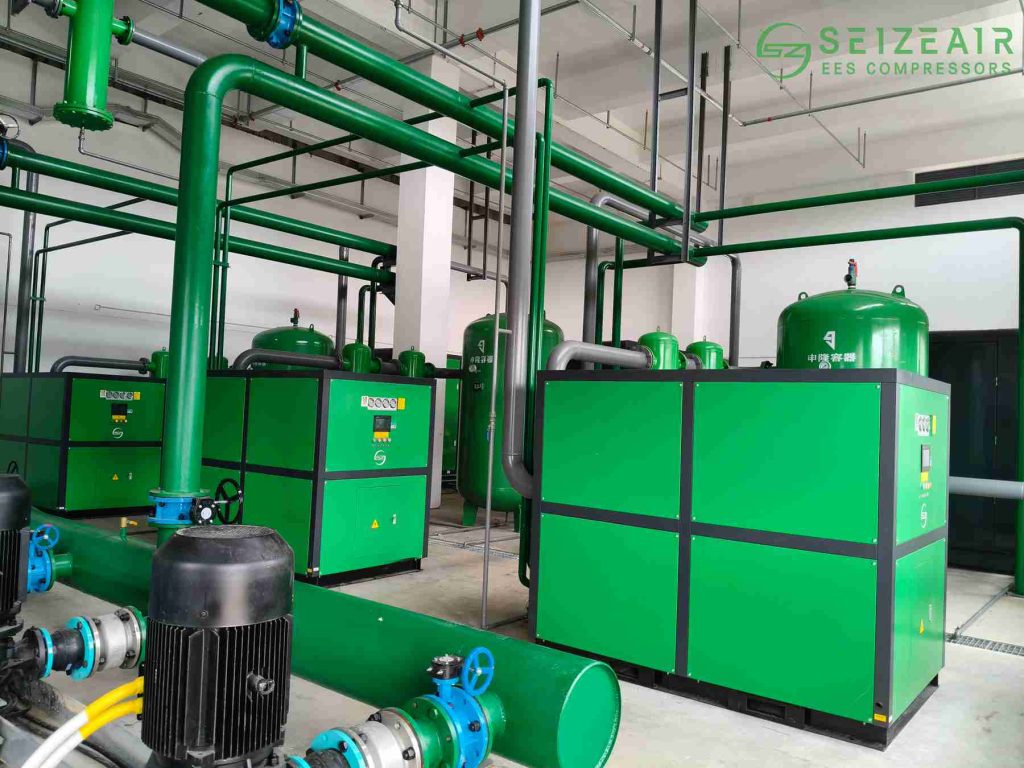
This is one of the most common questions plant managers face. The answer depends on age, condition, operating hours, and energy efficiency.
| Factor | Repair may make sense | Replacement may make sense |
| Age | Less than 8 years | More than 10 to 12 years |
| Operating hours | Low seasonal use | More than 3,000 hours per year |
| Efficiency | Close to modern standards | Far above current specific power benchmarks |
| Maintenance cost | Stable and predictable | Rising rapidly |
| Spare parts | Readily available | Hard to find or expensive |
| Downtime risk | Low impact | Threatens production |
| Future demand | Stable | Growing or changing |
If your old compressor is still reliable but inefficient, one option is to keep it as a backup and install a new variable-speed drive (VSD) compressor as the lead machine. This gives you redundancy and immediate savings without throwing away a usable asset.
Can an Energy Efficient Air Compressor Reduce Carbon Emissions?
Yes. Every kilowatt-hour saved is a kilowatt-hour that does not have to be generated. The carbon reduction depends on your local grid mix. A common average factor is about 0.4 to 0.5 kg of CO2 per kWh.
If a new compressor saves 100,000 kWh per year, the CO2 reduction is roughly:
100,000 x 0.45 = 45,000 kg of CO2 per year
That is the same as taking several passenger cars off the road. For companies with carbon-reduction targets, upgrading compressed air equipment is one of the most cost-effective ways to make progress while also saving money.
What Is the Most Efficient Type of Air Compressor for Continuous Duty?
For continuous-duty applications, the best choice is usually a rotary screw compressor with a variable-speed drive. Screw compressors are designed to run 24/7 without the thermal cycling and wear that shorten the life of piston compressors. They also deliver a steady flow of air at a stable pressure, which protects downstream equipment.
At very large scales, such as petrochemical plants or steel mills, centrifugal compressors can be even more efficient. A magnetic-levitation centrifugal blower or compressor eliminates mechanical bearings and gearbox losses, pushing efficiency to very high levels. However, centrifugal machines have a narrower stable operating range and are most efficient when they run near their design point.
For the majority of factories, an industrial screw compressor strikes the best balance. It handles demand variation, maintains efficiency across a wide range of operating conditions, and has lower capital and maintenance costs than a centrifugal machine. When energy savings are the goal, the practical answer is usually a VSD or two-stage screw compressor.
Oil-Injected vs Oil-Free: Which Is More Efficient?
The choice between an oil-injected screw air compressor and an oil-free screw air compressor is usually driven by air quality requirements, not efficiency. Food, pharmaceutical, and electronics plants often need oil-free air to meet product safety or Class 0 standards.
Historically, oil-free machines used more energy because sealing and lubrication were more difficult. Modern oil-free screw and centrifugal designs have closed much of that gap. In some applications, an oil-free machine with a well-designed system can match the efficiency of an oil-injected one.
The best approach is to define your air quality needs first, then select the most efficient compressor that meets them. Paying for oil-free air you do not need is wasteful, but risking product contamination to save a few kilowatts is even worse.
Why Plant Managers Choose Energy Efficient Screw Compressors
Screw compressors dominate industrial applications because they are reliable, quiet, and efficient. Within the screw category, the latest generation of machines offers dramatic improvements over units built just ten years ago.
A modern energy efficient screw compressor typically delivers:
- Lower specific power than piston or vane compressors
- Steady airflow with minimal pulsation
- Quiet operation, often below 70 dB
- Long service intervals and fewer moving parts
- Integrated drying, filtering, and control options
For a plant that needs clean, stable compressed air for production, an industrial screw compressor is usually the most practical place to start when cutting the electric bill.
Real-World Savings: What the Numbers Look Like
Let us put this into a realistic scenario. A mid-sized electronics plant runs a 100 HP fixed-speed single-stage screw compressor for 6,500 hours per year. The electricity rate is $0.13/kWh. The compressor is slightly oversized, so it unloads about 25% of the time.
Annual cost = 75 kW x 0.85 load/unload average x 6,500 h x $0.13/kWh = $53,887
The plant replaces it with a 100 HP class VSD permanent magnet screw compressor with a specific power about 18% lower. The new machine also tracks demand, eliminating most unload losses. Total estimated energy reduction is 35%.
Annual savings = $53,887 x 0.35 = $18,860
With a $6,000 utility rebate and an installed cost of $52,000, the payback is:
($52,000 – $6,000) / $18,860 = 2.44 years
Over ten years, the electricity savings alone are $188,600. Add lower maintenance and reduced downtime, and the total benefit is well above $200,000.
A smaller example shows the same principle. A 20 HP piston compressor in a metal fabrication shop runs about 2,500 hours per year. It consumes roughly 42,000 kWh at a cost of $5,040. By switching to a 20 HP VSD screw compressor, the shop cuts consumption by 25%, saving $1,260 per year. The payback is under three years, and the shop also gets quieter operation and cleaner air.
These examples illustrate why energy efficiency is not an abstract benefit. It is a direct reduction in one of the largest operating costs in many plants.
How to Measure Compressed Air Efficiency
You cannot manage what you do not measure. The key metrics for compressor efficiency are specific power, load factor, and pressure stability.
**Specific power** is input kW divided by free air delivery. A lower number means more air for each kilowatt. When you compare quotes, ask for specific power at your exact operating pressure, not at the ideal test point.
**Load factor** is the ratio of actual power over time to full-load power. A load factor below 60% often indicates oversizing or large demand swings. That is a strong signal that a VSD compressor will save money.
**Pressure band** is the difference between the compressor’s load and unload setpoints. A wide band wastes energy and stresses downstream equipment. A narrow, stable pressure band indicates good control and storage.
Free online calculators can estimate savings, but a site audit is more accurate. Many suppliers and utilities offer audits that include flow meters, power loggers, and leak detection. The audit gives you a baseline, identifies the biggest opportunities, and provides the data you need to justify an upgrade.
Buying Checklist for an Energy Efficient Air Compressor
Before you sign a purchase order, run through this checklist.
| Check | Why it matters |
| Verify specific power at your operating pressure | A lower kW/100 cfm means lower electricity bills |
| Ask for a VSD option | Essential if demand fluctuates |
| Check IE class of the motor | IE4 or IE5 motors reduce losses |
| Look at total pressure drop | Filters, dryers, and piping all add to energy use |
| Plan for heat recovery | Recovers value that would otherwise be wasted |
| Confirm controller features | Sequencing, remote monitoring, and alarms protect efficiency |
| Review maintenance costs | Cheap machines can be expensive to keep running |
| Choose a supplier with local service | Fast support minimizes downtime |
| Ask about rebates | Can significantly shorten payback |
| Request an energy study | Measure before you buy, measure after you install |
A reliable industrial air compressor supplier will help you with sizing, rebates, and installation rather than simply selling you the biggest machine in the catalog.
How to Build a Business Case for an Energy Efficient Air Compressor
Getting approval for a compressor upgrade is easier when you present a clear business case. Decision makers want to see numbers, risks, and timelines. A strong proposal includes four parts: current cost, projected savings, total cost of ownership, and implementation plan.
Start with the current cost. Collect the last twelve months of electricity bills and estimate the compressor share. Use meter data if available; otherwise, use the formula:
Annual compressor electricity cost = motor power (kW) x load factor x operating hours x electricity rate ($/kWh)
Next, estimate the projected savings. Use the specific power of the existing machine and the proposed machine. Multiply the power difference by annual operating hours and electricity rate. Include the effect of VSD if demand varies.
Then add the other costs of ownership. A cheaper compressor may need more frequent maintenance, expensive spare parts, or longer downtime. A premium machine may have a higher purchase price but lower lifetime cost. Present both scenarios over ten years so the real difference is visible.
Finally, describe the implementation plan. Include delivery, installation, commissioning, staff training, and post-installation verification. A good supplier will support each step and provide a written performance guarantee.
Sample business case summary
| Item | Existing compressor | Proposed VSD screw compressor |
| Rated power | 75 kW | 75 kW |
| Specific power | 22 kW/100 cfm | 17 kW/100 cfm |
| Annual operating hours | 6,000 | 6,000 |
| Average load factor | 0.80 | matched to demand |
| Annual electricity cost | $43,200 | $30,240 |
| Annual energy savings | — | $12,960 |
| Installed cost | already sunk | $48,000 |
| Utility rebate | — | $5,000 |
| Net investment | — | $43,000 |
| Simple payback | — | 3.32 years |
| 10-year electricity savings | — | $129,600 |
If the payback is under four years and the supplier has a strong service record, the project is usually easy to approve. If the payback is longer, emphasize reliability, carbon reduction, and the risk of keeping an aging machine.
Common Mistakes That Inflate Compressor Energy Bills
Even with efficient equipment, simple mistakes can erase the savings. Here are the most common ones we see in the field.
- **Oversizing the compressor**. A bigger machine costs more and runs unloaded more often. Always size for actual demand plus modest growth.
- **Running pressure too high**. Every extra bar wastes about 7% of energy. Separate high-pressure points instead of raising the whole plant.
- **Ignoring leaks**. A small leak costs little; hundreds of small leaks cost thousands. Audit and repair leaks quarterly.
- **Skipping maintenance**. Dirty filters, old oil, and clogged coolers raise power use and shorten compressor life.
- **Running multiple compressors poorly**. Without sequencing, two or three machines can all run at partial load instead of one at full load and one idle.
- **No demand-side management**. Adding storage, removing unnecessary restrictions, and educating operators can cut demand without touching the compressor.
Avoiding these mistakes is often the fastest way to reduce the electric bill, even before you buy new equipment.
Final Thoughts
An energy efficient air compressor is one of the fastest-paying investments in a modern factory. Whether you need a variable-speed drive (VSD) compressor, a two-stage screw compressor, or an oil-free screw air compressor, the key is to match the machine to your real air demand and to account for the full cost of ownership.
If you are unsure where to start, begin with an energy audit or compressed air assessment. The data will show you exactly how much you can save and which technology makes the most sense for your plant. When you are ready to move forward, contact Seize Air today or contact us and we will help you size, select, and install the right energy efficient solution for your operation.