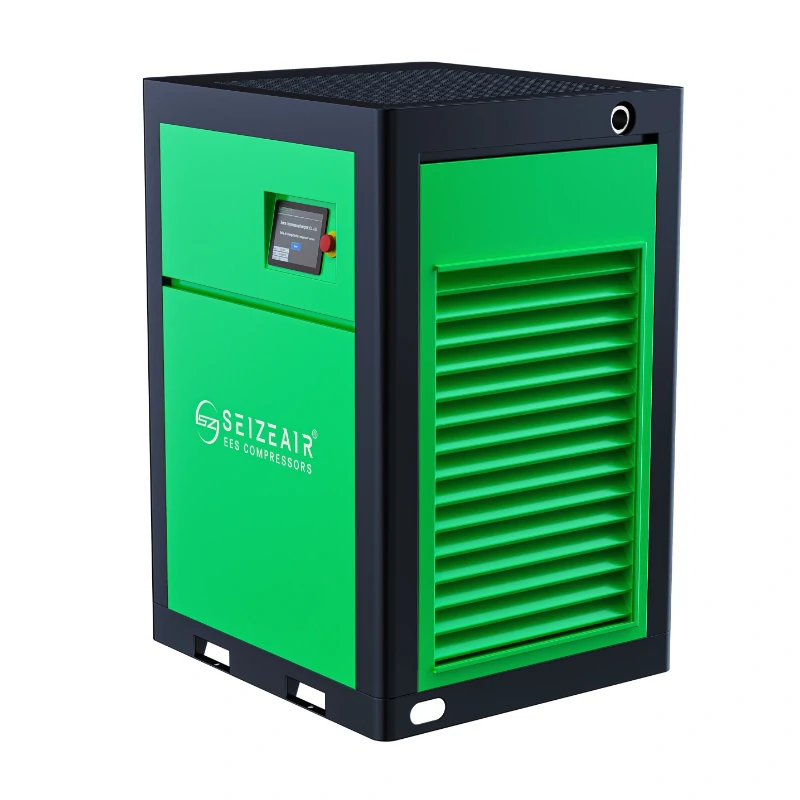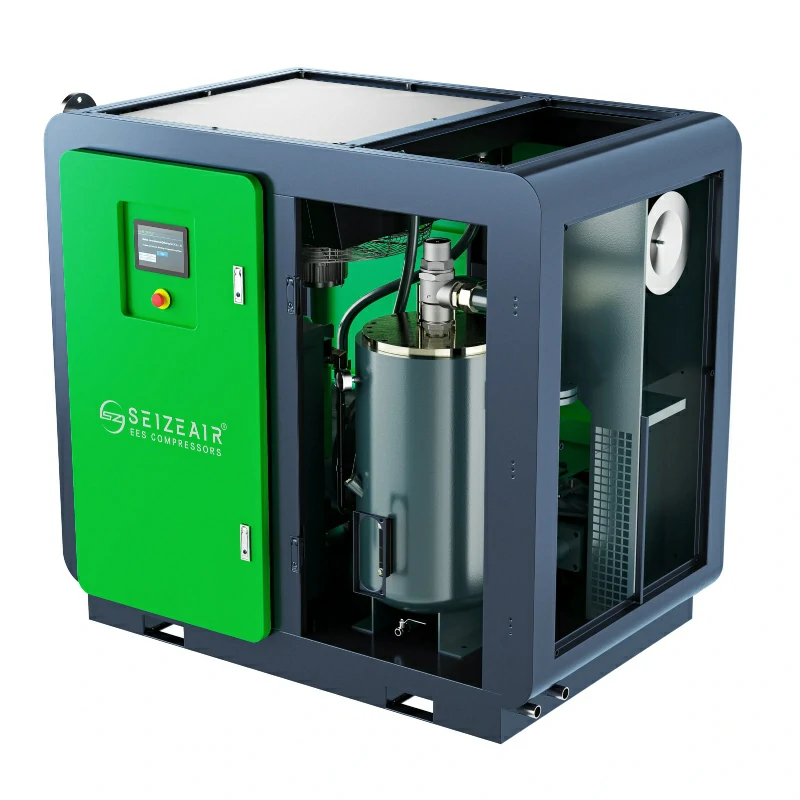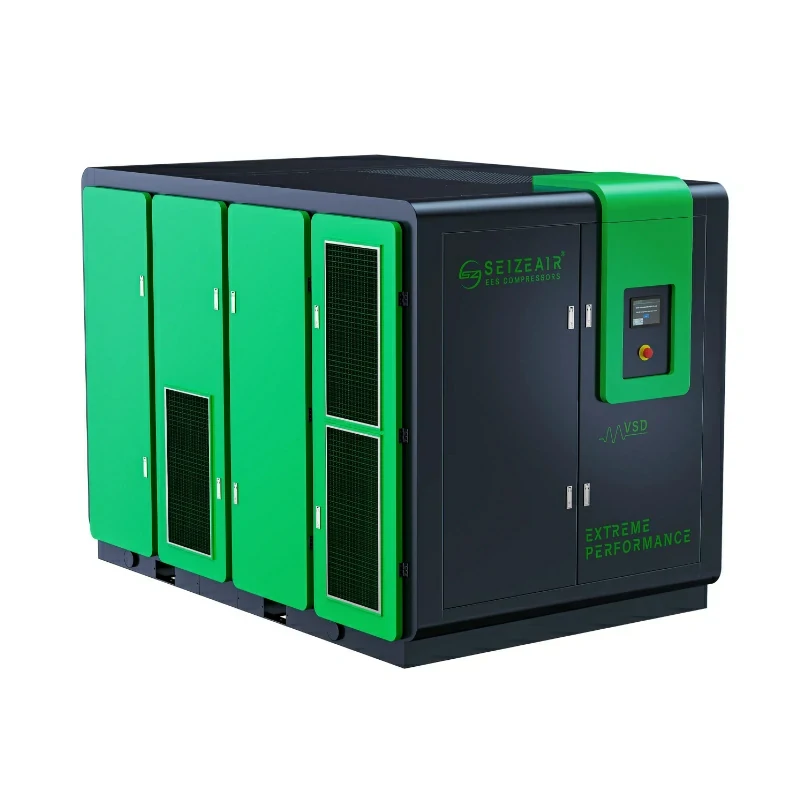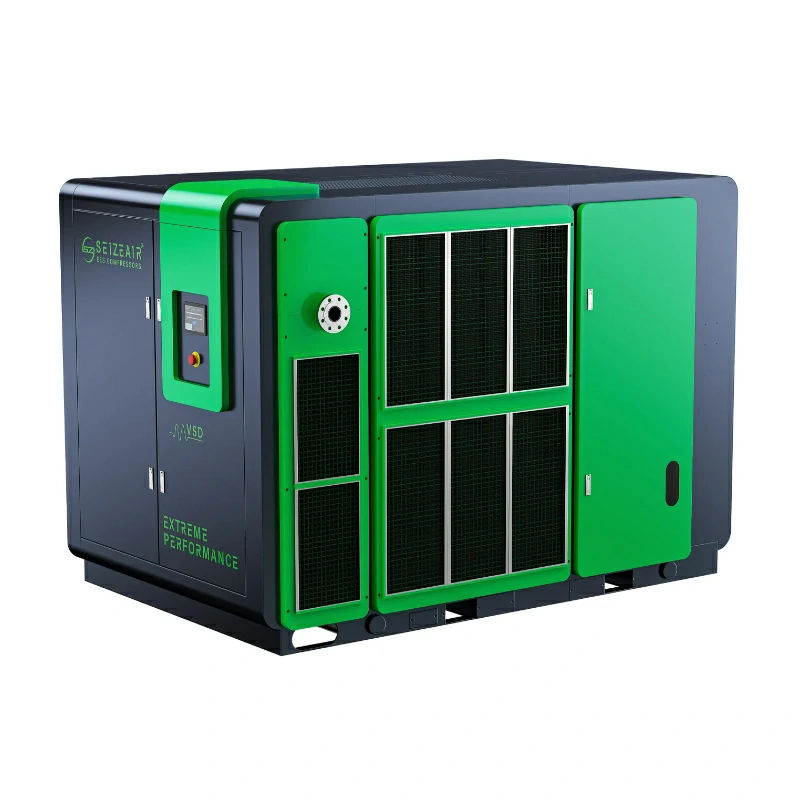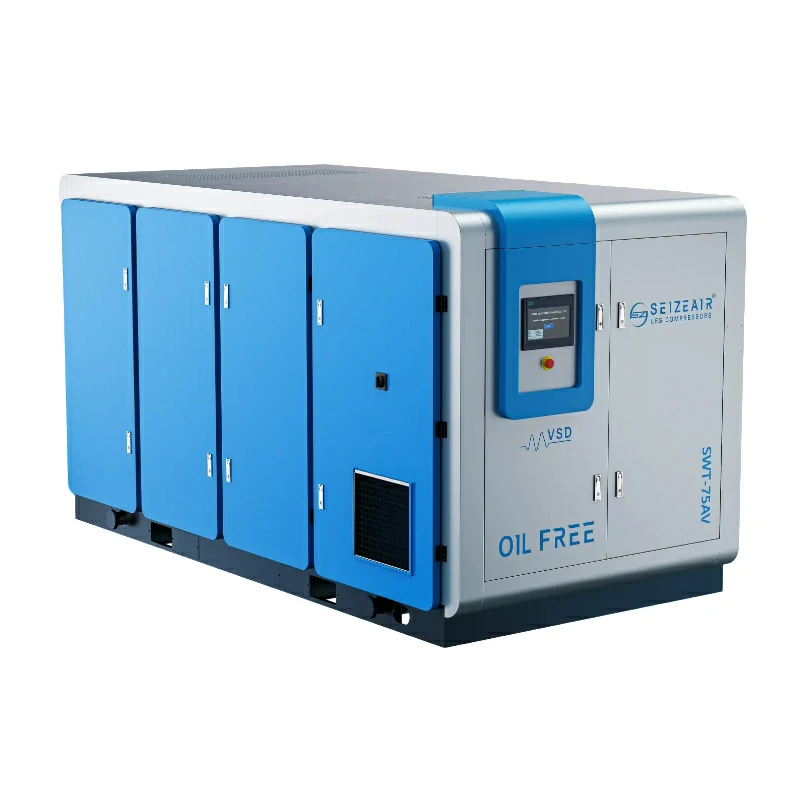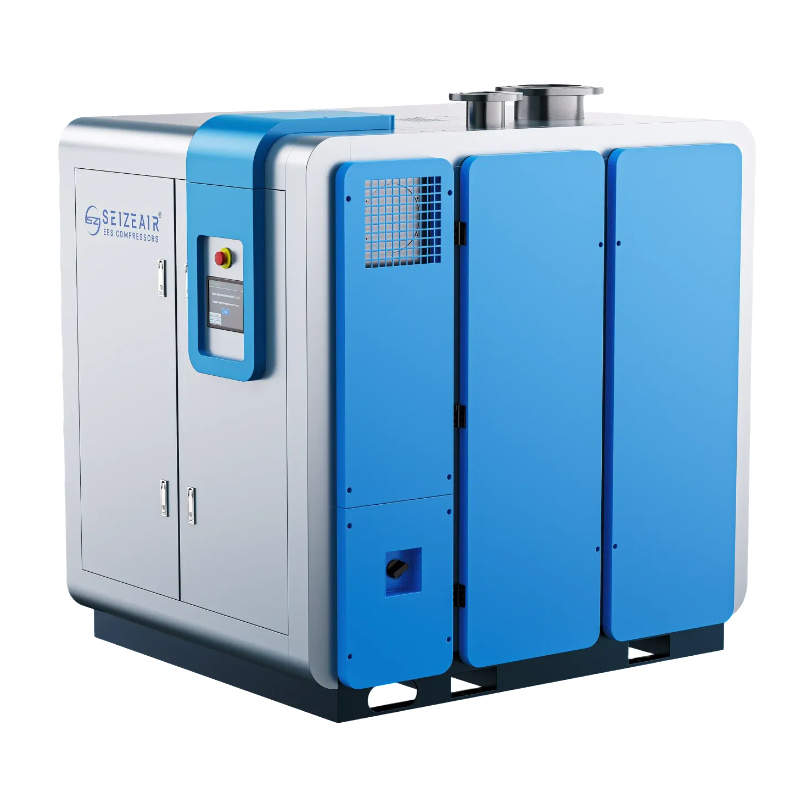


An oil free water injected compressor produces 100% oil-free compressed air certified to ISO 8573-1 Class 0 by injecting filtered water directly into the compression chamber, where it replaces oil as the cooling, sealing, and lubricating medium. In the sections below we explain how the technology works, what Class 0 really means for your process, where these machines are used, and how to size, run, and maintain one for contamination-sensitive production.
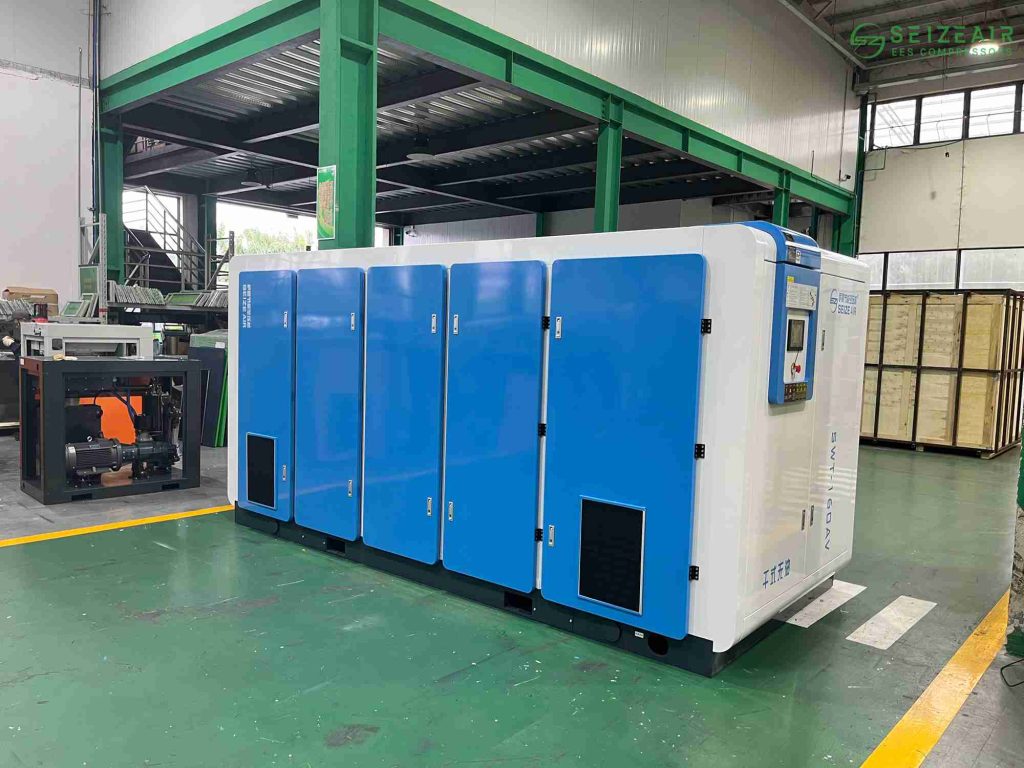
What Is an Oil Free Water Injected Compressor?
At its core, an oil free water injected compressor is a rotary screw machine that uses water instead of oil inside the compression chamber. In a conventional oil-injected screw compressor, lubricating oil cools the rotors, seals the clearance between them, and carries away the heat of compression. A water-injected design does the same job with water: a controlled stream of clean, often distilled or filtered water is introduced at the inlet or directly into the compression zone. The water absorbs heat, keeps the rotors cool, washes away fine dust, and is later separated from the air, cooled, filtered, and recirculated.
The result is compressed air that never touches oil on its way through the machine. Because no oil is present in the compression chamber, there is no risk of oil aerosol or vapor carryover into the air stream. This is what allows the output to be classified as oil-free, and specifically as Class 0 under the ISO 8573-1 purity standard.
The broader oil free screw air compressor family includes dry (oil-free) screw designs and water-based designs. Water-injected units sit in a sweet spot: they deliver true Class 0 air while running at much lower discharge temperatures than dry screw machines, which reduces thermal stress on components and often improves efficiency.
How Does a Water Injected Oil Free Screw Compressor Work?
The operating cycle is straightforward once you picture the air and water moving together through the screw element:
Raw ambient air
      |
Intake filter  -->  Male + female rotor (compression chamber)
      |                    |
      |            Filtered water injected into chamber
      |                    |
      |            Compression + water cooling (heat absorbed)
      |                    |
      |            Air-water mixture exits element
      |                    |
      |     Separation: water drops out, passes through
      |     cooler + fine filter, then recirculates
      |                    |
100% oil-free compressed air (ISO Class 0) to downstream line
Several things happen at once inside the chamber. First, the injected water forms a thin film on the rotors that reduces friction and seals the small gaps, so the compressor holds pressure efficiently. Second, because water has a very high specific heat capacity, it soaks up the heat of compression almost immediately. Discharge temperatures in a water-injected machine typically stay well below those of a dry screw, often in a range that protects both the element and any heat-sensitive downstream equipment.
After compression, the air and water mixture leaves the element and passes through a separator. The water is removed, cooled, and returned to a recirculation tank; a side stream is continuously filtered to keep the water clean. The air then moves on to the aftercooler and any downstream dryers or filters. Because the separation step removes the water, the delivered air is dry and oil-free.
It is worth noting that a water lubricated oil free screw compressor is a close cousin of the water-injected design. In water-lubricated machines, water serves mainly to lubricate the bearings and rotor housing rather than being sprayed into the compression chamber in large volume. Both approaches avoid oil in the air path, but the injection method, water volume, and component design differ. We compare the two later in this guide.
What Does ISO Class 0 Mean for Compressed Air Quality?
ISO 8573-1 is the international standard that defines the purity of compressed air by setting maximum allowable concentrations of contaminants: solid particles, water, and oil (which includes liquid oil, oil aerosol, and oil vapor). For oil, the standard lists classes 1 through 4, each with a rising allowable limit. Class 1, the tightest of the numbered classes, permits no more than 0.01 mg/m3 of total oil.
Class 0 sits above Class 1 and is defined differently. It is not a fixed numeric limit but a customer-specified requirement: the air must contain no oil that can be detected by the applicable test method, and the supplier certifies that the technology cannot introduce oil into the air stream. In practice, a class 0 air compressor is one where the compression process is certified oil-free by design, so the user does not have to rely on downstream filters to “clean up” oil that was never supposed to be there.
| ISO 8573-1 Oil Class | Max Total Oil (mg/m3) | Typical Use Case |
|---|---|---|
| Class 4 | 5 | General workshop air, non-contact tools |
| Class 3 | 1 | Light industrial, non-sensitive processes |
| Class 2 | 0.1 | Textiles, some packaging lines |
| Class 1 | 0.01 | Breathing air, sensitive instruments |
| Class 0 | No oil detectable (certified by design) | Food, pharma, electronics, medical |
For industries where a single drop of oil can spoil a batch, contaminate a sterile product, or short a circuit board, Class 0 is not a nice-to-have. It is the baseline requirement, and an oil free water injected compressor meets it at the source rather than at the filter.
Oil Free Water Injected vs Oil Injected vs Dry Screw: Which Should You Choose?
Buyers often compare three routes to clean air: stay with an oil-injected machine and filter aggressively, move to a dry (oil-free) screw, or adopt a water-injected oil-free design. The right answer depends on your purity requirement, duty cycle, climate, and budget.
| Factor | Oil-Injected (filtered) | Dry Screw Oil-Free | Water-Injected Oil-Free |
|---|---|---|---|
| Oil in air path | Yes (removed by filters) | No | No |
| Achievable purity | Class 1 with good filtration | Class 0 | Class 0 |
| Discharge temperature | Moderate | High (no liquid cooling) | Low (water cools) |
| Risk of oil carryover | Exists if filters fail | None | None |
| Cooling medium | Oil + aftercooler | Air / finned cooling | Injected water loop |
| Upfront cost | Lowest | Highest | Mid to high |
| Best fit | Non-sensitive duty | High-purity, dry-climate sites | Purity + cooler running |
A common misconception is that any oil-injected compressor can reach Class 0 with enough filtration. Filters reduce oil, but they do not eliminate the source, and a clogged or bypassed filter reintroduces risk. For true Class 0, the compression step itself must be oil-free. If you want the full picture of the trade-offs, our comparison of oil injected vs oil free compressor breaks down lifetime cost, energy, and failure modes in detail.
Key Benefits of Oil Free Water Injected Air Compressors
The advantages go beyond simply “no oil.” Here is what plants typically gain when they switch to a water-injected oil-free design.
| Benefit | Why It Matters | Operating Impact |
|---|---|---|
| True Class 0 air | No oil in compression chamber | Meets food, pharma, electronics specs |
| Lower discharge temperature | Water absorbs compression heat | Longer rotor and seal life |
| In-chamber cleaning | Water washes fine dust | Cleaner internals, less wear |
| No oil management | No lube oil to buy or change | Lower consumable cost and handling |
| Stable air quality | Purity set by design | No dependence on filter condition |
| Quieter operation | Water dampens pulsation | Better plant working environment |
From a total-cost-of-ownership view, the saving on lubricating oil, oil filters, and oil separator elements is real, and the cooler running temperature protects the most expensive parts of the machine. For a deeper look at the wider oil free air compressor range and how it fits different budgets, our product overview covers screw, scroll, and centrifugal options side by side.
Where Are Oil Free Water Injected Compressors Used?
Any process where compressed air touches the product, the package, or a sterile environment benefits from Class 0 air. The table below maps common industries to the reason oil-free water-injected air earns its place.
| Industry | Use of Compressed Air | Why Oil-Free Water-Injected |
|---|---|---|
| Food & beverage | Product blowing, filling, packaging, nitrogen generation | Prevents oil taint and contamination |
| Pharmaceutical | Air handling, tablet coating, cleanrooms, fermentation | Meets GMP and Class 0 specs |
| Electronics & semiconductor | PCB cleaning, chip blowing, instrument air | Oil vapor ruins sensitive parts |
| Medical & dental | Breathing air, surgical tools, lab air | Patient-safe, oil-free supply |
| Chemical & paint | Spraying, agitation, instrument air | Clean air protects product quality |
| Brewing & dairy | Fermentation air, bottling, mixing | No off-flavors from oil |
| Laboratory | Sample handling, gloveboxes, analyzers | Stable, contaminant-free supply |
In food production, even trace oil can leave a rancid taste or fail a customer audit. That is why many plants specify oil free air compressors for food applications from the start, rather than retrofitting filtration later. The same logic applies where product contact is indirect but still regulated.
Pharmaceutical manufacturing is the strictest case. Air used in cleanrooms, in drying, or in direct product contact must meet both ISO 8573-1 Class 0 and the relevant GMP expectations. Specifying an oil free air compressor for pharmaceutical use at the design stage removes a whole category of compliance risk and simplifies validation documentation.
Water Injected vs Water Lubricated: What Is the Difference?
The terms get mixed up, and understandably so, because both use water and both avoid oil in the air path. The difference is where and how the water is applied.
In a water-injected compressor, water is sprayed or introduced into the compression chamber in meaningful volume, where it cools and seals during compression. In a water-lubricated compressor, water typically lubricates the bearings and the rotor-housing interface; the compression itself may rely more on precision geometry and a thinner water film. Both deliver oil-free air, but the engineering, the water loop size, and the service points differ.
For most buyers the practical question is not the label but the certified result: does the unit deliver Class 0 air, at what discharge temperature, and how much water treatment does the site need to support? A water-lubricated oil-free screw is an excellent fit for many of the same applications as a water-injected unit, and the choice often comes down to available models, service network, and local water quality.
Energy Efficiency and Operating Costs
Energy is usually the largest share of a compressor’s lifetime cost, so efficiency deserves real attention. The standard metric is Specific Power, sometimes called Specific Energy Requirement (SER):
Specific Power (SP) = Motor Rated Power (kW) / Free Air Delivery (FAD, m3/min)
A lower SP means more air per unit of electricity, which is what you want. To estimate the annual energy bill of a candidate unit:
Annual Energy Cost = Motor Power (kW) x Annual Run Hours x Electricity Price (per kWh)
As a worked example, a 75 kW unit running 6,000 hours per year at 0.12 per kWh costs roughly 75 x 6000 x 0.12 = 54,000 per year in electricity alone. Shaving the Specific Power by even 5% saves about 2,700 annually, before counting any incentive or carbon saving. Water-injected designs help here because lower discharge temperatures reduce the load on aftercoolers and can improve volumetric efficiency at higher pressures.
When comparing quotes, always ask for the certified FAD at your target pressure, not just the motor kW. Two machines with the same motor size can deliver very different volumes of oil-free air.
Maintenance and Service Requirements
“Oil-free” does not mean “maintenance-free.” The machine still has rotors, bearings, seals, a water loop, and electrical systems. What changes is the elimination of oil changes, oil filters, and oil separator elements.
| Task | Typical Interval | Notes |
|---|---|---|
| Water filter / softener check | Monthly | Keep recirculation water clean |
| Air intake filter | 3 to 6 months | Depends on dust load |
| Water loop biocide / treatment | Per water test | Prevent biofilm and scaling |
| Belt / coupling inspection | 6 to 12 months | If applicable to drive |
| Rotor and seal inspection | Annual | Part of preventive service |
| Control and sensor check | Annual | Verify pressure and temp readings |
The single most important maintenance discipline for a water-injected machine is water quality. Because water circulates through the system, untreated water can cause scaling or biofilm. A simple pre-treatment step, such as softening or a side-stream filter, protects the loop and keeps the air clean. Sites with poor local water should budget for this in the total cost of ownership.
How to Choose the Right Size and Configuration
Sizing starts with demand, not with a catalog number. Add up the air consumption of every tool, valve, and process that runs at the same time, then apply a realistic simultaneous-use factor. Match the compressor’s certified FAD at your required pressure to that number, with headroom for growth but not so much that the unit idles inefficiently.
Next, decide between fixed-speed and variable-speed drives. If your demand swings through the day, a variable-speed drive pays back quickly by matching output to demand. If demand is flat, a fixed-speed unit at the right size can be the cheaper capital choice. Pressure matters too: every extra bar costs energy, so specify the lowest pressure that meets the process.
For help turning this into a shortlist, our oil free air compressor selection guide walks through flow, pressure, duty cycle, and air-treatment choices step by step, with a worksheet you can fill in before talking to any supplier.
Frequently Asked Questions
Is a water injected compressor really 100% oil free?
Yes, when certified to ISO 8573-1 Class 0. Because no oil enters the compression chamber, there is no oil source to contaminate the air. Purity is achieved by design, not by downstream filtration.
Do I need a dryer if the compressor is oil free?
Usually yes for most plants. “Oil-free” addresses oil, not water. The compressed air still carries moisture, so an aftercooler and a dryer (refrigerated or desiccant) are normally required to hit the needed dew point.
What kind of water does the machine use?
Typically filtered, softened, or demineralized water, depending on the manufacturer’s specification and local supply quality. The goal is to avoid scaling and biofilm in the recirculation loop.
Are water injected units more efficient than dry screw oil-free machines?
Often they run cooler and can show good Specific Power, especially at higher pressures, but the honest answer depends on the specific models, pressures, and duty cycle. Always compare certified FAD and Specific Power, not just motor size.
Can one machine serve food and pharmaceutical lines?
If both lines require Class 0 and the volumes are compatible, a single properly sized unit with the right downstream treatment can serve both. Validate the dew point and any extra filtration each process needs.
Conclusion
An oil free water injected compressor is one of the most practical ways to guarantee ISO Class 0 air at the source: no oil in the chamber, cooler running, simpler consumable management, and certified purity that downstream filters alone cannot promise. For food, pharmaceutical, electronics, and medical processes, that combination of cleanliness and reliability is exactly what protects product quality and audit outcomes.
Choosing the right air system is easier with expert input. If you are specifying compressed air for a contamination-sensitive process, talk to our application engineers for a free air-quality and energy audit tailored to your site. We can help you compare an oil free water injected compressor against other oil-free options and size the unit to your real demand profile, so you get Class 0 air without paying for capacity you will never use.