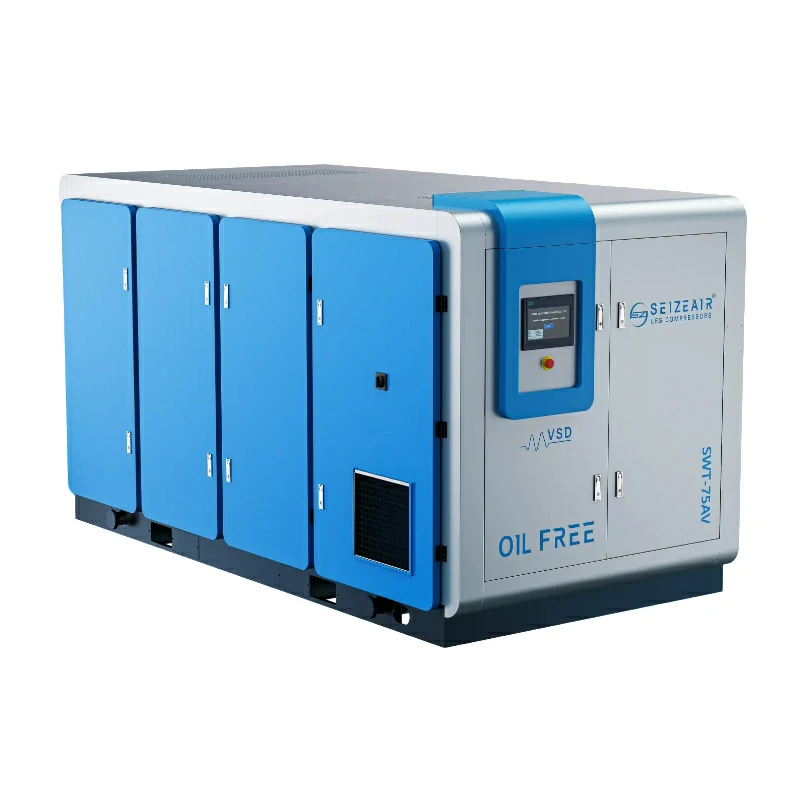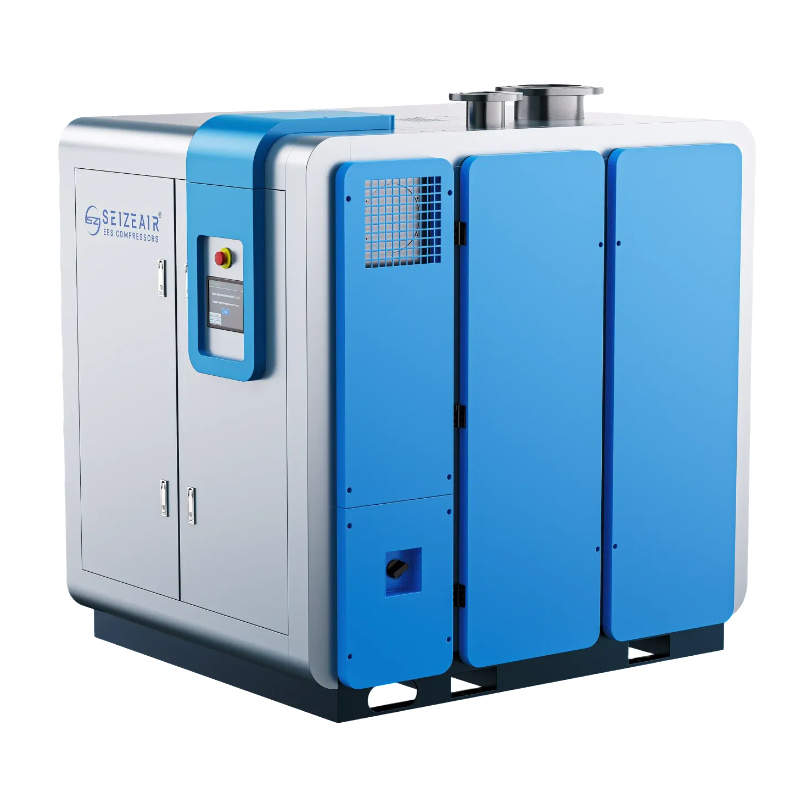


An air compressor for food industry has to do far more than move air from point A to point B — it has to deliver clean, oil-free compressed air that will never end up in the product, on the line, or in a customer’s mouth. This guide walks through what Class 0 actually means, which oil-free technologies hold up in a real food plant, and how to build an air system that sails through a BRCGS or FSMA audit instead of failing it.
On this page
- What an air compressor for food industry does on the line
- Why oil in food-plant air is a recall waiting to happen
- What ISO 8573-1 Class 0 means (and what it doesn’t)
- Purity classes, contamination sources and control
- Oil-free technologies and how to choose one
- Building a food-grade treatment train
- Selection, validation, cost and the audit traps
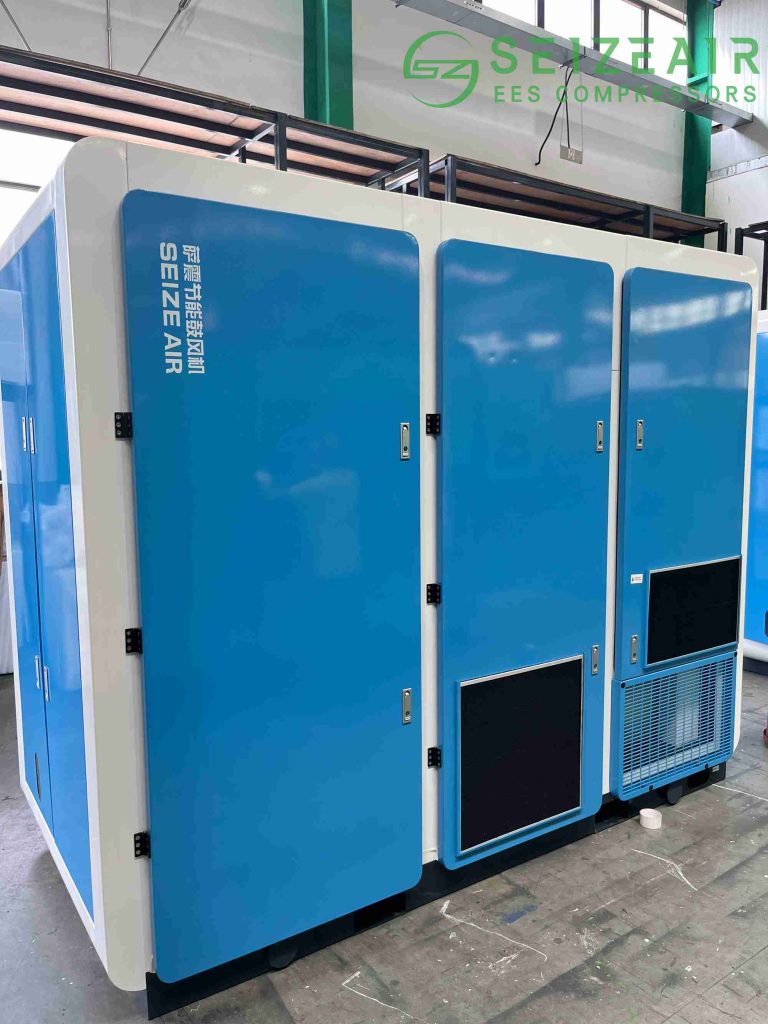
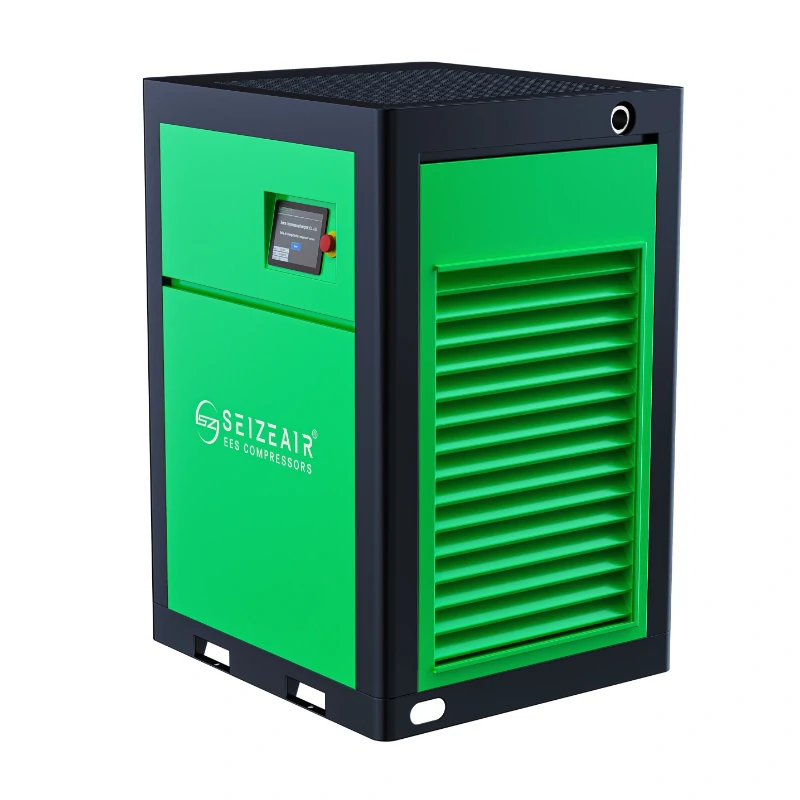
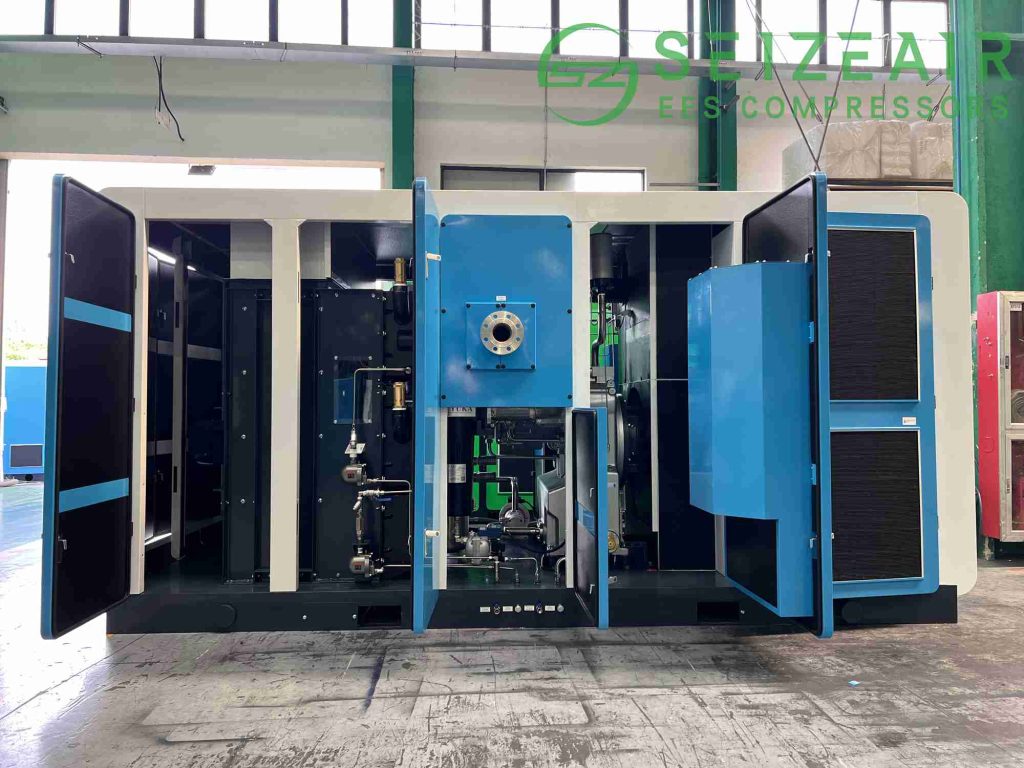
External shot of an oil-free screw air compressor installed for food production.
What Does an Air Compressor for Food Industry Actually Do on the Line?
Walk any snack, dairy, beverage or meat plant and you will hear compressors running long before you see them. The uses split into two camps, and the split decides everything about the spec.
Direct contact is the dangerous one. Here the air meets the food itself: blowing bottles clean before fill, pushing powder ingredients through a pneumatic line, whipping dough or icing, sparging tanks, and flushing modified-atmosphere packs. If that air carries oil, microbes or off-notes, the product is compromised at the source. This is where an air compressor for food processing has to be Class 0 oil-free, full stop.
Indirect contact is gentler. Air runs actuators on fillers, opens and closes valves, drives tooling, and powers instrument air for controls. Older specs let plants get away with filtered oil-injected air here. That gap is closing, because a single shared ring main can cross-contaminate, and auditors now ask why the “safe” line isn’t oil-free too.
Around the plant you also find aeration (wastewater and fermentation), nitrogen generation for MAP, and the endless blow-off guns used to clear crumbs and water. Each pulls from the same air system, so the weakest point sets the real purity.
Pneumatic conveying of food powder relies on oil-free compressed air.
Where the Air Touches the Product Most Often
- Bottling and canning — high-pressure blow-off to clear dust and rinse water before the product goes in.
- Packaging — forming, filling and sealing heads; any leak lands on film or food.
- Mixing and kneading — aeration and agitation where air becomes part of the recipe.
- Pneumatic conveying — moving flour, sugar, milk powder and spices through pipes.
- Modified atmosphere packaging — nitrogen flush to stall spoilage; the nitrogen comes from compressed air.
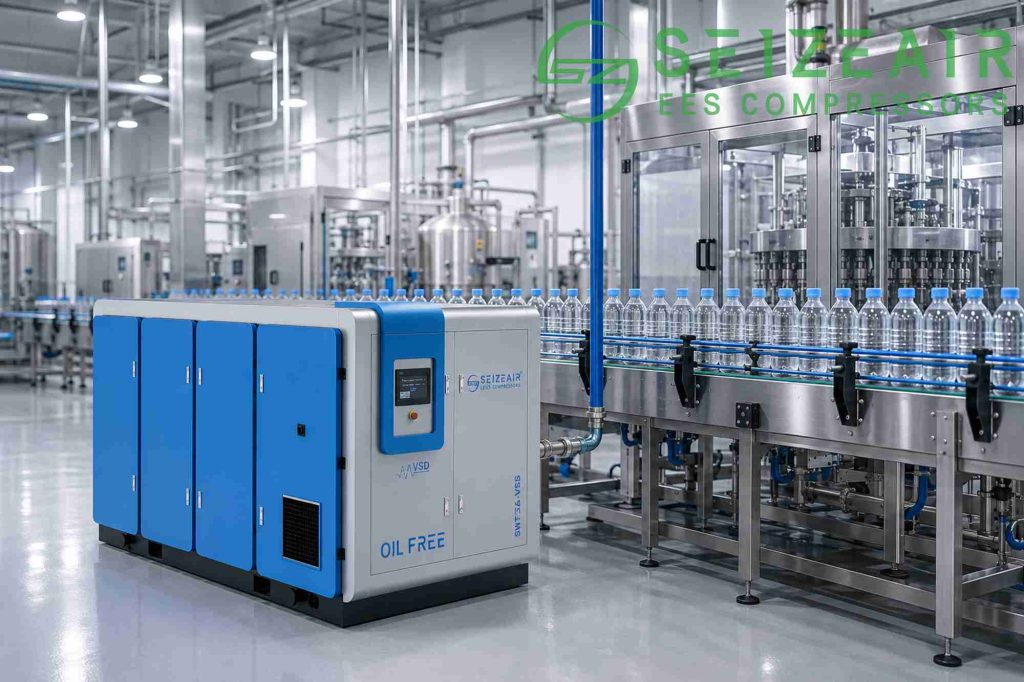
For bottling lines in particular, an air compressor for beverage bottling running 24/7 at 6–10 bar needs steady flow and a rock-solid dry point, or you get fogging inside PET preforms and a line that keeps tripping on moisture.
Why Food Plants Cannot Risk Oil in Their Compressed Air
Oil is the contaminant that scares food safety managers most, and not because of the oil itself. A lubricated rotary screw throws aerosol, vapour and liquid mist downstream no matter how good the separator is. Coalescing filters catch most of it, but the vapour passes straight through — and vapour is exactly the part that carries taste and smell.
The nasty bit is what rides along with the oil. Lubricant breakdown at compression temperature forms polycyclic aromatic hydrocarbons (PAHs), some of which are listed as probable human carcinogens. Even at trace levels they give food an off-flavour and an off-odour that panelists catch before instruments do. One contaminated batch can mean a recall, a withdrawn lot, and a customer who doesn’t come back.
Then there is the simple economics. A food-safe oil free air compressor for food processing costs more up front than an oil-injected unit, but it removes the single biggest source of compressed-air recalls. When the alternative is a shutdown and a public notice, the maths flips fast.
Rule of thumb we give plants: if a regulator, retailer or customer can ask “did air touch this?”, treat it as direct contact and spec oil-free.
What Is ISO 8573-1 Class 0, and Why Does It Matter for Food?
ISO 8573-1 is the standard that grades compressed air purity. It splits contaminants into three families — solid particles, water (humidity, liquid and dew point), and total oil — and gives each a numbered class. The lower the number, the cleaner the air. Class 1 is the tightest “standard” grade; class 0 is the grade above that, defined by the user because no off-the-shelf limit is tight enough.
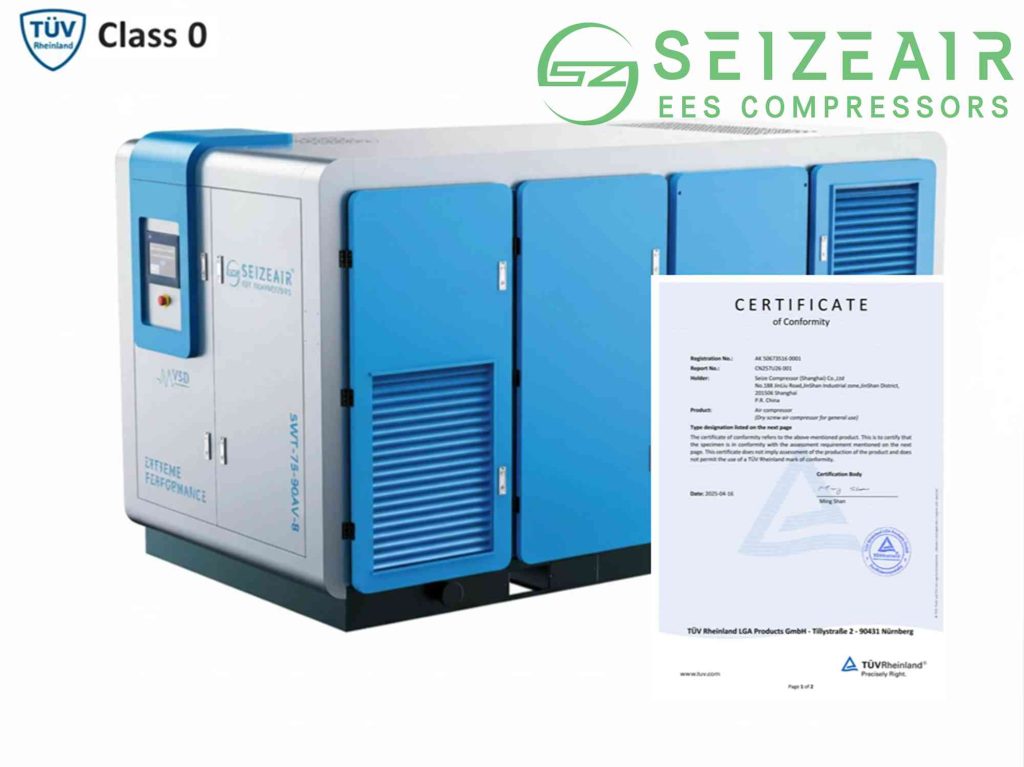
For oil, class 0 means you set your own maximum, typically below 0.01 mg/m3 total oil, because any oil in food contact is unacceptable. For solids and water, class 0 is similarly a customer-specified spec tighter than class 1. So when someone sells you a “Class 0 oil-free compressor,” read the fine print: the machine removes oil at the source, but the class 0 oil free compressor for food safe claim only holds if the whole train — dryer, filters, pipework — is built and maintained to keep it there.
This is why a bare compressor and a food-grade air system are not the same purchase. The compressor is step one. The treatment train behind it is what earns the certificate.
A complete food-grade compressed air system: oil-free compressor plus dryer and filters.
ISO 8573-1 Purity Classes at a Glance
| Contaminant family | Class | What it means (typical limit) | Use in food |
|---|---|---|---|
| Solid particles | Class 1 | ≤ 0.1 mg/m3, < 0.1 µm grades | Indirect contact, instrument air |
| Solid particles | Class 0 | User-specified, tighter than class 1 | Direct food contact |
| Water (pressure dew point) | Class 4 | Dew point +3 °C | General plant air |
| Water (pressure dew point) | Class 2 | Dew point -40 °C | Dry, cold, sterile lines |
| Total oil | Class 1 | ≤ 0.01 mg/m3 | Near-food, not direct |
| Total oil | Class 0 | User-specified, effectively oil-free | Direct food contact (required) |
Dew point is the number plants underestimate. A +3 °C dew point sounds dry until a cold weekend drops the pipe below freezing and water condenses into the line. For sterile and MAP lines, a -40 °C dew point is the safer call, which points you at a desiccant dryer rather than a refrigerated one.
Compressed Air Quality Standards Food Plants Must Follow
ISO 8573-1 sets the air grade, but it sits inside a bigger stack of rules. Knowing which one bites you depends on where you sell.
- ISO 22000 / FSSC 22000 — the food safety management system; your compressed air plan is part of the hazard analysis.
- HACCP — compressed air is a documented CCP (critical control point) wherever it touches product.
- FDA 21 CFR (US) and EC 1935/2004 (EU) — materials in contact with food, including the air, must not transfer unsafe constituents.
- BRCGS / SQF / IFS — retailer schemes that ask for written compressed-air purity specs and test records.
- 3-A and EHEDG — hygienic-design guidance for the wet, cleanable parts of the system.
So when a buyer asks for compressed air quality standards for food industry compliance, they are really asking for a chain of evidence: the class you claim, how the train delivers it, and the test results that prove it month after month.
The Five Contaminants Hiding in Food-Plant Air
| Contaminant | Where it comes from | What it does to food | How you control it |
|---|---|---|---|
| Solid particles | Intake dust, rust, pipe scale | Grit in product, abrasive wear | Remote intake + particulate filter |
| Water | Compression, humid intake air | Microbial growth, rust, fogging | Dryer sized to dew point + drain traps |
| Oil aerosol & vapour | Lubricated compressor, intakes | Off-flavour, PAHs, recall | Oil-free compressor + carbon filter |
| Microorganisms | Warm, wet receivers and pipes | Spoilage, pathogens | Dry air + 0.01 µm sterile point-of-use |
| Gases (CO, NOx, SO2) | Dirty intake near cookers/exhaust | Taint, safety risk | Intake sited upwind, away from process |
Notice the pattern: four of the five are solved upstream of the compressor or at the filter, not by the compressor alone. The intake location is the cheapest fix most plants ignore — pull air from a clean, upwind roof vent and you delete most of the gas and particle load before it costs you a filter.
Oil-Free Compressor Technologies That Actually Work in Food
“Oil-free” is not one machine. Four technologies cover the food range, and the right pick depends on flow, pressure, footprint and how clean the air must stay at the far end of the line.
| Technology | How it stays oil-free | Best fit in food | Watch-out |
|---|---|---|---|
| Water-lubricated screw | Water does the sealing and cooling; no oil in the chamber | Direct contact, dairy, beverage, general food | Needs clean feed water and good drainage |
| Dry (oil-free) screw | Teflon-coated rotors, two-stage with intercooling | High flow, continuous lines | Higher discharge temp; needs cooling |
| Scroll | Orbiting scroll, no contact, no oil | Small labs, filling, low flow | Limited capacity per unit |
| Centrifugal | High-speed impellers, no oil in path | Large plants, utilities, MAP nitrogen | High minimum flow; poor at part load |
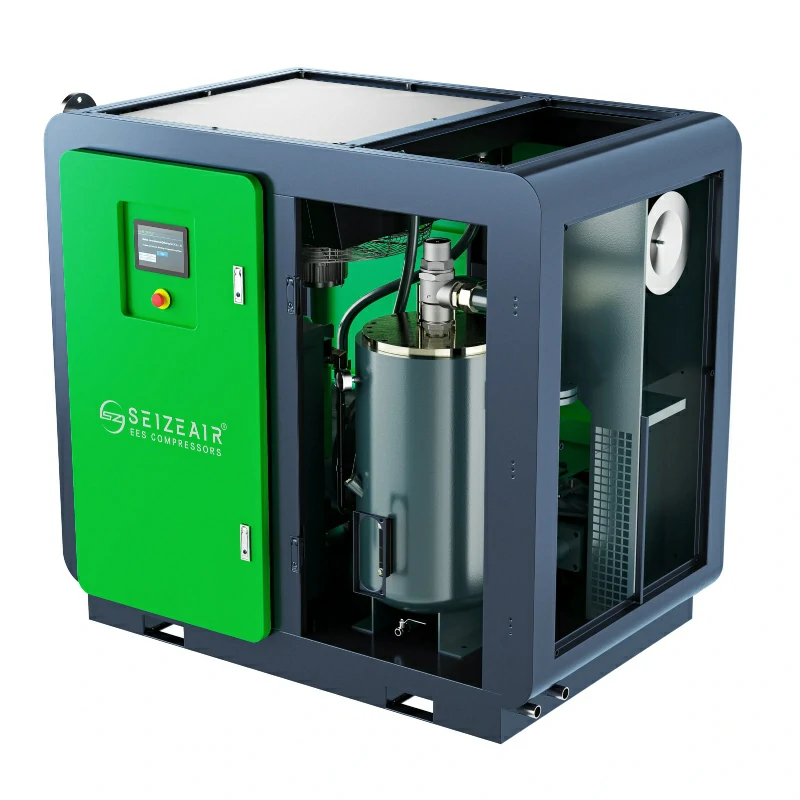
For most food plants, the oil-free water lubricated screw air compressor is the sweet spot: it removes oil at the source, runs cool, and handles the 0.7–45 m3/min most lines need. Higher-volume sites lean on an oil free screw air compressor in dry type, while low-flow filling and lab points often use an oil free scroll compressor that sips power and stays silent next to the line.
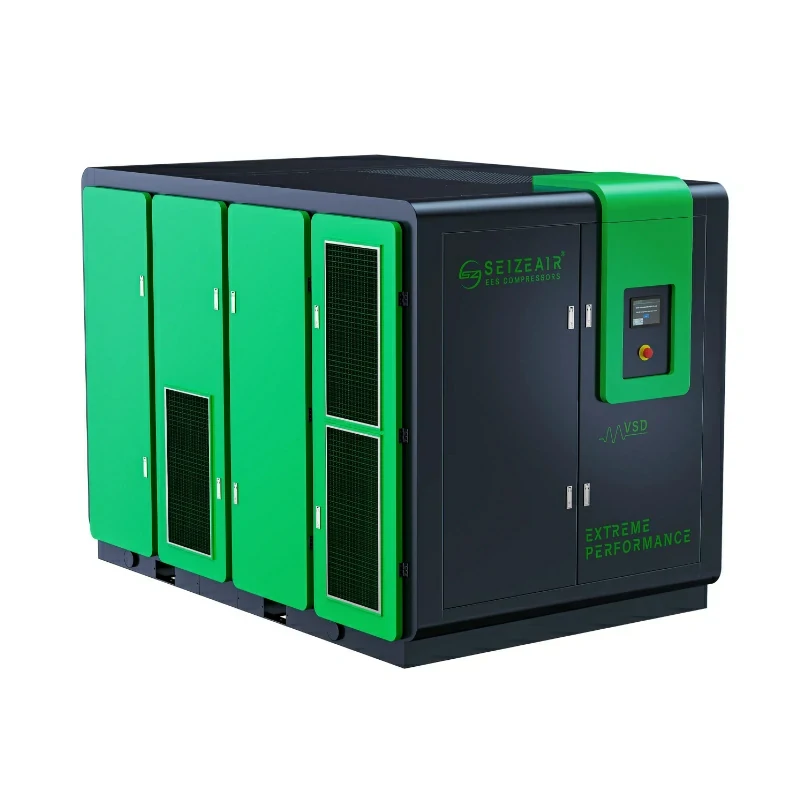
Seize Air builds all four and tunes the selection to your flow profile rather than selling the biggest unit — a point we come back to on cost.
Direct vs Indirect Contact
Does the compressed air touch the product? | +– YES (blow-off, mix, convey, MAP flush, rinse) | –> Class 0 oil-free + sterile point-of-use filter | +– NO (actuator, tooling, instrument air) –> Filtered is legal, but Class 0 oil-free is now best practice because one shared ring main cross-contaminates the rest
The diagram is the whole argument in one branch. If you answer “yes,” there is no debate — oil-free, class 0, sterile at the point of use. If you answer “no,” you can technically run filtered air, but mixing it on one ring with the product line is the mistake auditors flag first.
Building a Food-Grade Air System
A compressor alone is not a food-grade system. The train behind it is where class 0 is won or lost. The order matters because each stage protects the next.
Start with the intake: a pre-filter on a clean, upwind roof penetration. Then the compressor. Then an aftercooler drops the air to near ambient and dumps most water at the moisture separator. From there the dryer sets your dew point — pick a refrigerated air dryer for general +3 °C air, or a desiccant adsorption dryer when you need -40 °C for sterile or MAP lines.
Filtration is the part plants cheap out on. A compressed air precision filter after the dryer strips the remaining oil aerosol and dust, an activated carbon stage pulls the vapour and any taste, and a 0.01 µm sterile filter at the point of use is the last line before the food. Skip the point-of-use filter and a clean ring still picks up bugs in a warm branch line.
For MAP and inerting, a nitrogen generator on the same oil-free supply turns clean air into on-site N2, so you are not trucking cylinders and you control the purity end to end.
On-site nitrogen generation fed from oil-free compressed air for MAP.
A Practical Sizing Example
Say a biscuit line needs 10 m3/min at 7 bar, dew point -40 °C, class 0 oil. You would size the oil-free screw for ~11–12 m3/min to cover leaks and growth, put a desiccant dryer rated to -40 °C, then a coalescing filter, carbon filter and sterile point-of-use. Free air delivery (FAD) is the number to check on the data sheet, not the motor kW — FAD is the actual volume at your working pressure, and vendors quietly quote it at a pressure that isn’t yours.
Leakage alone eats 20–30% of output in an old plant. Fix the leaks before you buy a bigger machine; the payback is usually under a year.
How to Choose an Air Compressor for a Food Factory
Selection is mostly about matching the machine to the real load, not the nameplate. Five things decide it:
- Flow (FAD) — total demand at working pressure, plus 15–20% for leaks and growth.
- Pressure — most food lines sit at 6–10 bar; aeration and some blowing want lower.
- Duty cycle — continuous lines want fixed or VSD screw; intermittent want scroll or smaller VSD.
- Dew point — general air +3 °C, sterile/MAP -40 °C.
- Footprint and noise — a hygienic air compressor for food plant often sits near the line, so smooth, enclosed, washable casings matter.
If the load swings through the day, a variable-speed drive trims energy you would otherwise waste holding pressure at night. In a plant where air is 10–15% of the electricity bill, that saving pays for the upgrade on its own.
Common Mistakes That Fail Food Audits
- Buying oil-free but skipping the point-of-use sterile filter — class 0 lost at the last metre.
- One ring main shared between product and workshop air, with no isolation.
- No written purity spec, so “food grade” means whatever the tech guesses.
- Testing only at the compressor, never at the point of use where the food actually is.
- Letting the intake sit next to a fryer exhaust — gases and grease straight into the product.
Monitoring and Validation: Keeping Class 0 Real
A certificate on the wall is not compliance; records are. Food plants should test at the point of use, not the compressor, and they should test for the things that actually fail: particle counts, oil vapour (the part filters miss), and microbial load.
A sensible plan is particle and oil-vapour checks every 3–12 months, microbial swabs at the same points annually or after any filter change, and a logged filter change schedule. Audit schemes such as BRCGS and FSSC 22000 want to see that trail. Compressed air monitoring food industry programs are now sold as kits, so there is no excuse for “we don’t have the gear.”
Keep a simple log: date, point, method, result, who signed. When the auditor asks, you hand it over in one folder. That is the difference between a clean visit and a corrective-action report.
Point-of-use purity testing for class 0 validation.
Energy and Running Cost Realities
The purchase price is the small number. Over a compressor’s life, electricity is roughly 70–80% of the cost, so the spec that saves money is the one that saves kWh. Oil-free water-lubricated screws run cool and efficient; VSD trims part-load waste; heat-recovery kits grab the rejected heat for wash water or space heating and pay back fast in a cold climate.
The cheaper oil-injected route looks good on the quote and costs you at the filter, the carbon stage, and the recall risk. For food, the oil-free path is usually the cheaper one once you count the things that go wrong.
Air Compressor for Food Industry: FAQ
What type of air compressor is used in the food industry?
Plants that let air touch product use oil-free machines — water-lubricated or dry screw, scroll, and centrifugal. Lines that only run actuators can use filtered oil-injected air, but Class 0 oil-free is now the default best practice.
Is oil-free compressed air required for food contact?
Yes for any direct contact. Oil aerosol carries PAHs and off-flavours and can trigger a recall. ISO 8573-1 Class 0 holds the air to a user-specified limit stricter than class 1, effectively oil-free at the point of use.
What does ISO 8573-1 Class 0 mean?
Class 0 is the top purity grade. For oil it means the operator sets a limit tighter than class 1 because no oil is acceptable. For solids and water, class 0 is also a user-specified stricter spec.
How often should food-grade compressed air be tested?
Most plants test particles, oil vapour and microbes at the point of use every 3–12 months, and after any filter change or service. Audit schemes may ask for annual evidence.
Final Word and Next Step
Getting an air compressor for food industry right is less about the box and more about the system: oil-free at the source, dried to the dew point your line needs, filtered to a sterile point of use, and proven by records the auditor can read in one sitting. Do that and “food grade” stops being a hope and becomes a number on a certificate.
Talk to Our Food-Grade Air Team
If you are speccing a new line, replacing an old oil-injected unit, or prepping for an audit, our engineers will size the compressor and treatment train to your real flow and dew point — and show you the running-cost maths. Contact us for a food-industry air system quote.