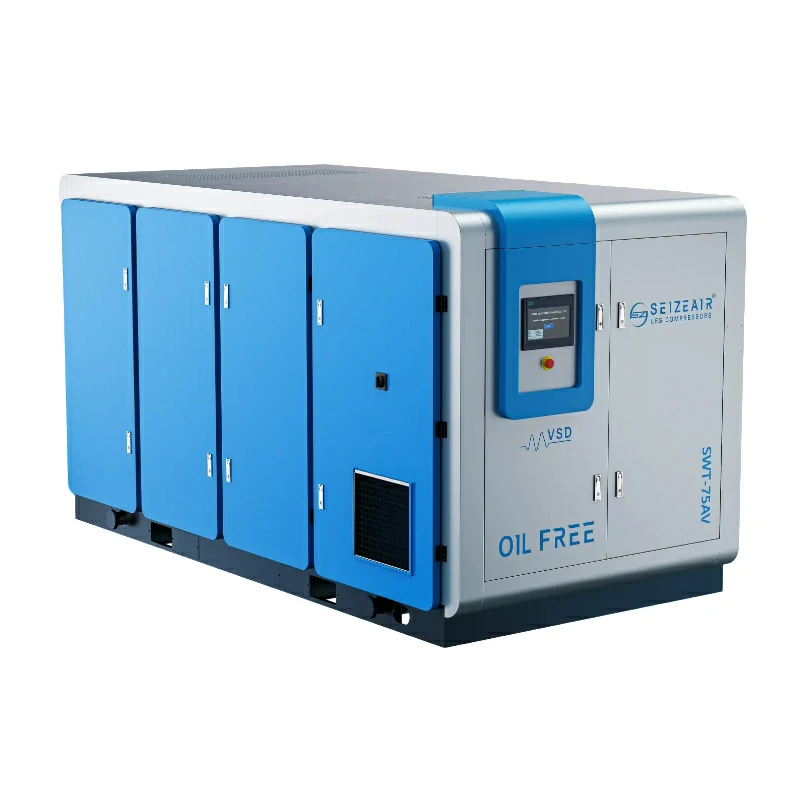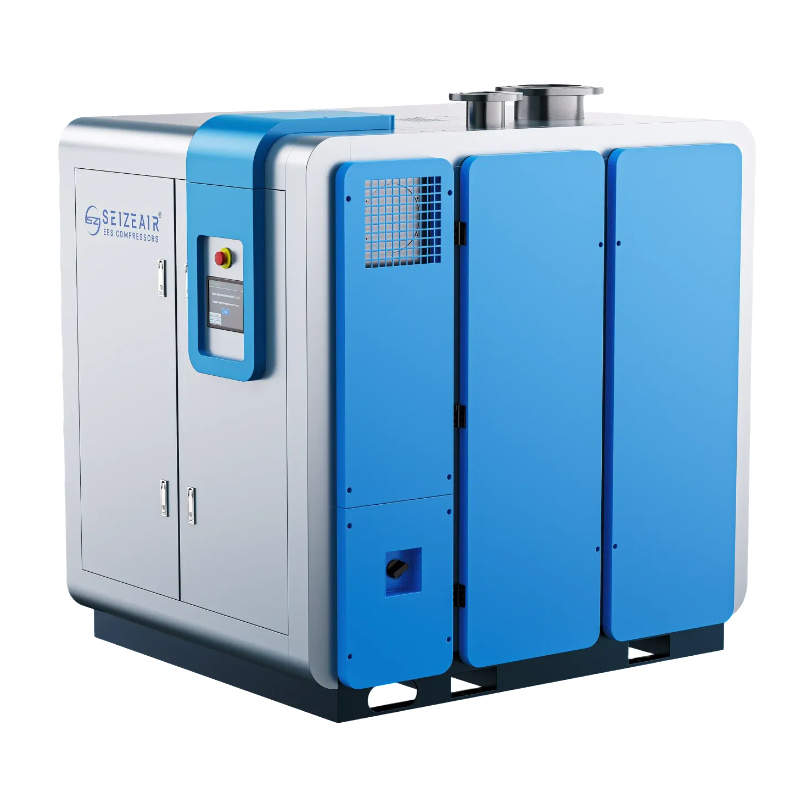


Import air compressor from China and the price gap is real — a 90 kW rotary screw package that quotes at USD 60,000 or more from a Western brand can usually be sourced, shipped and cleared for well under half that. The gap only survives, though, if you control the four things that quietly destroy it: a vague specification, a “factory” that turns out to be a trading company, a shipment released without a proper factory acceptance test, and a landed-cost model that forgets duty, port charges and installation. This guide walks the eleven steps in the order buyers actually run them — sizing, sourcing, verification, certification, HS codes and duty, Incoterms, payment, inspection, packing and freight, customs clearance, commissioning — with the checklists and cost math you can paste straight into your next RFQ.
Key takeaways
- Budget on landed cost, not on the factory price. Freight, duty, port charges and installation typically add 25-45% to the EXW number on a heavy compressor.
- Specify performance, not just a model number. Free air delivery at a stated pressure, specific power in kW per m3/min, and ISO 8573-1 purity class belong in the contract.
- Verify the legal entity on the business licence. A trading company can be fine, but you should know which one you are dealing with before you wire a deposit.
- Never release the balance payment before a witnessed run test and a document set you have actually read.
- Plan spare parts and service coverage before the machine ships, not after it breaks.
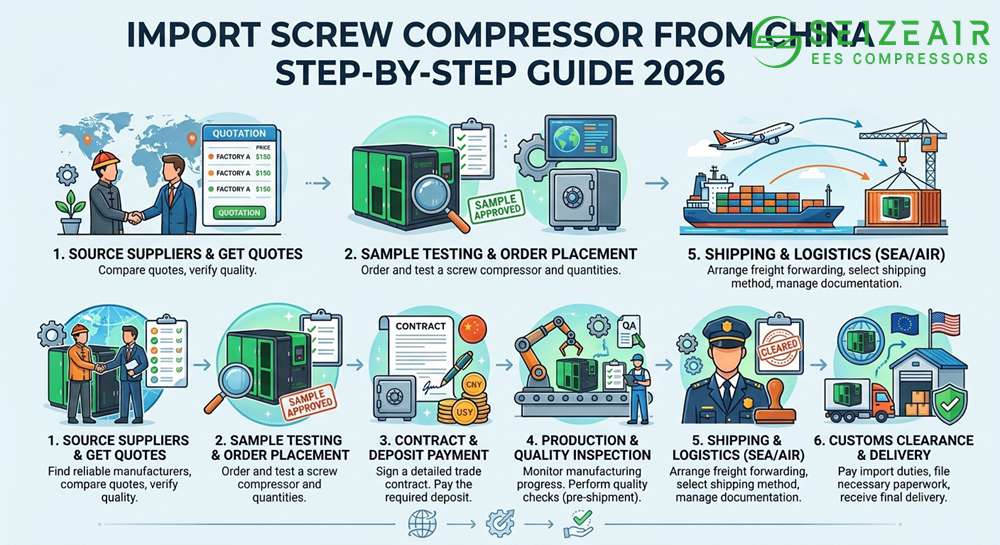
The Import Process at a Glance
Eleven steps sound like a lot. In practice they collapse into four phases: get the specification right, get the supplier right, get the paperwork right, then get the machine onto your floor. Here is the whole sequence in one picture.
  [ SPECIFY ]   ->  [ SOURCE ]   ->  [ VERIFY ]   ->  [ CONTRACT ]
  m3/min, bar        3-5 factories    business        proforma invoice,
  duty cycle         direct, not      licence,        Incoterm, payment
  ISO 8573 class     marketplace      ISO 9001,       terms, lead time,
                                      CE / ASME       penalty clause
      |                  |                |                 |
      v                  v                v                 v
  [ BUILD ]    ->  [ TEST ]     ->  [ SHIP ]     ->  [ CLEAR & INSTALL ]
  20-45 days         FAT at            export case,   customs entry, duty,
  after deposit      factory,          fumigation,    inland delivery,
                     video + test      container      commissioning,
                     report            booking        operator training
Most problems that cost real money happen at the two arrows on the left. If the specification is wrong, everything downstream is wrong, and no amount of clever negotiation on freight will recover it.
Why Do Buyers Import Air Compressors from China?
China is not simply “cheap” — it is structurally cheaper in a way that is hard to replicate elsewhere. The country builds the full stack: rotor grinding machines, motor laminations, castings, coolers, screw rotor profiles, variable frequency drives, and the control electronics that sit on top. A factory in Shanghai or Wuxi can source an airend, a motor and a VFD within a two-hour drive, assemble them under one roof, and run a full-load test before the unit is crated.
What actually drives the price gap
- Labour and overhead per kilowatt. Assembly hours on a 90 kW package are a fraction of the European equivalent, and overhead recovery per unit is lower because the factory is shipping volume through the same line.
- Component clustering. Motors, bearings, coolers and drives are sourced domestically at scale. You are not paying a margin stack of four sub-suppliers across three continents.
- Product range density. One supplier typically covers 7.5 kW to 560 kW across oil-injected, oil-free, two-stage, high-pressure and portable platforms, so a mixed order consolidates into fewer shipments.
- OEM and private label willingness. Most established factories will build to your colour, your control language, your nameplate and your documentation set with a reasonable minimum.
Where the savings quietly disappear
Be honest about the other side of the ledger. A 1,800 kg compressor is expensive to move. Ocean freight on a 40′ high-cube out of Shanghai swings wildly with the market, and destination charges — terminal handling, customs brokerage, container freight station fees, inland haulage — are frequently larger than the freight itself. Add duty, then add installation: a foundation, electrical work, pipework and a dryer, and you understand why a “50% cheaper” machine can end up only 25% cheaper by the time it is running.
The other leak is quality spread. There are genuinely excellent Chinese compressor factories with real rotor grinding capability, in-house test benches and ISO 1217 test reports. There are also workshops bolting bought-in airends into a painted canopy with no performance data at all. They sit next to each other on the same B2B platform with the same stock photos. Step 3 exists to separate them.
1、Calculate Your Real Air Demand Before You Request a Quote
Every expensive import mistake we see traces back to a specification written in a hurry. “We need about 100 hp” is not a specification — it is a guess that a salesperson will happily fill with whatever is in stock. You need four numbers before you send a single RFQ.
The four numbers every RFQ needs
- Flow: required free air delivery in m3/min or cfm, at the pressure your equipment actually needs. Not the compressor’s maximum — your demand.
- Pressure: the minimum bar or psi at the point of use, plus an allowance for dryer and filter pressure drop (usually 0.5-1.0 bar) and line loss.
- Duty profile: hours per day, days per year, and how much the demand swings between shifts.
- Air quality class: ISO 8573-1 target for particles, water and oil. If you do not state it, you will get general industrial air whether or not your process can tolerate it.
The sizing arithmetic is simple enough to do on paper:
Required FAD = (sum of all connected consumer demand x diversity factor) x (1 + leakage allowance)
where the diversity factor accounts for the fact that not every tool or valve fires at once — typically 0.6 to 0.85 in a mixed workshop, and closer to 0.9 to 1.0 in a process plant with continuous consumers. The leakage allowance is usually 10-15% on a well-maintained system and 20-30% on an old one. A plant that has never had a leak survey should assume the higher figure, or better, get one done before ordering.
Two corrections matter more than people expect. Altitude: above roughly 1,000 m the thinner air reduces mass flow, so a compressor that delivers 10 m3/min at sea level delivers measurably less on a mine site at 2,500 m. Ambient temperature: a compressor room at 45 C will derate and trip where the same unit at 25 C runs happily. State both in the RFQ and ask the factory to confirm performance at your site conditions, not at their test bench conditions.
If you want the full derivation, our industrial air compressor sizing guide walks through the diversity factors industry by industry.
Peak demand is the wrong number to design around
Almost every plant has a demand curve with a sharp morning spike, a long steady midday plateau, and a tail that drops at shift change. Sizing a fixed-speed machine to cover the spike means it runs unloaded for much of the day, burning 25-40% of full-load power to produce nothing. That is where variable speed earns its money.
  m3/min
   12 |             ____            ________
      |     ___    /    \          /        \
    8 |    /   \__/      \________/          \______
      |   /                                         \
    4 |  /                                           \____
      | /                                                 \___
    0 +-----+-----+-----+-----+-----+-----+-----+-----+-----+-----
       06:00     10:00     14:00     18:00     22:00     02:00

   fixed-speed unit : loads and unloads across the whole band
   VSD unit         : motor speed tracks the demand line, no unload waste
As a rough rule: if your demand swings more than about 30% between peak and average, price a variable speed unit alongside a fixed-speed one and compare on five-year running cost, not purchase price. The electricity line dwarfs the purchase price over the life of the machine — typically energy is 70-80% of total cost of ownership, capital is 12-15%, and maintenance makes up the rest.
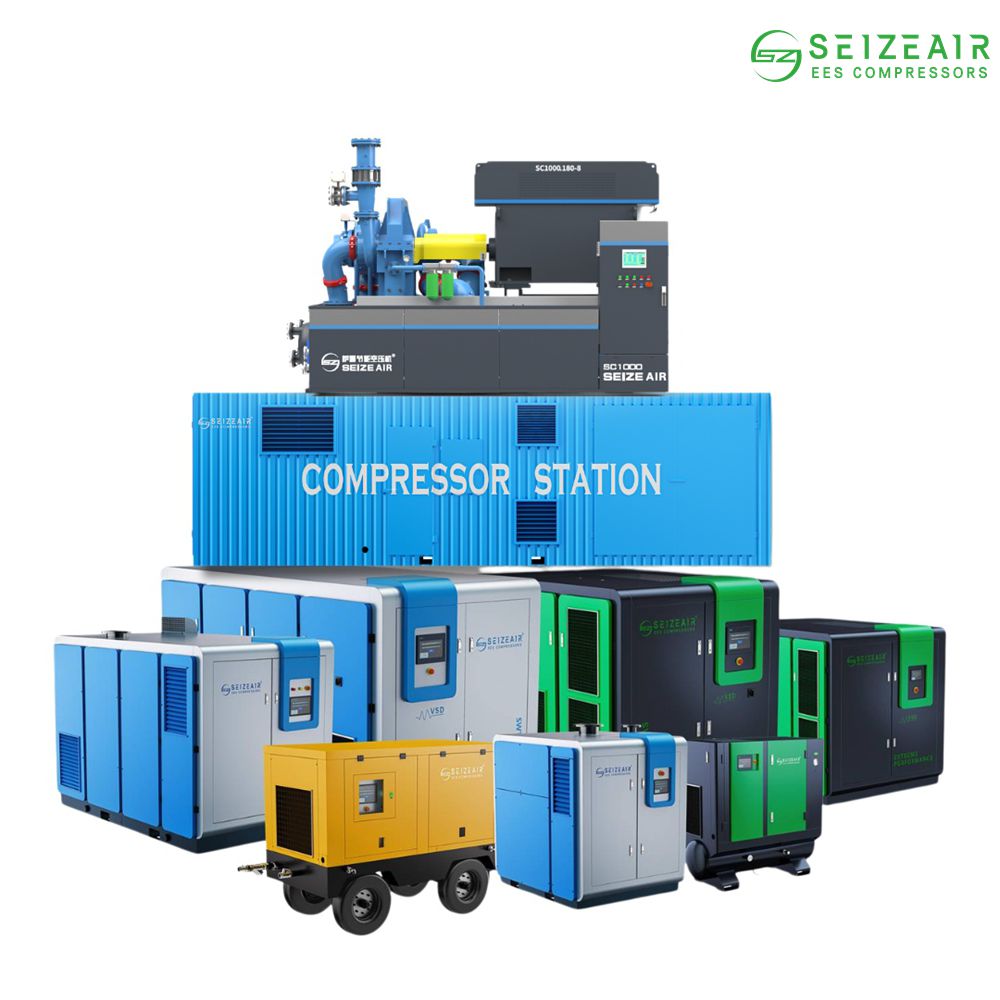
2、Pick the Right Compressor Type for the Job
Once the duty point is known, the platform choice is mostly mechanical common sense. The table below is the shortlist most buyers work from when they import industrial air compressor equipment from China.
| Type | Best fit | Typical range | What to pin down in the contract |
|---|---|---|---|
| Oil-injected rotary screw, fixed speed | General manufacturing, steady demand, workshops | 7.5-250 kW, 0.8-45 m3/min, 7-13 bar | Specific power in kW/(m3/min) at rated pressure, not motor kW |
| Permanent magnet VFD screw | Variable demand, multi-shift plants, energy retrofits | 15-250 kW, 1.0-45 m3/min, 6-13 bar | VFD brand, IP rating, minimum speed, and turndown ratio |
| Two-stage screw | Continuous high volume, 24/7 duty | 45-560 kW, 15-92 m3/min, 4.5-13 bar | Inter-stage cooling method, specific power at part load |
| Oil-free screw (dry or water-lubricated) | Food, beverage, pharma, electronics, textiles | 5.5-250 kW, 0.7-45 m3/min, 7-13 bar | ISO 8573-1 Class 0 certificate and the test report behind it |
| High-pressure screw or piston | PET blowing, laser cutting, hydrostatic testing | 15-40 bar and above | Pressure vessel certification for every receiver and cooler |
| Centrifugal | Very large single-point demand | Above roughly 100 m3/min | Surge margin, inlet filtration, engineering scope and site support |
| Portable diesel | Construction, mining, road works, rental fleets | 100-1,500 cfm | Engine emission standard (EPA Tier / EU Stage) and noise rating |

Two platforms deserve a closer look before you commit. For variable duty, a permanent magnet variable frequency screw air compressor holds its efficiency down to low part load where a standard VSD with an asynchronous motor falls away, which is exactly where most plants spend their day. For food, beverage, pharmaceutical or electronics work, an oil-free screw air compressor removes the oil-removal risk entirely — no coalescing filter to saturate, no carryover incident waiting to contaminate a batch.
One more decision that belongs here rather than later: whether to buy the compressor bare or as a package. Ordering the dryer, receiver, filters and drains from the same factory, in the same container, avoids the classic mismatch where an imported compressor arrives with a dryer that has different voltage, different thread standards and no drain.
3、How to Tell a Real Factory from a Trading Company
There is nothing wrong with trading companies — some are excellent at consolidation, documentation and communication. The problem is paying factory pricing to someone who will place your order with a factory you have not vetted, and then discovering that the warranty runs through an intermediary. You are entitled to know who is actually building your machine.
Run these checks before you place a deposit
- Match the legal entity. Ask for the business licence (营业执照) and check that the registered name matches the company on the proforma invoice and the bank account. If the beneficiary is a Hong Kong or mainland entity with a different name, stop and ask why.
- Ask for the manufacturing scope on the licence. A genuine factory lists manufacturing of compressors or general equipment. A trader’s licence lists trading, import/export and wholesale.
- Request a live video walk-through. Not a brochure video. Ask them to walk from the rotor grinding area to the assembly line to the test bench, on a call, at a time you choose. Factories can do this in two minutes. Traders cannot.
- Ask for the airend source. “Do you grind your own rotors, and on what machine?” A real manufacturer answers immediately and with specifics. Everyone else goes vague.
- Check the test capability. Ask what standard the run test follows and whether they can issue an ISO 1217 Annex C test report. No test bench means no performance guarantee that is worth anything.
- Look for export history in your market. A factory that has shipped to your country before already knows your voltage, your frequency, your documentation and your port’s quirks. Ask for two references, ideally one you can call.
- Verify certificates independently. Certificate numbers on CE, ISO and EAC documents can often be checked with the issuing body. Do it before the deposit, not after.
Pricing behaviour tells you a lot too. A quote that comes back 40% below everyone else, with no questions asked about your altitude, ambient temperature or duty cycle, is not a bargain — it is a signal that nobody has read your specification. We have catalogued the other warning signs in air compressor factory red flags, and Seize Air’s own audit checklist is the same one we hand to customers who come to Shanghai to visit.
4、Certifications and Compliance Paperwork You Must Have Before Shipping
This is the step that turns a cheap machine into an expensive paperweight. Customs authorities and insurers do not care how good your compressor is; they care whether the documents exist and match.
The core set almost every market asks for
- Commercial invoice, packing list, bill of lading — must agree on model, serial number, quantity, weight and value.
- Certificate of Origin — usually issued by CCPIT. Form E, Form F and other preferential forms can cut or eliminate duty under the relevant free trade agreement, so ask which one applies to your country.
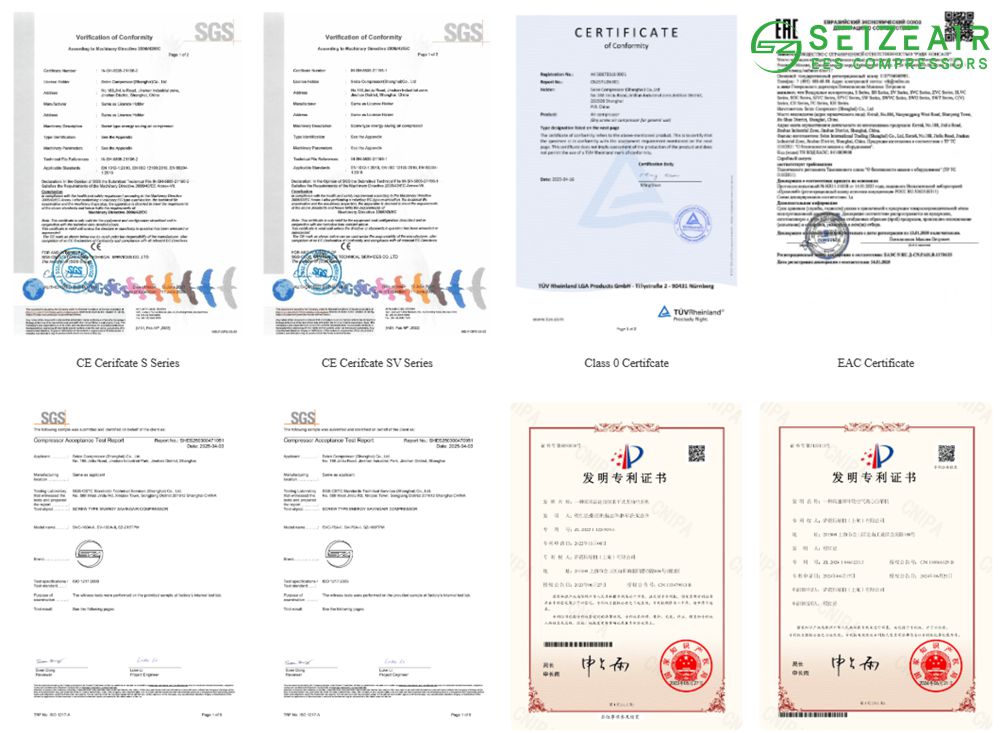
- CE declaration of conformity and technical file — for the EU, the machinery must meet the Machinery Directive (2006/42/EC) with the relevant harmonised standards listed, and the importer must hold the technical documentation.
- UKCA marking — for Great Britain, in parallel with CE during the transition arrangements in force at the time of shipment.
- ISO 1217 performance test report — the only document that proves the machine delivers what the datasheet claims.
- ISO 8573-1 air purity test report — mandatory in practice for food, pharma, electronics and any Class 0 claim.
- Test certificates for pressure vessels — air receiver, oil separator vessel, aftercooler, and any shell operating above the applicable threshold.
Pressure equipment is the one people forget
A compressor package is not just a machine — it contains pressure vessels, and in most jurisdictions those are separately regulated. In the EU, assemblies above a certain pressure-volume threshold fall under the Pressure Equipment Directive and need appropriate conformity assessment, sometimes involving a notified body. In North America, air receivers normally need an ASME Section VIII stamp with a U-1 form, or a CRN for Canadian provinces. If you are buying a high pressure air compressor at 25 bar or 40 bar, this is not a formality: the vessel documentation is the gating item for legal installation. Tell the factory your destination and the applicable code at RFQ stage, because vessel certification cannot be retrofitted after the unit is built.
Destination-specific requirements
- North America: electrical approvals through an NRTL (UL, ETL, CSA) are expected by most inspectors and insurers, even where not strictly mandated by the authority having jurisdiction. Confirm motor voltage and frequency — 480 V / 60 Hz is standard, but 575 V and 208 V installations exist.
- Eurasia: EAC marking with the relevant technical regulation, plus a certified translation of the manual into Russian.
- Saudi Arabia: SABER product conformity and a shipment certificate of conformity, arranged before loading.
- Nigeria, Kenya, Egypt and much of Africa: pre-shipment inspection under SONCAP, PVoC or GOEIC-type programmes. These take days to arrange and can hold a container at destination if skipped.
- India: BIS registration where applicable, plus IEC for imported electrical equipment.
- Australia and New Zealand: RCM marking and electrical safety approval, with duty preferences available under the China-Australia FTA.
Ask for scans of the original certificates — with numbers visible — before you pay the balance, and file the originals with the machine. Manuals in the local language are part of the compliance package in many jurisdictions, so request them at order stage rather than discovering the gap during an inspection.
5、 HS Codes, Import Duty and the Real Landed Cost
Two numbers decide whether your import makes financial sense: the duty rate that applies to your classification, and the total landed cost once everything is in. Both are knowable in advance, and both are routinely guessed.
Getting the HS classification right
Most industrial compressors fall under heading 8414. Rotary screw and other compressor types commonly land in 8414.80 subheadings, while reciprocating piston compressors and certain portable units sit in 8414.30 or 8414.40, and turbo compressors in 8414.30. The last digits vary by country, and the classification drives the duty rate, the free trade agreement treatment, and sometimes the licence requirements.
Do not let anyone pick the code by habit. Give your broker the machine type, drive type, pressure, flow and whether it is skid-mounted with a dryer or tank, and get a written classification opinion before you sign. A wrong code discovered at destination is a penalty, a delay, and sometimes a re-export.
| Destination | Typical HS line for a rotary screw package | Indicative duty on Chinese origin | Other charges to budget |
|---|---|---|---|
| European Union | 8414.80 subheading | Roughly 2% | Import VAT at the national rate, terminal handling, brokerage |
| United Kingdom | 8414.80 subheading | Roughly 2% under the UK Global Tariff | 20% import VAT, deferred if you are VAT registered |
| United States | 8414.80 subheading | Low or zero MFN, but additional tariff programmes on Chinese origin may apply — verify the current list | Merchandise processing fee, harbour maintenance fee, customs bond |
| Middle East (GCC) | 8414.80 subheading | Around 5% common external tariff | 5% or 15% VAT depending on country, conformity programme fees |
| India | 8414.80 subheading | Commonly 5-10% basic customs duty | IGST at 18%, social welfare surcharge, port and CFS charges |
| Australia | 8414.80 subheading | Zero to 5%, often nil under ChAFTA with a valid certificate of origin | 10% GST, quarantine inspection on timber packaging |
| West and East Africa | 8414.80 subheading | Wide range, frequently 5-20% | Pre-shipment inspection fees, IDF, port congestion and demurrage risk |
| Latin America | 8414.80 subheading | Varies significantly by country and by Mercosur or Pacific Alliance rules | High inland logistics cost, local content and labelling rules |
These are planning ranges for budgeting, not tariff advice. Duty rates, trade remedies and surcharges change. Confirm the exact rate with a licensed customs broker in your country before you commit to a purchase order.
The landed cost formula, in plain text
Landed cost = EXW or FOB price + inland transport and export clearance in China + ocean or air freight + marine insurance + import duty + destination charges + inland delivery and installation
where destination charges include terminal handling, customs brokerage, container freight station or devanning, port storage risk, and any pre-shipment inspection or conformity programme fee. Marine insurance is typically written on CIF value plus 10%:
Insured value = (CIF value) x 1.10, and premium = insured value x rate (commonly 0.1% to 0.5% for new machinery on a standard voyage)
Worked example: 90 kW VSD screw package to a European port
The following is a realistic structure, not a quotation. It shows where the money actually goes, and why the factory price is the least informative number in the whole transaction.
| Cost element | Indicative amount (USD) | Share of landed cost | Notes |
|---|---|---|---|
| EXW factory price, 90 kW PM VFD screw package | 18,000 – 26,000 | 55-65% | Depends on airend source, VFD brand and control spec |
| Inland haulage to port, export clearance, documentation | 500 – 1,200 | 2-3% | Includes customs declaration and origin certificate |
| Ocean freight, share of a 40′ high-cube | 1,500 – 4,500 | 5-11% | Very volatile; get a rate valid to the booking date |
| Marine insurance | 60 – 180 | Under 1% | Cheap relative to the risk it covers — always buy it |
| Import duty at roughly 2% | 400 – 650 | 1-2% | On customs value, before VAT |
| Destination charges: THC, brokerage, devanning, delivery | 1,200 – 3,000 | 4-8% | Often under-estimated; can exceed ocean freight |
| Installation: foundation, cabling, pipework, commissioning | 2,500 – 8,000 | 8-20% | Highly site-dependent; get a local quote early |
| Indicative landed and installed cost | 24,160 – 43,530 | 100% | Excludes recoverable import VAT |
Read that table again and the strategic point is obvious: you can negotiate hard for a week to take USD 800 off the factory price, or you can spend an afternoon consolidating two machines into one container and booking freight three weeks earlier, and save more. Freight and destination charges are where the soft money is.
6、How to Read a Chinese Supplier’s Quotation
A proforma invoice from a compressor factory is a short document with a lot of silent assumptions. Check these before you sign anything:
- Validity. Steel and copper move. A quotation without a validity date is not a quotation. Thirty days is normal; if your approval cycle is longer, say so and ask for a longer hold.
- MOQ. For standard models, one unit is usually fine. For OEM colour, custom control language or a private label, expect a minimum order quantity — commonly three to five units, sometimes one full container. Ask what the MOQ actually applies to, because salespeople use the word loosely.
- Lead time and when the clock starts. “30 days” usually means 30 working days after deposit and after technical confirmation, not after your email. Get it in writing.
- Scope of supply. Does the price include the air receiver, dryer, filters, drains, first-fill lubricant, and a set of commissioning spares? Vague scope is the single most common source of a dispute after the container arrives.
- Electrical specification. Voltage, phase and frequency, and whether the control panel is rated for your supply. 400 V / 50 Hz and 480 V / 60 Hz are not interchangeable.
- Warranty terms in words, not adjectives. Duration, what is covered, who pays freight on a warranty part, and what the response commitment is.
- Penalty and remedy. What happens if the machine misses the agreed flow, or ships three weeks late? A contract without a remedy is a polite document, not a commercial one.
7、 Incoterms
Incoterms decide who pays what, who carries the risk, and — critically — who controls the shipment. Get this wrong and you can end up legally responsible for a machine you cannot locate.
- EXW (Ex Works). You collect from the factory gate. Maximum control, maximum responsibility: you handle export clearance in China, which requires a local entity or an agent with one. New importers usually find this harder than it looks.
- FOB (Free On Board). The factory handles export clearance and delivery onto the vessel; you handle freight and everything after. This is the default for experienced buyers because it keeps freight control and cost visibility on your side.
- CIF (Cost, Insurance and Freight). The seller pays freight and insurance to your port. Convenient, but you inherit the destination charges, which are where the unpleasant surprises live, and you have no say in routing or carrier.
- DAP (Delivered At Place). Delivered to your door with you handling import clearance and duty. Useful if you have a trusted broker but no freight relationships.
- DDP (Delivered Duty Paid). The seller does everything including duty. Tempting for a first import, but verify that the seller can legally act as importer of record in your country, and expect the duty to be priced in with a margin.
Our default recommendation: FOB for the first shipment if you have any freight relationship at all, CIF if you do not, and DDP only when the supplier can show a track record of clearing in your country. Whichever you pick, name the port explicitly — “FOB Shanghai” rather than “FOB China”.
8、 Payment Terms That Protect Both Sides
Payment is where trust and structure meet. The standard arrangement for a first order is 30% deposit by T/T against the proforma invoice, and 70% balance against a copy of the bill of lading, or — better for you — after a passed factory acceptance test and before release.
- T/T (telegraphic transfer). Fast, cheap and normal. The balance trigger is the only thing to negotiate, so negotiate it.
- L/C at sight. Bank-mediated, safer for very large orders, but it is document-heavy and expensive, and any discrepancy in the paperwork lets the bank refuse payment. Use it above roughly USD 150,000 or when your counterparty is new to you.
- D/P or D/A. Documents against payment or acceptance. Occasionally offered, rarely worth the complexity for machinery.
- Platform escrow or trade assurance. Reasonable for small orders and accessory purchases; awkward for a 90 kW machine with a custom configuration.
- Open account. Earned, not requested. Once you have three clean shipments behind you, ask for 30 or 60 days and treat it as a real cost saving.
Two practical rules. First, always pay to the bank account in the legal entity’s name on the business licence — if a supplier emails “updated bank details” mid-order, call a known number and verify by voice. Business email compromise on China orders is common and it is entirely preventable. Second, keep the balance payment as your leverage: it is the only moment in the transaction when the factory needs something from you more than you need something from them.
9、 Factory Acceptance Test and Pre-Shipment Inspection
If you take one step seriously in this whole process, take this one. A witnessed run test converts a specification into a fact, and it is your last cheap opportunity to find a problem. Most factories will run the test on a video call and send the data sheet the same day; if yours will not, that is information too.
What to test during the FAT
- Free air delivery at rated pressure, measured by nozzle or flow meter, following ISO 1217. Accept within about 5% of the contracted value.
- Specific power — input kW divided by delivered m3/min — logged on a power analyser at full load and at two part-load points. This is the number that determines your electricity bill for a decade.
- Load and unload setpoints, and the pressure band the machine actually cycles within.
- Noise level measured at 1 m on four sides. Compare against the quoted dB(A) with a small tolerance.
- Oil carryover for oil-injected machines, and the ISO 8573-1 purity result for oil-free machines.
- Vibration on the airend and motor bearings, against ISO 10816 limits.
- A continuous run of at least two to four hours at full load, with no trips, no leaks and stable temperatures.
- Nameplate and serial number photographed and cross-checked against the proforma invoice and the declaration of conformity.
For continuous heavy duty, this is also the point to confirm the part-load behaviour of a two-stage screw air compressor against a single-stage alternative, because the efficiency advantage only shows up when you measure it at 40% and 70% load rather than at nameplate. Seize Air runs every unit on a loaded test bench before it is crated, and we send the raw log rather than a summary — buyers should expect nothing less from any factory.
10、 Export Packing, Container Loading and Ocean Freight
A compressor is heavy, top-heavy, and sensitive to humidity. A 40-day voyage through a tropical humidity cycle will find every gap in the packing.
Packing that survives a 40-day voyage
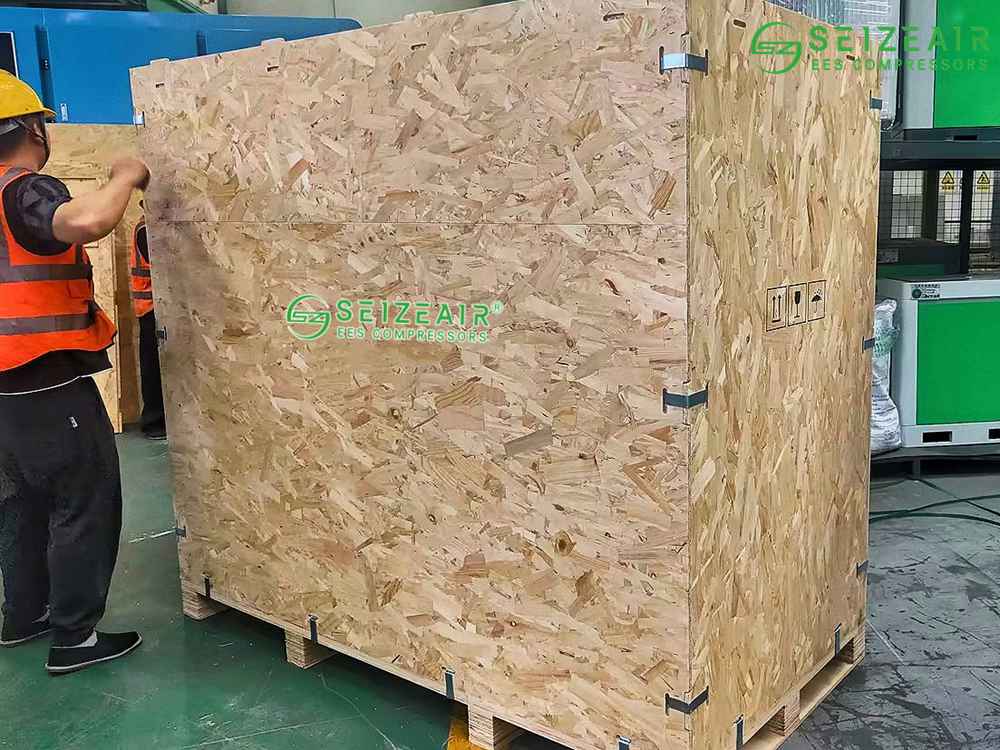
- Seaworthy plywood case with a steel or heavy strap base, not a light crate. ISPM 15 heat-treated timber with the stamp visible, or your container will be held for treatment at destination.
- VCI paper or bag plus desiccant inside the canopy, with the control panel separately bagged. Condensation inside a container is normal; rust on a new airend is not.
- Bolted, not strapped, to the pallet base, with the centre of gravity marked and lifting points identified.
- Shock and tilt indicators on at least two faces. They cost almost nothing and turn an insurance claim from an argument into a photograph.
- Loose parts boxed and itemised against the packing list — filters, belts, drains, tools, manuals and the certificate pack.
Ask for loading photographs: empty container, machine going in, lashing in place, doors closed and sealed with the seal number legible. These five images settle most damage claims.
On consolidation: a 90 kW package with canopy and dryer typically fills a 20′ container or takes up a substantial share of a 40′ high-cube. Two mid-size machines often travel together more economically than separately, and an all-in-one screw compressor package — compressor, dryer, receiver and filters on one skid — removes a surprising amount of destination assembly, wiring and leak risk in a single decision. Book freight three to four weeks ahead and get a rate valid to the booking date; rolling a booking on a volatile lane can cost more than the inland haulage.
11、 Customs Clearance, Delivery and Commissioning on Site
Clearance is mostly preparation. Have the commercial invoice, packing list, bill of lading, certificate of origin, and the compliance documents from Step 4 in your broker’s hands before the vessel berths. Free time at the port is short — often three to five days — and demurrage and storage charges start the day after.
| Document | Who issues it | When it is needed |
|---|---|---|
| Commercial invoice and packing list | Supplier | Before shipment; values must match the bill of lading |
| Bill of lading, original or telex release | Carrier or forwarder | At clearance and release |
| Certificate of Origin (Form E, Form F or general) | CCPIT or chamber of commerce | At clearance; drives duty preference |
| ISPM 15 marking and packing declaration | Packer | At quarantine inspection |
| CE or UKCA declaration of conformity and technical file | Manufacturer | Before installation; importer must hold it |
| ISO 1217 performance test report | Factory test bench | At FAT; the basis of any performance claim |
| Pressure vessel certificates and forms | Manufacturer, notified body or ASME holder | At local vessel registration |
| Marine insurance certificate | Insurer | Before loading, to be covered from the factory gate |
| Pre-shipment inspection or conformity certificate | Appointed agency | Before loading, where the destination requires it |
Commissioning is where most imported units fail
Not because they are faulty, but because the site is not ready. Before the machine arrives, confirm: a level foundation capable of the static and dynamic load; incoming power at the right voltage, phase and protective device rating; adequate ventilation and, for water-cooled units, the water supply and drainage; discharge pipework sized for the flow, with an isolation valve and a drain leg; and enough clearance around the canopy for the maintenance you will be doing for the next ten years.
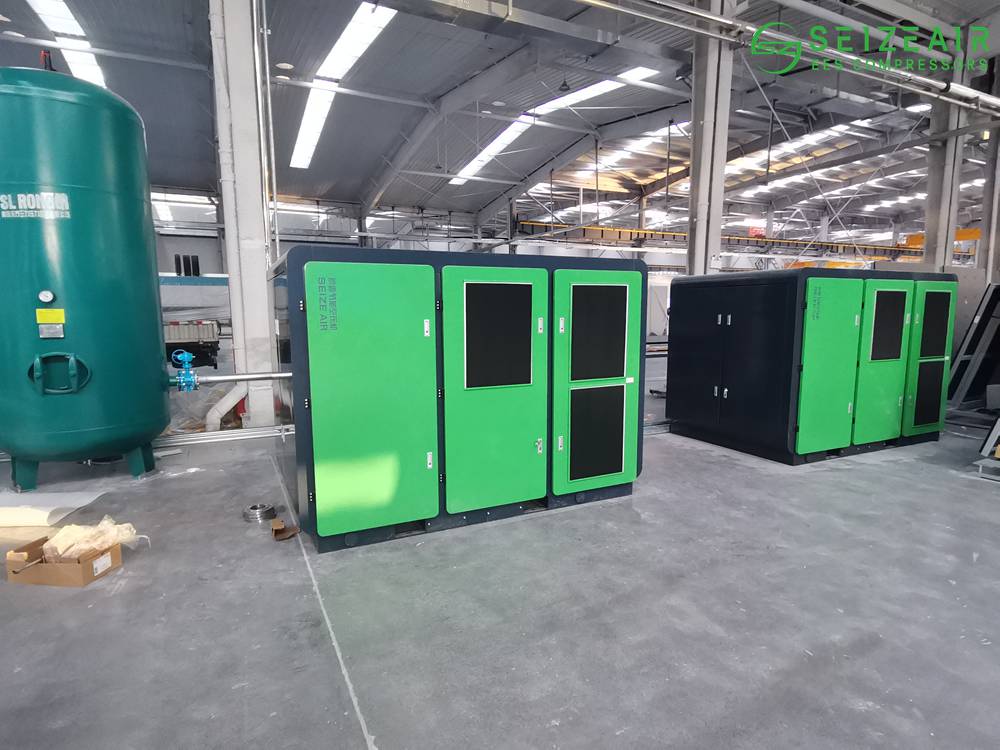
At commissioning, log the actual delivered flow and specific power at your site conditions and compare them against the factory test report. If the numbers diverge by more than the agreed tolerance, you now have documentation from both ends, which is exactly what a claim needs.
How Long Does It Take to Import an Air Compressor from China?
Realistic planning figures for a standard configured machine, from signed proforma invoice to running unit:
- Technical confirmation and quotation: 3-10 days, depending on how clean your specification is.
- Production after deposit: 20-45 days for standard models; 45-75 days for large two-stage, centrifugal or heavily customised units.
- Factory acceptance test: 1-3 days including the run test and report.
- Inland transport, export clearance and vessel wait: 5-12 days.
- Ocean transit: roughly 25-40 days to Europe or the US West Coast, 15-25 days to Southeast Asia or the Middle East, 30-45 days to South America or West Africa, plus transhipment time where applicable.
- Customs clearance and inland delivery: 3-10 days if documents are complete; considerably longer if they are not.
- Installation and commissioning: 2-7 days.
Total: typically 8 to 14 weeks door to door. Order backwards from the date you need air, then add two weeks, because something always slips — usually the production slot after Chinese New Year or the national holiday period in October.
Is It Safe to Buy Air Compressors from China?
Yes, with the same discipline you would apply to any cross-border capital purchase. The risk in importing is not that Chinese engineering is poor — the country builds world-class screw, centrifugal and oil-free machines — it is that the market contains both extremes and the listing pages look identical. Safety comes from structure: a written specification, a verified legal entity, a witnessed run test, documents checked before balance payment, and a balance payment you still control when the machine is on the bench.
The buyers who get hurt are almost always the ones who optimised only for price, skipped the test, paid 100% up front, and discovered after arrival that the machine was built for a different voltage.
Do You Need an Import Licence for an Air Compressor?
In most countries, no special licence is required to import an industrial air compressor. You need a registered business, a tax or EORI-style identification number, and a customs broker. Exceptions and additional steps do exist: some markets require pre-shipment inspection or product conformity certification before loading; pressure vessels attract local registration and periodic inspection rules; and a small number of jurisdictions apply import licensing to certain machinery categories. If your machine includes a pressure receiver, ask the local authority about registration before it ships — that is the item most likely to need paperwork at the destination end.
Common Mistakes When Importing Air Compressors from China
- Quoting on motor kW instead of delivered flow. Two “75 kW” machines can differ by 15% in actual air output. Always specify m3/min at a stated bar.
- Ignoring site altitude and ambient temperature. Performance at the test bench is not performance at your plant.
- Buying the compressor but forgetting the dryer. Undried air destroys pneumatic tools, instruments and product quality.
- Skipping the run test to save two days. Those two days are the cheapest insurance in the transaction.
- Paying 100% up front. You lose every lever you had.
- Under-budgeting destination charges. They routinely exceed the ocean freight.
- No spare parts plan. A machine waiting on a USD 40 filter is an expensive machine.
- Wrong voltage or frequency. It happens more often than anyone admits, and it is entirely avoidable.
- Accepting “CE certified” without the declaration and technical file. The marking on the photo is not the documentation.
- No written warranty remedy. “Two years warranty” means nothing without saying who pays freight and how quickly a part ships.
Spare Parts, Warranty and After-Sales Service Planning
Before the container ships, put three things in writing. First, a recommended commissioning spares kit — air filter element, oil filter, separator element, lubricant, and the common sensors — shipped with the machine or within the first month. Second, a consumables schedule with the intervals and the part numbers, so your maintenance team can plan purchases rather than react to a shutdown. Third, the warranty claim process: who you contact, what response time is committed, who pays freight on a warranty part, and whether a local technician or distributor is involved.
On service coverage, ask how the factory supports your region. A manufacturer with genuine export depth will have regional service partners or engineers who travel, plus remote diagnostics on the controller. When you are comparing air compressor manufacturers in China, ask specifically how many service points they have outside China and what the committed response time is — the answer separates an exporter from a manufacturer that genuinely supports what it sells.
Your Pre-Order Checklist
- Flow, pressure, duty cycle, altitude, ambient temperature and ISO 8573-1 class written down and sent with the RFQ.
- At least three quotations, all quoting the same specification, all with validity dates.
- Business licence checked; legal entity matched to the invoice and the bank beneficiary.
- Video walk-through of the factory completed, or a third-party audit report obtained.
- CE or UKCA declaration, ISO 1217 test report, and vessel certificates requested as scans.
- Destination compliance confirmed: conformity programme, electrical approval, manual language.
- HS code confirmed in writing by a broker; duty and VAT estimated into the landed cost model.
- Incoterm and named port agreed; destination charges quoted, not assumed.
- Payment structure agreed with the balance tied to a passed FAT.
- FAT scope agreed in the contract, including specific power and part-load points.
- Packing specification and loading photographs requested.
- Spares kit, consumables schedule and warranty process in writing.
Frequently Asked Questions
How much does it cost to import an air compressor from China?
For a mid-size industrial screw package, plan on the factory price plus 25-45% for freight, insurance, duty, destination charges and installation. The exact figure depends far more on the shipping lane and your port’s charges than on the machine itself, which is why a landed cost model matters more than a price list.
What is the HS code for an air compressor?
Most industrial compressors fall under heading 8414. Rotary screw packages are typically classified in an 8414.80 subheading, while some piston and portable units sit in 8414.30 or 8414.40. The final digits vary by destination, so get a written classification from a licensed broker in your country before you order.
Can I import just one air compressor from China?
Yes, for standard models. The MOQ of one applies to catalogue configurations; custom colours, private labelling or modified control panels usually attract a minimum of three to five units or a full container. Freight economics also favour shipping more than one machine at a time.
Are Chinese air compressors reliable?
The good ones are, and they are used in mining, textiles, food processing and pharmaceuticals worldwide. Reliability depends on which factory you buy from and whether the machine was specified and tested properly — not on the country of origin. Verify the test capability, not the marketing.
Who pays import duty under CIF terms?
Under CIF the seller pays freight and insurance to the destination port, but the buyer handles import clearance, duty, taxes and all destination charges. CIF does not mean delivered — it means delivered to the port, not to you.
How long does shipping from China take for a compressor?
Count 25-40 days ocean transit to Europe or the US West Coast, 15-25 days to Southeast Asia or the Gulf, and 30-45 days to South America or West Africa. Add production, inland haulage and clearance, and the realistic door-to-door figure is eight to fourteen weeks.
Do I need CE marking to import an air compressor into the EU?
Yes. The machine must carry CE marking with a declaration of conformity and a technical file, and pressure vessels in the package have their own conformity requirements. As the importer you are responsible for holding that documentation, so request it before shipment rather than after.
What payment terms are normal with Chinese compressor factories?
Thirty percent deposit and seventy percent balance is standard. For a first order, tie the balance to a passed factory acceptance test rather than to a copy of the bill of lading. Letters of credit are worth the cost above roughly USD 150,000.
Can I get OEM or private label compressors from China?
Most established factories offer OEM and ODM: your colour, your nameplate, your control language and your documentation. Expect a minimum quantity and a slightly longer lead time, and confirm early who owns the drawings and the tooling.
Ready to Source Your Next Compressor?
Importing works when the specification is tight, the factory is verified, and the paperwork is complete before the container moves. If you want a second pair of eyes on your duty point, or a quotation built from a real specification rather than a stock model, send us your flow, pressure, duty cycle, power supply and destination port. We will come back with a configured proposal, the compliance documents that apply to your market, and a landed cost estimate you can take to your finance team. Seize Air has shipped energy-efficient compressors to more than 200 countries and regions, and we are happy to walk your team through the specification before you commit.
Talk to a compressor engineer about your import
Share your required flow (m3/min or cfm), working pressure (bar), duty hours, site altitude and ambient temperature, power supply, and destination port — and we will return a configured quotation with shipping, certification and landed cost figures.
Request a quotation and landed cost estimate
Duty rates, freight rates and conformity requirements change frequently. The figures in this guide are planning ranges for budgeting purposes; confirm current values with a licensed customs broker and your freight forwarder before committing to a purchase.