

Selecting a rotary screw air compressor is no longer just about picking a horsepower rating and hoping for the best. In 2026, the focus has shifted dramatically toward Total Cost of Ownership (TCO), smart integration, and extreme energy efficiency. Whether you are powering a small precision workshop or a massive industrial manufacturing line, this guide breaks down everything you need to know to secure a reliable, high-performance system.
Why Does a Screw Air compressor Outperform Piston Technology?
To understand the dominance of modern rotary screw technology in today’s market, we need to look at how these machines actually build pressure. Piston units are “reciprocating”—they rely on a back-and-forth motion that creates massive heat spikes, high vibration, and pulse-heavy air that can damage sensitive downstream equipment.
The Volumetric Efficiency Logic
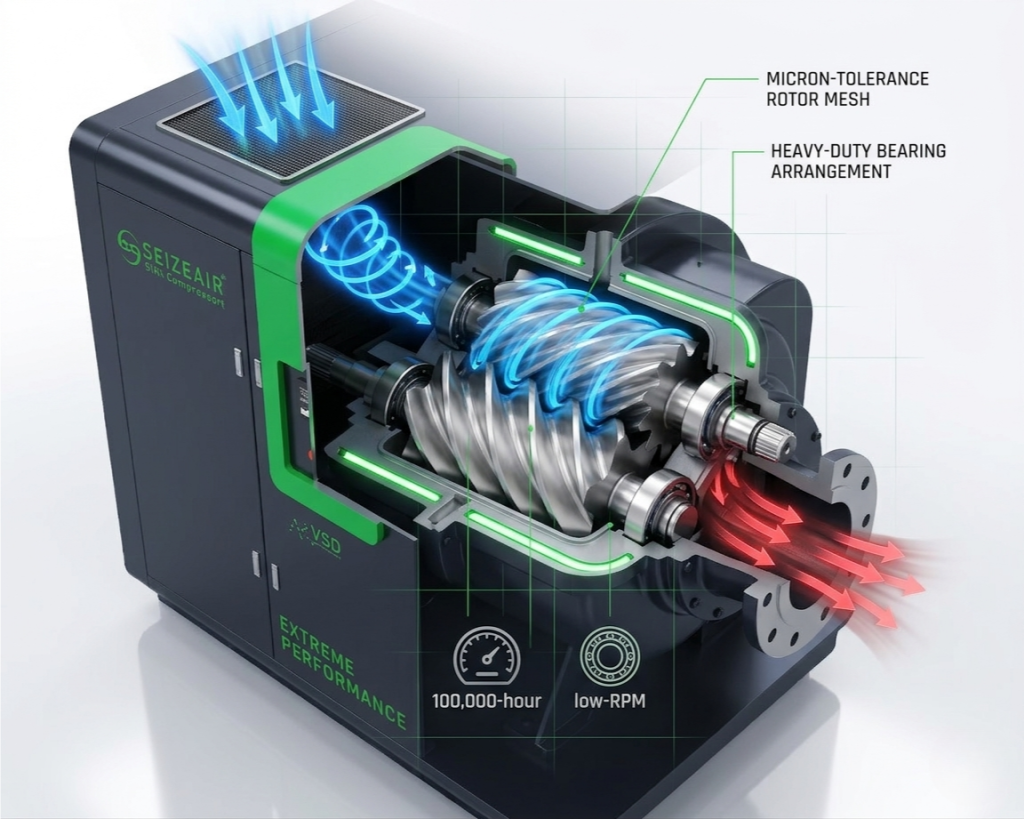
A rotary screw unit utilizes two intermeshing helical rotors (male and female). As these rotors turn, the “mesh” moves along the length of the screw, gradually reducing the volume of the trapped air and building pressure continuously. This is why industrial rotary screw systems are the preferred choice for continuous industrial applications.
Laminar Flow: Unlike pistons that “punch” the air, the rotors in a helical screw system “squeeze” it, resulting in a smooth, continuous flow that doesn’t cause fatigue in downstream piping or tools.
Internal Clearances: Modern CNC grinding technology allows for clearances measured in microns within the compression chamber. This minimizes “blow-by” (air escaping back to the intake), which is the primary cause of efficiency loss in older machines.
The “Duty Cycle” Reality Check
Piston: Typically rated for 20-30% duty cycle. If run for 60 minutes, it will likely overheat and carbonize the lubricant, leading to failure.
Screw: Engineered for 100% duty cycle. These packages are thermally stable and are designed to run 24/7 without interruption. In fact, running a rotary screw package for short periods is actually harmful, as it prevents the oil from reaching the 80°C-90°C required to evaporate internal condensate, which can lead to sludge buildup over time.
How Does a Screw Air compressor Achieve Maximum Energy Efficiency?
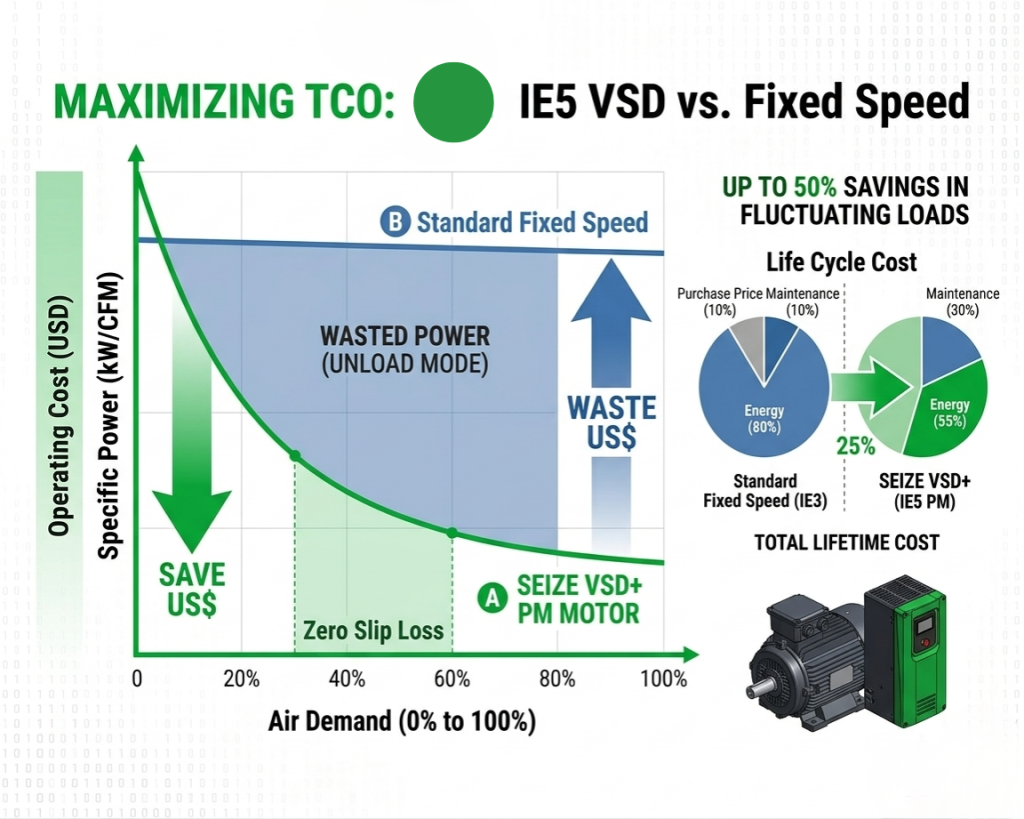
In 2026, the “cheapest” compressor is often the most expensive mistake a facility manager can make. Electricity accounts for 75-80% of the total lifetime cost of a rotary screw system, making efficiency the primary purchasing criterion.
The “Unload” Energy Sink
A fixed-speed rotary screw machine runs at a constant RPM. When your air tank is full, it goes into “Unload” mode. The motor still spins at 100% speed, consuming about 30% of its full-load power while producing zero compressed air. This is like leaving your car engine red-lining at a red light—it burns fuel and money without moving you forward.
VSD (Variable Speed Drive) & Permanent Magnet (PM) Motors
VSD technology acts like a dimmer switch for your motor, perfectly matching output to demand. Modern pioneers in the industrial compressed air industry have moved to IE5 PM motors to eliminate parasitic losses.
Zero Slip Loss: Unlike induction motors, PM motors used in a high-efficiency rotary screw package have no rotor copper loss, converting almost all input energy into compressed air.
Wide Range Efficiency: A standard VSD might lose efficiency at 20% speed, but an IE5 PM motor in a quality rotary screw system stays ultra-efficient across the entire speed range, saving thousands in annual energy costs.
Soft Start: It eliminates the 600% current spikes at startup, reducing wear on your factory’s electrical infrastructure and lowering peak-demand utility charges, making your investment pay for itself faster.
What Size Screw Air compressor Does My Factory Really Need?
Most factories suffer from “Oversizing Syndrome,” buying a massive rotary screw unit when a smaller VSD package would actually be more efficient. Selecting the correct size is a technical exercise, not a guess.
The 5-Step Sizing Audit
Baseline CFM: Sum the requirements of all tools. (e.g., CNC: 25 CFM, Painting: 15 CFM). This gives you the gross demand your compressed air system must meet.
The “Simultaneity” Factor: If only 70% of machines run at once, multiply your total by 0.7. Oversizing a rotary screw package leads to short-cycling and inefficiency.
Pressure Drop Calculation: If you need 7 bar at the tool but have 100 meters of small-diameter piping, you might need to produce 8.5 bar at the source. Warning: Every 1 bar increase in pressure adds ~7% to your energy bill.
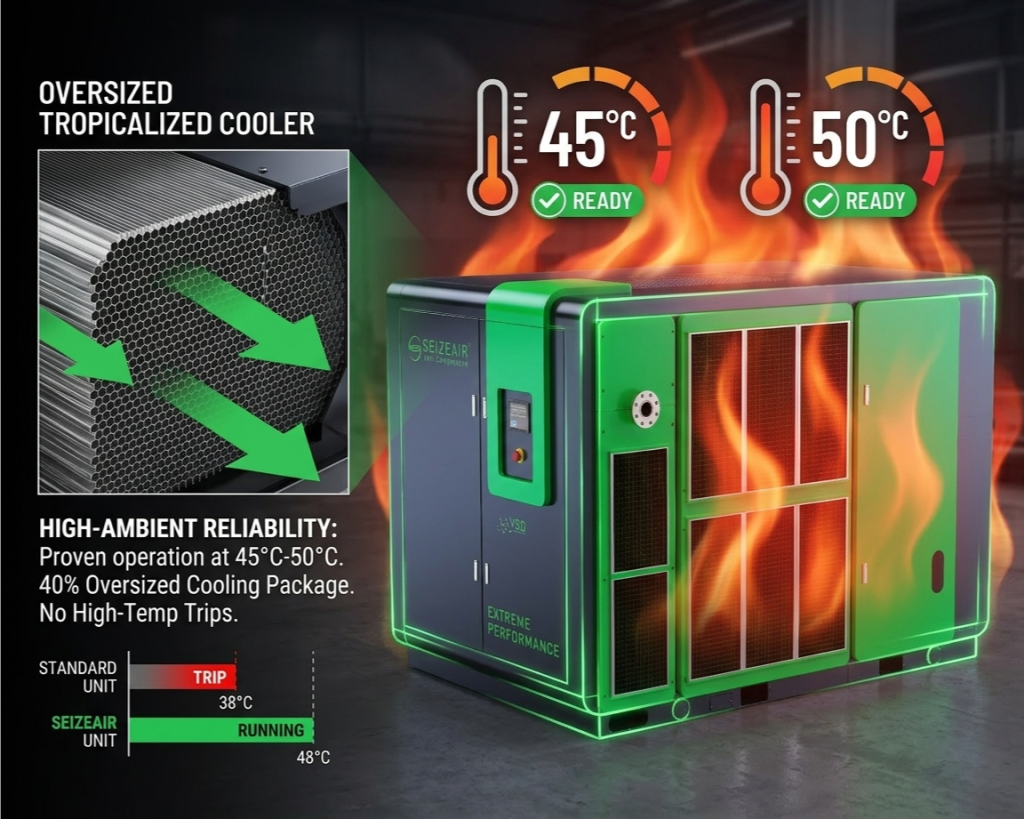
Environmental Variables: High altitude or high heat (45°C+) requires de-rating the machine’s output. A robust industrial rotary screw system from manufacturers like Seize Compressor is known for “Tropicalized” designs with oversized coolers that prevent the dreaded “High-Temp Trip” in summer.
Leakage Buffer: Allow for 10% leakage, but prioritize a “Leak Audit” before buying a larger unit. Fixing leaks is cheaper than buying a bigger machine.
What Makes a Screw Air compressor Reliable Under the Hood?
What distinguishes a $5,000 machine from a $15,000 reliable workhorse? It’s the metallurgy and engineering under the hood. When you invest in a premium rotary screw system, you are paying for durability.
The Airend (The Heart)
Look for Large Diameter, Low Speed airends. Small airends spinning at 6,000 RPM inside a cheap rotary screw package create massive friction and heat. A high-quality airend should rotate between 1,500 and 3,000 RPM. This slower speed doubles the lifespan of the bearings and reduces noise, ensuring your equipment runs quietly for decades.
The Separation System (The Lungs)
A reliable industrial rotary screw system must have a high-efficiency oil separator to ensure air quality.
Centrifugal Separation: Heavy oil drops are spun out immediately.
Gravity Separation: Air slows down in the tank, allowing oil to settle.
Coalescing Filter: Microscopic mist is captured before the air exits the system.
High-end units from brands like Seize achieve <2ppm oil carryover, ensuring your air is nearly “technically oil-free” before it even hits your downstream filters, protecting your end products from contamination.
Cooling System
In 2026, independent cooling is the standard for any industrial compressed air package. Look for centrifugal fans (which are quieter and more powerful than axial fans) and oversized aluminum radiators. Proper cooling prevents oil varnish—the #1 cause of mechanical failure in a hard-working rotary screw system.
How Often Should You Maintain a Screw Air compressor?
In a 24/7 production environment, downtime cost per hour often exceeds the price of the compressor itself. Modern maintenance is about data, not guesswork.
| Component | Function | Service Interval | 2026 Best Practice |
|---|---|---|---|
| Air Filter | Blocks micro-dust | 2,000 Hours | Use 2-stage filtration in dusty zones to protect your equipment. |
| Oil Filter | Removes metal shavings | 2,000 Hours | Monitor pressure differential on the controller to avoid bypass. |
| Oil Separator | Reclaims lubricant | 4,000 Hours | Replace immediately if pressure drop > 0.8 bar to maintain efficiency. |
| Lubricant (Oil) | Seals & Cools | 4,000 Hours | Use specialized synthetic oil to prevent varnish inside the system. |
| PM Motor | Power source | 30,000 Hours | Check bearing lubrication and cooling vents for optimal performance. |
What Components Complete a Screw Air compressor System?
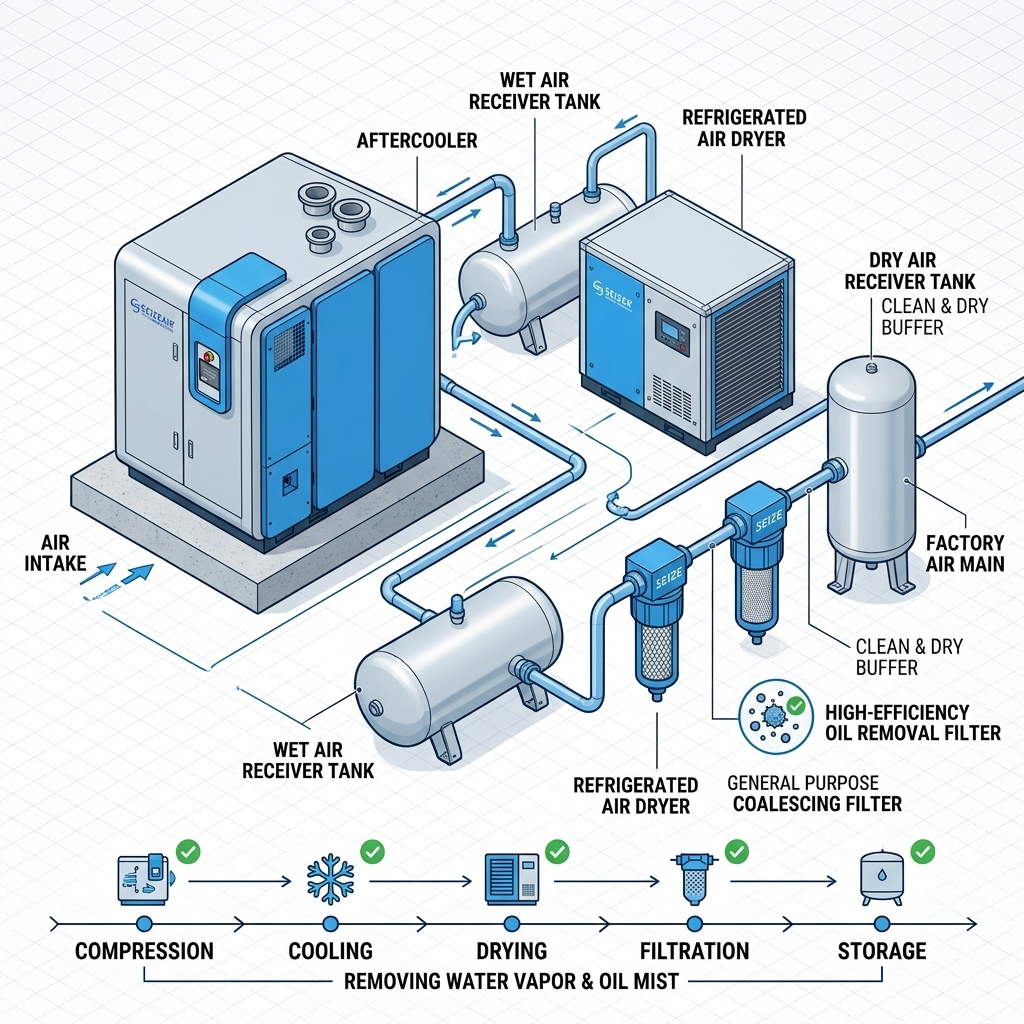
A reliable rotary screw package is only as good as the system built around it. A pillar-grade setup for your new compressed air station includes:
Wet Tank: Placed before the dryer to drop initial moisture and dampen pulsations from the rotary screw unit.
Refrigerated Dryer: Lowers the dew point to 3°C to prevent liquid water in your lines, protecting tools fed by your system.
Precision Filters: One “General Purpose” and one “High Efficiency” filter to remove oil and dust down to 0.01 micron, ensuring the output is pristine.
Dry Tank: Placed after the dryer to provide a “clean air” buffer for sudden demand spikes, preventing the rotary screw unit from short-cycling.
Many manufacturers like Seize offer “Integrated Smart Stations” where all these components are pre-piped on a single skid with the compressor, reducing installation errors and footprint by 40%.
Why Is Serviceability Critical for a Screw Air compressor?
The market is shifting away from legacy “Locked” brands toward serviceable, open-architecture designs. Your compressed air equipment should be easy to fix, not a locked-down appliance.
Proprietary Parts: Some brands use unique threads or software “dongles” that force you to buy their $500 filters for your system.
Open Architecture: Reliable brands like Seize Compressor use high-quality, standardized components for their rotary screw range. This means if you need a sensor or a filter in an emergency, you aren’t stuck waiting 4 weeks for a “brand name” ship-out. Your equipment gets back online today.
IoT Integration: By 2026, your compressor should email you. If the discharge temperature rises by 5 degrees over the monthly average, the system should flag it as a “clogged cooler” warning before the machine shuts down, preventing catastrophic failure of your rotary screw package.
How to Choose a Screw Air compressor for Long-Term Value?
Investing in a reliable industrial rotary screw system is a 10-15 year commitment that impacts your operational budget significantly.
The 10-Year Math: Don’t look at the $10k vs $12k purchase price of the equipment. Look at the $50k vs $80k electricity bill. IE5 VSD units pay for the price difference in less than 12 months compared to a base-model rotary screw package.
Ambient Proofing: If your factory isn’t climate-controlled, ensure the system is rated for 45°C+ operation to prevent summer shutdowns.
Support Network: Choose a manufacturer like Seize that provides transparent technical data and field-engineer support for their rotary screw product line, ensuring you have a partner, not just a vendor.
Conclusion
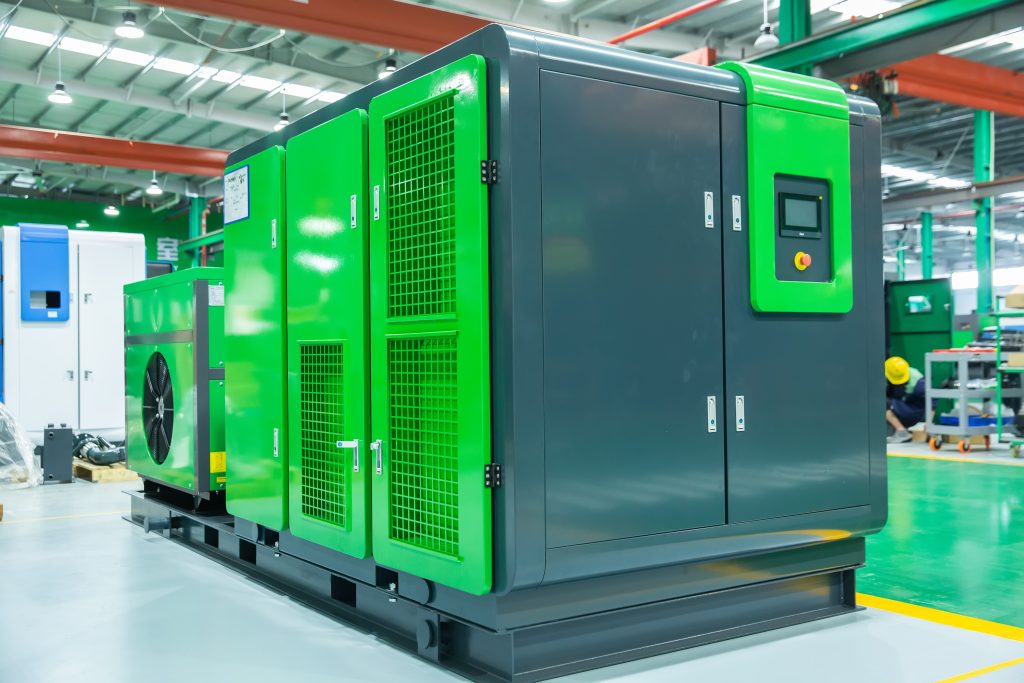
In 2026, real reliability is defined by IE5 permanent magnet motors, oversized cooling for 45°C+ environments, and low-RPM airend designs. Brands like Seize have earned their reputation by engineering for these exact industrial pressures, ensuring that your utility bills stay low and your production lines stay pressurized. Don’t just buy a machine; buy the peace of mind that comes with a system built to be forgotten.