

Industrial air systems are notorious power hogs. In a typical manufacturing facility, compressed air accounts for up to 10% to 30% of total electricity consumption. Shockingly, nearly 30% of that energy is wasted through leaks, poor maintenance, and inefficient system design. If you are looking for practical ways to achieve air compressor energy savings, lower your utility bills, and reduce your carbon footprint, this comprehensive, engineer-backed guide will walk you through every optimization strategy from the supply side to the demand side.
1. What Is the True Cost of Operating an Industrial Air Compressor?
To understand why saving energy on compressed air is so critical, we have to look at the physics of air compression. Air compressors generate a massive amount of heat; in fact, only about 10% to 15% of the electrical energy input is converted into usable compressed air energy. The rest is lost as thermal waste. This makes compressed air one of the most expensive utilities in your plant.
The Life-Cycle Cost Breakdown
Over a standard 10-year lifespan of an industrial air compressor, the initial purchase price and maintenance costs are a mere drop in the bucket. Compressed air power consumption typically represents over 70% to 80% of the total cost of ownership (TCO).
By actively implementing industrial compressed air energy efficiency measures, a medium-to-large production facility can easily save tens of thousands of dollars annually while relieving unnecessary stress on mechanical components.
2. How Do I Calculate Air Compressor Energy Savings and Baseline Waste?
You cannot manage what you do not measure. Before upgrading your hardware, you need to establish a baseline. Calculating your system’s current efficiency helps identify low-hanging fruit and justify the return on investment (ROI) of new equipment to management.
Key Metrics to Track
- Specific Power: The amount of electrical power required to produce a specific volume of air at a given pressure. It is usually expressed in kW/100 cfm (kilowatts per 100 cubic feet per minute) or kW/(m3/min). Lower specific power equals higher efficiency.
- Free Air Delivery (FAD): The actual quantity of air compressed and delivered to the discharge pipe, corrected back to the conditions of the free air at the inlet.
The Basic Energy Cost Formula
To run a reliable compressor efficiency calculation, use the following plain-text formula to find your annual baseline running cost:
Annual Cost = (Compressor Motor kW) * (Annual Running Hours) * (Electricity Rate per kWh) * (Load Factor) / (Motor Efficiency)
For instance, if you operate a 75 kW compressor for 4,000 hours a year at a power rate of $0.12 per kWh, assuming a 90% load factor and 93% motor efficiency:
Annual Cost = 75 * 4000 * 0.12 * 0.90 / 0.93 = $34,838 per year.
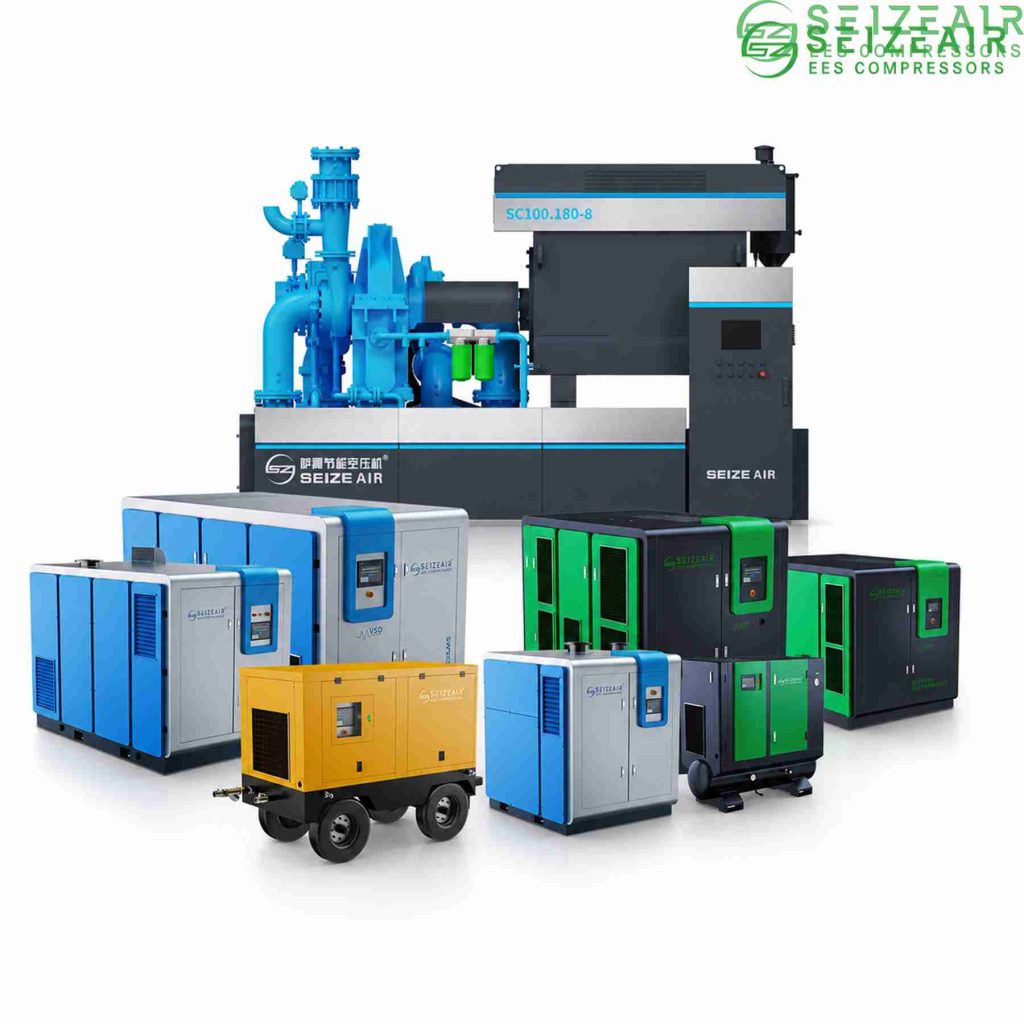
If your system operates with high artificial demand or massive air leaks, a significant portion of this budget is literally vanishing into thin air. Modern manufacturers like Seize Air design systems with highly optimized specific power ratings, allowing plants to cut these baseline costs right out of the gate.
3. How Much Energy Does a VSD Air Compressor Save Compared to Fixed Speed?
One of the single most effective ways to achieve air compressor energy savings is replacing traditional fixed-speed units with Variable Speed Drive (VSD) air compressors, particularly those utilizing Permanent Magnet (PM VSD) motors.
Fixed Speed vs. VSD
- Fixed Speed Compressors: Run at a constant speed regardless of the actual air demand in the factory. When demand drops, the compressor goes into an “unloaded” state. While unloaded, the motor still spins—often consuming 30% to 40% of its full-load power while producing zero compressed air.
- VSD Compressors: Automatically adjust the motor’s rotational speed to precisely match real-time air consumption. If your production line slows down, the compressor slows down, consuming proportionally less electricity.
Efficiency Comparison: Fixed Speed vs. VSD
The table below illustrates how different operational loads impact energy waste across both technologies, highlighting the impact of reducing energy consumption of air compressors:
| Factory Air Demand (% of Capacity) | Fixed Speed Power Consumption (%) | VSD / PM VSD Power Consumption (%) | Potential Energy Savings (%) |
| 100% (Full Load) | 100% | 102% (Minor inverter loss) | -2% |
| 80% (Heavy Load) | 94% (Due to modulation/unload cycles) | 81% | 13% |
| 50% (Fluctuating) | 82% | 52% | 30% |
| 30% (Low Load) | 72% | 33% | 39% |
If your facility experiences fluctuating air demand—such as multi-shift operations, varying tool usage, or seasonal production changes—implementing a variable speed drive compressor energy calculation setup can cut overall energy consumption by up to 35% to 50%.
4. How Do I Stop Air Compressor Leaks in My Factory?
If you ask any plant engineer, “Where is the immediate opportunity for saving energy in compressed air systems?” the answer is always the same: fixing air leaks.
In a factory with no active leak management program, it is common for 20% to 30% of the total compressed air capacity to be lost to leaks. This forces your compressor to run longer, cycle more frequently, and consume excessive power.
Common Leak Hotspots
- Degraded quick-disconnect fittings and couplings
- Worn-out seals on filters, regulators, and lubricators (FRLs)
- Faulty or stuck open condensate drain valves
- Rusted or poorly threaded pipe joints
- Cracked flexible hoses leading to pneumatic tools
Steps to Implement an Effective Leak Detection Program
- Acoustic Ultrasonic Detection: While large leaks can be heard during a quiet weekend shift, small micro-leaks are impossible to detect over ambient factory noise. Utilize an ultrasonic leak detector to pinpoint high-frequency hissing sounds without shutting down production.
- Tag and Log: Every discovered leak should be tagged with a physical label and logged into a master spreadsheet detailing location, severity, and the specific part needed for repair.
- Fix and Retest: Prioritize high-volume leaks near the headers first, then move downstream to individual workstations. Once repaired, re-verify with the ultrasonic tool.
- Upgrade Drains: Replace manual, cracked-open valves or unreliable timer-controlled drains with zero-loss electronic demand drains. Zero-loss drains only open when water accumulates, ensuring zero compressed air escapes during the cycle.
5. What Is the Correct Operating Pressure for Maximum Compressor Efficiency?
A widespread misconception among machine operators is that higher pressure is always better. In reality, running your system at an unnecessarily high pressure is a fast track to inflated energy bills.
The 1-Bar Rule of Thumb
As a rule of thumb for optimizing compressed air system pressure drop:
Reducing the discharge pressure by 1 bar (approx. 14.5 psi) yields roughly a 6% to 7% savings in input electrical energy.
Furthermore, higher systemic pressure causes “artificial demand.” This means that every un-repaired leak and open blow-off nozzle will vent air much faster at 8 bar than it would at 7 bar, compounding your energy losses.
Actionable Pressure Control Strategies
- Determine True Endpoint Requirements: Identify the tool or machine on your floor that requires the highest operating pressure. If most of your plant operates perfectly at 6.0 bar, but one machine requires 7.5 bar, do not raise the pressure of the entire central system. Instead, install a localized pressure booster for that specific machine and lower the main system pressure.
- Minimize Systemic Friction: Pressure drop is the loss of air pressure caused by friction as the air travels from the compressor discharge through the piping, filters, and dryers to the final point of use. If your header outputs 8.0 bar but the tool only receives 6.0 bar, you are losing 2.0 bar to friction.
- Clean and Replace Filters Regularly: Clogged inline air filters create a massive pressure drop. When a filter element is blocked, the compressor must work harder and consume more power to push air through. Monitor differential pressure gauges across your filtration system and replace elements routinely to maintain efficient compressed air distribution.
6. How Does Piping Design and Storage Tank Sizing Affect Energy Waste?
The physical layout of your air distribution network plays a huge role in achieving air compressor energy savings. Poor piping choices choke air flow, starve downstream equipment, and create artificial loads on the supply side.
Piping Layout: Choose Loops Over Dead Ends
Avoid straight-line “dead-end” piping layouts wherever possible. Instead, implement a closed-loop ring main system. A ring main allows compressed air to flow in multiple directions toward a point of high demand, effectively cutting air velocity and halving the pressure drop across the network.
Material Selection Matters
Say goodbye to traditional black iron or carbon steel pipes if you are building or expanding a system. Steel pipes scale, rust internally, and feature rough inner walls that cause severe friction losses. Switch to aluminum compressed air piping. Aluminum is lightweight, completely corrosion-resistant, and features a smooth internal surface that minimizes friction and maintains clean air quality.
Sizing Your Air Receivers (Storage Tanks)
An undersized air receiver tank forces the compressor to rapidly cycle on and off, leading to heat buildup and high energy draw. A properly sized receiver tank acts as a buffer for sudden spikes in air demand.
Ideally, you should allocate roughly 3 to 5 gallons of storage capacity for every 1 cfm of compressor output capacity (or about 30 to 50 liters per kW). Ample storage lets you handle short-term surges without firing up an auxiliary backup compressor, protecting your energy profile.
7. Can You Recover and Reuse Waste Heat from an Air Compressor?
As mentioned earlier, around 85% to 90% of the electrical energy drawn by an air compressor turns into thermal energy (heat). In a standard setup, this heat is blown away via cooling fans or liquid cooling towers into the atmosphere.
By integrating an air compressor heat recovery system, you can capture this thermal byproduct and repurpose it for other plant operations.
How Reclaimed Heat Can Be Used
- Preheating Boiler Feedwater: If your facility utilizes steam boilers, preheating the incoming water with compressor waste heat dramatically cuts your gas or oil consumption.
- Space Heating: Directing hot exhaust air through ductwork into production bays or warehouses during cold winter months reduces facility heating costs to nearly zero.
- Sanitary Hot Water: Heating water for industrial showers, kitchens, or cleaning stations.
Many advanced, high-efficiency systems, such as the industrial packages engineered by Seize Air, offer integrated heat exchanger options that make it remarkably straightforward to harness this thermal energy, turning a waste product into an active cost-saving mechanism.
8. What Maintenance Steps Ensure Long-Term Compressed Air Efficiency?
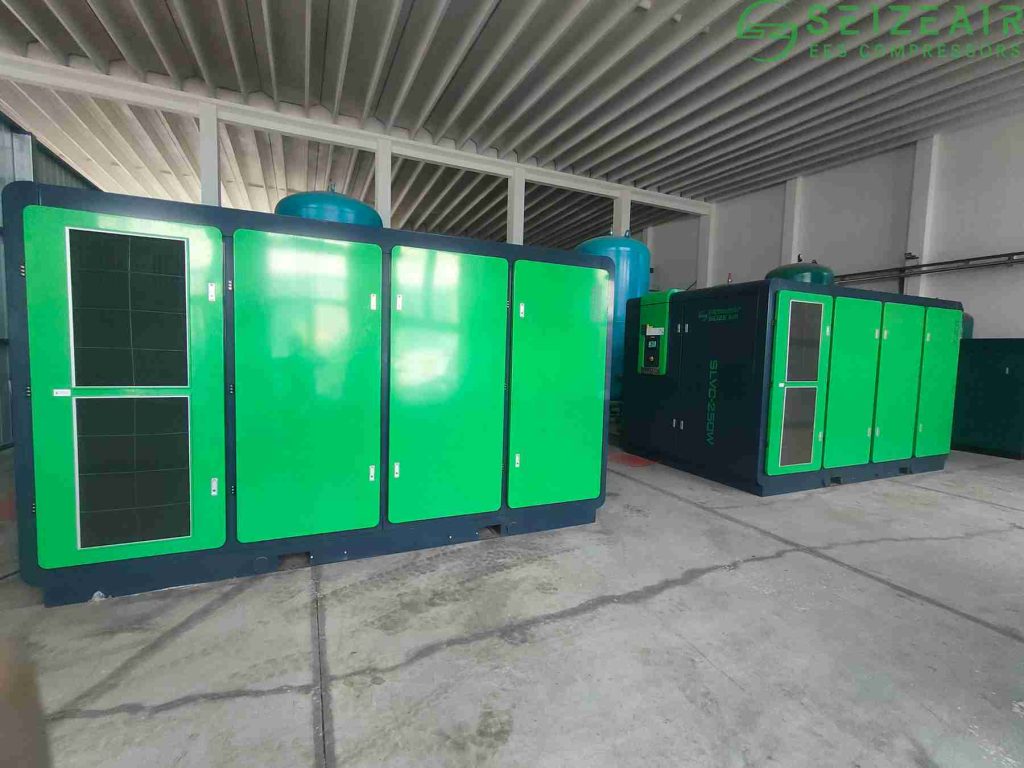
When a factory runs multiple air compressors to meet varying demand, leaving them to run on their own internal pressure switches leads to system conflict. Compressors will fight each other, with multiple units running in inefficient part-load or unloaded states simultaneously.
The Role of Master Controllers
Implementing a centralized master controller or sequencing software links all units into a single intelligent network. The controller monitors system pressure drops and calculates exact total volume requirements, ensuring only the most efficient combination of base-load and trim-load (VSD) compressors are running at any given moment.
Comprehensive Energy-Saving Maintenance Checklist
To help your team maintain top-tier efficiency month after month, implement this structured compressed air maintenance checklist:
| Frequency | Maintenance Task | Target Energy Benefit |
| Weekly | Check and drain manual/automatic condensate traps. | Prevents water slugging and downstream corrosion/pressure drop. |
| Monthly | Inspect air intake filters and clean/replace if dirty. | Reduces intake restriction, keeping specific power low. |
| Monthly | Conduct a walk-through ultrasonic leak audit. | Stops air wastage before it impacts utility bills. |
| Quarterly | Check differential pressure across inline oil separators. | Minimizes internal pressure drops within the compressor package. |
| Bi-Annually | Check belt tension or direct-drive couplings. | Ensures optimal mechanical power transfer from motor to air end. |
| Annually | Calibrate pressure sensors and temperature probes. | Prevents the system from over-pressurizing due to inaccurate readings. |
Implementing these routine checkpoints as part of your screw compressor energy saving tips ensures that your system doesn’t slowly degrade into an energy sink over time.
Summary
Achieving lasting air compressor energy savings isn’t about a single magic fix; it is about taking a holistic look at your entire generation and distribution system. By lowering systemic line pressure, sealing air leaks with a structured detection program, configuring smart storage, and moving toward advanced VSD technology, you protect your bottom line and improve equipment longevity.
Partnering with forward-thinking manufacturers like Seize Air allows factories worldwide to seamlessly adopt advanced, energy-efficient PM VSD machinery that complies with strict global energy standards while drastically cutting operating overhead.
Optimize Your Plant’s Energy Performance Today
Ready to cut down your monthly electricity bills and identify hidden inefficiencies in your compressed air setup? Our engineering team is here to help. Contact us today to request an in-depth system audit, obtain expert advice on choosing the perfect VSD configuration for your specific manufacturing demands, or learn more about our high-efficiency industrial compressor lines. Let’s work together to build a smarter, more sustainable production floor.