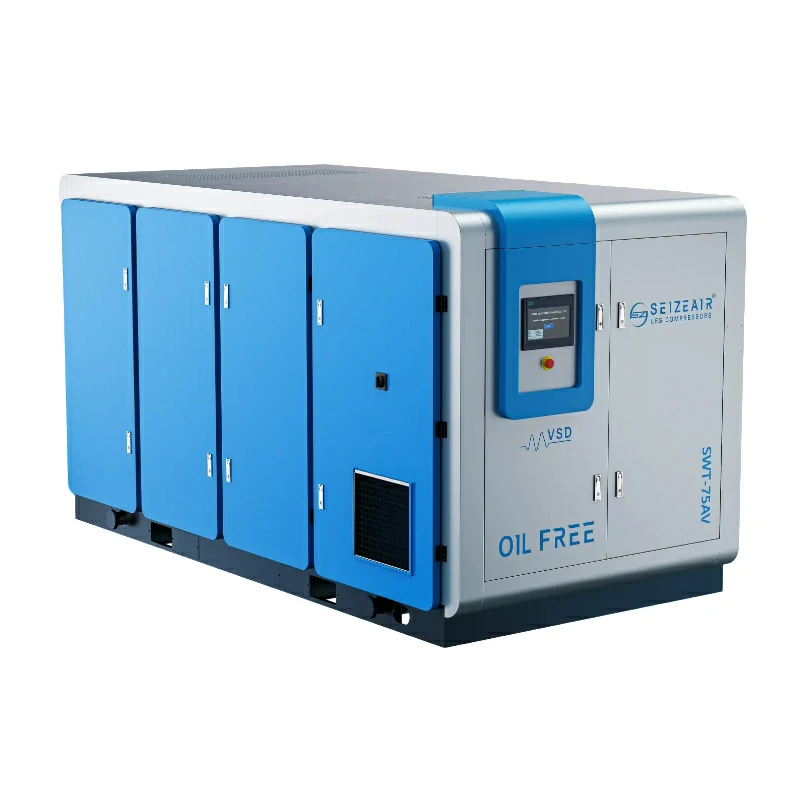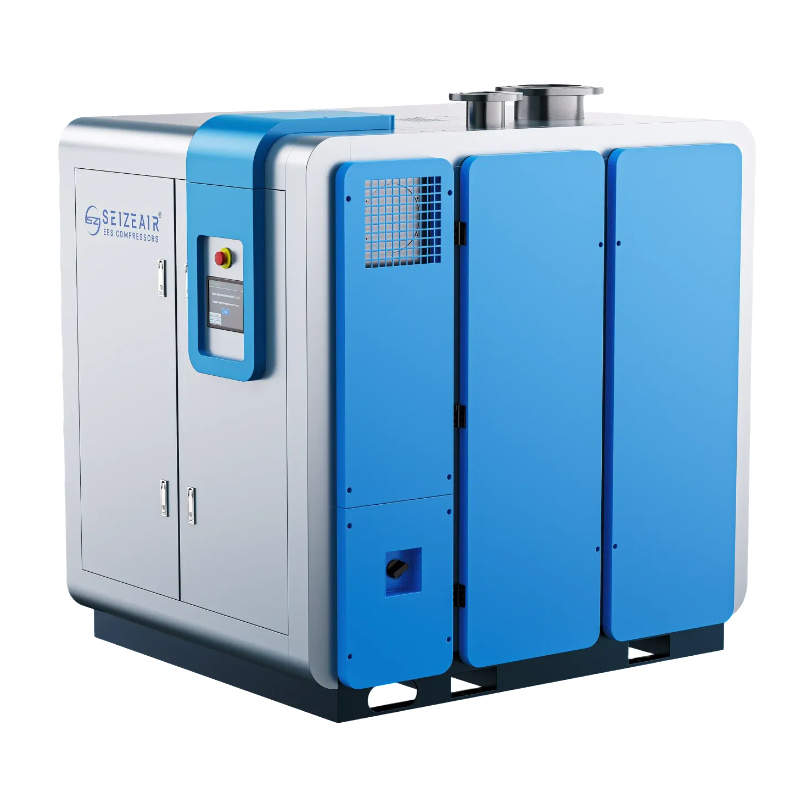


A centrifugal air compressor is the right answer when your plant needs a continuous, oil-free supply of compressed air at flow rates of several thousand cubic feet per minute and above. Below we break down how these machines work, where they outclass screw and reciprocating units, and the real numbers behind their efficiency, surge behaviour and running cost.
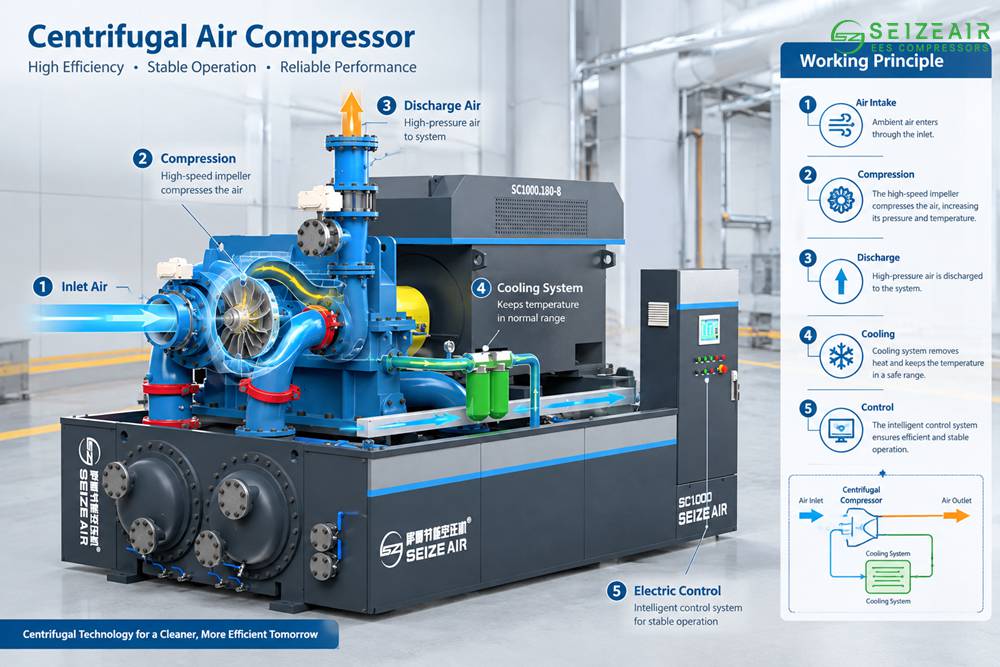
How does a centrifugal air compressor actually work?
The short version: a centrifugal air compressor does not squeeze air between rotating and stationary screws, and it does not push a piston back and forth. Instead, it flings air outward from a spinning impeller. The impeller is a precision-machined wheel with curved blades, and it can spin anywhere from roughly 20,000 rpm in a large process machine up to 60,000 rpm or more in a smaller high-speed package. As air leaves the tip of those blades it is moving extremely fast, so it carries a lot of kinetic energy.
That kinetic energy is the whole trick. Right after the impeller, the air enters a stationary diffuser – a set of diverging passages that slow the air down on purpose. When you slow a gas in a carefully shaped passage, its velocity turns back into pressure. The pressurised air is then collected in a volute (a snail-shaped casing) and sent to the discharge. One impeller plus one diffuser is called a stage, and a single stage typically raises pressure by a factor of two to four.
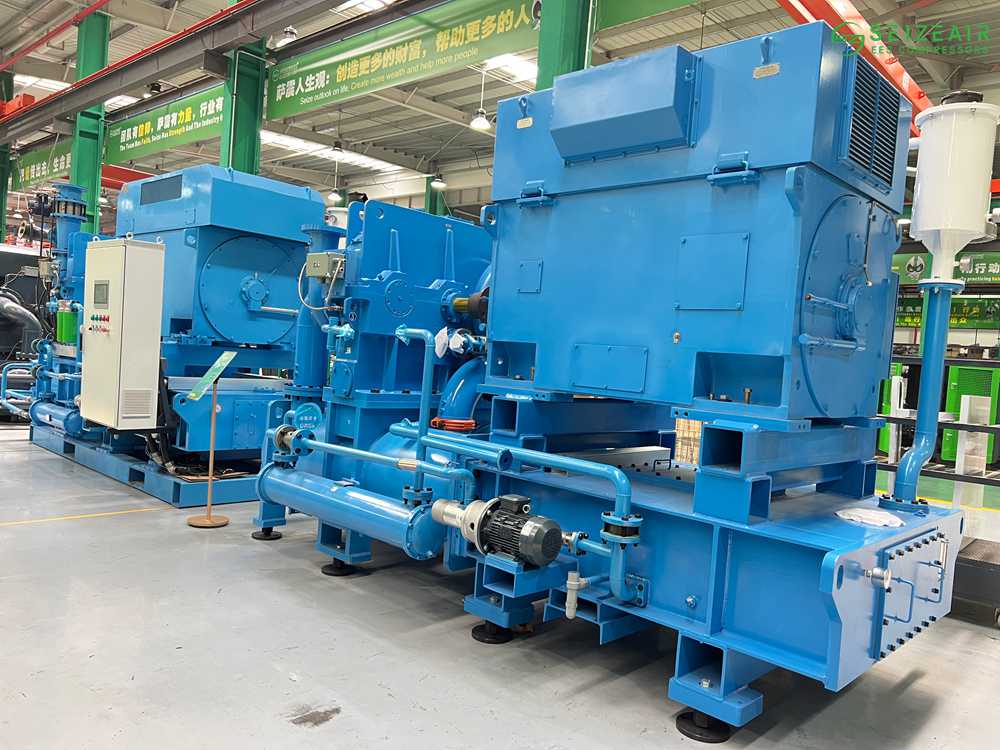
For higher pressures you simply stack stages in series. After each stage the air is usually cooled in an intercooler before the next impeller speeds it up again, because cooler air is denser and cheaper to compress. This is why a process centrifugal unit often looks like a row of matched stages bolted to one gearbox.
The flow path can be shown in plain text as a simple stage:
inlet air
    |
    v
[ impeller ]  -- spins at 20,000 to 60,000 rpm
    |
    v  kinetic energy rises
[ diffuser ]  -- velocity is converted back to pressure
    |
    v
[ volute ]    -- collects and discharges at higher pressure
And a multi-stage machine just repeats the acceleration and cooling steps:
Stage 1     Stage 2     Stage 3
1.0 bar --> 2.5 bar --> 6.0 bar --> 12 bar
(each stage re-accelerates the air, then an intercooler drops the heat)
Because there is no metal-to-metal contact inside the compression path, a properly designed oil free centrifugal air compressor can deliver Class 0 oil-free air without any oil in the air end at all. That single fact drives most of its popularity in sensitive industries.
What is the difference between a centrifugal and a reciprocating air compressor?
This is one of the most searched comparisons for a reason: reciprocating (piston) compressors are what most small shops know, while centrifugals live in the utility room of a refinery. They could hardly be more different in how they scale.
A reciprocating compressor traps a pocket of air and squeezes it with a piston. It is brilliant at high pressure and low flow – think instrument air at 30 bar from a small package. But every piston has valves, rings and a connecting rod that wear, and the motion is inherently pulsating. Push the flow up and you need more cylinders, more frames and more maintenance. A centrifugal compressor does the opposite: it is happiest at low-to-medium pressure and very high flow, with almost no reciprocating parts to wear out.
| Aspect | Centrifugal air compressor | Reciprocating (piston) compressor |
|---|---|---|
| Typical flow range | 1,000 to 50,000+ cfm (hundreds of m3/min) | 10 to 1,500 cfm |
| Typical discharge pressure | 2 to 15 bar, sometimes higher in staged designs | up to 30 bar and beyond, even 200+ bar in special units |
| Internal moving parts | impeller on a shaft, bearings only | piston, rod, crankshaft, valves, rings |
| Oil-free capability | inherent in the air path with dry seals or mag bearings | needs special arrangements; oil carry-over is a constant battle |
| Pulsation | smooth, steady discharge | pulsating, needs dampeners |
| Best fit | steady plant air, utilities, process gas | high-pressure, intermittent, low-flow duty |
If you want the deeper technical contrast, our write-up on centrifugal and reciprocating compressors walks through the selection math for real plants.
Centrifugal air compressor vs screw compressor: which handles high flow better?
The closer fight is against the rotary screw air compressor, because modern screw machines have crept up the flow scale with two-stage airends and big motor frames. A single large screw package can now push past 100 m3/min. So where is the line?
Screws win on flexibility. They ride part load gracefully with variable speed drives, they start and stop without drama, and they suit plants whose demand swings hour to hour. Centrifugals hate swing – they are built to run flat out, around the clock, at a fixed duty point where their efficiency is spectacular. The moment your average demand clears roughly 2,000 to 3,000 cfm (about 55 to 85 m3/min) and stays there, the centrifugal starts to pull ahead on specific power and on lifecycle cost.
| Factor | Centrifugal | Rotary screw |
|---|---|---|
| Specific power at full load (high flow) | best in class, often 5 to 6% lower kWh per m3 | very good, but edges behind at the top end |
| Part-load behaviour | poor unless using IGV + load sharing | excellent with VSD |
| Footprint per cfm | compact for the output | larger as you scale up |
| Maintenance rhythm | long intervals, few wearing parts | airend and separator changes, more frequent |
| Capital cost curve | high fixed cost, falls per cfm at scale | lower entry, rises per cfm at scale |
For a side-by-side buyer view, see our guide on centrifugal air compressor vs a screw compressor.
At what flow rate does a centrifugal compressor become the economical choice?
There is no single magic number, but there is a well-understood cross-over. Below about 1,000 cfm, a centrifugal is almost never the cheapest option – you are paying for a precision gearbox and high-speed seals to do a job a screw or piston unit does for a fraction of the capital. Between 1,000 and 2,500 cfm the decision is mixed and depends on whether your load is steady. Above roughly 2,500 to 3,000 cfm of continuous demand, the centrifugal’s efficiency and low maintenance usually win, and by the time you are specifying 5,000 cfm or more it is often the only sensible architecture.
The reason is simple economics on the energy bill. Compressed air is roughly 70 to 90 percent of its lifecycle cost in electricity, not the machine. A half-percent gain in isentropic efficiency on a 2 MW machine saves a surprising amount of money over ten years. Centrifugals sit at the top of the efficiency table precisely in the band where that saving is largest.
A useful rule of thumb many specifiers use: size the centrifugal for the average load, not the peak, and let a smaller trim machine (often a screw) cover the peaks. That hybrid is common in large plants and is far cheaper than oversizing a single centrifugal.
Are centrifugal air compressors oil-free?
In a word, yes – and this is where they shine. Because the only thing touching the air is a clean impeller and a diffuser, there is no lubricating oil in the compression chamber. The shaft seals keep bearing oil away from the air path. Older machines used labyrinth or carbon-ring seals that could leak a little; today’s best designs either use dry gas seals or, at the premium end, magnetic bearings that remove the oil-lubricated bearing from the high-speed shaft entirely.
That is why a magnetic levitation centrifugal compressor is such a step change: with the rotor floating on a magnetic field there is no contact, no oil and essentially no mechanical wear in the core. For food, pharma and electronics plants that must certify Class 0 oil-free air, this removes a whole category of contamination risk.
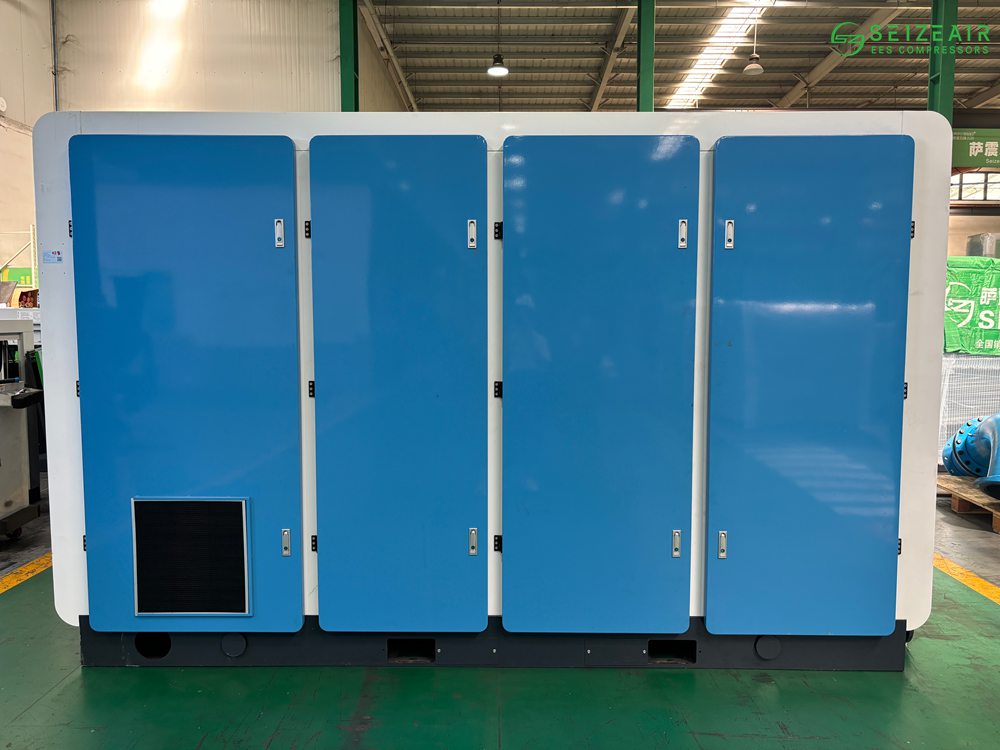
If your duty is sensitive, our oil-free screw air compressor range covers lower-flow oil-free needs, while the centrifugal handles the plant-wide volumes.
What causes surge in a centrifugal compressor and how is it controlled?
Surge is the one failure mode unique to dynamic compressors, and every plant engineer should understand it before commissioning a centrifugal. A centrifugal has a minimum stable flow. If demand drops below that flow while the machine keeps spinning, the pressure downstream can push air backwards through the impeller. The machine “breathes” – flow forward, then backwards – with a deep thumping sound and a violent torque swing. A few seconds of uncorrected surge can destroy an impeller.
Two things set the limits. The surge line is the low-flow boundary at a given speed. The stonewall (or choke) point is the high-flow boundary where the impeller passages go sonic and flow stops rising. Safe operation is the window between them.
Control systems keep you out of trouble in three ways:
- Inlet guide vanes (IGV). Swirl the incoming air to throttle capacity efficiently without slowing the motor, so the machine tracks demand while staying right of the surge line.
- Anti-surge recycle valve. When flow approaches the limit, a fast valve opens and dumps discharge air back to the inlet, lifting the flow above surge until demand recovers.
- Load sharing across trains. In a multi-unit house, the control trims machines individually so each rides its efficient band and none is forced into surge.
How efficient is a centrifugal air compressor?
Efficiency is the centrifugal’s headline strength. Polytropic efficiency of a well-built machine typically lands between 75 and 82 percent, and isentropic efficiency between 70 and 80 percent depending on stages and pressure ratio. The specific power – the metric that actually shows up on your bill – is among the lowest of any compressor type at high flow.
You can estimate the shaft power with the polytropic relation written in plain text:
Power(kW) = m_dot * R * T1 / (eta_poly * (k-1)/k) * [ (p2/p1)^((k-1)/k) – 1 ] / 1000
where m_dot is mass flow in kg/s, R is 287 J/(kg*K) for air, T1 is inlet temperature in K, k is 1.4 for air, p2/p1 is the pressure ratio and eta_poly is polytropic efficiency. Cooling between stages raises the effective efficiency, which is why intercooled multi-stage designs beat a single big ratio.
A practical way to read the numbers: at a 7 bar gauge discharge and 20 C inlet, a good centrifugal needs roughly 5.5 to 6.0 kW per m3/min of delivered air, while an older or poorly matched unit can drift above 7. Over a 2 MW installation running 8,000 hours a year, closing a one kW per m3/min gap is a six-figure electricity saving.
| Flow tier (cfm) | Typical pressure | Polytropic efficiency | Relative specific power |
|---|---|---|---|
| 1,500 – 3,000 | 7 – 10 bar | 74 – 78% | baseline |
| 3,000 – 8,000 | 7 – 12 bar | 77 – 81% | about 4 to 7% better |
| 8,000+ | up to 15 bar | 79 – 82% | best in class |
What does it cost to operate a centrifugal air compressor?
Two numbers matter: capital and energy. The capital cost of a centrifugal is high and fairly fixed – you are buying precision impellers, a high-speed gearbox or direct-drive motor, seals and a control system. The cost per cfm, however, falls sharply as you scale, which is the opposite of most technologies.
The operating cost is dominated by electricity. A 4,000 cfm centrifugal at 6 kW per m3/min draws on the order of 2 MW; at an industrial rate of 0.10 USD per kWh and 8,000 running hours, that is roughly 1.6 million USD a year in power alone. Shaving efficiency by a few percent is worth tens of thousands annually, which is why lifecycle thinking – not sticker price – should drive the decision.
Maintenance is the pleasant surprise. With no airend wear, no valve replacement and long seal intervals, planned maintenance is mostly filters, cooling water checks, vibration monitoring and the occasional seal. Most plants budget a major overhaul only every five to eight years.
Which industries rely on centrifugal compressors for high flow?
Anywhere a plant breathes a lot of air continuously, you will find a centrifugal. The usual suspects:
| Industry | Why centrifugal fits | Typical duty |
|---|---|---|
| Petrochemical and refining | huge steady instrument and process air, must be oil-free | plant air, regeneration, flaring assist |
| Power generation | continuous base load, high reliability | instrument air, turbine封 air |
| Steel and glass | very high flow, around the clock | furnace, pneumatic conveying |
| Pharmaceutical and food | certified Class 0 oil-free output | process and clean utility air |
| Textile and paper | large constant demand, efficiency sensitive | spinning, drying, forming |
For very high discharge pressure on a small flow, a high-pressure air compressor is often the better tool than stretching a centrifugal past its comfortable ratio, so match the architecture to the duty rather than forcing one machine to do everything.
How is a centrifugal compressor controlled across varying demand?
Because a centrifugal hates to be throttled by simply closing a valve (that wastes energy and walks you toward surge), plants use smarter methods. Inlet guide vanes are the classic answer: they pre-swirl the air so the impeller does less work per revolution, trimming capacity efficiently. Variable speed drives on the main motor do the same thing by changing the speed itself, which moves the whole performance map.
In large houses, the elegant solution is load sharing: spread the plant demand across several machines so each sits near its best efficiency point, and let the last unit swing with demand. A single centrifugal sized for peak is a classic mistake – it spends its life throttled and inefficient. Pair a base-load centrifugal with a trim screw and the system stays efficient across the whole day.
What are the maintenance requirements of a centrifugal air compressor?
Compared with a reciprocating or even a screw unit, a centrifugal is quiet to maintain. There are no valves to rebuild, no piston rings, no airend to replace on a schedule. The wearing items are the seals, the bearings (or the magnetic bearing controllers) and the filtration. A typical plan looks like:
- Daily: check vibration trends and seal differential pressure.
- Quarterly: inspect filters, cooling water and inlet conditions.
- Annually: verify efficiency against the original performance curve.
- Every 5 to 8 years: major overhaul of the core, seals and gearbox.
Magnetic-bearing machines push that even further because there is no oil film to age and no contact to wear. Our air compressor maintenance overview covers the full checklist across technologies if you want the cross-technology comparison.
Why magnetic levitation is changing the centrifugal game
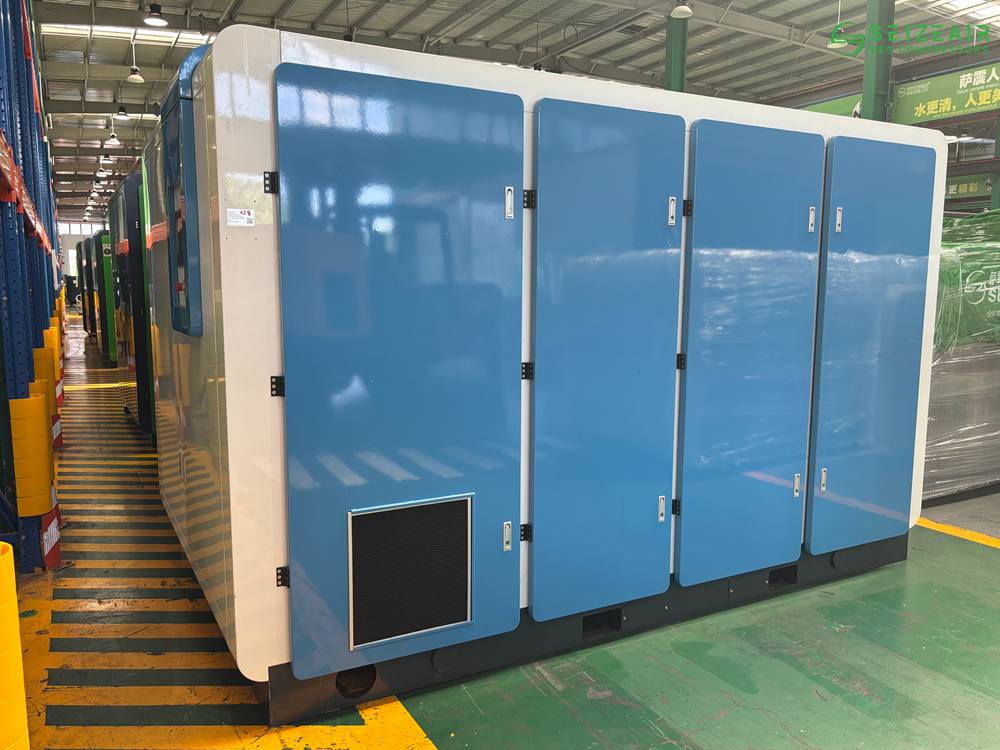
For decades the weak point of a centrifugal was the high-speed bearing and its oil system. Magnetic levitation removes that weakness: the rotor floats, the shaft never touches anything, and the only scheduled service is the control electronics and filters. The result is a machine with near-zero mechanical loss in the core, no oil in the basement, and a footprint small enough to drop into a plant that was never designed for a centrifugal.
This is the direction the leading centrifugal air compressor designs are moving, and it matters most where both oil-free air and uptime are non-negotiable – semiconductor, pharma and high-purity processing. The efficiency gain is real but modest; the maintenance and contamination gains are what change the economics.
How to size and select a centrifugal air compressor for your plant
Sizing is where projects succeed or fail. Start from the average demand, not the nameplate peak, and measure it – too many plants guess and oversize by 30 percent, then wonder why the machine surged. Steps that work:
- Log actual flow for two weeks at one-minute resolution to find the true average and the peaks.
- Add a realistic growth margin, usually 10 to 15 percent, not 50.
- Fix the discharge pressure you actually need; every extra bar costs roughly 7 to 8 percent more power.
- Decide oil-free or not – it changes the seal and bearing architecture.
- Choose base-load centrifugal plus trim machine if demand varies more than about 25 percent.
- Confirm cooling: water-cooled intercoolers are more efficient; air-cooled simplifies the plant.
Get the pressure right and the flow honest, and the rest of the selection is straightforward. Overspecify either and you pay for it every hour the machine runs.
Common mistakes when specifying high-flow compressed air
A few patterns show up again and again in failed projects. The first is sizing for peak instead of average, which forces throttling and surge control to do the job a second machine should. The second is ignoring the pressure line – teams ask for 10 bar “to be safe” when 7 bar would do, quietly burning 20 percent more energy forever. The third is forgetting that a centrifugal is a system: bad inlet air, restricted discharge piping or weak cooling water will drag real efficiency far below the nameplate.
The fix is rarely more iron. It is better measurement, honest demand data and a control strategy that lets each machine sit where it is efficient.
Conclusion
Choosing a centrifugal air compressor comes down to one question: do you have a steady, very high air demand that justifies the upfront investment? If your flow sits in the thousands of cubic feet per minute, you value low maintenance, and you need oil-free output, the answer is usually yes – and no other architecture will match its efficiency at scale. If your demand swings hard or your flow is modest, a screw or piston unit will serve you better for less money.
Still weighing whether a centrifugal air compressor fits your plant? Our engineers will review your logged flow data, pressure needs and air-quality requirements and return a sized recommendation with a lifecycle cost comparison. Contact us to start the conversation – we would rather size it right with you than see another overspec’d machine humming at half load.
Seize Air designs and manufactures energy-saving compressed air systems, including centrifugal and oil-free packages, for industrial plants worldwide. This guide is informational; final selection should be confirmed against your site data.