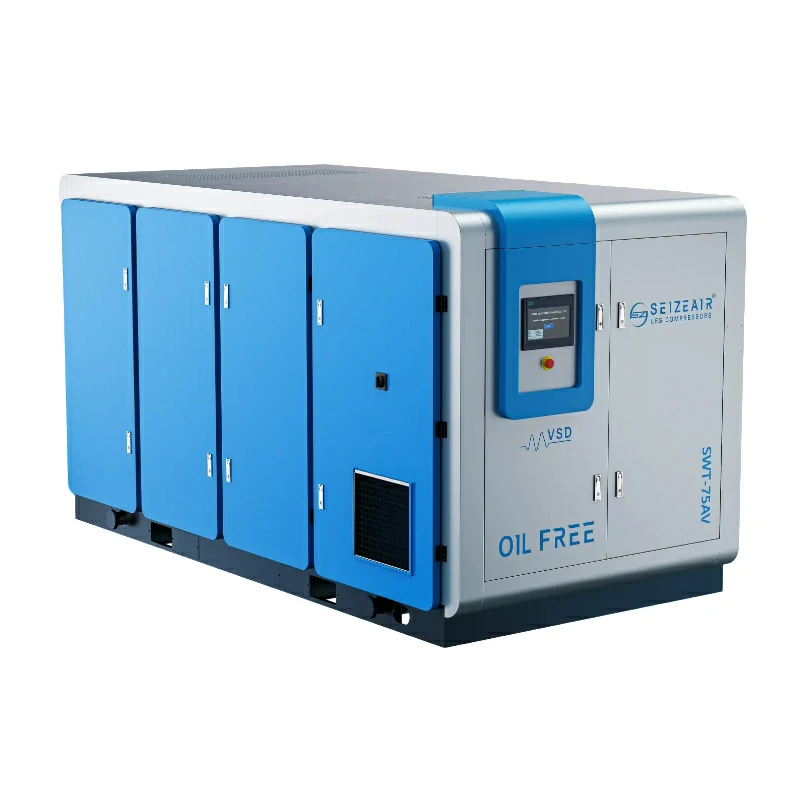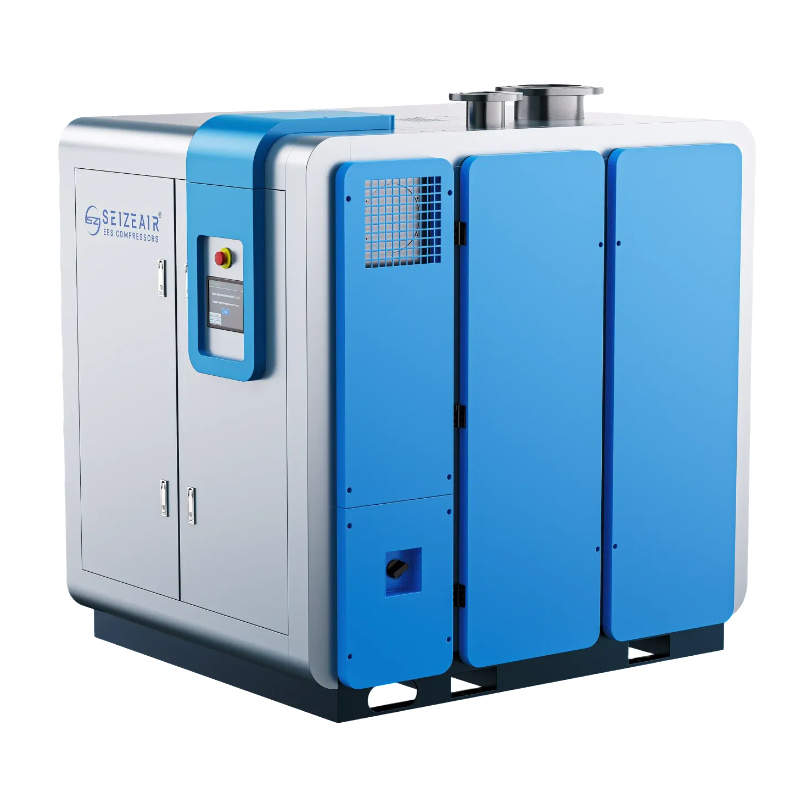


Choosing a safe air compressor for food industry packaging comes down to one thing most buyers overlook: air purity. On a packaging line, compressed air is rarely just a utility — it blows bottles, conveys powder, powers fillers, and sometimes touches the product directly. If that air carries oil mist, water, or bacteria, it ends up in the food. This guide covers the standards, compressor types, drying and filtration chain, and sizing math you need to specify a system that keeps inspectors happy and customers safe.
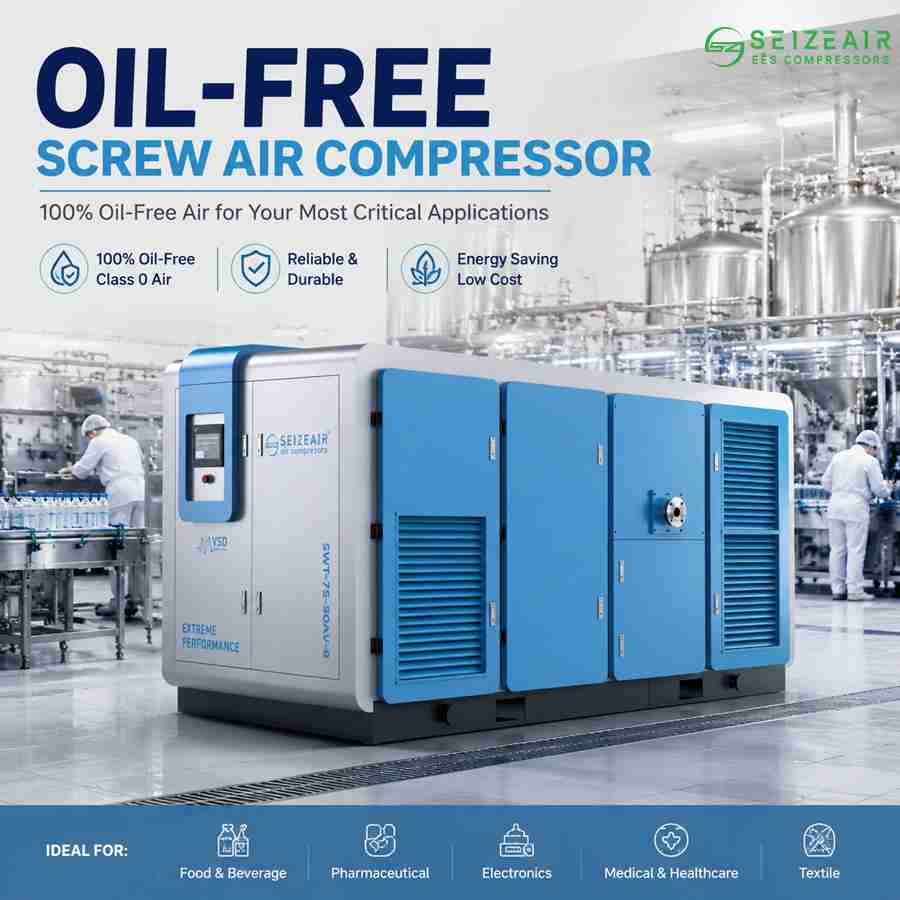
Why Compressed Air Is a Food Safety Issue, Not Just a Utility
Most plant managers think of compressed air the way they think of electricity — flip it on, it shows up, done. In food packaging that mindset is dangerous. Compressed air is classified by food safety authorities as a “food contact substance” the moment it can reach the product, and a lot of packaging processes put it right there.
Think about what air actually does on a line. PET bottle blowing pushes clean air into the preform to stretch it — that air sits on the inside of the bottle your drink goes into. Pneumatic conveying moves milk powder, sugar, or spice blends through pipes using air as the transport medium. Vacuum packaging pulls the air out before seal. Label applicators blow air to stick and smooth. Fillers and cappers use instrument air to actuate valves dozens of times a minute. In every one of those steps, what is in the air is what is on (or in) the food.
The usual contaminants are boring but relentless: oil aerosol carried over from a lubricated compressor, liquid water and rust from an undersized dryer, microbes that grow in a wet receiver, and solid particles shed from aging piping. Any of them can trigger a recall, and recalls in food are expensive in money and worse in trust. That is why HACCP plans now almost always list compressed air as a controlled point rather than an afterthought.
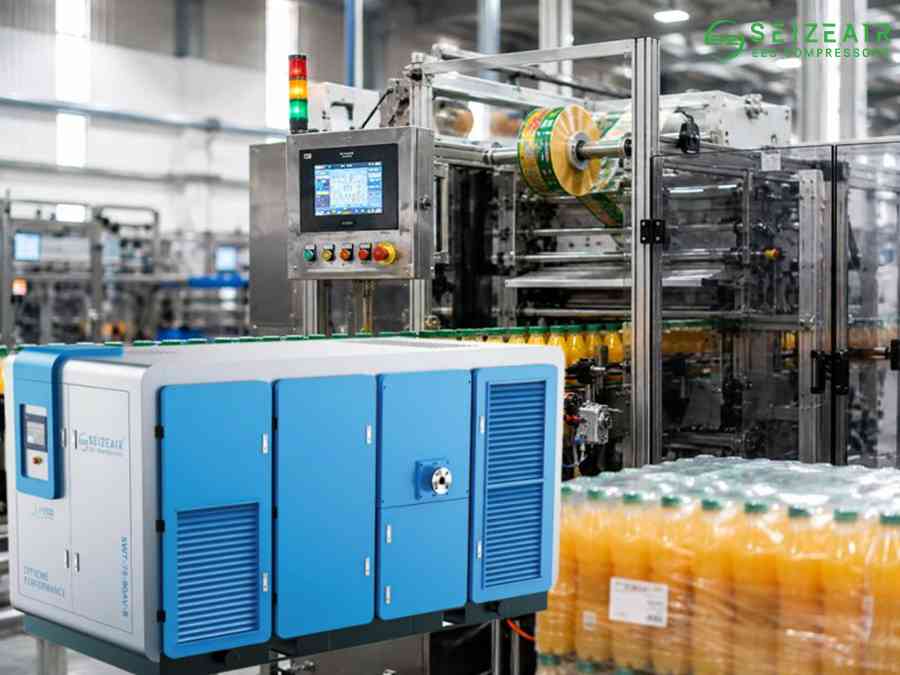
Do You Need an Oil-Free Compressor for Food Packaging?
Short answer: if the air can touch the product, yes. Longer answer: even when air is “only” indirect, oil-free is the safer and usually cheaper-long-term call.
Here is the trap. A lubricated (oil-injected) compressor can be fitted with coalescing filters and still pass a particle count, but those filters cannot guarantee zero oil at the point of use under all conditions — oil vapor passes through standard filters, and once vapor condenses downstream you have liquid oil in the line again. Food-grade facilities that try to “filter their way to safe” usually end up chasing intermittent oil spikes. The honest comparison is laid out in our piece on oil-free vs oil-lubricated air compressors, but the practical rule is simple: for direct contact, only oil-free is defensible.
Oil-free does not mean “no lubrication anywhere.” It means no oil enters the compression chamber, so nothing lubricating the rotor or piston can migrate into the airstream. That is achieved either by designing the compression stage to run without oil (dry screw, scroll, centrifugal) or by using water as the sealing and cooling medium (water-lubricated). Both routes reach the purity grade food plants need.
What Type of Air Compressor Is Used in Food Industry?
Walk through any modern food or beverage plant and you will see a narrow set of architectures, almost all oil-free:
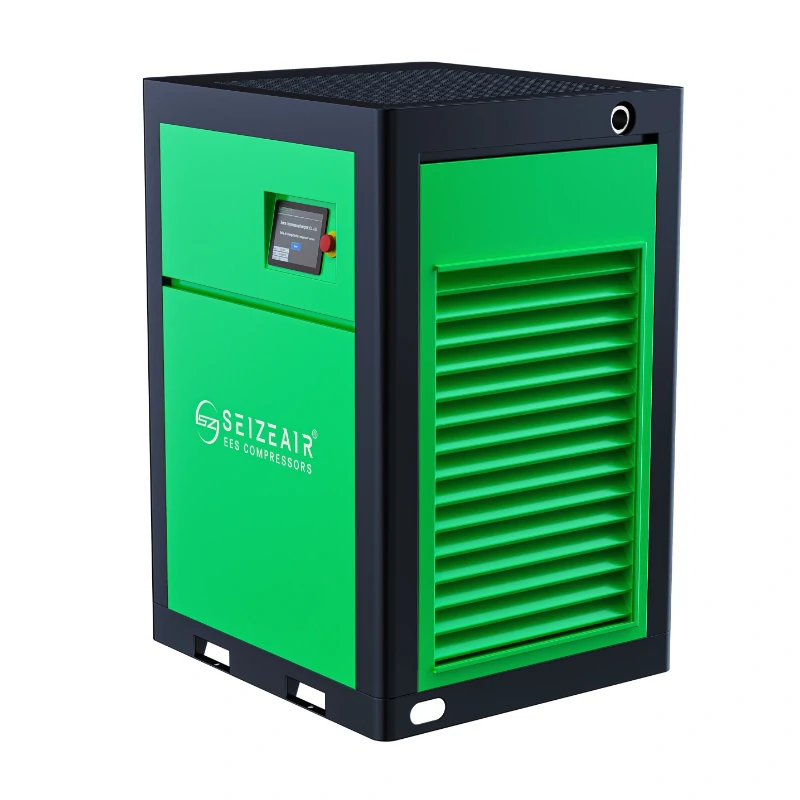
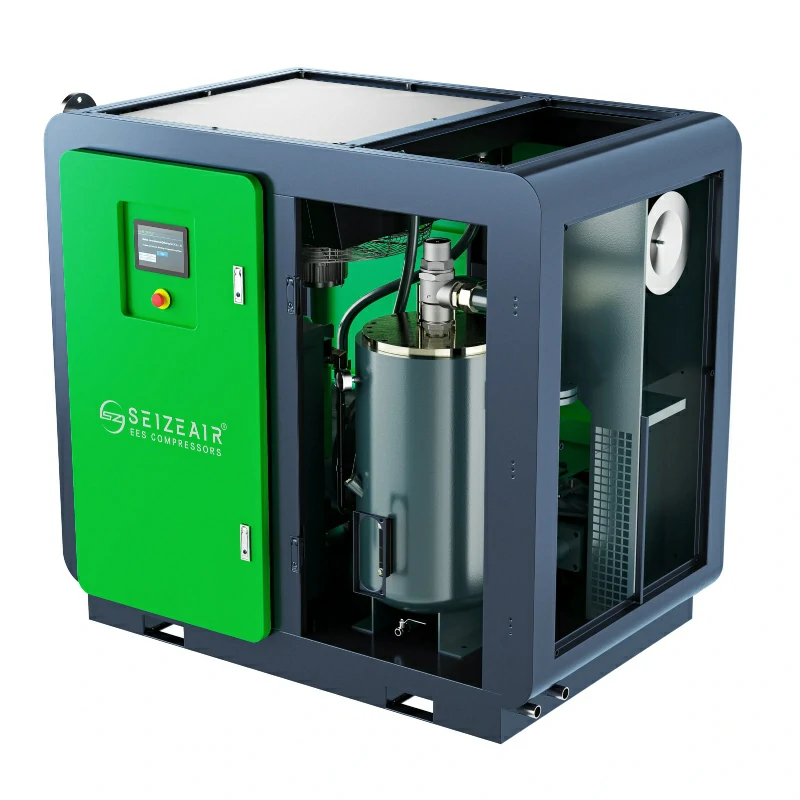
- Oil-free screw air compressor. The workhorse for mid-to-large lines. Two dry rotors mesh without oil in the chamber, and the airstream stays clean by design. Sizes run from small 5.5 kW units up to 250 kW+, so they cover everything from a single filler to a whole plant air ring main.
- Oil-free water lubricated screw air compressor. Instead of oil, these use water for sealing, cooling, and lubrication inside the screw. The output is not only oil-free but naturally cooler and very low in particulate, which is why dairies and beverage plants like them near product. The water is separated and managed in a closed loop.
- Oil-free scroll compressor. Two interleaving spirals compress air in a continuous, pulse-free motion. Scroll units are smaller, quiet, and famously clean, which makes them ideal for labs, small packaging cells, and instrumentation air where flow demand is modest but purity is non-negotiable.
- Oil-free centrifugal compressor. For very large, steady-demand sites — think big breweries or centralized utility air — centrifugals deliver high flow with almost no moving contact, so they are inherently oil-free and efficient at scale.
For most packaging operations the realistic shortlist is the oil-free screw air compressor, the oil-free water lubricated screw air compressor, and the oil-free scroll compressor. Pick among them on flow, pressure, and how much noise or footprint your line can tolerate — not on whether they are clean, because all three are.
Class 0 and ISO 8573-1:
If you only remember one standard, make it ISO 8573-1. It grades compressed air on three contaminants — solid particles, water (by pressure dew point), and oil (aerosol plus vapor) — and assigns Class numbers. Lower class number means stricter. Class 0 is the strictest: it is not “a little oil is fine,” it is “no oil detectable by the test method,” which is what food and pharma demand.
A supplier who says “Class 1” is not giving you food-grade air. Class 0 is the line in the sand for direct food contact. The table below is the simplified version buyers actually use when writing a spec.
| ISO 8573-1 Class | Total oil (aerosol + vapor) | Pressure dew point | Typical use |
|---|---|---|---|
| Class 0 | None detectable (< 0.01 mg/m3) | As required by process | Direct food/beverage contact, packaging |
| Class 1 | ≤ 0.01 mg/m3 | ≤ +3 °C | Instrument air, indirect use |
| Class 2 | ≤ 0.1 mg/m3 | ≤ +3 °C | General industrial, non-food |
| Class 3 | ≤ 1 mg/m3 | ≤ -20 °C | Rough industrial use only |
Note the oil figure for Class 0 includes vapor, not just droplets. That is exactly why filtering an oil-lubricated machine is never enough — vapor sails through ordinary filters. For food packaging, write “ISO 8573-1 Class 0 for oil” into the purchase order and make it a acceptance test, not a hope.
Sizing Your Compressor:
Oversizing wastes capital and lets the compressor idle in inefficient territory; undersizing starves the line during peak. The right size starts from real demand, not a catalogue number. Here is the plain arithmetic plants use:
Required airflow (CFM) = total connected demand (CFM) x load factor (0.5 to 0.8) + leakage allowance (10 to 30 percent of demand).
Working pressure (bar) = highest single tool requirement + 1.0 to 1.5 bar for line loss and filter pressure drop.
Most packaging lines sit at 6 to 7 bar at the point of use. Blow-off and some cleaning duties push toward 8 to 10 bar, so size to the worst single consumer, not the average. Duty cycle matters too: a line running 20 hours a day wants a fixed or VSD unit rated for continuous duty, while an intermittent cell can use a smaller tank-backed machine.
Leakage is the silent budget-killer. A plant with a 20 percent leak rate is buying a compressor a fifth bigger than it needs and paying to compress air that hisses out of a cracked coupling. Audit leaks before you size — it is the cheapest capacity you will ever add.
The Drying and Filtration Chain That Makes Air Food-Safe
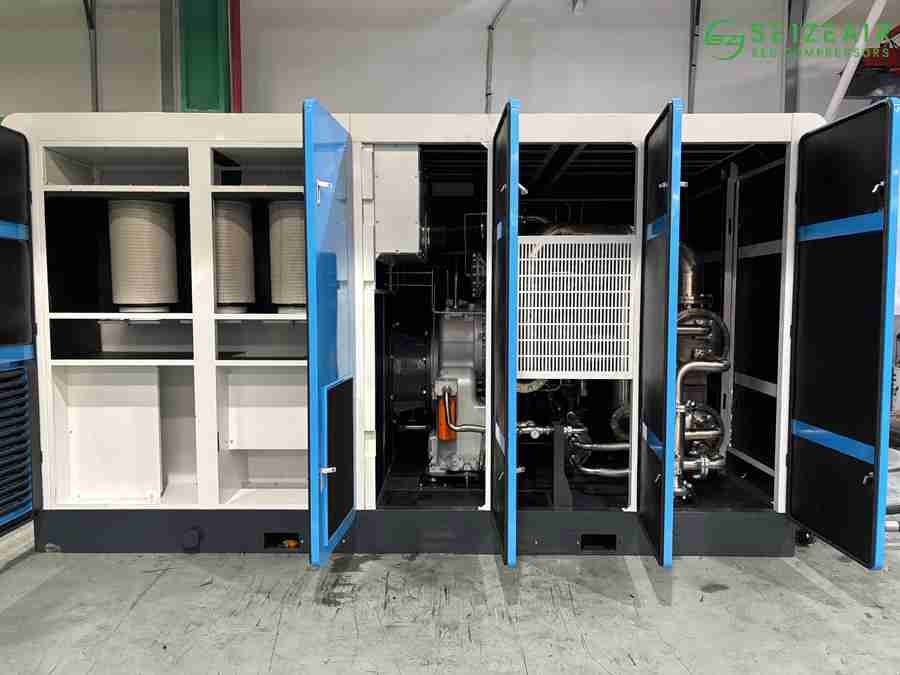
An oil-free compressor gives you clean air at the compressor. It does not give you dry, particle-free, microbe-free air at the nozzle. That last mile is the treatment chain, and skipping it is the most common reason “oil-free” systems still fail audits.
The standard chain reads like this:
Ambient intake -> Oil-free compressor -> Aftercooler -> Dryer -> Coalescing + precision filter -> Point of use (clean) (no oil in chamber) (drop T) (remove H2O) (catch particles & residual oil) (food contact)
A refrigerated air dryer cools the air to about +3 °C pressure dew point, condensing most water out. For cold storage rooms, outdoor lines in winter, or any place where condensation downstream would be a hazard, a desiccant (adsorption) dryer pulls the dew point down to -40 °C or lower. Then a precision filter — often in stages, coalescing then particulate — catches what is left: droplets, rust, and fine dust.
For modified atmosphere packaging (MAP), where you flush a pouch or tray with inert gas to extend shelf life, a nitrogen generator on the same air supply produces food-grade N2 on site. It is cheaper and more reliable than wrestling gas cylinders, and it keeps the flush gas at the same purity standard as the rest of your line.
| Packaging application | Air purity need | Recommended treatment |
|---|---|---|
| PET bottle blowing | Class 0 oil, very dry | Oil-free compressor + refrigerated/desiccant dryer |
| Powder conveying (milk, sugar) | Class 0 oil, low dust | Oil-free + precision filter, dry air |
| Vacuum packaging | Class 0, microbe-controlled | Oil-free + sterile filter at vacuum pump inlet |
| Modified atmosphere (MAP) | Class 0 + pure N2 | Oil-free + nitrogen generator |
| Label blow-off / actuators | Class 1 acceptable | Oil-free + basic filtration |
Oil-Free Screw vs Scroll vs Centrifugal — Picking the Right Architecture
All three are oil-free, so the decision is about scale, cost, and plant character. The comparison below is the one buyers keep coming back to.
| Type | Flow range | Pressure | Best fit in food packaging |
|---|---|---|---|
| Oil-free scroll | Low (up to ~1.5 m3/min) | Up to ~8 bar | Labs, small cells, instrument air, quiet zones |
| Oil-free screw | Medium to large (0.7 to 45 m3/min) | Up to ~12.5 bar | Main plant air, fillers, blow-off, conveying |
| Oil-free centrifugal | Very large (high m3/min) | Up to ~10 bar | Central utility air for big breweries/sites |
If you run one packaging line in a mid-size plant, an oil-free screw air compressor is the default. Add a oil-free scroll compressor only when a specific low-flow, low-noise point (a lab or a clean room cell) needs isolation from the main ring. Centrifugal enters the picture once your total demand is large and steady enough that its efficiency at scale pays back the higher capital.
Variable Speed Drive:
Air compression is usually the single biggest electricity draw in a packaging plant, often 10 to 30 percent of the site bill. A fixed-speed compressor runs at full output and dumps excess through a bypass when demand drops — you pay to make air you throw away. A variable speed drive (VSD) unit matches motor speed to live demand, so it sips power when the line is slow and ramps up at peak.
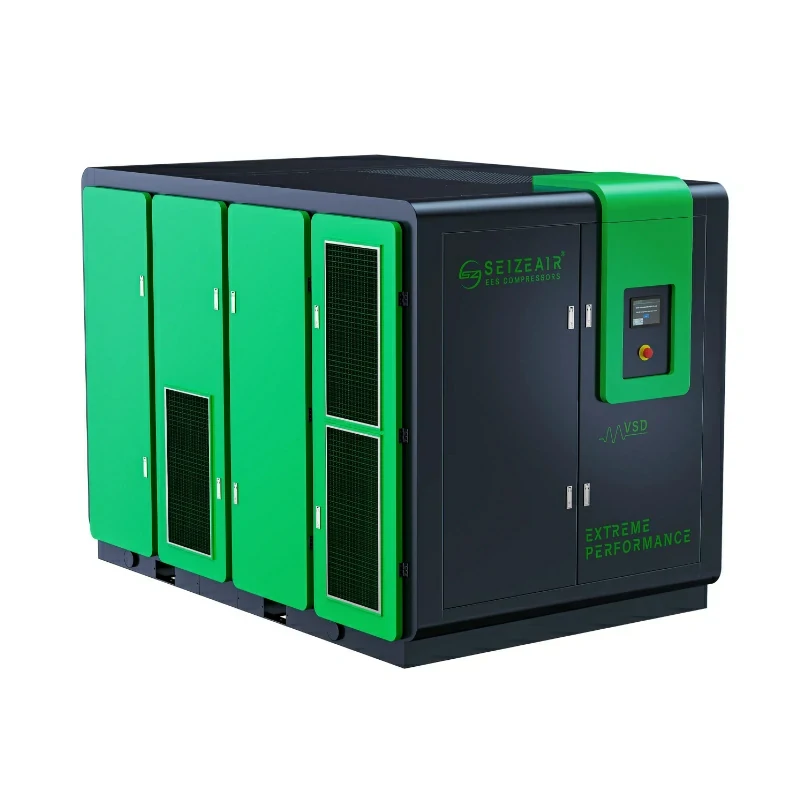
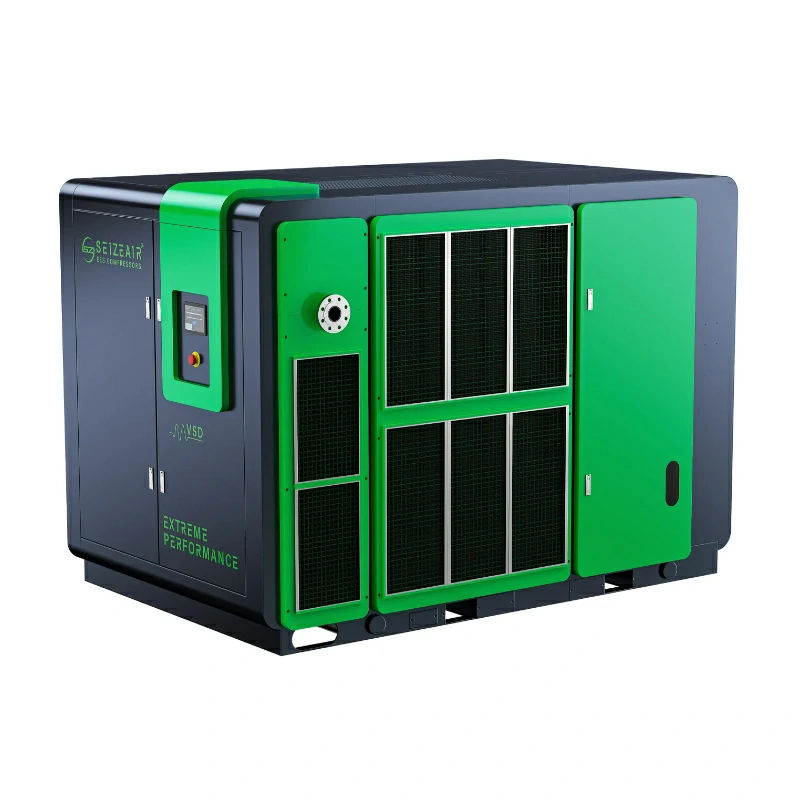
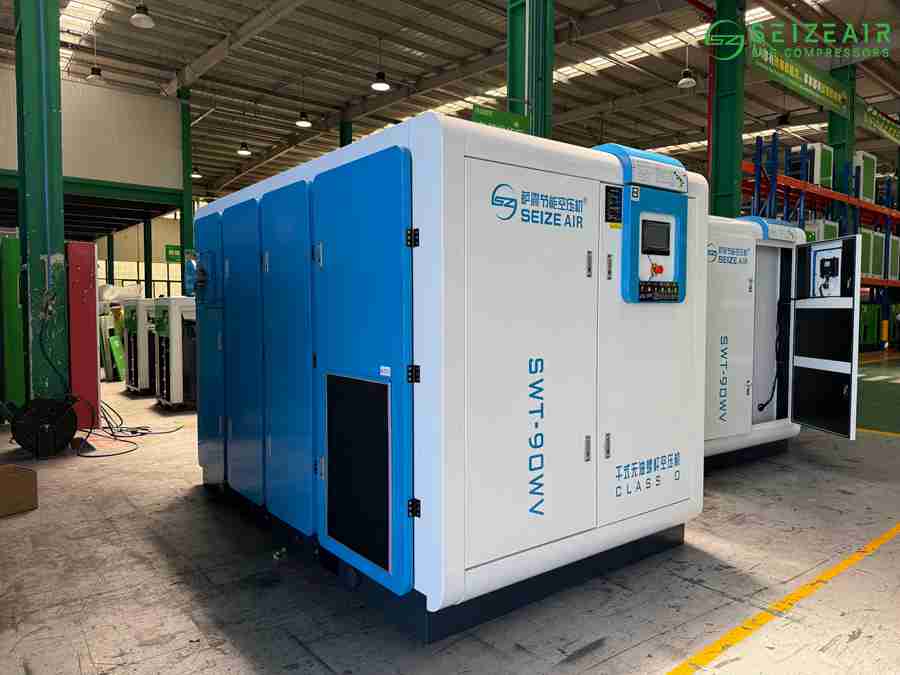
For food plants with shifting shifts, weekend low runs, or seasonal SKUs, VSD pays back fast, commonly inside two to three years on a well-loaded machine. The purity is identical to a fixed unit — VSD is about the motor, not the air path. Specialists such as Seize Air have pushed permanent-magnet VSD oil-free screw platforms that hold Class 0 while trimming the kWh per cubic meter, which is the combination most food buyers actually care about: safe and cheap to run.
Mistakes That Quietly Ruin Food-Safe Air Systems
The failures we see are rarely the compressor. They are the decisions around it.
- Buying on price per kW alone. A cheap oil-lubricated unit plus filters looks affordable until the first oil-positive audit. Total cost of ownership, including rejected batches, wins every time.
- Forgetting the dryer. Oil-free at the compressor and wet at the nozzle because the dryer was undersized for summer ambient. Size dryers for worst-case inlet temperature, not the catalogue average.
- One filter for everything. A single element cannot do coalescing and sterile duty at once. Stage them, and put a final point-of-use filter right before product contact.
- Ignoring intake air. Pulling intake near a frying area or a forklift lane loads the filter with grease and fumes. Intake should be high, screened, and away from contamination sources.
- No monitoring. If you cannot see dew point and particulate trending, you are guessing. A basic inline dew-point and particle monitor turns “we think it is clean” into “we know it is clean.”
A Practical Selection Checklist
Before you request a quote, run this checklist. If a supplier cannot answer every row, keep looking.
| Question to settle | Why it matters | Target for food packaging |
|---|---|---|
| Is oil-free confirmed at the chamber? | Decides direct-contact safety | Yes — dry or water-lubricated, no oil in path |
| What ISO 8573-1 class is specified? | Audit and HACCP alignment | Class 0 for oil on contact points |
| What is true CFM at working pressure? | Prevents starving the line | Demand x load factor + leakage |
| Dryer dew point for your climate? | Stops downstream condensation | +3 °C min; -40 °C for cold/wet duty |
| Filtration staged to point of use? | Catch what dryer misses | Coalescing + precision filter, final at use |
| VSD or fixed for your duty? | Energy cost over 10 years | VSD if demand varies; fixed if flat |
If you want a plant-wide walkthrough rather than a single line spec, our food processing air compressor guide breaks the decision down room by room. For most buyers, though, the checklist above plus the type comparison is enough to brief a supplier confidently.
Conclusion
A safe air compressor for food industry packaging is not the biggest or the cheapest machine on the floor — it is the one that delivers Class 0, dry, monitored air exactly where the product is. Start from real demand, lock in oil-free by design, treat the air after the compressor, and size the dryer for your worst day, not your average one. Do those four things and the audits take care of themselves.
Talk to an Engineer Before You Spec
The fastest way to get this wrong is to size it from a brochure. If you are scoping a new line or replacing an aging unit, tell our team your flow, pressure, and duty cycle and we will map the right oil-free configuration — compressor, dryer, filtration, and monitoring — to your actual process. Reach the Seize Air engineering desk through the contact page and we will come back with a written specification, not a sales pitch.