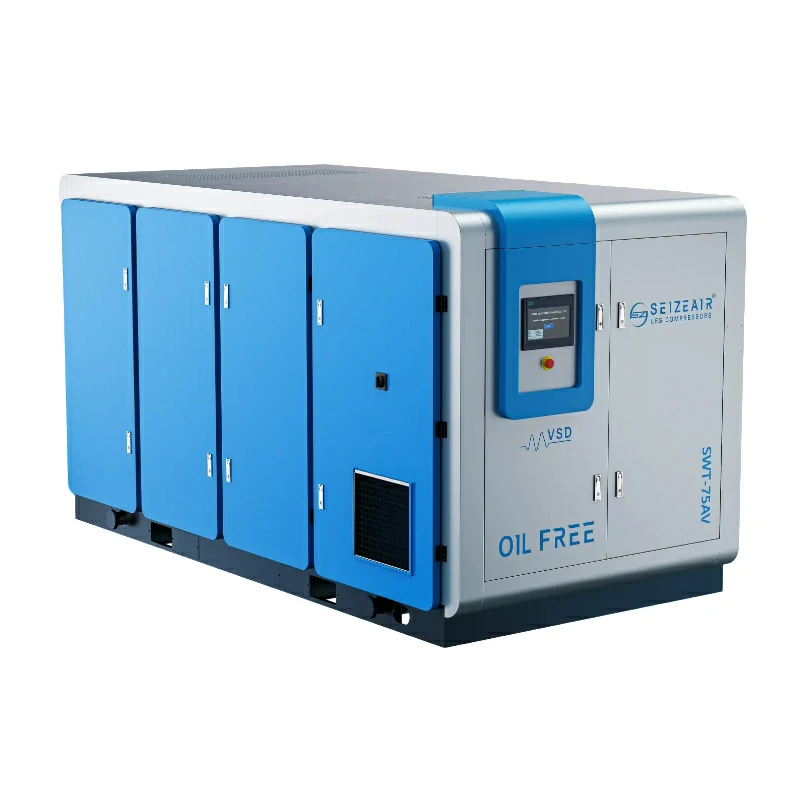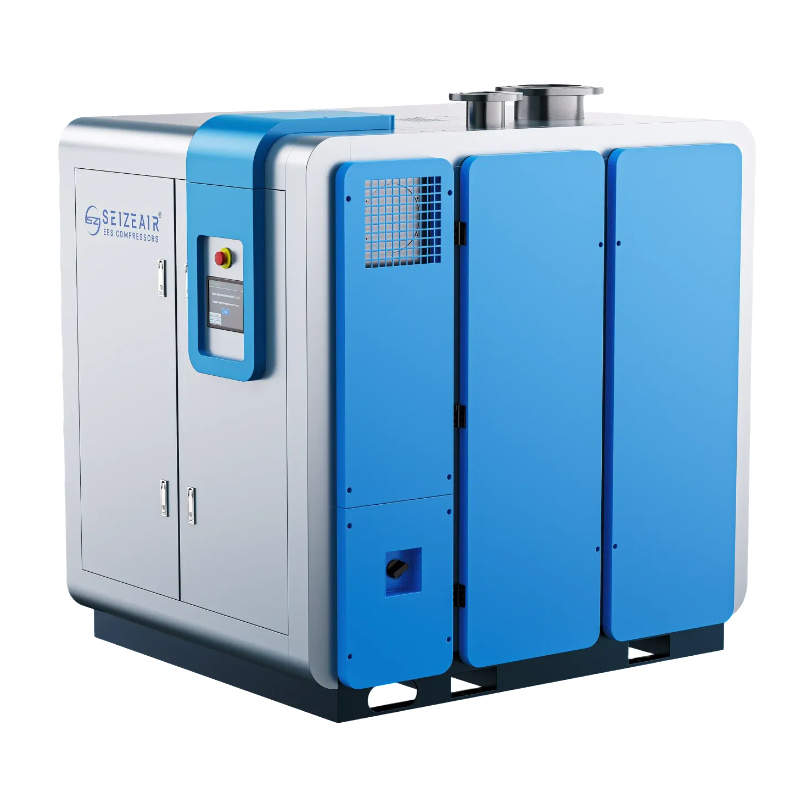


Compressed air is often referred to as the “fourth utility” in manufacturing. While essential, it is notoriously expensive, with energy consumption accounting for nearly 75% of the total lifecycle cost of an industrial air compressor. For factory managers in 2026, the challenge isn’t just finding a machine that works; it’s about balancing initial capital expenditure (CAPEX) with long-term operational excellence (OPEX).
This guide explores how to optimize your compressed air system to maximize output while slashing utility bills.
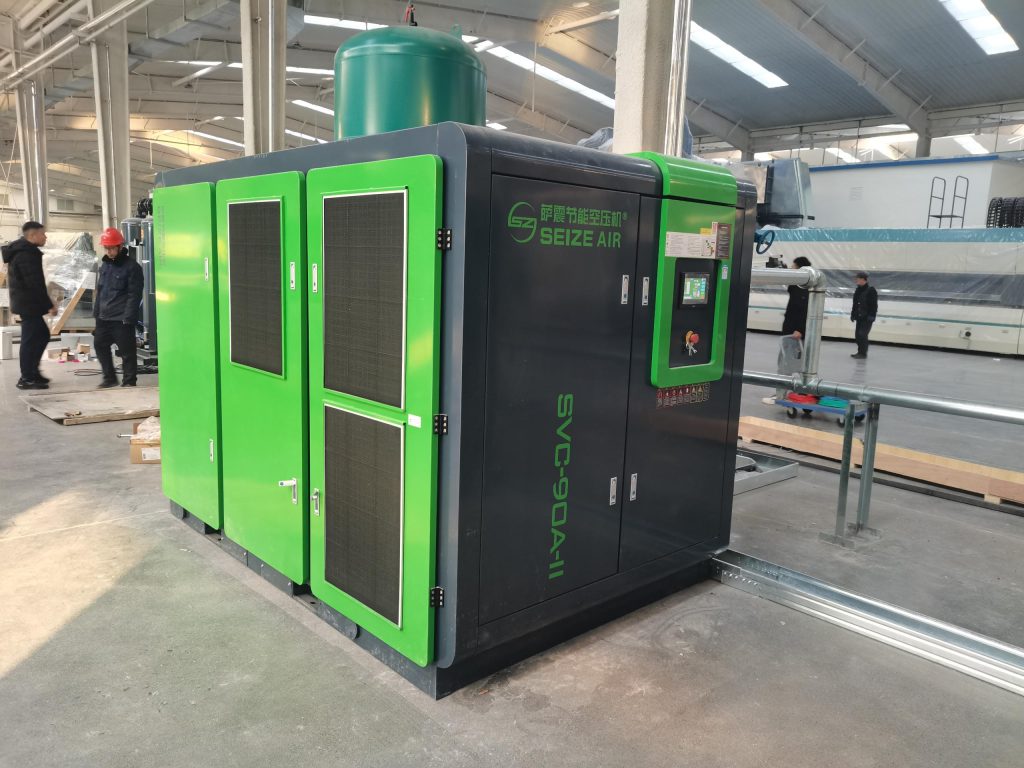
Is the Initial Purchase Price of an Industrial Air Compressor Misleading?
When procurement teams sit down to source an industrial air compressor, the discussion usually starts and ends with the purchase price. This is a strategic error. In the world of plant engineering, the “cheapest” machine is often the one that bankrupts your maintenance budget within three years. To find a truly cost-effective industrial air compressor for large scale plants, you have to look at the Total Cost of Ownership (TCO).
If you buy a low-efficiency unit for $20,000, but it pulls $15,000 more in electricity every year than a premium model, your “savings” vanish in 16 months. This is why we focus on specific power consumption in rotary screw compressors. The goal isn’t just to buy a box that blows air; it’s to buy reliable cubic feet per minute (CFM) at the lowest possible kW input.
| Cost Component | % of Lifetime Cost | The “Deep Dive” Optimization Strategy |
| Initial Investment | 10% – 12% | Don’t over-spec. Buy for current load + 20% growth. |
| Maintenance | 7% – 10% | Genuine parts only. Third-party filters increase pressure drop. |
| Energy (Power) | 75% – 80% | This is where the battle is won. Focus on Specific Power (kW/100 cfm). |
| Disposal/Install | 1% – 3% | Proper ventilation prevents overheating and oil degradation. |
From a decision-maker’s perspective, hardware reliability is the baseline, but energy intelligence is the differentiator. This is precisely where brands like Seize have carved out a niche—by engineering machines that prioritize the “Specific Power” metric over flashy, unnecessary digital add-ons that don’t contribute to the bottom line.
Which Industrial Air Compressor Technology Offers the Best ROI?
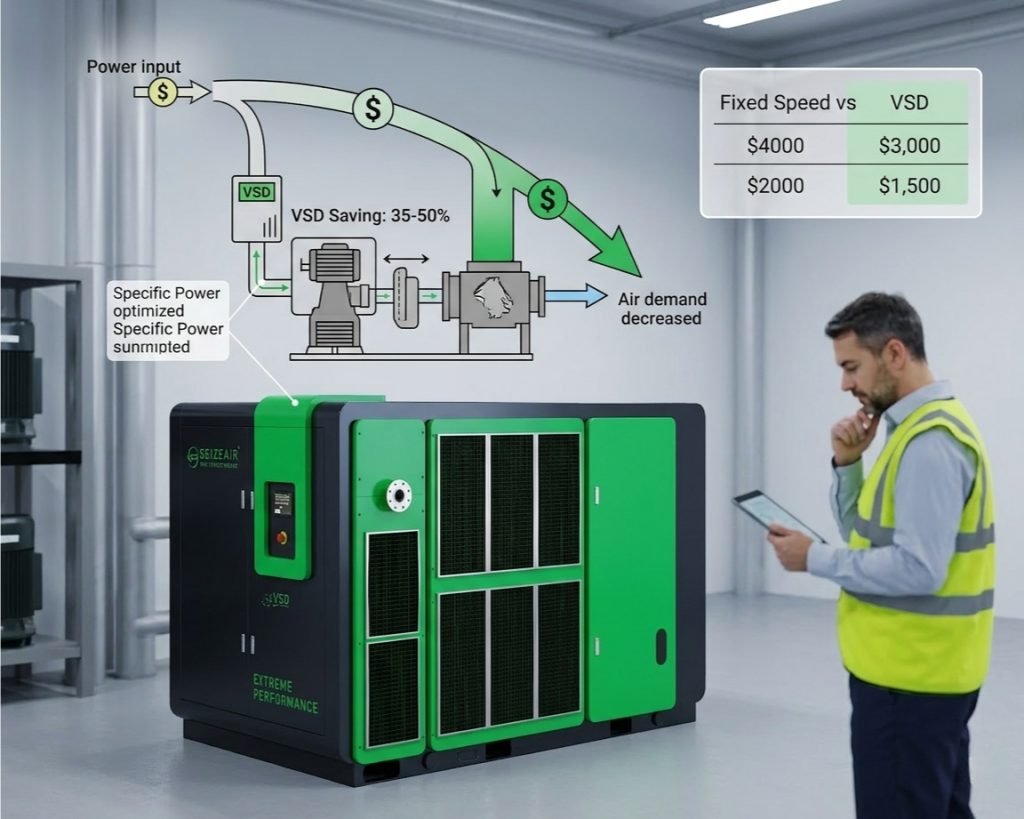
If you ask a site engineer what the “best” compressor is, they’ll tell you: “The one that doesn’t cycle on and off every thirty seconds.” Short-cycling kills motors and destroys efficiency. Understanding the difference between fixed speed and VSD industrial air compressors is the first step in reclaiming your utility budget.
The VSD Revolution (Variable Speed Drive)
In 2026, if your air demand fluctuates—even by 20%—and you aren’t using a VSD industrial air compressor, you are essentially idling a V8 engine at a red light. A VSD unit mirrors your factory’s “heartbeat.” When the packaging line slows down, the compressor slows down. This prevents “unload” waste, where a fixed-speed motor keeps spinning at 70% power even when producing zero air.
Two-Stage Compression
For large-scale plants, a two-stage rotary screw air compressor is the pinnacle of cost-effectiveness. By splitting the compression process into two distinct phases with inter-cooling in between, the air stays cooler. Thermodynamically, cooler air is significantly easier to compress. This physical reality translates to a 7-15% energy saving over single-stage units. It’s an upfront premium that high-output facilities, often those utilizing Seize‘s dual-stage lines, find pays back in less than two years through reduced amp draw.
Oil-Free vs. Oil-Injected Costs
Choosing oil-free vs oil-injected industrial air compressors isn’t just about the machine cost; it’s about the “downstream” cost. An oil-injected unit is cheaper to buy, but if you are in food or pharma, the cost of a single “oil carryover” incident could shutter your plant. Conversely, if you’re running heavy pneumatic drills, an oil-injected unit provides the internal lubrication your tools crave.
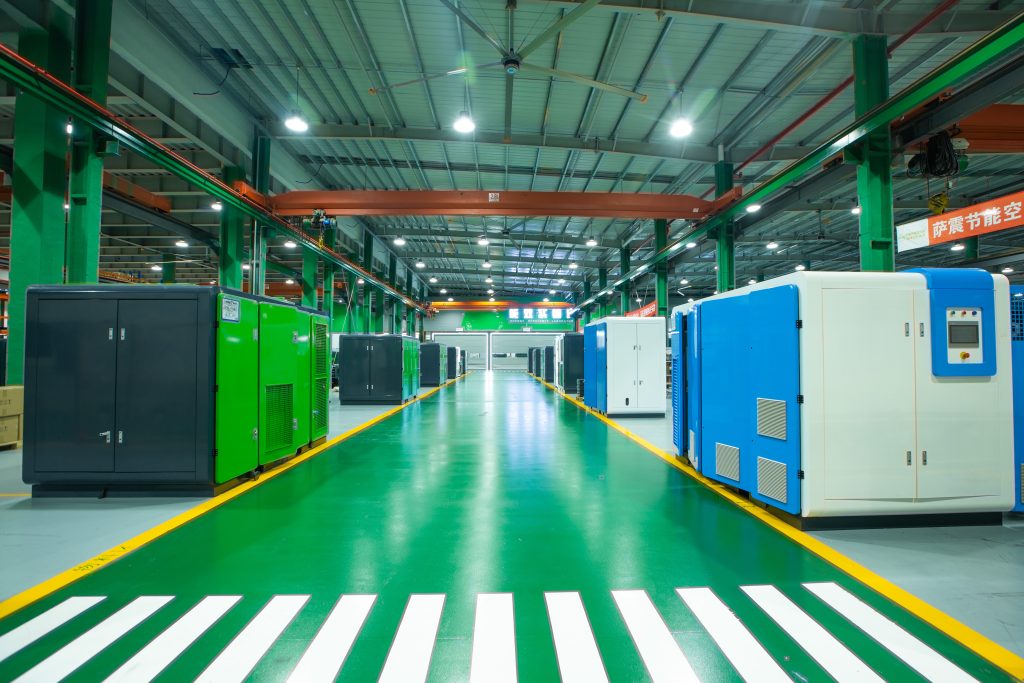
How Can I Reduce Energy Waste in Industrial Compressed Air Systems?
Most factory owners assume their energy bill is high because the compressor is “old.” Often, the compressor is fine—the distribution system is a disaster. To achieve compressed air energy savings in manufacturing, you must look past the machine.
The Ghost in the Pipes
A 1/4-inch leak in a line running at 100 PSI is roughly equivalent to throwing $10,000 into a furnace every year. You can’t hear these leaks over the roar of the factory floor, but your electric meter feels them.
- Ultrasonic Audits: Implement an audit every quarter. Don’t just patch the leak; identify why it happened.
- Material Selection: Transitioning from threaded iron pipe to aluminum piping for industrial air systems reduces friction and prevents the internal corrosion that causes leaks in the first place.
The “Pressure Creep” Habit
I’ve seen floor supervisors crank the compressor up to 125 PSI because one tool at the end of a 500-foot line is struggling. This is pure waste. Instead of raising the system pressure (which increases leak rates and energy draw), install a dedicated local receiver tank near the high-demand tool or upsize the piping diameter.
Pro Tip: Reducing system pressure by just 2 PSI reduces your energy bill by roughly 1%. It sounds small until you see the year-end spreadsheet. This is why Seize focuses so heavily on precision pressure transducers—keeping the variance to a minimum saves thousands.
What Maintenance Schedule Maximizes Industrial Air Compressor Lifespan?
We need to stop viewing maintenance as a “cost center.” It is an insurance policy against downtime, which can cost $1,000+ per minute in some automotive or food processing plants. A preventative maintenance checklist for industrial air compressors should be the “Bible” of your maintenance team.
| Maintenance Task | Frequency | Impact on Efficiency |
| Check Oil Levels | Daily | Prevents catastrophic air-end failure. |
| Clean Intake Filters | Weekly | Reduces motor strain; improves CFM output. |
| Test Auto-Drains | Weekly | Prevents water from entering the plant lines. |
| Oil Analysis | 6 Months | Predicts bearing wear before it happens. |
1. The Oil Analysis Deep Dive
Don’t just change the oil because the calendar says so. Perform oil analysis. It reveals if your bearings are wearing or if environmental dust is bypassing your intake filters. It’s the “blood test” for your machine.
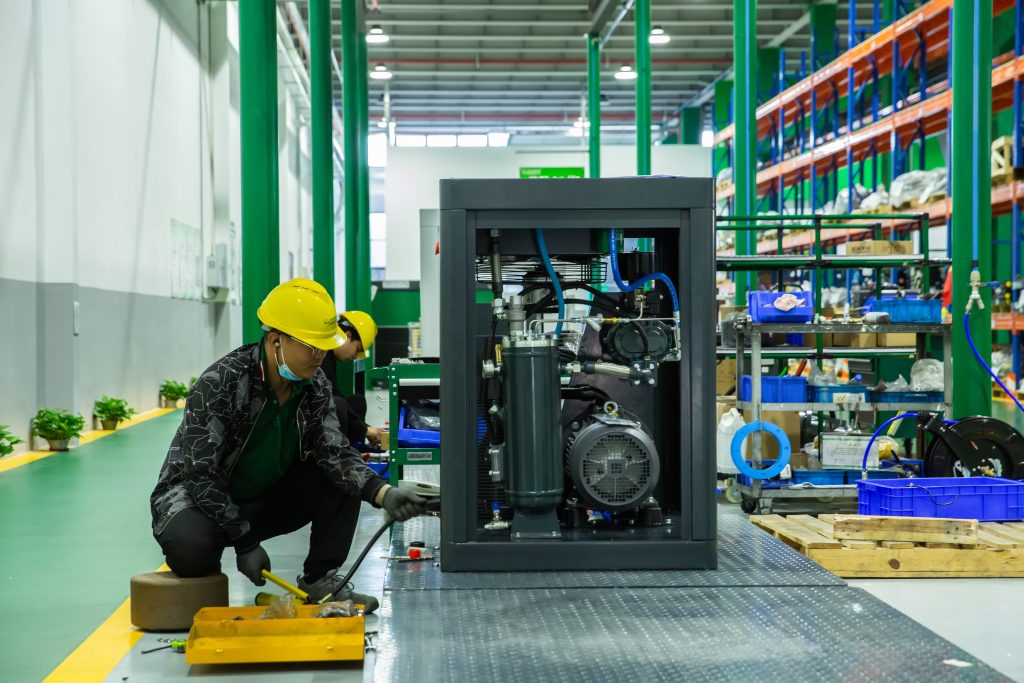
2. Thermal Imaging
Once a month, scan the electrical cabinet and the air end with a thermal camera. A “hot spot” is a precursor to a fire or a mechanical seizure.
3. Air Intake Management
If your industrial air compressor is sucking in 90°F air from the factory floor instead of 60°F air from outside, you’re losing 3% efficiency immediately. Cold air is denser; denser air compresses with less work.
Many modern plants are moving toward integrated solutions where the compressor, dryer, and tank are tuned as a single unit—a design philosophy championed by Seize to minimize installation footprint and maximize out-of-the-box efficiency without requiring an army of onsite contractors.
How Do I Calculate the Payback Period for a New Compressor?
If you are struggling to get budget approval for a new unit, you need to speak the language of the CFO. When comparing industrial air compressor prices vs. performance, use the “Simple Payback” formula.
- Baseline Energy: Measure the kW/h of your current machine over one week.
- Projected Energy: Use the manufacturer’s data (like Seize‘s energy-efficiency ratings) to estimate the new unit’s draw for the same CFM.
- The Delta: Calculate the annual savings in dollars.
- ROI: (New Machine Cost – Rebates) / Annual Savings = Years to Payback.
In most 24/7 manufacturing environments, an energy-optimized industrial air compressor pays for itself in 18 to 26 months. Beyond that, the machine is essentially “printing money” for the company through reduced overhead.
Common PAA Questions:
“We have an old compressor. Is it cheaper to fix it or buy a new one?”
Calculate the “Specific Power.” If your old unit is pulling 22kW to produce 100 CFM, and a new industrial air compressor can do it for 16kW, the electricity savings alone will likely pay for the new machine in under 24 months. If the repair cost (like a full air-end rebuild) exceeds 40% of a new unit, scrap it.
“How do I know if my pipes are too small?”
Check the pressure at the compressor discharge vs. the pressure at the furthest tool while the plant is under full load. If the difference (delta) is more than 10%, your piping is a bottleneck. You’re paying to create pressure that never reaches your product.
“Is heat recovery for industrial compressors worth the investment?”
Absolutely. In the winter, you can duct the hot exhaust air into your warehouse for “free” heating. In the summer, you duct it outside. About 90% of the energy you pay for in a compressor turns into heat—recovery turns that waste into a utility offset.
Conclusion
Achieving a cost-effective compressed air setup isn’t about finding the cheapest machine; it’s about system-wide optimization. By selecting a high-efficiency industrial air compressor, aggressively managing leaks, and utilizing heat recovery, you turn a major expense into a competitive advantage.
Sustainable manufacturing starts with the air you breathe—and the power you save.
Would you like me to run a “Payback Period” calculation based on your current electricity rate and air demand?