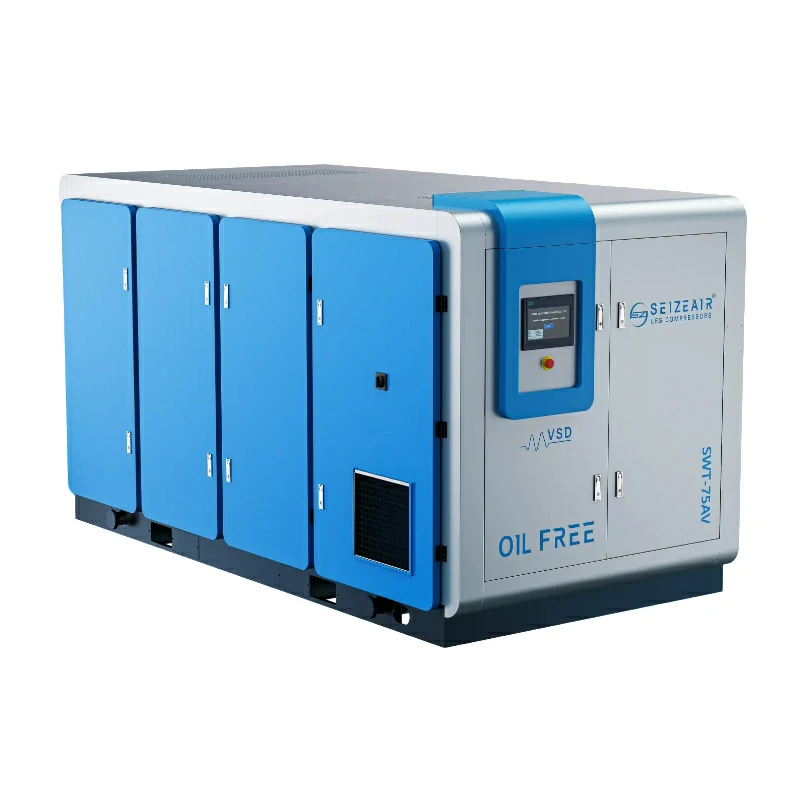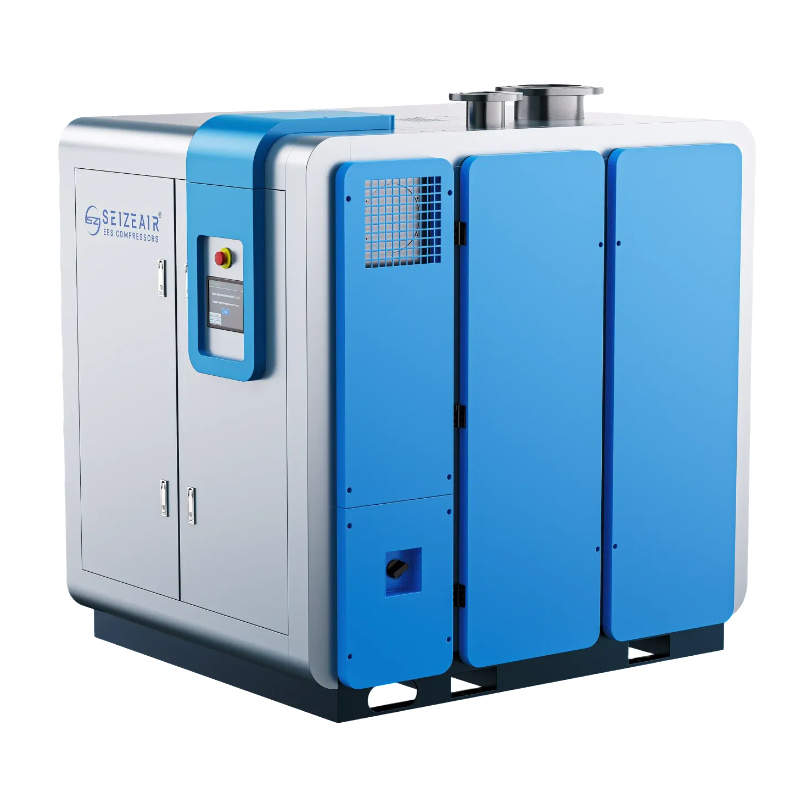


Buying an industrial air compressor is a major capital decision for any facility. While a used industrial air compressor offers massive upfront savings, the purchase price is only a fraction of its true cost. From decade-long reliability to production-halting “bargains,” this expert guide evaluates if a used industrial air compressor fits your operational needs.
The Economics of an Industrial Air Compressor: New vs. Used
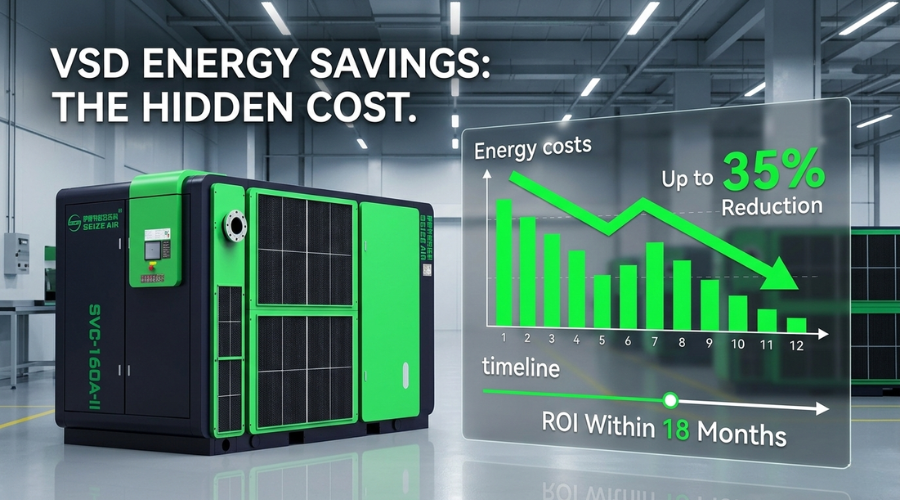
Before diving into mechanical checks, we focus on Total Cost of Ownership (TCO)—the make-or-break metric for industrial air compressor investments. For a standard compressor, industry data confirms purchase price represents only 10-15% of lifetime costs: 70-75% goes to electricity, 10-25% to maintenance ¹⁶. This explains why a
10,000used industrial air compressor often costs more than a 25,000 new model over five years.
Use this industry-standard TCO formula for industrial air compressors ²:
TCO = (Purchase Price + Installation) + (Annual Energy Costs × Lifespan) + (Annual Maintenance × Lifespan) + Downtime Costs
Example: 90 kW used fixed-speed industrial air compressor (
18,000)vs.newVSDindustrialaircompressor(45,000). Assuming 6,000 operating hours/year, $0.15/kWh, 75% load factor, 5-year lifespan:
- Used industrial air compressor (85% efficiency): Annual energy cost = $71,323
- New VSD industrial air compressor (95% efficiency + 35% savings): Annual energy cost = 46,360The124,815 energy gap over 5 years dwarfs the $27,000 upfront difference—before adding 30-50% higher maintenance costs for used industrial air compressors. Pro tip: Factor in local electricity rate hikes (average 3-5% annually) when projecting TCO for long-term use.
When to Buy a Used Industrial Air Compressor
- Immediate Availability: Supply chain lags stretch new industrial air compressor lead times to 4-16 weeks. A used industrial air compressor is “plug-and-play,” critical for facilities facing unexpected breakdowns. A food plant avoided $50k+/day in downtime by sourcing a used industrial air compressor in a week—ideal for emergency replacements when production can’t pause.
- Lower Initial Capex: Startups or small machine shops with low (under 50 cfm) or intermittent air demand prioritize cash flow over long-term efficiency—making a used industrial air compressor a practical choice. Look for units under 10 years old with 20,000 loaded hours for the best balance of cost and reliability.
- Depreciation Avoidance: New industrial air compressors lose 20-30% value in the first year, 50% in three ¹. Used units hold value steady, ideal for rental companies or 1-3 year projects (e.g., temporary construction sites). Reselling a well-maintained used compressor can recoup 60-70% of your investment.
- Static Demand Fit: Facilities with 24/7, 80% load operations (e.g., continuous manufacturing) benefit from used fixed-speed industrial air compressors—VSD efficiency gains are minimal here. Ensure the unit’s rated capacity matches your peak demand (±10%) to avoid overworking the machine.
Risks of a Used Industrial Air Compressor
- Efficiency Loss: Older industrial compressors lack VSD and energy recovery. A 10-year-old unit has 8.5-9.0 kW/m³/min specific power (ISO 1217:2016), vs. 6.5-7.0 for new models—adding 15k−30k/year in energy costs for a 100 cfm used air compressor ². Even minor efficiency gaps compound: a 5% efficiency loss costs $3,500/year for a 75 kW unit.
- Unknown History: 90% of compressor failures stem from poor maintenance (clogged filters, expired oil) ³. A used industrial air compressor with unverified logs may need a 5k−15k airend replacement—30-50% of its purchase price ⁹. Red flag: Sellers who refuse to share service records or oil analysis reports.
- Warranty Gaps: Used industrial air compressors sell “as-is” (30-90 day limited warranties at best), while new units include 2-5 years of coverage for critical parts like the airend. Budget 10-15% of the used unit’s price for unexpected repairs in the first year.
- Compliance & Air Quality Risks: Older used air compressors may fail EU Ecodesign/US DOE standards or ISO 8573-1 Class 0 (oil-free) requirements—costing fines or product recalls in pharmaceutical/electronics industries ⁷. Check if the unit meets current local emissions and energy regulations before purchasing.

Key Checks for a Used Industrial Air Compressor
1. Hours & Load Factor
- Loaded Hours: Critical for wear—rotary screw air compressors have 40k-60k hour airend lifespans ¹; 30k+ loaded hours = near end-of-life. Ask for a digital hour meter verification (avoid units with tampered meters).
- Load Factor: (Loaded Hours ÷ Running Hours) × 100. % = wasted energy from idling—a red flag for a used industrial air compressor. For example, a unit with 8,000 running hours but only 3,000 loaded hours (37.5% load factor) has been inefficiently sized.
2. Maintenance & Environmental History of the Industrial Air Compressor
- Environment: A used air compressor from a climate-controlled plant (e.g., pharmaceutical, electronics) is preferable to one from dusty/humid textile mills (accelerated wear ⁵) or coastal areas (salt corrosion). Inspect the base and housing for rust or dust buildup.
- Verified Logs: Request filter changes (ISO 8573-4:2019 compliant—every 500-2,000 hours), oil analysis (annual), and motor inspections. A well-maintained Seize air compressor outperforms a poorly kept budget brand, thanks to Seize’s robust build quality and factory-calibrated components that retain performance longer with proper care. Cross-verify logs with the service provider if possible.
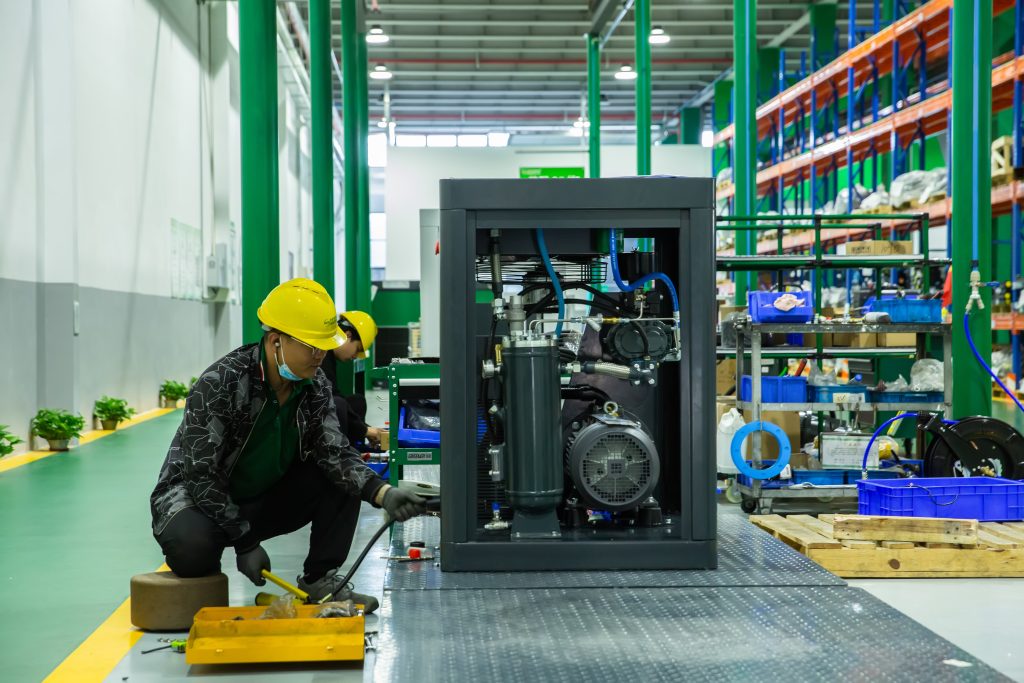
3. Technology Fit for Your Industrial Air Compressor Needs
- Connectivity: Older used industrial compressors lack Modbus/IoT for smart factory integration—critical for modern cost tracking and predictive maintenance. If your facility uses a BMS (Building Management System), ensure the used unit can be retrofitted (cost: 1,500−3,000).
- Pressure Stability: New industrial compressors offer ±0.1 bar precision vs. ±0.5 bar for used units—vital for precision machining or paint booths. Test the used unit’s pressure output during inspection to confirm consistency.
| Feature | Used Industrial Air Compressor | New Industrial Air Compressor |
| Upfront Cost | 30-60% of MSRP | 100% MSRP |
| Energy Efficiency | 17-28% lower | Peak (VSD + iPM motors) |
| Warranty | 30-90 days (limited) | 2-5 years (full coverage) |
| Maintenance Cost | 0.15−0.25/hour | 0.08−0.12/hour |
| Air Quality | Risk of contamination | ISO 8573 Class 0-1 (oil-free) |
| Lead Time | 1-2 weeks | 4-16 weeks |
| Regulatory Compliance | Not guaranteed | Fully compliant (2026 standards) |
Hidden Energy Costs of a Used Industrial Air Compressor
- Specific Power Gaps: A 200 cfm used industrial compressor (9.0 kW/m³/min) costs 6,120/yearmoreinelectricitythananewmodel(7.0kW/m3/min)—30,600 over 5 years. Use an online specific power calculator to compare units.
- Leakage Amplification: Used air compressors run at higher pressures to compensate for wear—every 1 bar increase = 7-8% more energy ². A 2 bar pressure hike adds 14-16% to your energy bill.
- Variable Demand Waste: Fixed-speed used air compressors cycle on/off, using 3-5x more energy during startup vs. VSD models. For facilities with 30-70% load variation, this waste adds up to 8k−12k/year.
Quick Inspection Checklist for a Used Industrial Air Compressor
Bring a technician to verify these critical components:
- Airend: No whining/grinding; discharge temp 75-95°C; rotor clearance use a feeler gauge for measurement).
- Oil Analysis: 0 ppm metal particles; viscosity 32-68 cSt; 1% water content (send a sample to a certified lab for verification).
- Cooling System: Clean heat exchangers (no scales/clogs); dew point ≤2°C; temperature rise <25°C (measure inlet vs. outlet temp).
- Motor: Megger test >1 MΩ; current draw within nameplate rating; vibration 3 in/s RMS (use a vibration analyzer).
When to Buy a New Industrial Air Compressor
- Mission-Critical Operations: Factory-shutting downtime (10k−100k/hour) justifies a new industrial air compressor’s warranty. Industries like semiconductor manufacturing or emergency services can’t afford unplanned outages.
- Strict Air Quality: Food/pharmaceutical industries need new oil-free air compressors (ISO 8573 Class 0 guarantee). Used oil-free units risk coating wear, leading to product contamination.
- Variable/Growing Demand: VSD new industrial air compressors save 35-50% energy for fluctuating loads. If you plan to expand production in 2-3 years, a new unit can be upsized or paired with additional compressors.
- Regulatory Incentives: Tax credits (up to $1,200/unit) and grants offset newcompressor costs. Many regions offer extra incentives for units with <7.0 kW/m³/min specific power— a benchmark Seize VSD air compressors consistently exceed, making them eligible for maximum incentives.
- Harsh Environments: Dusty/humid/coastal facilities need new industrial air compressors with specialized protection (e.g., corrosion-resistant coatings, high-efficiency filters) to extend lifespan.
Industry-Specific Industrial Air Compressor Choices
- Pharmaceutical/Medical: New oil-free industrial air compressors (FDA/ISO compliance, Class 0 air quality).
- Automotive: New VSD compressors (±0.1 bar pressure stability for paint booths and assembly lines).
- Small Machine Shops: Used compressors (low demand, verified maintenance—prioritize rotary screw over reciprocating for quieter operation).
Data Centers: New industrial air compressors (IoT monitoring, 24/7 reliability for cooling system actuators).