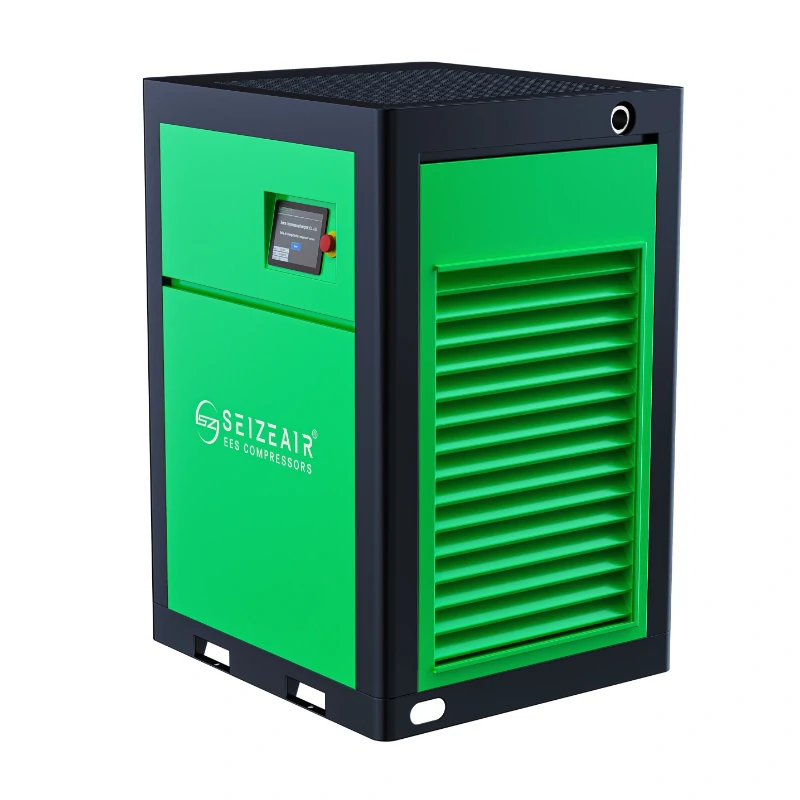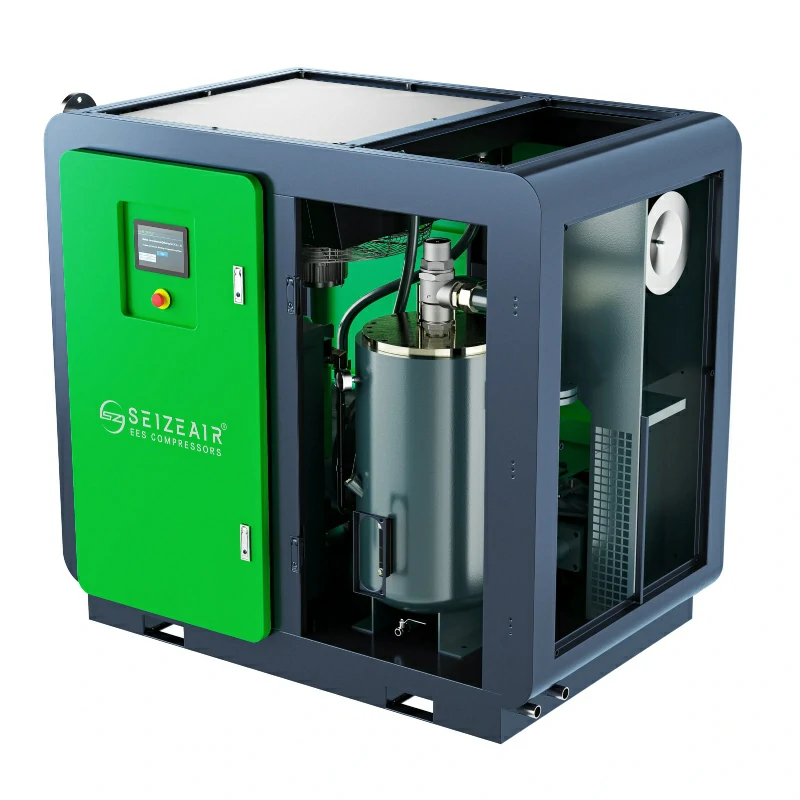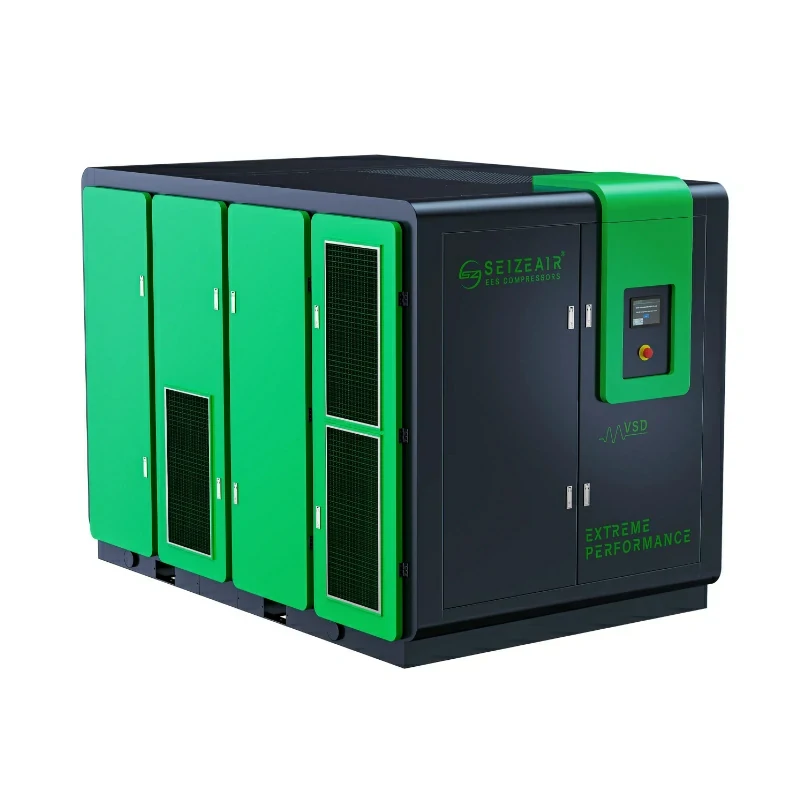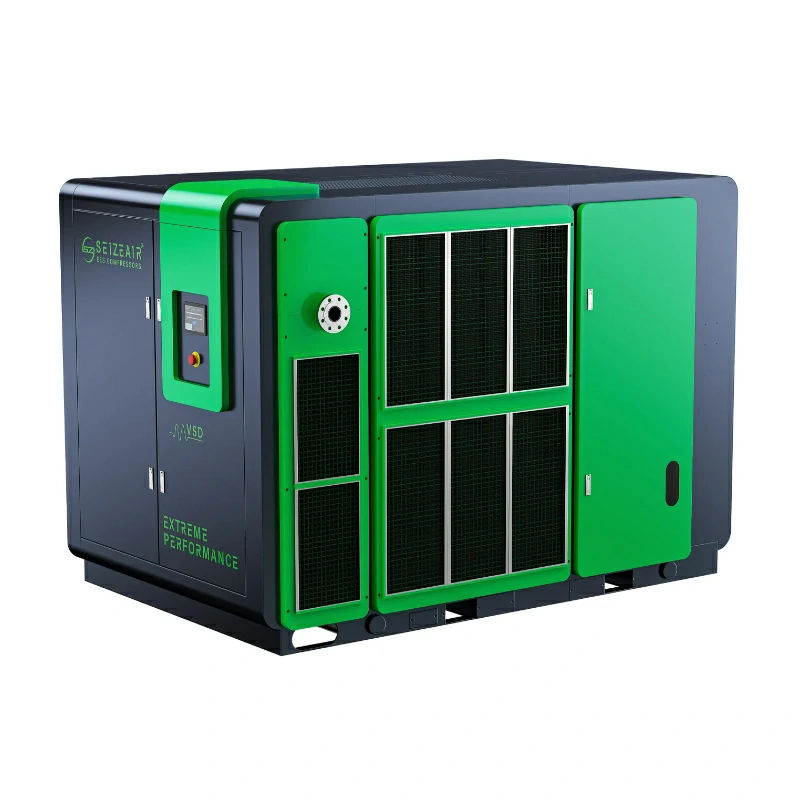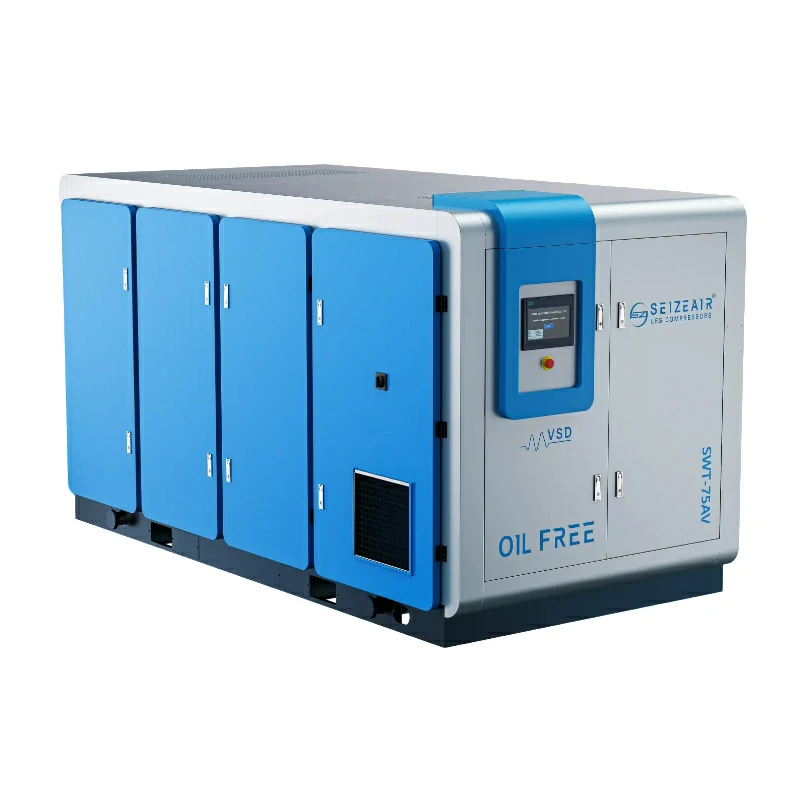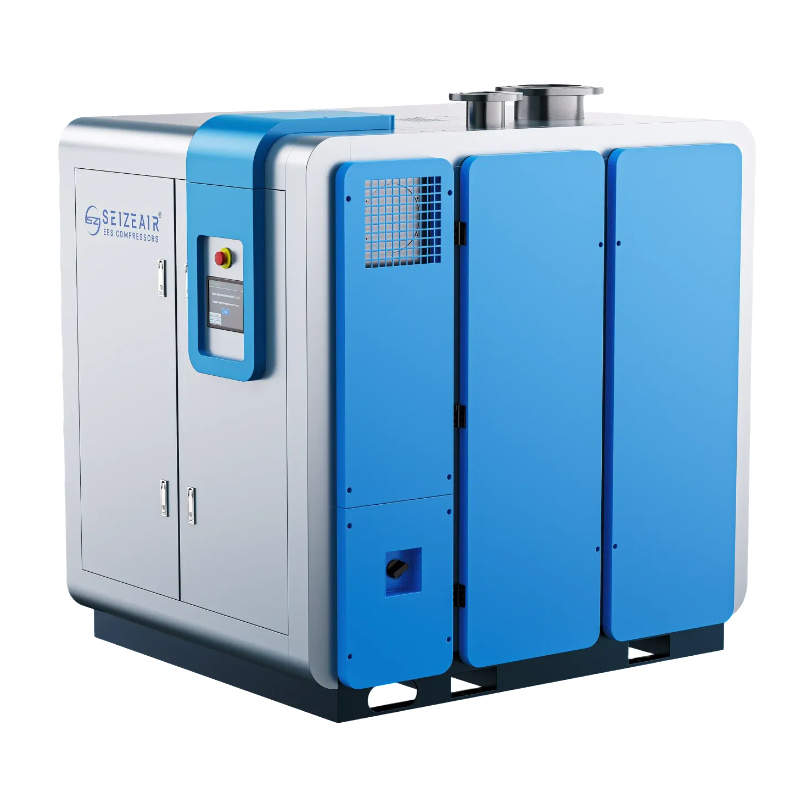


Installing a VSD energy efficient compressor allows industrial facilities to dynamically match motor speed with real-time air demand, cutting factory electricity consumption by up to 35% to 50% while maintaining rock-solid pressure stability.
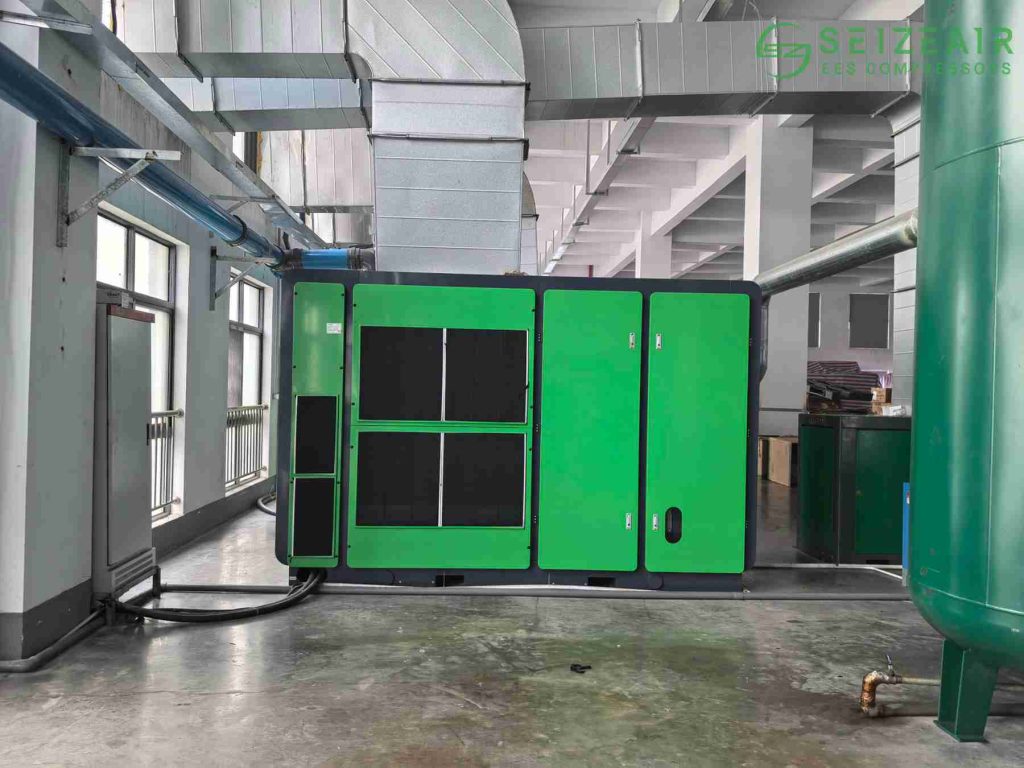
What Is a VSD Energy Efficient Compressor and How Does It Work?
How Does a Variable Speed Drive Air Compressor Regulate Motor Speed?
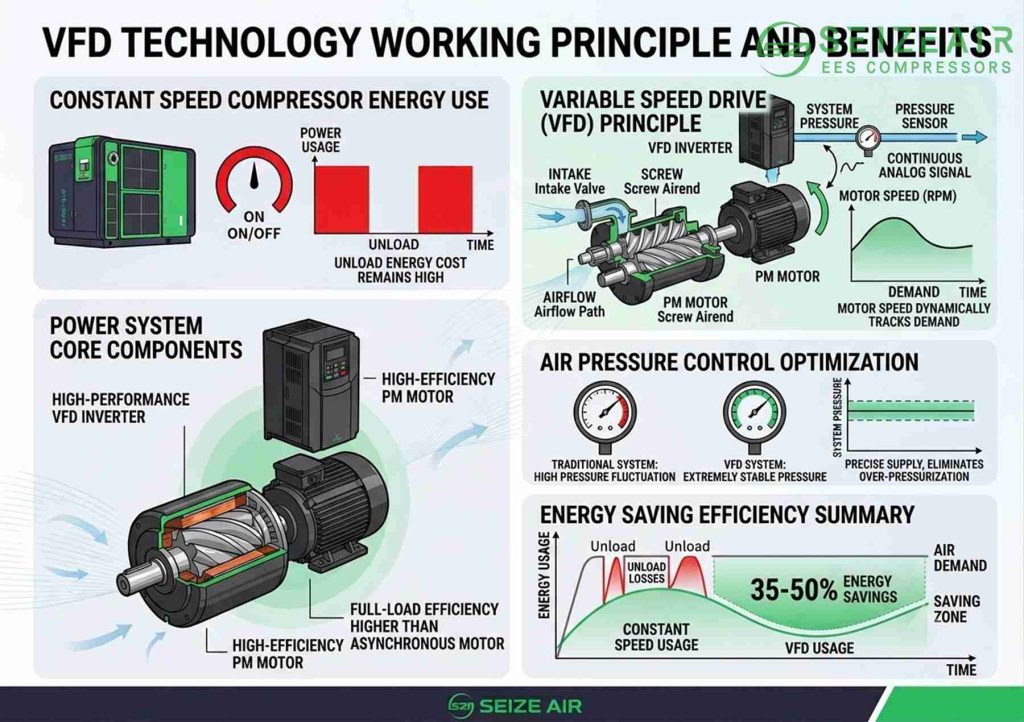
A Variable Speed Drive (VSD) energy efficient compressor is an advanced industrial air compressor that automatically adjusts its motor speed to match fluctuating real-time plant demand. Traditional fixed-speed air compressors run at a constant RPM regardless of how much air your production lines actually require. When air demand drops on a traditional unit, the machine shifts into an “unload mode”—a state where the motor continues spinning at full speed while consuming 20% to 40% of its total rated power just to idly circulate air without doing productive work.
A VSD compressor eliminates this idle power waste through an integrated variable frequency converter.
By adjusting the electrical frequency supplied to the motor, the compressor adjusts its output instantly. If your assembly line slows down by 40%, the motor drops its speed by 40%, drawing proportionally less kilowatt-hours from your utility grid.
How Does Variable Frequency Control Prevent Industrial Energy Waste?
Standard AC motors connected directly to plant main lines are locked into fixed rotational speeds determined by grid frequency (e.g., 50 Hz or 60 Hz). A variable frequency inverter rectifies incoming AC voltage to DC, and then synthesizes a modulated AC output at precise target frequencies. When system air pressure sensors detect a slight pressure buildup due to reduced tool usage, the onboard micro-controller signals the inverter to scale back frequency.
Factories that partner with progressive manufacturers like Seize Air often find that upgrading from obsolete load/unload machinery to variable frequency systems eliminates sudden power spikes, reduces mechanical strain, and keeps operating pressure within a tight band.
Why Is Energy Efficiency Crucial for Industrial Air Compressors?
Why Do Electricity Costs Account for Over 70% of a Compressor’s Lifetime Expense?
Air compressors are one of the most energy-intensive mechanical assets in manufacturing, frequently referred to as a plant’s “fourth utility” alongside water, electricity, and natural gas. When evaluating the lifecycle cost of an industrial air system over a typical 10-year period, the initial purchase price represents a surprisingly minor fraction of overall expenditure.
10-Year Air Compressor Lifecycle Cost Structure
| Cost Component | Percentage of Total Lifecycle Cost | Key Cost Drivers & Variables |
| Electricity & Utility Power | 70% – 80% | Running hours, motor efficiency rating, partial-load efficiency |
| Initial Capital Equipment | 10% – 15% | Purchase price, freight, installation, commissioning |
| Routine Servicing & Repairs | 10% – 15% | Synthetic lubricants, oil separators, air filters, overhauls |
Because utility expense dominates life-cycle costs, selecting an energy efficient compressor directly dictates long-term factory profitability. Over a 5-year operating window, the electrical savings produced by an efficient unit often exceed the original machinery purchase price multiple times over.
What Is the Environmental and Operational Impact of Compressed Air Energy Losses?
Inefficient compressed air operations trigger dual operational risks: excessive carbon emissions and elevated utility billing penalties. When an air compressor runs unmanaged, roughly 85% to 90% of the electrical energy input is converted directly into heat loss, leaving only 10% to 15% converted into usable pneumatic energy.
By deploying a high-efficiency VSD air system, plants minimize wasted kilowatt-hours, lower peak demand charges imposed by local utility providers, and align with modern corporate sustainability frameworks like ISO 5001 energy management protocols.
Fixed-Speed vs. Variable Speed Drive (VSD) Compressors
What Is the Main Difference Between Fixed-Speed and Variable Speed Air Compressors?
The fundamental difference between fixed-speed and variable speed air compressors lies in how they react to fluctuations in factory air usage. A fixed-speed air compressor operates on an all-or-nothing principle: it either runs at 100% capacity or drops into an unloaded idling state where it continues consuming significant energy without generating useful air volume. A VSD energy efficient compressor dynamically ramps motor speed up or down to track actual real-time consumption.
Fixed-Speed vs. VSD Energy Efficient Compressor
| Performance Parameter | Fixed-Speed Industrial Compressor | VSD Energy Efficient Compressor |
| Motor Speed Control | Fixed RPM (e.g., constant 1,750 / 3,500 RPM) | Dynamic variable RPM (e.g., 800 to 3,600 RPM) |
| Operating Mechanism | Load/Unload or Inlet Valve Modulation | Frequency-controlled variable motor rotation |
| Idle Power Loss | High (20% to 40% full-load power when unloaded) | Near Zero (stops or idles at minimal RPM) |
| Inrush Current at Start | Massive surge (up to 700% to 800% rated current) | Soft-start curve (never exceeds 100% rated current) |
| System Pressure Range | Broad fluctuation band (±7 to ±15 PSI variance) | Stable pressure band (typically within ±1.5 PSI) |
| Optimal Duty Profile | Baseload continuous plants operating at 100% | Plants with varying, multi-shift air demands |
| Upfront Equipment Cost | Lower initial capital outlay | Higher initial investment with rapid payback |
How Much Power Can a VSD Air Compressor Really Save?
What Is the Real-World Power Saving Percentage of a VSD Compressor?
Real-world field data across diverse manufacturing sectors confirms that a VSD energy efficient compressor delivers average electricity savings between 30% and 50% compared to traditional fixed-speed units operating under variable load conditions.
Because few manufacturing plants maintain an absolutely flat air consumption profile 24 hours a day, the variable drive adjusts output during shift changes, breaks, and varying production schedules to avoid over-generating air.
How to Calculate Energy Savings Using Specific Power and Affinity Laws?
To accurately calculate potential energy savings, engineers evaluate a compressor’s Specific Power, expressed as required electrical input per unit of delivered air volume:
Specific Power Requirement = System Input Power (kW) / Delivered Air Volume (100 CFM)
Lower specific power ratings signify a more efficient machine. When a fixed-speed compressor operates unloaded, its specific power efficiency drops significantly because it consumes electricity while producing zero air volume.
Using the affinity laws governing rotating positive-displacement machinery, power consumption drops in direct proportion to speed reduction when system pressure is held stable:
Power_2 = Power_1 * (RPM_2 / RPM_1)
90 kW Compressor Operating 6,000 Hours/Year
Let us compare a standard 90 kW fixed-speed unit against an energy efficient VSD unit in a facility operating 6,000 hours per year at an average electricity rate of $0.13 per kWh, with an average plant air load profile of 65%.
By switching to high-efficiency technology from Seize Air, plant operators can capture these utility savings to recover equipment upgrade costs within 12 to 16 months.
Key Technical Features That Make a Compressor Energy Efficient
Why Are Permanent Magnet (PM) Motors More Efficient Than Standard Motors?
Traditional air compressors use standard AC induction motors (IE2 or IE3 efficiency classes) that experience rotor copper losses and slip efficiency drops when throttled. Modern VSD energy efficient compressors feature direct-coupled Permanent Magnet (PM) Motors rated at IE4 or IE5 Ultra-Premium Efficiency.
PM motors eliminate rotor slip losses entirely, maintaining peak efficiency levels above 96% to 97% even when running at reduced speeds down to 20% capacity.
How Does Two-Stage Rotary Screw Compression Reduce Specific Power Requirements?
In a single-stage rotary screw compressor, air is compressed from atmospheric pressure directly to final discharge pressure in one step, creating significant thermal dissipation losses. Two-stage rotary screw designs split the compression ratio across two distinct sets of rotors arranged in series.
Cooling the air between compression stages brings the process closer to an ideal isothermal compression cycle. This thermal management reduces internal mechanical resistance and delivers up to 10% to 15% more compressed air per kilowatt of energy input compared to single-stage equivalents.
What Technical Features Define High-Efficiency Compressors?
| System Component | Technical Engineering Standard | Energy Efficiency Benefit |
| Drive Motor Technology | IE4 / IE5 Permanent Magnet (PM) Synchronous Motor | Prevents efficiency drop-offs across low-RPM operational bands |
| Motor-Airend Coupling | Direct-drive 1:1 ratio direct coupling | Eliminates 2% to 5% mechanical friction loss found in belts or gears |
| Inverter Controller | Vector-controlled frequency drive with cooling channels | Delivers rapid torque adjustment without overheating |
| Airend Rotor Profile | Precision-ground 5:6 asymmetric rotor geometry | Minimizes internal blow-by leakage across high-pressure pockets |
| Cooling Fan Motor | Variable speed ECM / VSD cooling fan assembly | Adjusts fan speed based on oil temperature, saving auxiliary power |
Engineering teams selecting heavy-duty two-stage systems from Seize Air gain access to these combined innovations, maximizing CFM output per kilowatt while ensuring continuous duty reliability.
How to Calculate the Return on Investment (ROI) for a VSD Compressor
What Is the Formula for Air Compressor ROI and Simple Payback Period?
Evaluating the financial viability of an energy efficient compressor replacement involves measuring the capital expenditure premium against projected monthly utility reductions.
Mathematical Formula for VSD Energy Savings and Payback
Annual Utility Savings ($) = System kW Rating * Annual Operating Hours * (Base Specific kW - VSD Specific kW) * Electricity Cost ($/kWh)
Simple Payback Period (Months) = (Incremental Cost of VSD Unit / Annual Utility Savings ($)) * 12
Practical Facility ROI Scenario
Consider a factory upgrading from an aging 55 kW fixed-speed compressor to a 55 kW VSD unit.
- Baseline Annual Power Usage: 240,000 kWh
- Utility Electricity Rate: $0.14 per kWh
- Current Annual Power Expense: $33,600
- Projected VSD Power Reduction (35%): 84,000 kWh saved per year
- Annual Cost Savings: $11,760 per year
- VSD Premium Cost over Fixed-Speed: $9,500
Payback Period = ($9,500 / $11,760) * 12 = 9.69 Months
Within less than 10 months, the additional investment is completely recovered, generating net positive cash flow for the remaining lifecycle of the equipment.
When Should You Choose a VSD Compressor vs. Fixed Speed?
Is a VSD Compressor Suitable for All Industrial Applications?
While VSD technology offers clear power savings for many installations, selecting the right compressor type depends on your facility’s specific air demand profile.
                        Analyze Air Demand Profile
                                     |
                    Is Air Consumption Constant (100%)?
                                     |
                   +-----------------+-----------------+
                   |                                   |
                  YES                                  NO
                   |                                   |
                   v                                   v
    [ Fixed-Speed Compressor ]             [ VSD Energy Efficient Compressor ]
    - Continuous 24/7 continuous output     - Multi-shift manufacturing operations
    - Flat, steady process air demand       - Dynamic, fluctuating tool loads
    - Minimal load-unload cycling           - Multi-compressor trim capability
Application Selection Matrix: Fixed-Speed vs. VSD
| Industry Application / Environment | Recommended Compressor Type | Primary Operational Rationale |
| Multi-Shift Assembly Plants | VSD Energy Efficient | Matches changing tool activity across varying work shifts |
| Continuous Chemical Processing | Fixed-Speed Base-Load | Constant 100% full-load demand minimizes VSD inverter benefits |
| Automotive Body & Paint Shops | VSD Energy Efficient | Adjusts dynamically to intermittent robotic cycles and spray booth usage |
| Plastics Injection Molding | VSD Energy Efficient | Handles fluctuating air demands caused by varying mold cooling cycles |
| Small Local Workshops | Fixed-Speed Unit | Low total operating hours make capital payback periods longer |
How Do You Configure a Multi-Compressor Network for Maximum Efficiency?
In facilities requiring large air volumes, the most efficient setup often pairs fixed-speed units with a VSD compressor acting as a “trim” machine.
Multi-Compressor Master Controller Configuration

Total Demand: 1,500 CFM
+-------------------------------+-------------------------------+
| Fixed-Speed Base Unit (1,000 CFM) | VSD Trim Compressor (500 CFM)  |
| Operating at 100% Constant    | Dynamically Modulating Speed  |
| Maximum Base-Load Efficiency  | Smoothly Handles Demand Swings|
+-------------------------------+-------------------------------+
The fixed-speed unit runs continuously at 100% capacity where it is most efficient, while the VSD unit modulates speed to handle real-time demand fluctuations, preventing energy-wasting load/unload cycles across the network.
Common Myths About VSD Energy Efficient Compressors
Fact Checking Air Compressor Efficiency Misconceptions
Myth 1: VSD Inverters Suffer High Failure Rates in Dusty or Hot Environments
Fact: Early inverter drives were sensitive to harsh industrial conditions. Modern industrial VSD compressors house frequency drives within sealed IP54 or IP65 electrical enclosures featuring dedicated cooling channels and heat sinks. With routine maintenance of intake filters, modern VSD systems operate reliably in ambient temperatures up to 45°C to 50°C.
Myth 2: VSD Compressors Consume More Energy When Running at 100% Speed
Fact: Frequency inverters introduce a minor component switching loss (roughly 1.5% to 2%) when operating at maximum motor speed. However, because typical industrial facilities experience fluctuating demand for most of their operating hours, the energy saved during partial-load operation outweighs this minimal full-speed switching loss.
Myth 3: A VSD Compressor Eliminates the Need for Air Receiver Tanks
Fact: While a VSD compressor dynamically tracks air demand, an air receiver tank remains essential. Storage tanks absorb sudden pressure spikes, allow moisture to condense out of the system, and prevent the compressor from hunting during rapid load changes. Combining an air receiver tank with a VSD compressor provides optimal pressure control.
High-efficiency equipment designed by Seize Air incorporates heavy-duty inverter protection, thermal isolation channels, and smart controllers to ensure long-term operation under demanding real-world conditions.
How to Optimize Your Entire Compressed Air System for Maximum Efficiency
How Do You Audit and Fix System Air Leaks to Prevent Wasted Power?
Installing an energy efficient compressor addresses air supply efficiency, but eliminating downstream distribution waste is equally critical. In an unmanaged factory piping network, air leaks routinely waste 20% to 30% of total compressor output.
Cost Impact of Unattended Air Leaks at 100 PSI Operating Pressure
| Leak Orifice Diameter | Air Loss Rate at 100 PSI | Approximate Electrical kW Wasted | Estimated Annual Financial Loss ($0.13/kWh) |
| 1/16 Inch (1.6 mm) | 6.5 CFM | 1.2 kW | $1,366 / year |
| 1/8 Inch (3.2 mm) | 26.0 CFM | 4.8 kW | $5,463 / year |
| 1/4 Inch (6.4 mm) | 104.0 CFM | 19.2 kW | $21,852 / year |
| 3/8 Inch (9.5 mm) | 234.0 CFM | 43.2 kW | $49,167 / year |
How Does Reducing Line Pressure Drop Save Electrical Power?
Every 2 PSI drop in overall system pressure reduces compressor motor power draw by approximately 1%.
Many facilities over-pressurize their compressed air mainlines to offset pressure drops caused by restrictive piping. You can optimize system performance by taking the following steps:
- Replace old 90-degree iron elbows with smooth, long-radius aluminum or stainless steel fittings.
- Upgrade restricted dead-end branch lines to a looped ring-main piping network.
- Swap outdated timer solenoid condensate valves for zero-loss electronic drains that discharge condensate without venting compressed air.
By combining optimized distribution piping with an energy efficient compressor from Seize Air, plant operators can maximize system performance while keeping operational costs low.
Frequently Asked Questions About Energy Efficient Compressors
What is the expected service life of a VSD rotary screw air compressor?
With proper maintenance, high-quality industrial VSD rotary screw compressors typically offer an operational service life of 10 to 15 years, or roughly 60,000 to 80,000 operating hours.
Can a VSD compressor operate effectively in dirty or dusty environments?
Yes, provided the machine is equipped with heavy-duty air filtration, IP55/IP65 rated motor enclosures, and isolated inverter cooling ducts. Regular filter maintenance prevents dust buildup on inverter heat sinks.
What is the difference between a soft starter and a VSD frequency inverter?
A soft starter only controls voltage during the initial motor startup to reduce inrush current spikes. Once the motor reaches running speed, the soft starter bypasses and the motor runs at 100% fixed speed. A VSD inverter continuously adjusts motor speed based on fluctuating system air demand.
How does stable plant pressure from a VSD compressor benefit tools?
Standard load/unload compressors fluctuate within broad pressure bands (e.g., ±10 to ±15 PSI). A VSD compressor holds line pressure stable within a tight ±1.5 PSI band. This consistent supply improves pneumatic tool precision, reduces equipment wear, and eliminates product quality defects caused by pressure drops.
Ready to Reduce Your Factory Energy Expenses? Contact Our Air Experts Today
Upgrading your air system to a high-efficiency VSD compressor is one of the fastest ways to lower your monthly utility bill, improve pressure stability, and meet corporate sustainability targets.
Whether you need a complete compressed air audit, guidance on sizing a new system, or a direct quote on our premium VSD rotary screw series, our engineering team is here to help you optimize your plant floor.
Reach out to our air system specialists today to request your customized energy-saving proposal and compressor audit!