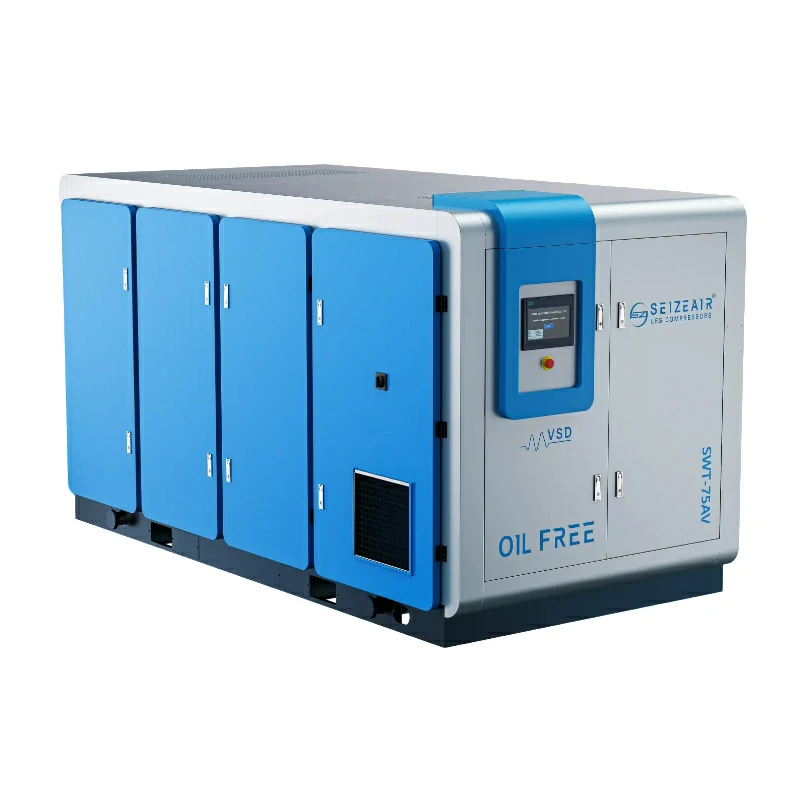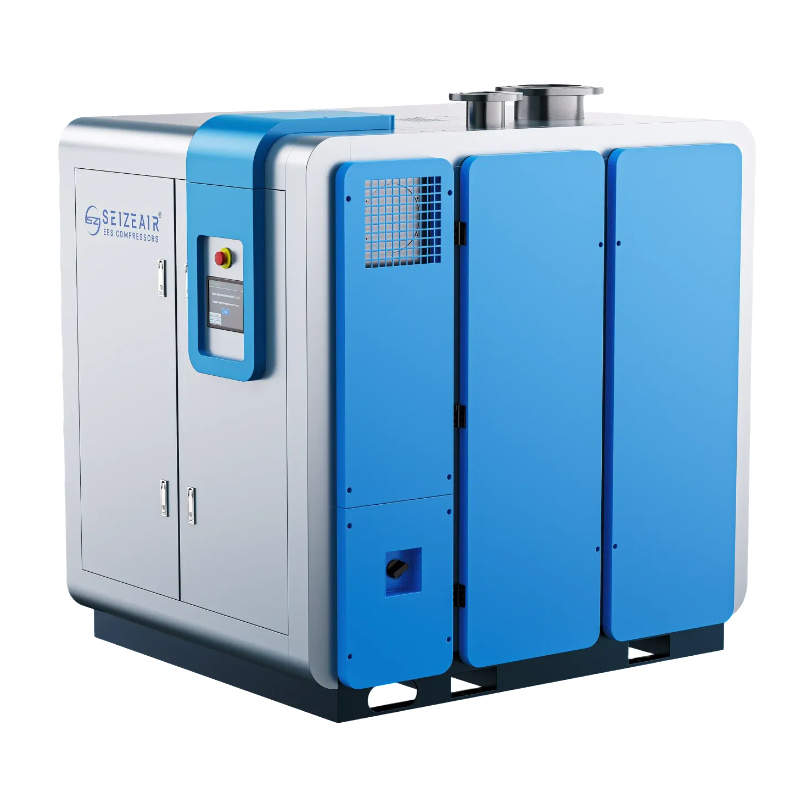


Picking a screw compressor manufacturer in China in 2026 is no longer the gamble it used to be. A decade ago, the phrase mostly conjured up pictures of cheap copycat workshops; today, it points to a mature industry with publicly listed groups, ISO-certified plants, IIoT-ready controllers, and rotor profiles that rival anything coming out of Europe. If you’re shortlisting suppliers for a new line, an energy-efficiency retrofit, or an OEM/distribution partnership, this guide walks you through the ten names worth your attention, the technology shifts that are actually changing the market, and the practical questions you should ask before you wire a deposit.
Why are so many global buyers choosing a screw compressor manufacturer in China in 2026?
Three forces are pulling buyers east, and they didn’t appear overnight.
First, the energy-efficiency gap has closed. Until around 2018, European screw compressor manufacturers held a comfortable lead on specific power (kW per m³/min delivered). That lead has shrunk to almost nothing in the oil-injected variable speed segment. Several Chinese screw compressor manufacturers now offer permanent-magnet VSD units with claimed specific power figures under 6.5 kW/(m³/min) at 7 bar, which is the same band the German and Belgian brands advertise. Independent test reports from TÜV and CSA groups back up a number of these claims.
Second, vertical integration has moved up the value chain. The strongest Chinese players don’t just assemble. They cast their own rotors on German or Japanese CNC grinding machines, build their own permanent-magnet motors in-house, and write their own controller firmware. That vertical play lets a Chinese screw compressor factory pass cost savings down the line while keeping tighter control over lead times — usually 15 to 30 days for a standard unit, versus 8 to 12 weeks from a European supplier for an equivalent spec.
Third, export experience has matured. A modern Chinese screw compressor manufacturer usually has a dedicated export department, multilingual after-sales engineers on rotation, and a service network that covers the buyer’s region through local partners. Documentation, CE/UL documentation, and ISO 8573-1 air-quality declarations are routine, not optional.
The net effect: total cost of ownership over a 10-year horizon is often 25 to 40% lower for a Chinese-built unit of comparable efficiency. That’s the number finance teams care about, and it’s the reason procurement officers keep coming back.
What types of screw compressors do Chinese manufacturers actually make?
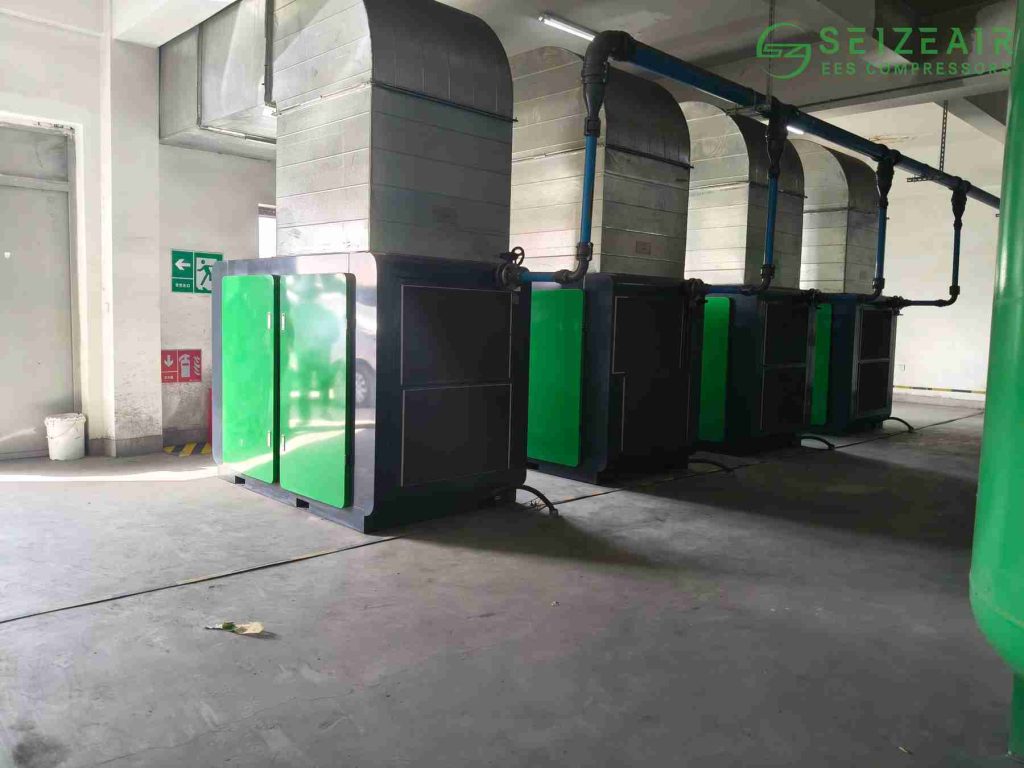
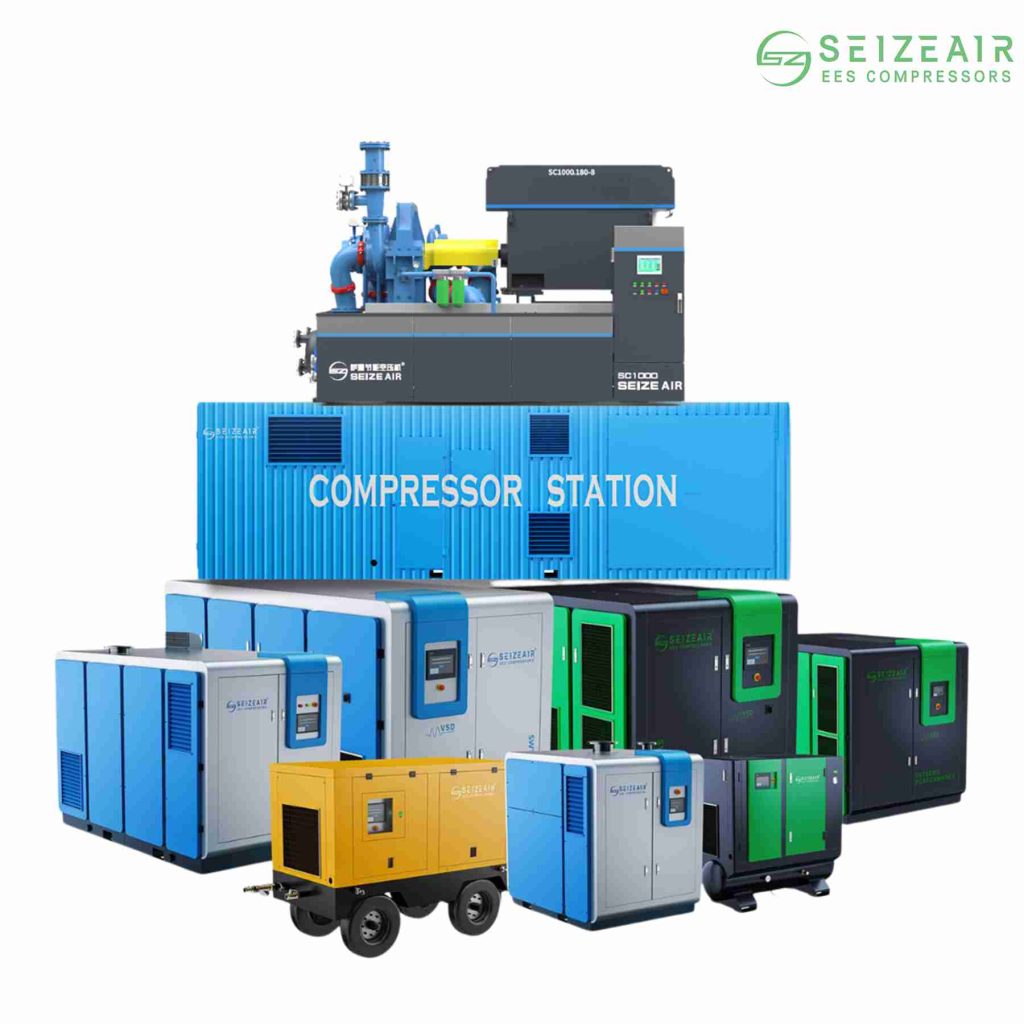
The category has expanded well beyond the single “industrial screw compressor” label. A serious screw compressor manufacturer in China typically offers six core families, each with a different application sweet spot — from oil-injected screw air compressors to oil-free screw air compressors and high-pressure specialty units.
| Family | How it works | Typical pressure | Best for | Energy efficiency |
| Oil-injected fixed speed | Male/female rotors compress air inside an oil-flooded chamber | 7 – 13 bar | Workshops with stable load (8+ hrs/day) | Baseline |
| Oil-injected VSD / PM motor | Inverter + permanent-magnet motor matches output to demand | 7 – 13 bar | Variable load, two-shift operations | 25 – 35% savings vs fixed speed |
| Two-stage oil-injected | Air is compressed in two rotors in series for lower discharge temp | 7 – 13 bar (high eff.) | 24/7 plants, energy-sensitive sites | 8 – 12% savings vs single-stage |
| Oil-free dry (Class 0) | Water-injected or dry twin rotors, no oil in compression chamber | 7 – 10 bar | Pharma, food & beverage, electronics | Higher specific power, no oil contamination |
| Oil-free water-lubricated | Water injected into the compression chamber acts as coolant and seal | 7 – 10 bar | Pharma, medical air, food | Very clean output, lower discharge temp |
| High-pressure oil-injected | Multi-stage compression with intercooling | 25 – 40 bar | PET blowing, laser cutting, nitrogen generation | Application-specific |
Most established Chinese screw compressor suppliers will also build low-pressure units (2 – 4 bar) for textile and fermentation plants, oil-free scroll compressors for small clean-air loads, and centrifugal compressors for high-volume air at moderate pressure.
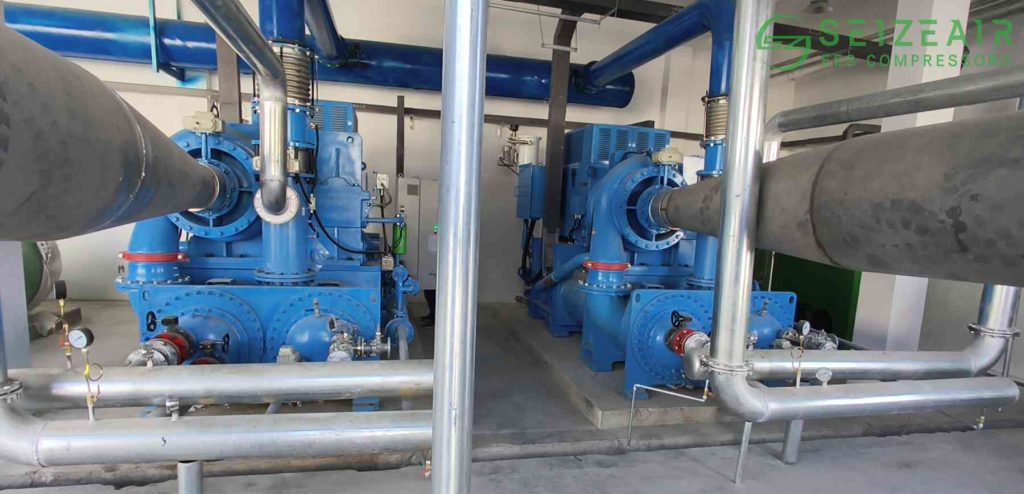
How a rotary screw compressor actually compresses air
Intake Air Rotor Pair Discharge Air
| (Male + Female) |
v ____
[Filter] —> ( Suction Port ) ====> ( Compression ) —> [Oil Separator] —> [Aftercooler] —> [Dryer] —> End User
| Chamber |
| |
Low Pressure High Pressure
(Atmospheric) (7-13 bar typical)
Air Volume: Large —> Small (volume decreases as pressure rises)
Air Temperature: Cool —> Hot (typically 70-95°C at discharge)
Air Purity: 100% —> 99.9% (oil removed via separator; water removed via dryer)
What happens inside: a male rotor (typically 4-6 lobes) drives a female rotor (typically 5-7 flutes) without touching. As the rotors mesh, the trapped air pocket shrinks along the housing, the pressure climbs, and the heated, oil-mixed air pushes out through the discharge port. The oil’s job is to seal the gaps, cool the rotors, and absorb most of the heat. That’s why oil-injected designs run cooler and tighter than oil-free.
How do you evaluate a screw compressor manufacturer in China before placing an order?
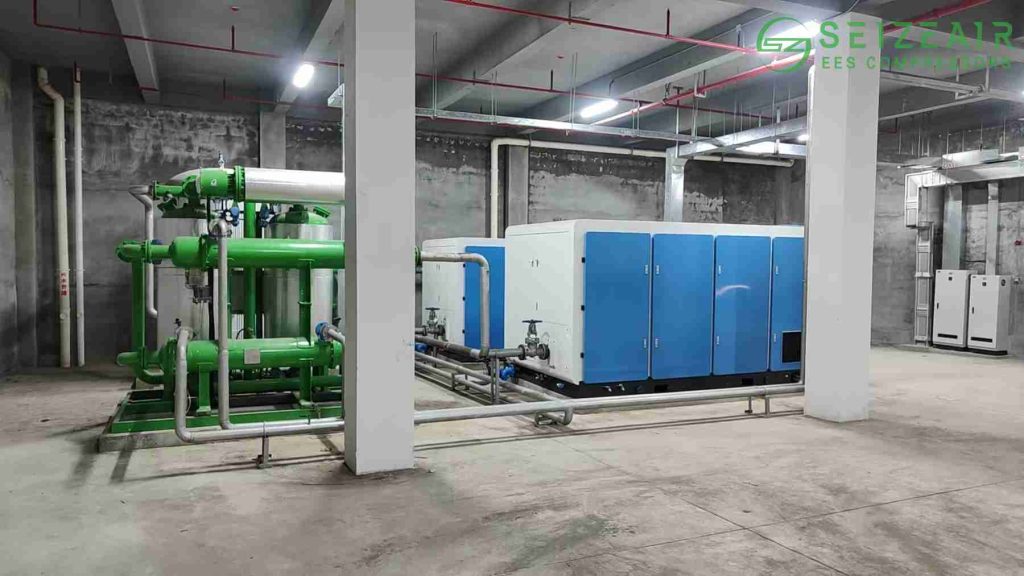
Shortlisting is one thing; surviving the first 12 months of ownership is another. Here’s a practical checklist most seasoned buyers run through.
1. Engineering depth, not just product count. Ask how many R&D engineers the manufacturer employs relative to total headcount. A ratio above 8% usually signals a serious engineering culture. Ask to see the rotor profile, the controller firmware version, and the motor nameplate — those three tell you more than a 60-page catalog. The rotor profile in particular, because rotor geometry is the single biggest determinant of specific power and noise.
2. Test reports that are actually recent. ISO 1217 (performance), ISO 2151 (noise), and ISO 8573-1 (air quality) test certificates should be dated within the last 18 months. Older reports may not reflect the current production line.
3. Manufacturing footprint. A single-site factory is a single point of failure. Look for a screw compressor manufacturer that operates at least two production halls and keeps a buffer of critical components (rotors, motors, inverters) on hand.
4. Reference customers in your industry.A compressor that works in a steel mill may not be the right spec for a semiconductor fab. Ask for three references in your exact vertical — and call them. If you need a unit for underground use, ask specifically for a mine safety air compressor reference.
5. After-sales coverage in your country. A good Chinese screw compressor supplier will either have a service partner in your region or be willing to fly an engineer out within 72 hours. Get this in writing.
6. Warranty terms that aren’t boilerplate. Standard is 2 years on the whole machine, 3 – 5 years on the airend, lifetime on the rotor profile. Anything less deserves a follow-up question.
7. Customization capability. If you need a non-standard color, a 60 Hz motor, an integrated VSD dryer, or a special voltage, ask the factory directly. Most mid-to-large Chinese manufacturers will accommodate, especially for repeat orders.
A single conversation with the export manager often reveals more than ten rounds of email. If the manufacturer won’t pick up the phone or schedule a video tour, walk away.
Top 10 screw compressor manufacturer China options in 2026
Below is the list, ranked by a blend of overall brand recognition, export volume, technical capability, and 2026 market momentum. The list isn’t paid placement, and inclusion doesn’t equal endorsement — every buyer’s spec sheet is different.
1. Seize Air (Shanghai)
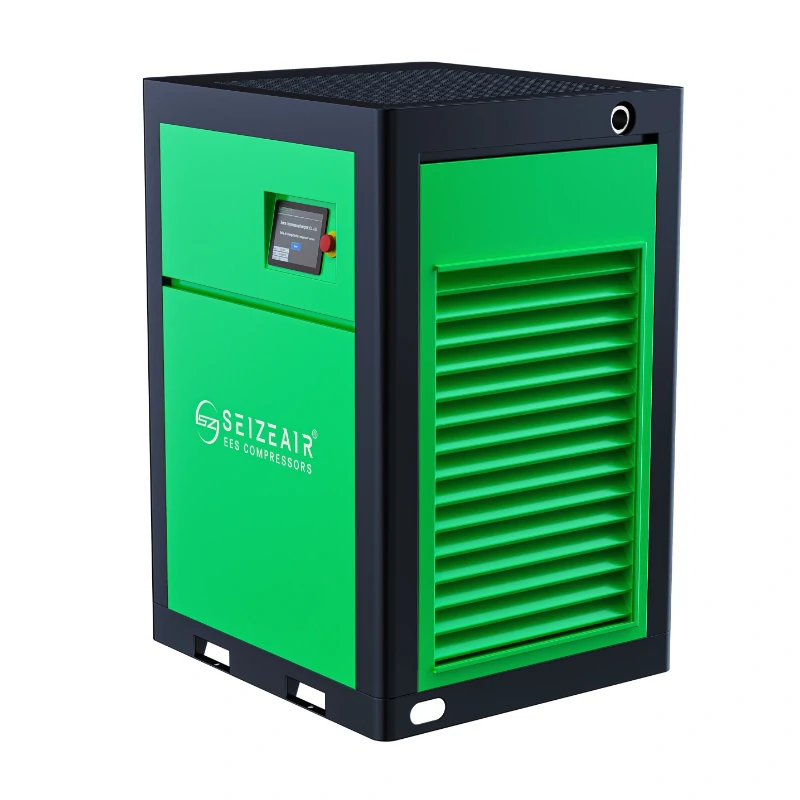
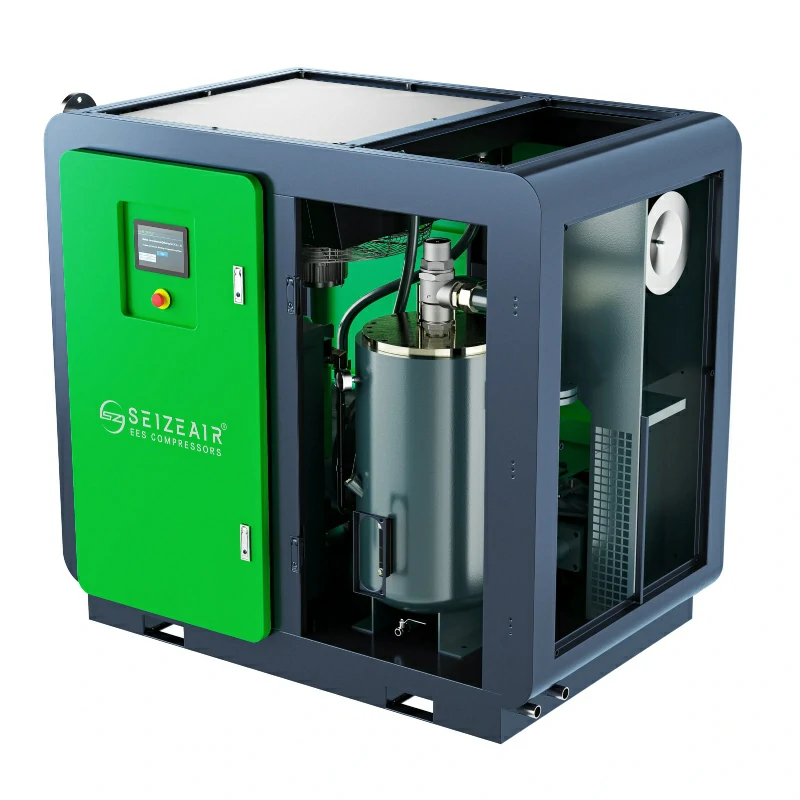
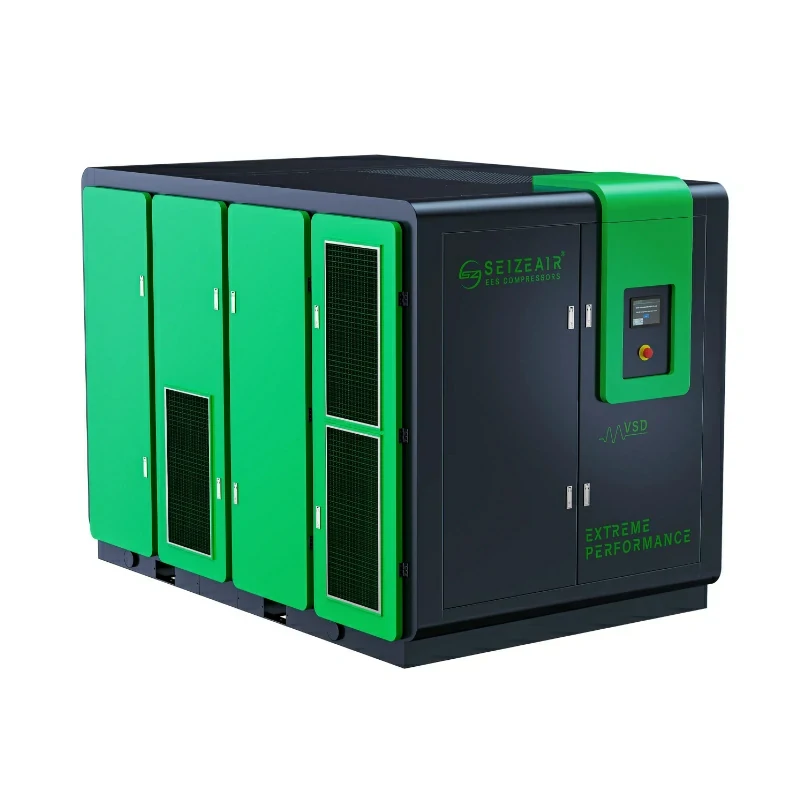
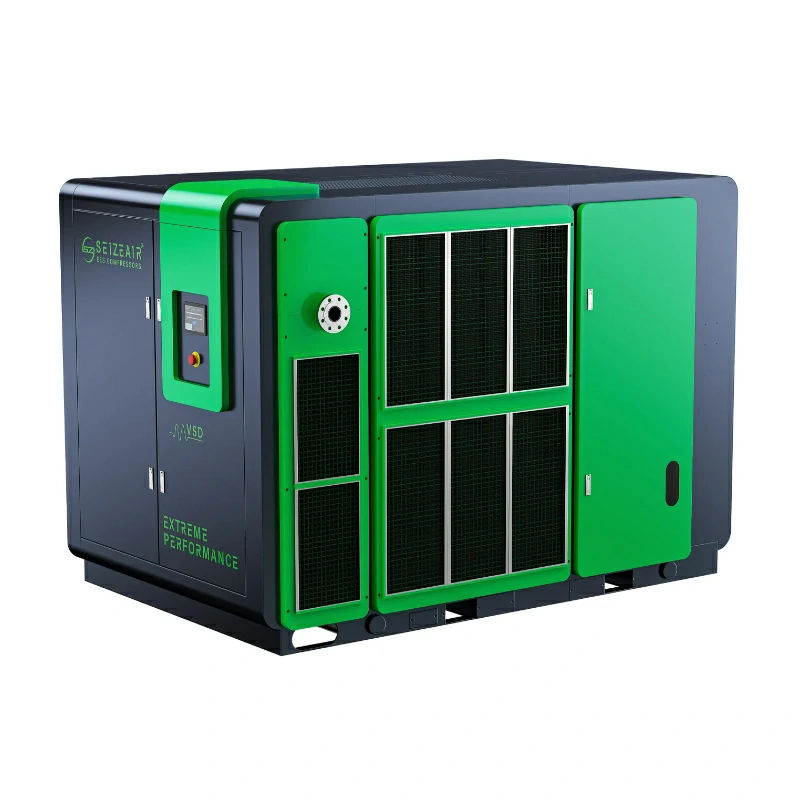
Seize Air is the energy-saving specialist of this list. Headquartered in Shanghai with a 40,000 m² plant, the company has shipped more than 80,000 units and holds over 101 patented technologies. The product range is unusually deep for its size: oil-injected single-stage and two-stage PM VSD units from 7.5 kW all the way to 560 kW, dry oil-free and water-lubricated oil-free Class 0 compressors, magnetic levitation blowers and magnetic levitation compressors, plus a full downstream line (dryers, filters, nitrogen generators, containerized stations). For buyers who care about specific power and lifetime electricity cost, the energy-saving lineup is the headline. If you’re sourcing an oil-injected screw compressor manufacturer in China with a credible energy-efficiency story, Seize Air deserves a spot on your shortlist.
2. Kaishan Compressor (Quzhou, Zhejiang)
One of the largest publicly listed compressor groups in China. Kaishan has the broadest product range of any domestic player — everything from 4 kW workshop units to 355 kW industrial two-stage compressors, plus a meaningful oil-free division. The brand is well known in Southeast Asia, the Middle East, and Latin America. If you need a single supplier for both oil-injected and oil-free across multiple power bands, Kaishan is the most reliable default.
3. Hongwuhuan Group (Shanghai)
Hongwuhuan is a long-established screw compressor manufacturer in China, founded in the late 1990s, with a strong presence in the domestic market and steady export growth into Africa, Russia, and Central Asia. The product line is conservative but solid: oil-injected fixed speed and VSD units from 7.5 to 200 kW. Pricing is competitive, lead times are short, and the company is known for being flexible on OEM/ODM work.
4. Sany Heavy Industry (Changsha, Hunan)
You probably know Sany for excavators and concrete pumps, but the industrial compressor division is quietly significant. Sany brings heavy-industry quality control and a global service network that already covers most major markets. The product range is more focused — primarily oil-injected VSD units from 7.5 to 250 kW — but the build quality is high and the after-sales backbone is unmatched among Chinese players.
5. Denair (Shanghai)
Denair has built a reputation as a specialist in oil-free screw compressor technology, with both dry-type and water-lubricated Class 0 lines. The company is one of the more active Chinese exhibitors at European compressor trade shows. For pharma, food & beverage, and electronics buyers, Denair is often the first name on the shortlist. The oil-injected line is smaller and less mature than the top three, so don’t go to Denair for a 7-bar workshop compressor if you don’t need oil-free.
6. Fusheng Industrial (Shanghai / Taiwan)
Technically a Taiwanese-owned manufacturer with major production in mainland China, Fusheng has been selling compressors globally for over 60 years. The brand carries trust in markets where Chinese factories are still viewed with skepticism. The product range covers oil-injected fixed speed and VSD, plus oil-free screw and oil-free scroll. Pricing is mid-to-high and lead times are a bit longer than pure-domestic competitors.
7. Hanbell Precision (Shanghai / Taiwan)
Another Taiwanese-owned screw compressor manufacturer in China, Hanbell is strongest in oil-free and high-pressure applications. The brand is highly respected in the PET blowing industry and in HVAC refrigeration compressors. If your application needs 30+ bar or a tightly controlled Class 0 oil-free spec, Hanbell is a strong candidate. For general workshop air, the line is less competitive on price.
8. Shenyang Blower Works (Shenyang, Liaoning)
SBC is one of the oldest heavy-industrial equipment manufacturers in China, best known for centrifugal compressors, blowers, and turbo machinery. The screw compressor line is a smaller part of the business, but it benefits from the same metallurgical expertise. If you need very large oil-free centrifugal compressors (above 200 kW) alongside a smaller screw unit, SBC can supply both from one engineering team.
9. Liuzhou Tech Compressor (Liuzhou, Guangxi)
Liuzhou Tech is a state-affiliated screw compressor manufacturer with a strong domestic footprint, especially in southern China. The product line is heavily skewed toward medium and large oil-injected fixed-speed units (75 – 355 kW), which is exactly what heavy industry and mining sites need. The export presence is more limited, but the build quality is honest and pricing is aggressive.
10. Zhejiang Refine Compressor (Quzhou, Zhejiang)
Zhejiang Refine is a smaller, more specialized player that has carved out a niche in laser cutting air compressors, oil-free scroll, and compact high-pressure units. It’s the kind of supplier you bring in for a specific application rather than a full plant air supply. For B2B buyers targeting the laser cutting OEM channel, Refine is a name worth knowing.
Quick comparison: the top 10 screw compressor manufacturers in China at a glance
| # | Manufacturer | HQ / Plant location | Core strength | Power range | Oil-injected | Oil-free | Notable export regions | Best for |
| 1 | Seize Air | Shanghai | Energy-saving PM VSD, full range | 7.5 – 560 kW | Yes | Yes (Class 0) | Global (200+ countries) | Energy retrofit, OEM |
| 2 | Kaishan | Quzhou, Zhejiang | Broadest catalog, listed group | 4 – 355 kW | Yes | Yes | SE Asia, ME, LatAm | Multi-product sourcing |
| 3 | Hongwuhuan | Shanghai | Cost-competitive, flexible OEM | 7.5 – 200 kW | Yes | Limited | Africa, Russia, CIS | Budget-conscious buyers |
| 4 | Sany | Changsha, Hunan | Heavy-industry QC, global service | 7.5 – 250 kW | Yes | Limited | Global | Industrial-grade buyers |
| 5 | Denair | Shanghai | Oil-free specialist | 7.5 – 315 kW | Yes | Yes (Class 0) | EU, ME, Asia | Pharma, food, electronics |
| 6 | Fusheng | Shanghai / Taiwan | Established brand, mid-high tier | 7.5 – 250 kW | Yes | Yes | Global | Brand-sensitive buyers |
| 7 | Hanbell | Shanghai / Taiwan | High-pressure, oil-free | 7.5 – 200 kW | Yes | Yes | Global PET, HVAC | 30+ bar, Class 0 |
| 8 | Shenyang Blower | Shenyang, Liaoning | Centrifugal + large oil-free | 75 – 2000 kW | Limited | Yes | Domestic, CIS | Heavy industrial |
| 9 | Liuzhou Tech | Liuzhou, Guangxi | Medium/large fixed-speed | 75 – 355 kW | Yes | No | Limited | Mining, heavy industry |
| 10 | Zhejiang Refine | Quzhou, Zhejiang | Laser cutting, high pressure | 7.5 – 75 kW | Yes | Yes (scroll) | Asia, EU | Laser OEM, specialty |
A note on this table: the rankings reflect overall market presence and product depth, not a strict quality ladder. The right screw compressor manufacturer in China for your project depends on your pressure profile, duty cycle, air-quality requirements, and channel strategy.
What technology trends are shaping Chinese screw compressor manufacturers in 2026?
The Chinese screw compressor industry spent most of the last ten years catching up on European efficiency benchmarks. 2026 is the first year where some of the technology trends are pushing ahead rather than following.
| Trend | What’s changing | Why it matters | Adoption in 2026 |
| Permanent-magnet VSD as default | PM motors + VSD inverters are now baseline on 7.5 – 250 kW oil-injected | 25 – 35% energy savings vs fixed speed | >70% of new mid-power sales |
| Two-stage compression at mid-power | Two-stage PM VSD available from 15 kW up | Lower discharge temp, higher efficiency, longer bearing life | Growing fast, 20% of new installs |
| Class 0 oil-free water-lubricated | Water injection replaces oil as the seal and coolant | Pharma and food applications, lower total cost | Mature, 15% of new oil-free orders |
| IoT controllers and remote monitoring | Built-in 4G/5G modules, cloud dashboards, predictive maintenance | Reduces unplanned downtime, enables service contracts | Standard on 75 kW+, growing on smaller units |
| IE5 / IE6 ultra-premium motors | Permanent-magnet motors with even lower losses | Small additional savings, regulatory compliance in EU | Standard on most new PM VSD units |
| Heat recovery modules | Waste heat captured for hot water, heating, or process use | Pays back in 12 – 24 months in cold climates | Niche but growing in EU and N. China |
| VSD dry oil-free | Variable speed on dry oil-free compressors | Energy savings in oil-free applications | New, mostly premium models |
For buyers evaluating a screw compressor manufacturer in China in 2026, the practical question is no longer “do they offer PM VSD?” — that’s table stakes. The question is whether the manufacturer offers a credible two-stage PM VSD line, an oil-free variant that fits your application, and an IoT controller you can actually integrate with your plant SCADA.
How much does it actually cost to import a screw compressor from a Chinese factory?
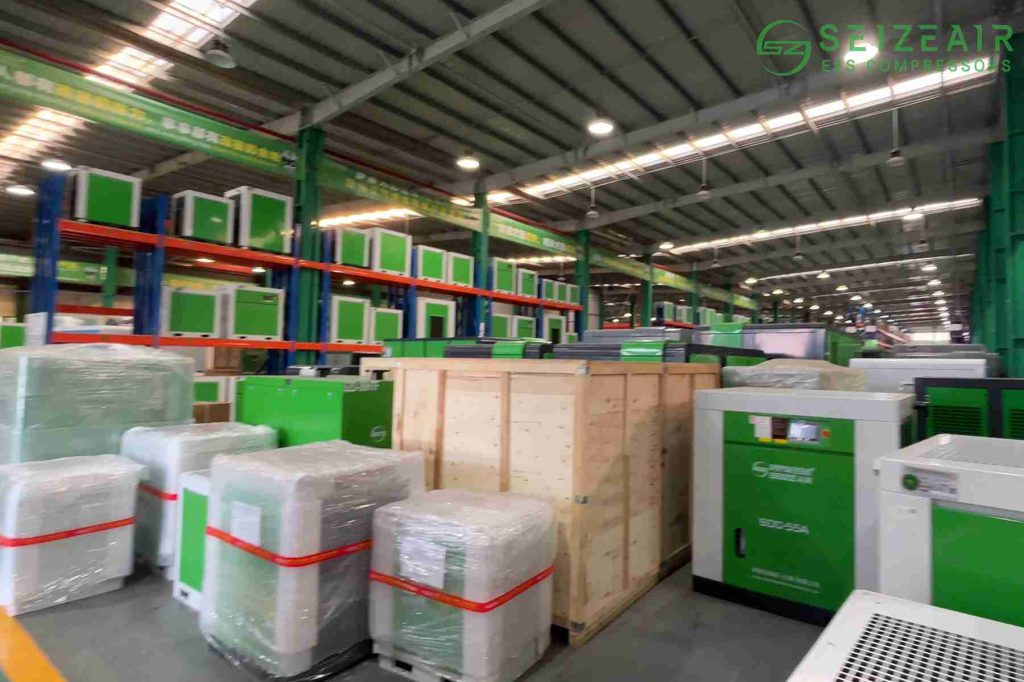
A realistic landed cost has four buckets, and buyers who only look at the FOB price get surprised at the port.
| Cost bucket | Typical range (mid-power oil-injected PM VSD, 75 kW) | Notes |
| Ex-works / FOB price | $5,000 – $8,500 | Varies by brand, configuration, order volume |
| Inland freight (factory to port) | $150 – $300 | Shanghai/Ningbo to sea port is usually under 200 km |
| Sea freight (20′ FCL, 1 unit) | $400 – $900 | To US West Coast ~$1,800 – $2,500; to EU ~$500 – $800; to ME ~$300 – $500 |
| Customs duty + VAT (import side) | 0 – 10% of CIF | Depends on destination country and HS code; many industrial compressors fall under 0 – 3.5% |
| Last-mile delivery + install | $300 – $1,200 | Higher if site is remote or rigging is required |
| First-year spare parts kit (recommended) | $400 – $800 | Filters, oil, belt, sensors — buy with the unit |
A 75 kW oil-injected PM VSD compressor from a reputable Chinese manufacturer typically lands between $7,000 and $12,000 all-in for a buyer in the EU, North America, or the Middle East, depending on configuration and shipping terms. That’s roughly 40 – 60% of what a comparable European unit would cost ex-works. Buyers looking for a true 75 kW oil-injected PM VSD spec should compare the published FOB quotes against this benchmark before signing.
Two ways to drive the number down further: (1) order 5+ units in a single shipment to share the FCL freight and the customs broker fees, and (2) consolidate spare parts and service kits in the same container as the main units.
Sourcing workflow from a Chinese screw compressor manufacturer
[Buyer] [Manufacturer] [Logistics]
| | |
|— 1. RFQ (spec) ——>| |
|<– 2. Quote + datasheet-| |
|— 3. Sample order —->| |
|<– 4. Production photos-| |
|<– 5. FAT video ——–| |
|— 6. PO + deposit —->| |
| |— 7. Production (15-30d)-|
| |— 8. QC + testing ——-|
|<– 9. Inspection report-| |
|— 10. Balance payment->| |
| |— 11. Export packing —-|
| |— 12. Container loading->|—> [Ocean freight]
| | |— 13. Customs + shipping docs
|<– 14. B/L, invoice, —-| |
| packing list, certs | |
|— 15. Customs clearance (buyer side) —————>|
|— 16. Last-mile + commissioning ——————–>|
|— 17. After-sales (remote + spare parts) ———->|
This 17-step path is the realistic version. From RFQ to a running compressor on the buyer’s floor, expect 45 to 75 days door-to-door for a standard unit.
Which screw compressor manufacturer in China is right for your industry?
Different verticals have very different air-quality, pressure, and reliability requirements. Here’s a quick read-across.
| Industry | Pressure need | Air quality | Top features to look for | Suggested supplier type |
| Auto manufacturing | 7 – 10 bar | ISO 8573-1 Class 3-4 | Two-stage PM VSD, IoT monitoring | Energy-saving specialist (Shanghai-based OEM) |
| Pharma & medical | 7 – 10 bar | Class 0 oil-free | Dry or water-lubricated oil-free | Oil-free specialist (Denair, Hanbell) |
| Food & beverage | 7 – 10 bar | Class 0 oil-free, food-grade | Water-lubricated, sanitary piping | Oil-free specialist (Denair, Hanbell) |
| Electronics / semiconductors | 7 – 10 bar | Class 0, low dew point | Dry oil-free + adsorption dryer | Oil-free specialist + downstream |
| Textile | 2 – 4 bar | Class 4-5 | Low-pressure, high-volume | Low-pressure specialist (Kaishan, others) |
| PET bottle blowing | 30 – 40 bar | Class 2-3 | High-pressure multi-stage | High-pressure specialist (Hanbell, Refine) |
| Laser cutting | 12 – 16 bar | Class 1-2 (low dew point) | High-pressure + refrigerated dryer | Laser cutting specialist (Refine) |
| Mining | 7 – 10 bar | Class 4-5 | Explosion-proof, rugged | Heavy industrial (Sany, Liuzhou Tech) |
| Construction site | 7 – 14 bar | Class 4-5 | Diesel/electric portable | Mobile specialist (diesel mobile compressor lines) |
| Glass / cement | 7 – 10 bar | Class 4-5 | Two-stage, high ambient temp | Industrial heavy-duty (Kaishan, Sany) |
| Nitrogen / oxygen generation | 7 – 10 bar | Class 1-2 | High-pressure + adsorption dryer | High-pressure + downstream package |
If your industry isn’t in the table, the rule of thumb is straightforward: match the air quality (ISO 8573-1 class) first, match the pressure profile second, and let the energy-efficiency spec fall out from those two.
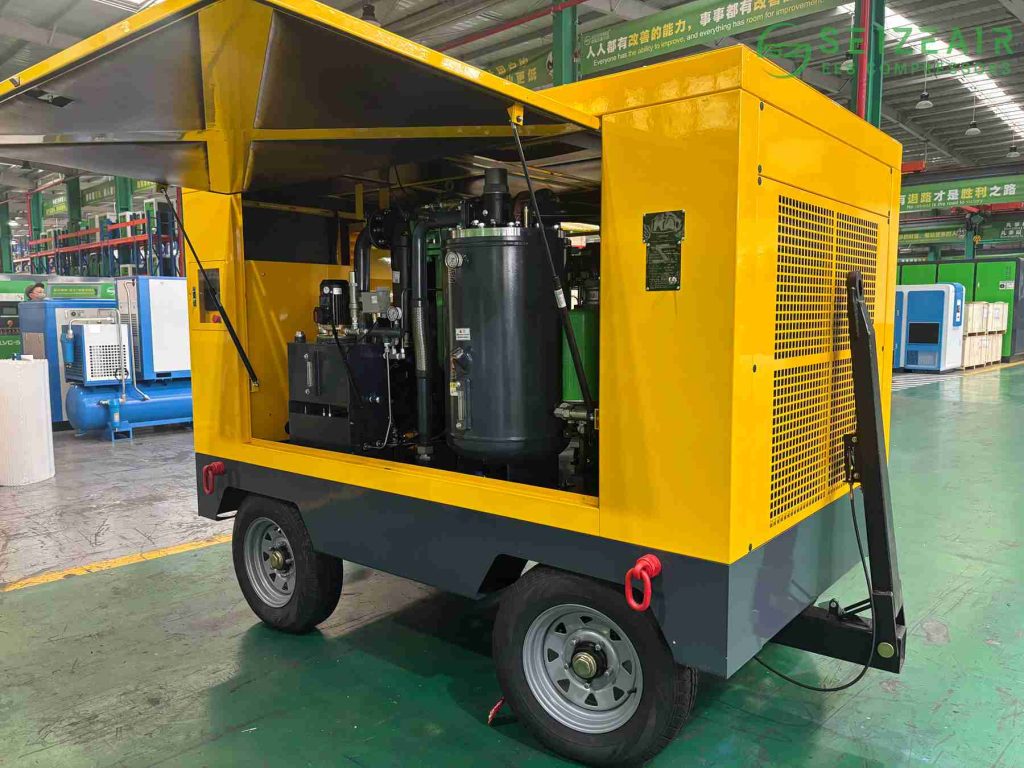
How do you verify a Chinese screw compressor manufacturer’s quality and certifications?
Trust, but verify. Here are the documents and signals worth asking for — and a few red flags.
| What to ask for | What it tells you | Red flag |
| ISO 9001 certificate (current) | The factory has a certified quality system | Expired or missing |
| ISO 14001 / 45001 | Environmental and safety management | Only ISO 9001 alone in 2026 |
| CE / UKCA marking (for EU/UK) | Compliant with EU directives | Self-declared without a Notified Body number |
| UL / cUL listing (for North America) | Electrical safety for the US/Canadian market | No UL on the control panel |
| ISO 1217 test report | Actual performance vs claimed | Generic catalog figure with no test reference |
| ISO 8573-1 air purity report | Confirms the oil content and particle spec | “Class 0” claimed with no third-party report |
| Energy-saving certification (e.g. China Energy Label, Tier 2) | Government-verified efficiency | No third-party test at all |
| Patent portfolio (rotor, motor, controller) | In-house R&D depth | Zero patents but high R&D claims |
| Customer references in your industry | Real-world performance | Only references in unrelated industries |
| Factory audit video or live tour | Actual production capacity | Refuses to share any video or to allow a third-party audit |
A word on factory audits: if you’re placing a first order above $50,000, consider hiring a third-party inspection company (SGS, TÜV, BV, or a local Chinese QA firm) to do a pre-shipment inspection. The cost is typically 0.5 – 1% of the order value and pays for itself many times over if it catches a quality drift.
Common mistakes buyers make when sourcing a screw compressor from China
Most sourcing failures are not about the machine — they’re about the process. These are the recurring patterns we see.
1. Choosing on price alone. The cheapest quote is usually the most expensive in year three. Energy cost over 10 years is typically 5 to 10 times the purchase price, so a 10% efficiency gap is far more expensive than a 20% price gap upfront.
2. Skipping the factory audit. A polished Alibaba listing can hide a trading company with no production capacity. Confirm that the supplier is the actual factory (or has a verifiable partnership with one).
3. Ignoring the controller. The compressor itself is hardware; the controller is what you live with for ten years. Ask for a demo of the controller UI, the alarm log, the parameter list, and the remote access option. If the interface looks like 2005, the firmware probably is too.
4. Under-specifying the dryer. A screw compressor without a properly sized refrigerated dryer delivers wet air, which corrodes your downstream equipment and ruins your air quality spec. Many buyers treat the dryer as an afterthought and end up replacing it within 18 months. For applications needing pressure dew points below -20°C, an adsorption dryer is the right call.
5. Forgetting the heat rejection. A 75 kW compressor rejects around 75 kW of heat into the room. If your compressor room ventilation was designed for a 20-year-old fixed-speed unit, a modern PM VSD will still cook itself. Plan the airflow.
6. Not negotiating spare parts upfront. A 5-year spare parts bundle ordered with the machine costs a fraction of what the same parts cost in year four when you need them urgently. Build this into the initial contract.
7. Skipping language and documentation. Make sure the manuals, controller menus, and alarm messages are available in your language. Many Chinese manufacturers offer English manuals, but few offer Spanish, Portuguese, or Arabic unless you ask.
8. No commissioning plan. A compressor that arrives on a pallet is not yet a compressor. The oil must be filled, the vibration isolation pads set, the controller commissioned, and the dryer’s dew point verified. Plan for a 2-day commissioning with a qualified technician — either yours or the manufacturer’s.
Avoiding these eight mistakes won’t make a bad supplier good, but it will make a good supplier great.
FAQ:
How do I know if a Chinese screw compressor manufacturer is the actual factory or a trading company?
Ask for their business license, look up the registered scope on China’s National Enterprise Credit Information Publicity System, and ask to see a recent factory video with a dated newspaper or production board visible. A genuine factory will say yes to all three without hesitation.
What’s the typical MOQ when buying directly from a Chinese screw compressor manufacturer?
For standard catalog units, MOQ is usually 1 unit, though pricing is significantly better at 5+ units. For custom OEM/ODM orders (custom color, custom logo, custom controller UI), MOQ is typically 5 – 20 units.
How long is the warranty from a Chinese screw compressor manufacturer?
Standard is 2 years on the whole machine and 3 – 5 years on the airend. A few premium manufacturers offer longer terms on the airend. Always get the warranty in writing, in English, and signed.
Can I get a custom voltage and frequency?
Yes. Most Chinese manufacturers offer 380V/50Hz, 415V/50Hz, 460V/60Hz, and 480V/60Hz as standard options. Custom voltages (e.g. 220V three-phase for some African markets) are also available but may carry a small upcharge.
How is shipping handled — FOB, CIF, or DDP?
Almost all Chinese screw compressor manufacturers quote FOB Shanghai/Ningbo as the default. CIF to a major port is common; DDP (delivered, duty paid) is offered by some suppliers for buyers in markets with complex customs procedures. Pick the one your logistics team is most comfortable with.
What’s the difference between a Class 0 oil-free compressor and a regular oil-injected one?
Class 0 (per ISO 8573-1) means the compressed air contains less than 0.01 mg/m³ of oil — effectively zero. A regular oil-injected compressor delivers air with 1 – 5 mg/m³ of oil, which is fine for general workshop use but not for pharma, food, or electronics.
How long does a Chinese-built screw compressor last?
With proper maintenance, an oil-injected unit typically runs 60,000 – 100,000 hours before airend overhaul; an oil-free unit typically 40,000 – 80,000 hours. The numbers depend heavily on ambient temperature, duty cycle, and air quality of the intake.
Get a quote from a trusted screw compressor manufacturer in China
Choosing a screw compressor manufacturer in China is ultimately a relationship decision, not a spec sheet decision. Specs can be faked, but a supplier who answers the phone at 11 PM your time, sends a video of your exact unit being tested, and follows up six months after delivery to ask how it’s running — that supplier is the one you want for the next ten years.
If you’d like a detailed quotation, a factory tour (in person or live video), or a tailored recommendation for your specific application, the team at Seize Air is ready to help. You can also read more about the company’s manufacturing footprint and global service network before getting in touch. Share your working pressure, required airflow, duty cycle, and target industry, and we’ll come back with a configuration, a price, and a lead time — usually within one working day. The earlier you reach out, the more time we have to fine-tune the spec before production starts.