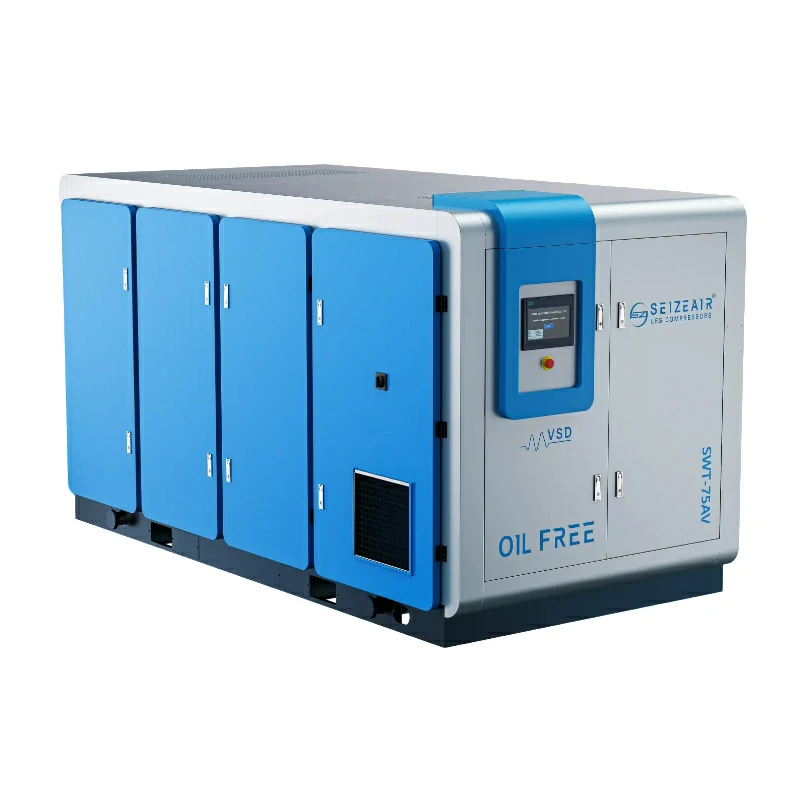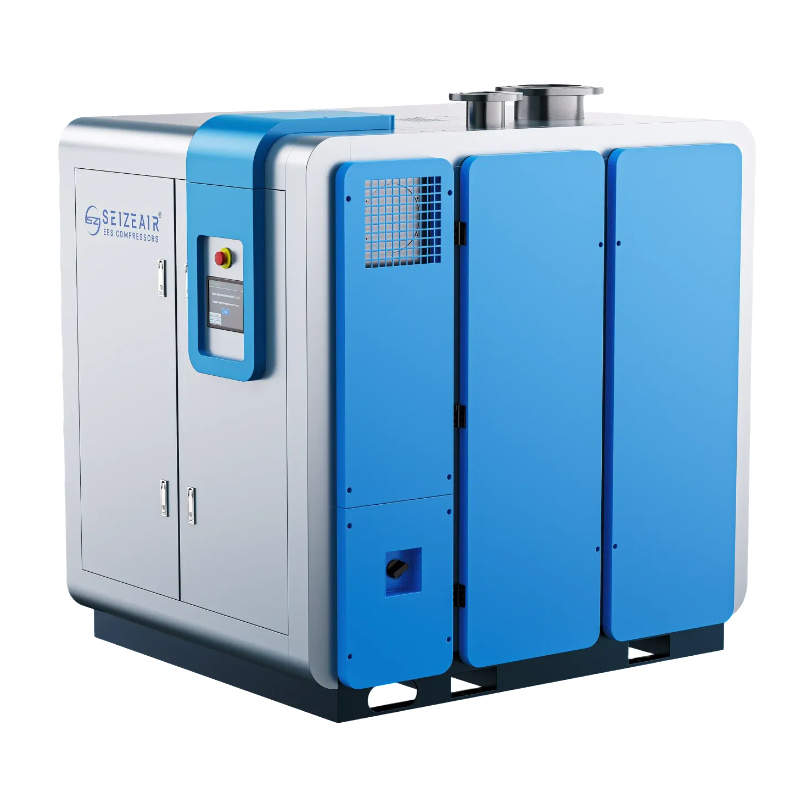


Oil injected vs oil free compressor is the single most consequential choice you make when specifying a compressed air system, because it decides your air purity, your running cost, and how many years the machine will reliably deliver. This guide breaks down both technologies across cost, lifespan, and real-world performance so you can match the right unit to your process instead of guessing from a price tag.
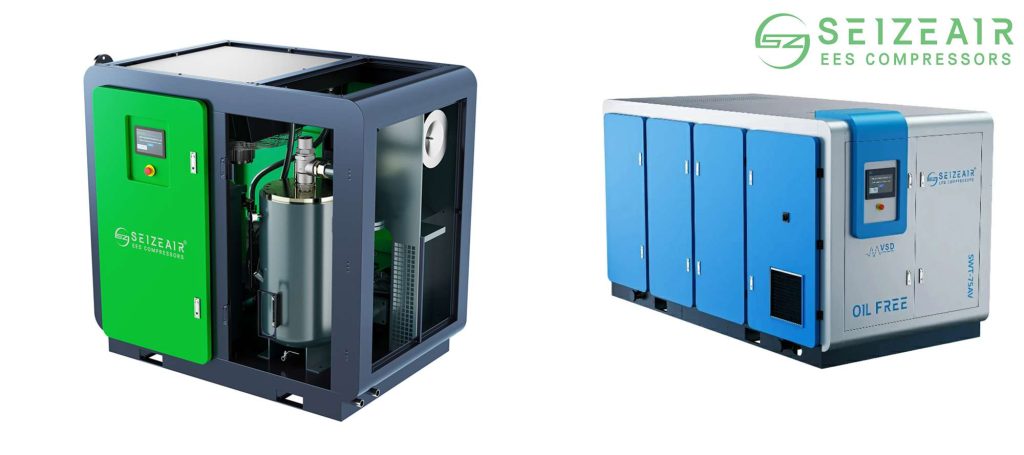
What Is the Difference Between Oil Injected and Oil Free Compressors?
The core difference is simple to state and expensive to ignore: an oil injected compressor sprays lubricating oil straight into the compression chamber, while an oil free compressor keeps oil completely out of the air path. That one design decision cascades into everything else — purchase price, maintenance rhythm, air quality certification, and even how long the unit survives on your factory floor.
With oil injection, the oil does three jobs at once. It lubricates the rotors, it seals the tiny gaps between them so less air slips backward, and it carries away the heat of compression. The trade-off is that oil mist ends up mixed with your air, so you need an oil separator and downstream filters to clean it before it reaches your tools or product.
With an oil-free machine, the compression chamber stays dry and clean. Sealing and cooling are handled by other means — a water film, self-lubricating coatings such as PEEK or PTFE, or two-stage compression with intercooling. The gears and bearings may still use grease, but they sit in a separate chamber that never touches the air stream. The result is air that meets ISO 8573-1 Class 0 straight out of the compressor, with no oil aerosol at all.
| Factor | Oil Injected Compressor | Oil Free Compressor |
|---|---|---|
| Oil in air path | Yes — oil is injected into the chamber | No — chamber is completely oil-free |
| Typical air purity | Class 1 achievable after filtration | Class 0 (highest grade) |
| Upfront cost | Lower | Higher (roughly 20 to 50 percent more) |
| Recurring maintenance | Oil, separator, filters every 2,000 to 4,000 hours | No oil service; simpler but longer intervals |
| Best fit | General industry, pneumatic tools, workshops | Food, pharma, medical, electronics, painting |
How Does an Oil Injected Compressor Work?
If you have ever stood next to a standard rotary screw unit, you have heard an oil injected compressor doing its job. Ambient air enters through the inlet valve and meets two interlocking rotors turning inside a housing. As the rotors mesh, a measured shot of oil is injected right at the suction port. The oil coats the rotors, fills the clearance gaps, and pulls heat out of the air as pressure builds.
The oil-and-air mixture leaves the compression chamber and drops into a separator tank. There, a coalescing element pulls the bulk of the oil out of the air, and a final filter catches the fine mist. The recovered oil is cooled and pumped back into the circuit, so it circulates rather than being consumed.
Air in --> Rotor house --> Oil injected --> Mix heated
   |
   v
Separator tank --> Coalescing element --> Fine filter --> Clean(er) air out
   |
   v
Cooled oil recirculated back to injection point
This design is mature, rugged, and cheap to build, which is exactly why the oil injected screw air compressors family dominates general industrial sites. The downside is that oil is now part of your air system forever, and the separator is a wear item you will replace on a schedule.
How Does an Oil Free Compressor Work?
An oil free compressor reaches the same pressure without letting any lubricant near the air. Three approaches are common, and each handles sealing and cooling differently.
- Dry screw (Class 0): rotors run with a hair-thin gap and are coated with non-stick, low-friction materials. No oil film means higher discharge temperatures (often 180 to 200 degrees C), so these units need robust cooling and precise machining.
- Water-lubricated screw: a film of water seals the rotors and absorbs heat directly. Discharge temperatures stay low (around 50 to 60 degrees C), and the only consumable is clean water plus a filter.
- Oil-free scroll and centrifugal: used for smaller or very large flows, relying on tight tolerances and often magnetic bearings instead of oil-lubricated ones.
Air in --> Compression chamber (NO oil) --> Sealing by coating / water film
   |
   v
Cooled (intercooler or water jacket) --> Class 0 air out
   |
   v
Bearings greased in SEPARATE chamber, never touching air
Notice the key safety feature in that diagram: the lubricated parts live in a sealed-off section. Even if a bearing seal weeps, the leak path does not open into the air stream, which is why oil-free units can still claim Class 0 purity.
Oil Injected vs Oil Free Compressor: Side-by-Side Comparison Table
When procurement teams ask us to justify a higher quote, this is the table we put in front of them. Read it top to bottom and the lifetime picture becomes obvious.
| Specification | Oil Injected | Oil Free |
|---|---|---|
| Residual oil in output | 1 to 3 ppm before filter; under 0.01 ppm after treatment | Below 0.01 mg/m3 (Class 0) as delivered |
| Discharge temperature | 80 to 110 degrees C | 50 to 60 C (water) or 180 to 200 C (dry) |
| Capital cost index | 100 (baseline) | 120 to 150 |
| Service interval | 2,000 to 4,000 hours | 3,000 to 16,000 hours (water); 20,000 to 40,000 hours (dry bearings) |
| Filter pressure drop | Higher (multi-stage needed) | Minimal |
| Typical lifespan | 10 to 15 years | 15 to 20 years |
| Contamination risk to product | Present if filters fail | Essentially none |
Which Is Better: Oil Free or Oil Lubricated Air Compressor?
There is no universal winner, and anyone who sells you one without asking about your process is selling, not advising. The honest answer is: it depends on what your compressed air touches.
If your air only powers pneumatic tools, actuators, and general workshop equipment, an oil lubricated unit is the smarter buy. You get lower capital cost, forgiving maintenance, and air that is perfectly adequate once it passes a coalescing filter. Spending extra on Class 0 purity you will never use is just burning budget.
If your air contacts a product, a patient, or a sensitive surface, oil free stops being a luxury and becomes a compliance requirement. A single drop of oil aerosol in a food line or a cleanroom can trigger a recall, a rejected batch, or a failed audit. In those cases the “expensive” oil-free unit is actually the cheap option once you price the risk of getting it wrong.
We dug into this trade-off by sector in our breakdown of oil-free vs oil-lubricated industrial air compressors, which is worth a read if your plant spans both clean and dirty air uses.
Are Oil Free Compressors More Expensive Than Oil Injected?
Yes on the invoice, usually no over the lifetime. The purchase price of an oil-free screw is roughly 20 to 50 percent higher than an equivalent oil-injected model, and that sticker shock is what stops most buyers. But the purchase price is a small slice of what you actually pay.
Compressed air is notorious for hiding its true cost: electricity typically accounts for 70 to 90 percent of a compressor’s lifetime spend, not the machine itself. Oil-free systems skip the multi-stage oil filtration that an oil-injected system needs, which means lower pressure drop across the air line and fewer watts lost pushing air through filters. Over a ten-year run, those saved watts add up to real money.
Here is the total-cost-of-ownership formula we use with customers, written in plain terms:
TCO = Purchase Price + (Annual Energy Cost x Years) + (Annual Maintenance Cost x Years) + (Annual Filter and Consumable Cost x Years) – Resale Value
Plug in real numbers and the oil-free column often wins on a 7 to 10 year horizon, especially where contamination risk carries a dollar figure. The table below shows a representative mid-size plant.
| 10-Year Cost Item | Oil Injected (USD) | Oil Free (USD) |
|---|---|---|
| Purchase | 40,000 | 58,000 |
| Electricity (70 percent of TCO) | 280,000 | 262,000 |
| Oil, separators, filters | 48,000 | 12,000 |
| Contamination risk provision | 20,000 | 0 |
| Estimated 10-year TCO | 388,000 | 332,000 |
Those figures are illustrative, not a quote, but they reflect what we see across food and pharma installations. Your numbers shift with local power rates and duty cycle.
Do Oil Free Compressors Last Longer? (Lifespan Compared)
On paper and in the field, oil-free machines tend to outlast oil-injected ones. A well-serviced oil-injected screw runs about 10 to 15 years before major airend rebuild. A dry oil-free screw, with its sealed bearing chamber and no oil degradation inside the chamber, commonly reaches 15 to 20 years.
The reason is mechanical, not marketing. Oil injected units circulate hot oil through the system continuously, and even good oil oxidizes and leaves varnish over time. Oil-free rotors avoid that internal fouling. Water-lubricated oil-free units need clean water and periodic sanitizing, but their rotors see far lower thermal stress than a dry screw running at 190 degrees C.
| Component | Oil Injected Life | Oil Free Life |
|---|---|---|
| Airend / rotor set | 10 to 15 years | 15 to 20 years |
| Separator element | Replace every 4,000 hours | Not applicable |
| Bearings | Rebuild with airend | 20,000 to 40,000 hours (dry) |
| Internal fouling | Oil varnish possible | Minimal |
Lifespan still hinges on service discipline. An oil-free unit ignored for years will fail just as surely as a neglected oil-injected one. Our oil-free air compressor selection guide covers the sizing and service questions that protect that lifespan.
Oil Injected vs Oil Free Compressor: Performance and Air Quality
Performance is where the two technologies stop being interchangeable. Both deliver the same pressure and flow on paper, but the air they deliver is not the same air.
Oil-injected output carries trace oil aerosol no matter how good the separator is, because no filter is perfect and filters wear. After a quality coalescing filter you can reach ISO 8573-1 Class 1, which limits total oil to under 0.01 mg/m3 and suits most industrial uses. Oil-free output is certified Class 0, the strictest grade, with total oil content not exceeding 0.01 mg/m3 including vapor and liquid.
| ISO 8573-1 Grade | Total Oil Limit | Reached By |
|---|---|---|
| Class 1 | 0.01 mg/m3 | Oil injected + good filtration |
| Class 0 | Below Class 1 (stated limit) | Oil free by design |
For painting, the difference shows up as orange-peel finish defects and fish-eyes caused by oil contamination. For electronics, it shows up as rejected boards. This is why the choice between dry and water-lubricated oil-free screw compressors matters more than the brand badge on the cabinet.
What Are the Disadvantages of Oil Free Air Compressors?
Oil free is not free of compromise, and pretending otherwise helps no one. The honest drawbacks:
- Higher capital cost. Precision rotors, coatings, and cooling systems cost more to build.
- Higher discharge temperature on dry types. Running at 180 to 200 degrees C means bigger coolers and careful material choice.
- Water quality dependency. Water-lubricated models need clean, treated water; poor water shortens seal life.
- Specialist service. Not every local technician is trained on Class 0 airends, so you need a competent support partner.
- Over-spec risk. Buying Class 0 when you only need Class 1 wastes money you could spend on better dryers or controls.
None of these are deal-breakers for the right application. They are simply the price of purity, and they are predictable costs you can plan around.
Can You Add Oil to an Oil Free Compressor?
This question comes up more than you would expect, usually from someone who bought an oil-free unit and assumes the “no oil” label is just a suggestion. The answer is firm: no, you do not add oil to the compression chamber of an oil-free compressor, and doing so ruins the certification and likely the machine.
The rotors in a dry oil-free screw are engineered with tight, calculated clearances and non-stick coatings. Introducing oil changes the thermal profile, fouls the coating, and breaks the Class 0 promise. The only place oil belongs in an oil-free machine is the separately sealed bearing chamber, and that lubrication is factory-managed — not a top-up you perform in the field.
If your oil-free unit is making metal-on-metal noise, that is a service call, not an oil can. Adding oil to the air side is the fastest way to turn a recoverable repair into a full airend replacement.
When Should You Choose Oil Free vs Oil Injected? (By Industry)
The cleanest way to decide is to ask one question: does my compressed air touch the product, the patient, or a contamination-sensitive surface? If yes, go oil free. If no, oil injected is the rational default.
| Industry | Recommended Type | Why |
|---|---|---|
| Food and beverage | Oil free | Direct product contact, recall risk |
| Pharmaceutical and medical | Oil free | Class 0 and regulatory mandate |
| Electronics and semiconductors | Oil free | Trace oil ruins components |
| Spray painting and coating | Oil free | Prevents finish defects |
| General manufacturing | Oil injected | Cost-effective, air quality adequate |
| Mining and construction | Oil injected | Rugged, low consumable cost |
| Workshops and pneumatic tools | Oil injected | No product contact, budget priority |
There is a clear reason oil-free air compressors are essential for the food and beverage sector, and the same logic extends to any line where a contamination event carries a five-figure or six-figure penalty.
Oil Free vs Oil Lubricated Compressor for Food, Pharma, and Medical
These three sectors are where the oil injected vs oil free compressor debate stops being theoretical. In food filling, oil aerosol can land directly on packaging and product. In pharma, it can compromise a sterile batch. In medical air for breathing, it is a patient-safety issue, not a quality metric.
Medical and laboratory buyers should study the oil-free medical air compressor purity standards before specifying, because the standard (often derived from ISO 8573-1 Class 0 plus local medical gas rules) leaves no room for a “good enough” oil-injected workaround. That grade is reached as standard on purpose-built oil-free screw units, which removes the filter-dependency risk entirely.
Oil Injected Screw vs Oil Free Screw Compressor: Which Screw Type?
Most industrial buyers end up comparing screw designs on both sides, because screws are the workhorse of continuous-duty plants. The screw mechanism is similar — two meshing rotors trapping air in a decreasing volume — but the lubrication strategy splits the families apart.
Oil injected screw compressors use the oil film as a de-facto seal, which lets the rotors run with a slightly larger, more forgiving clearance and cheaper tolerances. That is part of why they cost less. Oil free screw compressors must hold an extremely tight dry clearance, so the rotors are machined to higher precision and coated to survive without an oil film. The engineering premium is real, but so is the air quality.
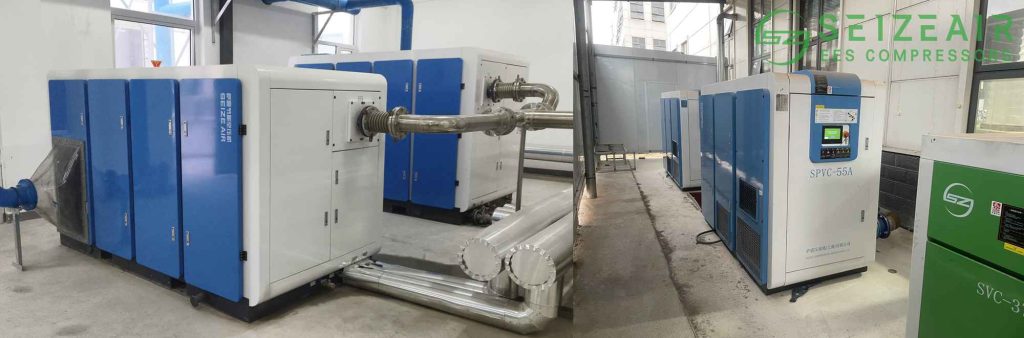
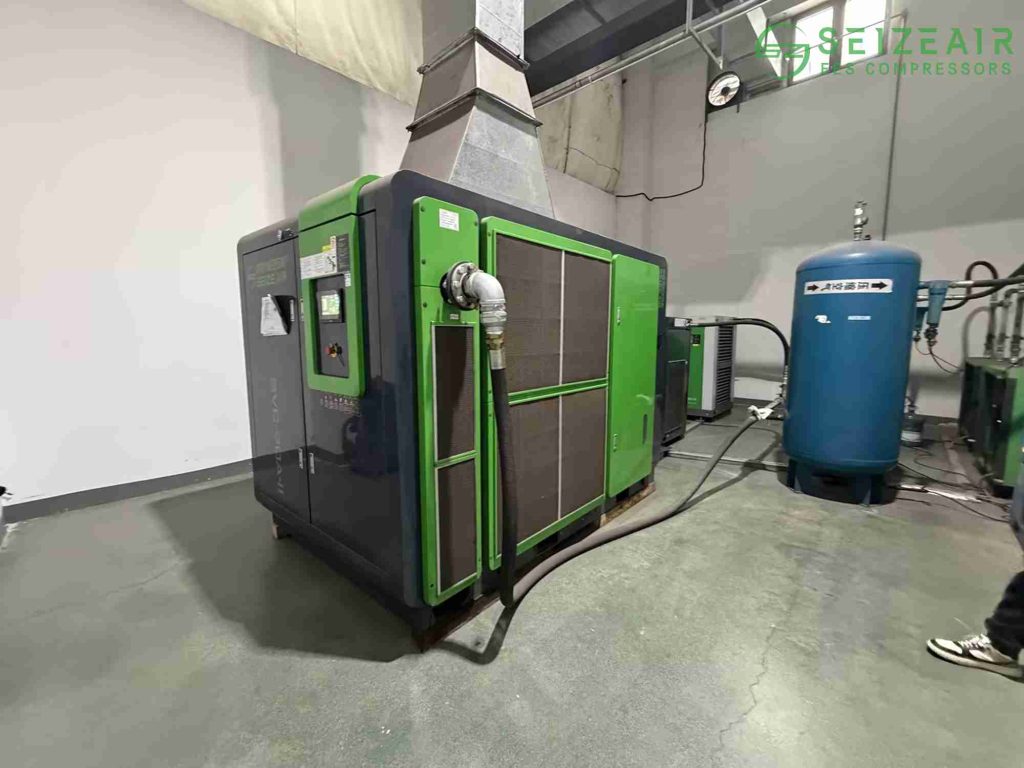
Seize Air builds both screw families, so we are not pushing you to one side by default — the right screw type follows your air purity requirement, not our inventory. If you want to see the hardware itself, a modern oil-free screw air compressor reaches Class 0 as standard and removes the filter-dependency risk entirely.
Maintenance: Oil Free vs Oil Lubricated Air Compressor
Maintenance is where the two technologies feel most different on a Tuesday morning. An oil-injected unit has a predictable, frequent chore list: change oil, swap the separator, replace inlet and coalescing filters, and watch the differential pressure across those elements. Oil-free units delete the oil and separator items entirely.
| Task | Oil Injected Interval | Oil Free Interval |
|---|---|---|
| Oil and separator change | Every 2,000 to 4,000 hours | Not required |
| Air filter | Every 2,000 hours | Every 3,000 to 4,000 hours |
| Water and filter (water-lubricated) | n/a | Every 3,000 to 4,000 hours |
| Bearing service (dry screw) | n/a | Every 20,000 to 40,000 hours |
| Airend rebuild | 10 to 15 years | 15 to 20 years |
Downtime math favors oil free too. Fewer consumable swaps mean fewer scheduled stops, and in a continuous process line every avoided stop is production you keep.
Energy Efficiency and Running Cost Over Time
Both technologies have closed the efficiency gap in recent years. Modern oil-free drives with permanent magnet motors and smart controls now match oil-injected units on specific power, the watts per unit of air. The quieter saving is in the pipe: with no oil filter train, oil-free systems lose less pressure across the line.
A simple way to compare running cost between two candidate units is the specific power relation, written plainly:
Specific Power (kW per m3/min) = Motor Power (kW) / Delivered Air Flow (m3/min)
Lower specific power means more air per watt. When you evaluate oil injected vs oil free compressor quotes, insist on specific power at your actual working pressure, not the catalogue best case, because that is the number your electricity bill cares about.
How to Choose the Right Compressor for Your Plant
Before you ask a vendor for a quote, answer these in order. They will narrow the field faster than any brochure:
- Does compressed air contact product, patient, or sensitive surface? If yes, specify oil free (Class 0).
- What is your duty cycle — continuous, or intermittent shifts?
- What pressure and flow do you actually need at the point of use, after line losses?
- What is your local power rate, and how many running hours per year?
- Do you have trained service support for Class 0 airends nearby?
- What is your planning horizon — under 7 years favors lower capital, over 10 years favors oil free TCO?
If you stall on any of these, that is exactly the moment to bring in a specialist rather than guess. A short air audit usually pays for itself by right-sizing the machine.
Common Mistakes When Comparing Oil Injected and Oil Free Units
We see the same errors repeated, and they are expensive:
- Buying on sticker price alone. The cheaper unit can cost more by year three once energy and filtration are counted.
- Over-specifying Class 0 where Class 1 is enough. Paying for purity you cannot use.
- Under-specifying for a clean process. Saving on capital and losing on a contamination event.
- Ignoring the separator as a recurring cost. It is a consumable, not a one-time part.
- Forgetting service access. A sophisticated oil-free airend with no local support is a liability.
Final Verdict
If you need a one-line answer: choose oil injected when your air is a power source and budget leads, choose oil free when your air is part of the product and purity leads. The oil injected vs oil free compressor decision is really a question about risk and total cost, not about which machine is “better” in the abstract.
For most general industrial sites, an oil-injected screw remains the sensible, cost-effective workhorse. For food, pharma, medical, electronics, and quality painting, oil free is the only defensible specification, and its lifetime economics usually justify the higher ticket.
Still unsure which side your plant falls on? Our engineering team will size the unit to your real demand and air-quality standard, then show you the TCO side by side. Reach out through the form or contact us for a free compressed air audit — we would rather get your specification right than sell you the wrong machine.