

A compressed air dryer is the piece of equipment that strips water vapor out of your compressed air before it reaches your tools, instruments, and products—and picking the wrong one quietly drains money through corrosion, downtime, and rejected batches. This compressed air dryer selection guide breaks down how dryers work, the main types, how to size one to your compressor, the pressure dew point you really need, and what each option actually costs, so you can spec the right unit instead of guessing.
What’s inside
- What a compressed air dryer is and how it works
- Why your system needs one
- The main types of compressed air dryers
- Refrigerated vs desiccant: which to choose
- How to size a compressed air dryer for your compressor
- What pressure dew point you actually need
- What drives compressed air dryer cost
- Best dryer for common applications
- Installation and maintenance
- Mistakes to avoid
What Is a Compressed Air Dryer and How Does It Work?
That question—what is a compressed air dryer and how does it work—comes up more than almost any other in spec meetings, so let’s start there. Compressed air leaves the compressor hot and almost completely saturated with water vapor. The hotter the air, the more moisture it can hold. As that air cools down in your piping, the vapor condenses into liquid water that pools in low spots, freezes in outdoor runs, and washes compressor lubricant into everything downstream.
A compressed air dryer lowers the moisture content to a controlled level, then separates the condensate out before it enters your distribution network. It does this one of two ways: by cooling the air until water drops out (refrigerated and some deliquescent designs), or by passing the air through a drying medium that grabs the vapor chemically or physically (desiccant and membrane designs).
The single number you’ll see on every datasheet is pressure dew point (PDP): the temperature at which water begins to condense out of the air while it’s at your system pressure. A lower PDP means drier air. General plant air usually lands around +3°C PDP; outdoor or sensitive processes drop to -20°C, -40°C, or lower. Everything else in dryer selection flows from that one target.
Why Your System Needs a Compressed Air Dryer
Skipping a dryer—or buying one sized for the wrong job—shows up as real, expensive problems:
- Pipe corrosion and rust contamination. Water plus oxygen plus steel equals rust that flakes into your air stream and scars finished parts.
- Frozen lines in winter. Condensate in an unheated outdoor run turns to ice and shuts a whole line down overnight.
- Sticky, sluggish pneumatic valves. Moisture swells seals and washes away grease, so actuators stall at the worst moment.
- Ruined coatings and paint. A single water droplet in a spray line craters a finish.
- Product contamination in food and pharma. Here, wet, oily air isn’t a nuisance—it’s a compliance failure.
Some processes are unforgiving about this. A compressed air dryer for laser cutting keeps the assist-air path clean so the beam doesn’t sputter; a compressed air dryer for food industry and pharmaceutical lines has to meet oil-free, often sterile, air classes. Even “simple” plants find that dry air pays for itself by cutting maintenance on valves and cylinders.
The Main Types of Compressed Air Dryers
There are four families you’ll actually meet in the field. Each trades cost, energy, and achievable dew point differently.
1. Refrigerated air dryers
The refrigerated air dryer is the default for general plant air. It cools the compressed air with a refrigerant loop (much like a fridge), condenses the water out, and re-warms the air slightly so it doesn’t sweat on the way to the point of use. You’ll find cycling and non-cycling versions: cycling units save energy at part load, non-cycling units hold a steady PDP under steady demand. Realistic floor is about +3°C PDP.
2. Desiccant (adsorption) air dryers
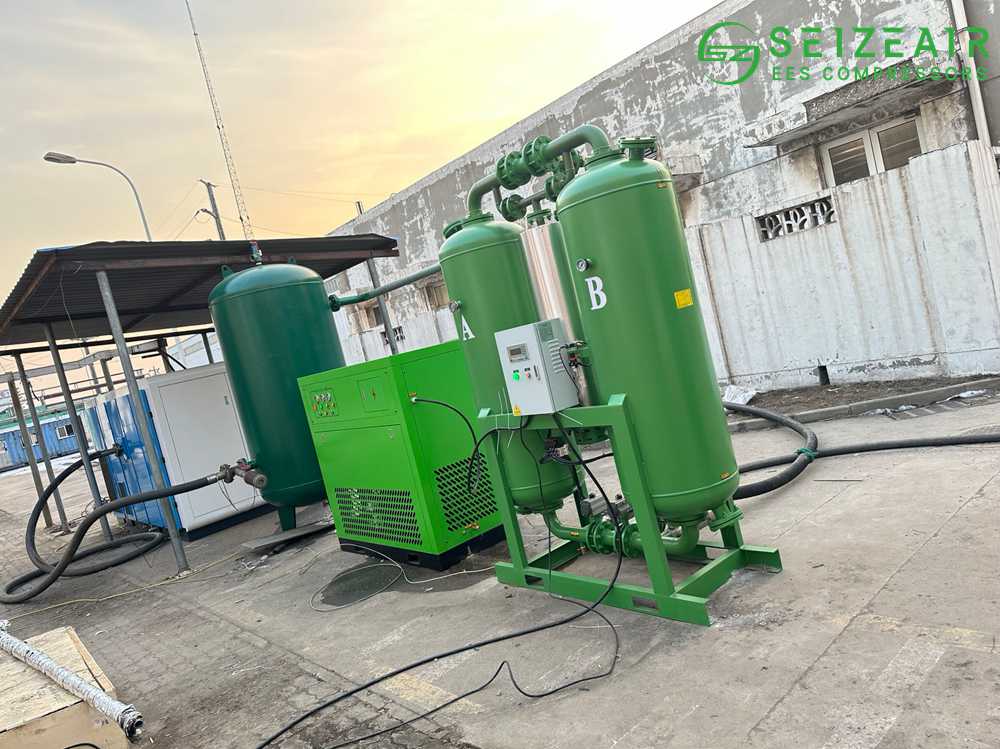
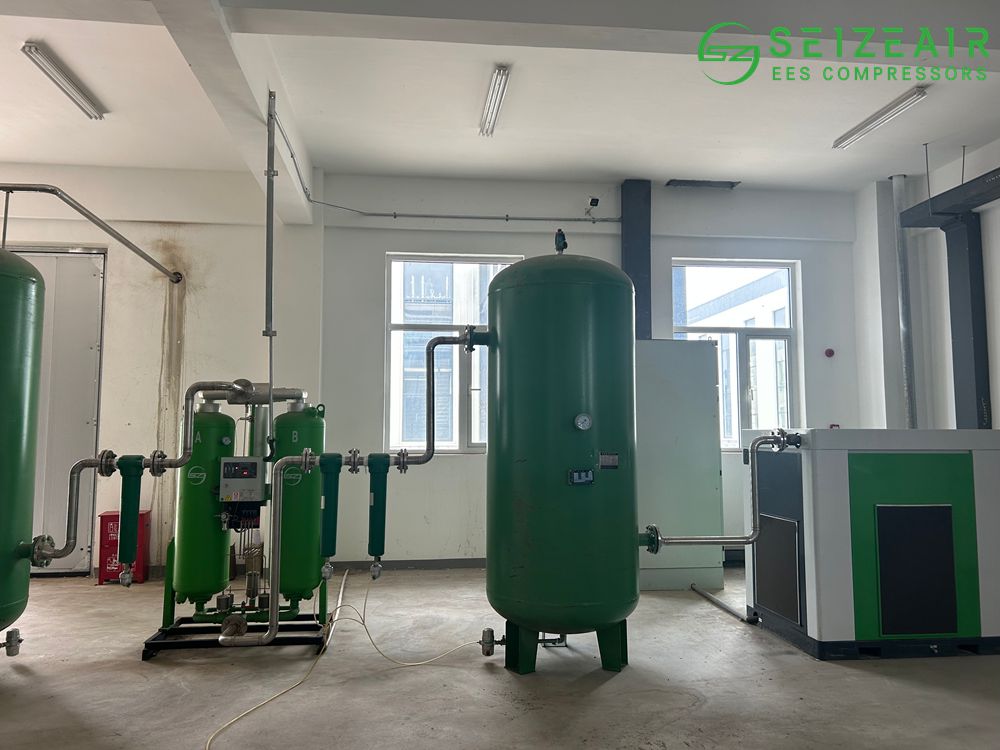
A desiccant air dryer—also called an adsorption dryer—pushes air through a bed of desiccant beads that soak up vapor. Because the beads saturate, these dryers run two towers and switch between them, regenerating the off-line bed. Heatless (purge) designs are simple and cheap to buy but waste some compressed air; heated and blower designs cut that waste with external heat.
For very low dew points with lower purge loss, a blower heat regeneration adsorption dryer uses an external blower and heater to regenerate the bed instead of burning your own compressed air. It costs more up front but can pay back fast on big, continuous flows.
3. Membrane air dryers
A membrane compressed air dryer uses bundles of hollow fibers that let water vapor pass through the wall and vent to atmosphere while dry air continues downstream. No electricity, no moving parts, no regeneration cycle—just a small pressure loss and a trickle of purge air. Best for low flows and remote or hazardous spots.
4. Deliquescent air dryers
These pass air up through a tank of salt-like tablets that dissolve as they absorb water. Dead simple and explosion-proof, but they only reach around +10°C PDP, consume media continuously, and add dissolved solids to the condensate. You’ll mostly see them on mobile and rental fleets.
| Dryer type | How it dries | Typical PDP | Best for | Relative capex | Running energy |
|---|---|---|---|---|---|
| Refrigerated | Cool & condense | +3°C | General plant, workshops | Low | Moderate |
| Desiccant (heatless) | Adsorption, purge regen | -20 to -40°C | Outdoor, instruments, paint | Medium | Higher (purge loss) |
| Desiccant (heated/blower) | Adsorption, heat regen | -40 to -70°C | Large continuous flows | High | Lower purge |
| Membrane | Selective permeation | -20 to -40°C | Low flow, remote, ATEX | Medium | Low (no power) |
| Deliquescent | Absorbent tablets | +10°C | Mobile, rental, harsh sites | Low | None |
Refrigerated vs Desiccant Air Dryer: Which Should You Choose?
This is the decision that shapes your budget, so it’s worth a clear rule of thumb. If your lowest winter pipe temperature stays above freezing and you don’t have sensitive instruments or coating, a refrigerated dryer at +3°C PDP is the cheapest path and uses the least energy per cubic meter. If you need air drier than +3°C—outdoor lines, pneumatic controls, laboratory or food/pharma duty—you need a desiccant dryer.
We laid the trade-offs side by side in our refrigerated vs desiccant air dryer comparison, but the short version is: refrigerated wins on cost and simplicity for most plants; desiccant wins whenever the dew point target drops below freezing or contamination isn’t an option.
One more note for corrosive or offshore sites: pair a desiccant dryer with a heated or blower regen design if it runs continuously, because heatless purge throws away 12–18% of your compressed air forever.
How to Size a Compressed Air Dryer for Your Compressor
Sizing is where most mistakes happen. The rule is straightforward in plain math:
Dryer rated flow >= Compressor FAD x 1.1
That 1.1 factor covers heat of compression, altitude, and inlet conditions the nameplate doesn’t show. So a 100 cfm (about 2.8 m3/min) compressor needs a dryer rated for at least 110 cfm at the same pressure.
Inlet temperature matters just as much. Every 5°C above the dryer’s rated 35°C inlet cuts capacity by roughly 3%. A compressor dumping 45°C air into a dryer rated at 35°C loses about 6% of its stated flow—so size for the air you actually deliver, not the catalog number.
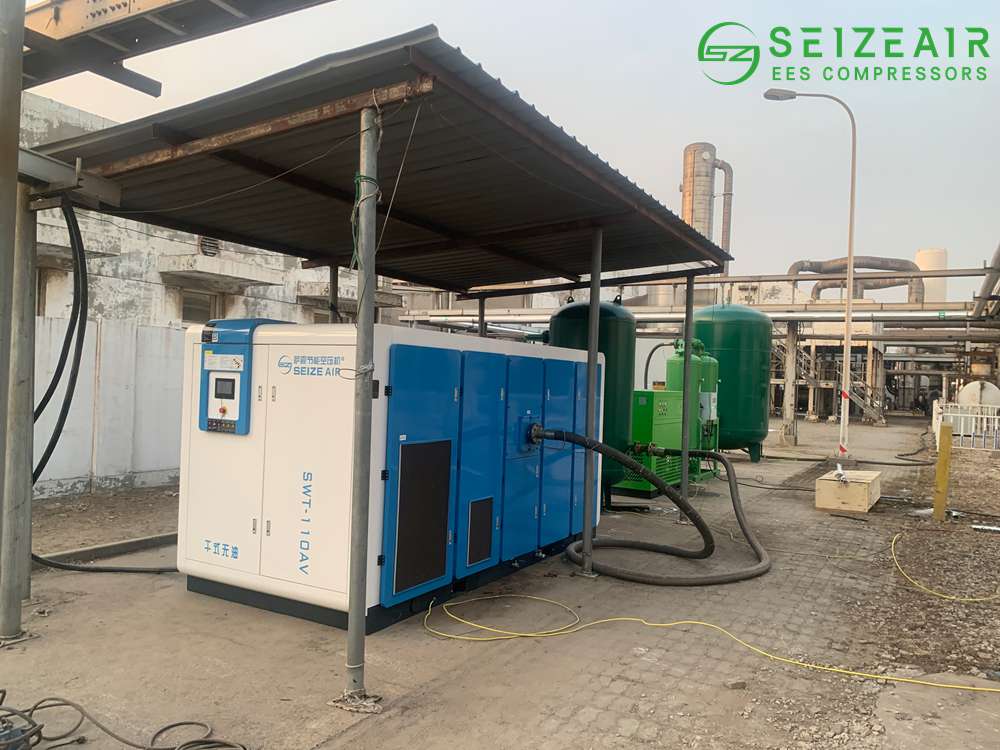
Here’s the path the air takes, and where the dryer sits:
Compressor → Aftercooler → Moisture separator → [ COMPRESSED AIR DRYER ]
                                                          ↓
                                              Coalescing / particulate filter
                                                          ↓
                                                  Air receiver tank → Point of use
| Compressor power (kW) | Approx. FAD (m3/min) | Min. dryer flow (m3/min) | Min. dryer flow (cfm) |
|---|---|---|---|
| 7.5 | 1.1 | 1.2 | 43 |
| 15 | 2.4 | 2.6 | 94 |
| 37 | 6.2 | 6.8 | 244 |
| 75 | 13.0 | 14.3 | 513 |
| 160 | 28.0 | 30.8 | 1105 |
Always match the dryer’s pressure rating to the compressor’s max working pressure, and add a margin if you run variable speed—VSD compressors swing flow, and a non-cycling dryer can ice up at very low loads.
What Pressure Dew Point Do You Actually Need?
You rarely need the driest air possible; you need dry enough. Over-specifying to -70°C PDP when +3°C would do wastes capital and energy. Use the process as the judge:
| Application | Recommended PDP | Why |
|---|---|---|
| General plant / pneumatic tools | +3°C | Stops liquid water and rust |
| Outdoor or unheated lines | -20°C | No freeze-ups in winter |
| Paint / powder coating | -20 to -40°C | Clean, dry assist air |
| Instrument air / labs | -40°C | Protects sensors and valves |
| Food, pharma, breathing | -40°C + oil-free class | Compliance, no contamination |
Whatever you pick, protect it at the point of use with a compressed air filter rated for your target particulate and oil class. A dryer sets the dew point; a filter removes the oil aerosol and fines that would otherwise ride along and spoil sensitive work.
Compressed Air Dryer Cost: What Drives the Price?
When buyers ask how much does a compressed air dryer cost, the honest answer is “less than the energy it spends over its life.” Capex is only part of the story.
| Cost driver | Effect on price | What to watch |
|---|---|---|
| Dryer type | Refrigerated < membrane < desiccant | Buy for the PDP you need, not the lowest tag |
| Flow rating | Scales with m3/min | Don’t oversize—wasted capacity |
| Regen method | Heatless cheapest, blower dearest up front | Blower pays back on big continuous flows |
| Energy over 10 yrs | Often 3–5x the purchase price | Count purge loss and part-load efficiency |
| Options | Filters, drains, bypass, controls | Specify as a package, not add-ons |
A small refrigerated unit for a workshop might be a few hundred dollars; a large heated desiccant system for a continuous process runs into five figures. The number that hurts most isn’t on the invoice—it’s the electricity the dryer pulls for the next decade, so favor part-load efficiency and low purge loss.
Best Compressed Air Dryer for Common Applications
Concrete recommendations beat theory, so here’s how it shakes out by duty:
- Laser cutting: -20 to -40°C PDP. A desiccant dryer (or refrigerated plus a high-grade filter) keeps the beam path and nozzle clear. Moisture here ruins cut quality fast.
- Food and pharmaceutical: Oil-free air plus a desiccant dryer at -40°C and sterile-grade filters. Compliance drives the spec, not price.
- Sandblasting and general plant: Refrigerated at +3°C is plenty; you just need to keep liquid water and rust out of the line.
- Outdoor or cold-climate distribution: Desiccant at -20°C minimum so lines don’t ice overnight.
- Remote or explosive atmospheres: Membrane or deliquescent, since they need no power or sparking parts.
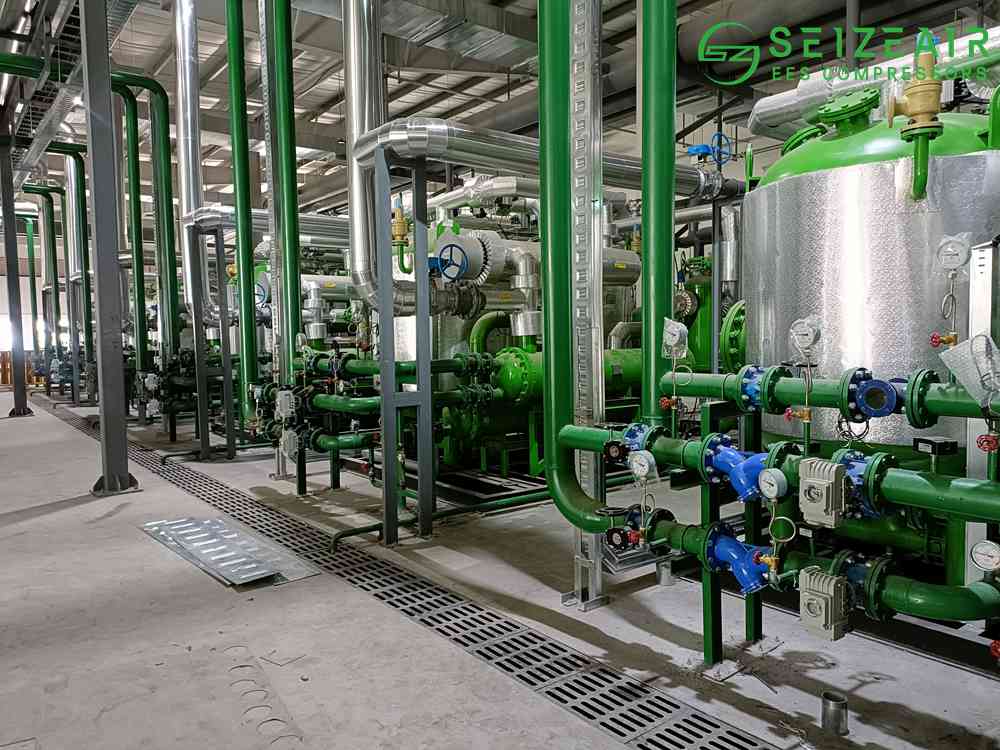
Many buyers sidestep the integration headache with an integrated air compressor with dryer and tank in one skid—less piping, one warranty, and a pre-matched dryer-to-compressor ratio.
Installation and Maintenance Tips
Good dryers fail from bad installation more often than bad design. A few field-tested habits:
- Put the dryer after the aftercooler and separator. Let the compressor’s own cooling drop most of the water first; the dryer handles the rest.
- Size the air receiver tank between dryer and point of use. It smooths flow swings and protects the dryer from load spikes.
- Fit a bypass. When the dryer is down for service, production keeps running on a temporary line.
- Service the drain. A stuck no-loss drain floods the system with the very water you removed.
- Change pre-filters on schedule. Oil loading kills desiccant beds early.
Keep a stock of the air compressor parts you’ll actually need—drains, filter elements, and sensor probes—so a small failure doesn’t become a week of downtime.
Common Mistakes to Avoid When Choosing a Compressed Air Dryer
- Undersizing to nameplate flow. Use FAD x 1.1, and add for hot inlet air.
- Ignoring inlet temperature. A 45°C inlet quietly robs 6% of capacity.
- Skipping the pre-filter. Oil ruins desiccant and clogs membranes.
- Chasing the lowest PDP. -70°C where +3°C suffices is pure waste.
- No bypass or spare parts. One stuck drain becomes a full shutdown.
- Buying capex-only. A cheap heatless dryer can burn more air in a year than a blower unit costs.
Conclusion
Choosing the right compressed air dryer comes down to three numbers: your compressor’s flow, the pressure dew point your process demands, and the true lifetime energy cost. Get those right and everything else—type, brand, options—follows naturally.
If you’re still weighing a refrigerated versus desiccant unit, or you want a dryer spec matched to your actual site conditions and inlet air, talk to our application engineers. Get in touch with your compressor model and duty cycle, and we’ll size the system with you and put a real quote together—no guesswork, no overspec.