

Roots blower technology is one of the oldest and most recognizable forms of positive-displacement air moving, and it still underpins thousands of wastewater, conveying and process installations around the world. In this guide you will learn how a roots blower works, how two-lobe and three-lobe designs differ, where these machines fit best, how to size and maintain them, and when a modern oil-free screw or magnetic levitation blower can lower your operating cost. Whether you are specifying a new unit or trying to understand why an existing machine is noisy and inefficient, this article gives you the practical detail needed to make a confident decision.
What Is a Roots Blower?
A roots blower is a rotary positive-displacement machine that delivers a nearly constant volume of gas per revolution regardless of the downstream pressure, within its rated range. Two lobed rotors mesh inside a close-fitting housing and rotate in opposite directions. As the lobes separate from the inlet, air is drawn in and carried around the outside of each rotor, then pushed out at the discharge port. The machine is named after the Roots brothers, who developed the design in the nineteenth century, and the basic principle has changed very little since.
What makes the roots blower distinctive is what it does not do: it does not compress the air internally. There is no reduction in volume inside the casing. The gas is simply trapped and transported from a low-pressure inlet to a slightly higher-pressure outlet. Pressure rise happens when the trapped pocket opens to the discharge line and downstream air flows back into it, equalizing pressure. This is why the machine is sometimes described as an external-compression device, and why its efficiency falls sharply as the required pressure rises.
In industry, the word “blower” is generally reserved for machines producing a modest pressure rise, typically below about 1 bar gauge, although some roots designs reach around 2 bar in multi-stage arrangements. Above that range, the terminology shifts toward compressors. If you are still clarifying the boundary between these machine families, the explanation of what a centrifugal air compressor is provides useful context on how pressure ratio changes the design choices.
How Does a Roots Blower Work?
The operating cycle is straightforward but worth understanding in detail, because it explains almost every strength and weakness of the machine. Each rotor has two or three lobes shaped like a figure eight or a clover. A pair of timing gears outside the gas stream keeps the rotors synchronized so that they never touch each other or the housing. Small clearances, typically a fraction of a millimeter, seal the pockets while allowing free rotation.
   Air inlet (low pressure)
          |
          v
   +------------------+
   |   (R1) >< (R2)   |   two counter-rotating lobed rotors
   |   air trapped    |   between each lobe and the casing
   |   and carried    |
   |   around         |
   +------------------+
          |
          v
   Discharge (higher pressure)
   pocket opens -> backflow equalizes pressure
The sequence repeats every revolution. On the inlet side, the rotating lobes create an expanding pocket that draws gas in. The gas is then isolated between a lobe and the casing wall and swept around to the discharge side. When the pocket opens to the outlet, higher-pressure gas rushes back in until pressures equalize, and the rotor then pushes the full pocket into the discharge pipe. Because several pockets open in rapid succession, the discharge is inherently pulsating, which is why roots blowers are almost always fitted with inlet and outlet silencers.
Why There Is No Internal Compression
Unlike a screw or centrifugal machine, the roots blower never reduces the trapped volume before discharge. The energy wasted in that sudden pressure equalization is the main reason a roots blower uses more power per unit of air than a compressor with internal compression, especially above roughly 0.5 bar. Understanding this single fact helps explain the efficiency comparison discussed later in this guide, and it is the technical reason many plants now evaluate alternatives when electricity is their dominant cost.
Roots Blower Performance Characteristics
Reading a roots blower performance map becomes much easier once you understand three relationships. First, delivered volume is almost directly proportional to shaft speed, so a curve plotted against speed is nearly a straight line. Second, capacity falls gently as discharge pressure climbs, because a larger pressure difference pushes more gas back through the running clearances; engineers call this slip. Third, the power required rises steadily with pressure, and the rate of increase steepens because the machine gains no benefit from compressing the gas progressively. These three traits together define the practical envelope of the design.
Turndown is the second characteristic worth studying. A fixed-speed roots blower does not naturally reduce output when the process asks for less air. Without a variable-speed drive, surplus flow must be vented through a bypass or relieved at the inlet, and the motor continues to draw close to full power. Even with a drive, there is a practical minimum speed set by lubrication, cooling and the onset of excessive slip. Below that point the machine becomes inefficient and may overheat, so a realistic specification states both the maximum and the sustainable minimum flow rather than a single design point.
Site conditions shift the curve as well. High altitude reduces inlet air density, so the same volumetric delivery contains less oxygen and less mass; aeration systems sized at sea level can underperform on elevated sites. Hot inlet air has a similar effect and also raises the discharge temperature, which the casing and bearings must tolerate. Dusty or humid inlet air accelerates rotor and filter wear. For all these reasons, capacity figures should always be quoted at clearly stated inlet conditions, and site corrections applied before a machine is selected.
Key Components of a Roots Blower
A roots blower package is more than two rotors in a box. Knowing the ancillary parts helps you diagnose problems and specify a complete, installable system rather than a bare machine.
Rotors, Casing and Timing Gears
The rotors are precision-machined, often with helical lobes on modern units to reduce pulsation and noise. The casing is cast iron or aluminum and must dissipate the heat generated by compression and backflow. Timing gears, usually oil-lubricated and housed separately from the air stream, synchronize the rotors. Keeping gear oil out of the gas path is what allows a roots blower to deliver nominally oil-free air, although trace contamination from carryover is still possible if seals wear.
Seals, Bearings and Cooling
Shaft seals prevent gear oil from migrating into the casing and process gas from escaping. Rolling bearings support the shafts and set the rotor clearances. Larger or higher-pressure units may include water-cooled jackets or an external cooler, because the external-compression process generates considerable heat. In continuous-duty applications such as wastewater aeration, thermal management often determines service life more than any other single factor.
Silencers, Valves and Drives
Inlet filters protect the tight clearances from dust. Discharge silencers, often absorptive or reactive designs, tame the characteristic low-frequency pulse. A relief valve or unloader protects against overpressure, and a non-return valve prevents backflow when the machine stops. Drives may be direct-coupled, belt-driven or geared depending on the speed required to match system airflow to the motor.
Types of Roots Blowers
Roots blowers are commonly classified by rotor profile, number of stages and cooling method. The choice between a two-lobe and a three-lobe design affects pulsation, noise and flow smoothness, while staging and cooling determine the pressure and duty the machine can sustain.
| Feature | Two-Lobe Roots Blower | Three-Lobe Roots Blower |
|---|---|---|
| Flow pulsation | Higher, more pronounced | Lower, smoother delivery |
| Operating noise | Higher at same flow | Generally quieter |
| Volumetric efficiency | Slightly higher at low speed | Comparable, better at speed |
| Typical use | General conveying, aeration | Aeration, vacuum, low-noise duties |
| Rotor balance | Simple, robust | Smoother running, more complex profile |
Single-stage designs suit most low-pressure duties. Two-stage (series) arrangements insert an intercooler between two blowers to reach higher pressures with better efficiency. On the drive side, direct coupling is preferred where a fixed-speed motor matches the duty, while belts allow a lower machine speed for a given motor speed. Variable-speed control is increasingly common, since it avoids the energy waste of throttling or bypassing excess air.
Main Applications of Roots Blowers
The roots blower earns its place wherever a large volume of air is needed at a modest pressure and simple, robust operation matters more than peak efficiency. A few sectors dominate global demand.
| Application | Why a Roots Blower Fits | Typical Pressure Band |
|---|---|---|
| Wastewater aeration | High flow, continuous duty, simple controls | Low, roughly 0.4–0.8 bar |
| Pneumatic conveying | Steady air volume moves bulk solids reliably | Low to moderate |
| Aquaculture & fish farming | Oxygen transfer in ponds and raceways | Low |
| Flue gas desulfurization | Oxidation air in scrubber systems | Low to moderate |
| Cement, chemical & printing | Process air, fluidization, sheet handling | Low to moderate |
In wastewater treatment, diffused aeration is the classic roots blower application and a frequent subject of guidance from bodies such as the Water Environment Federation. Aeration energy is often the single largest electrical cost in a treatment plant, which is exactly why operators scrutinize blower efficiency so closely. For bulk solids transport, the steady displacement of a roots machine keeps material moving without the surges that can cause blockages; our overview of low-pressure air compressors for pneumatic conveying explores the system side of that duty in more depth.
Roots Blowers in Vacuum and Pressure Duty
Although the majority of installations push air outward, the same positive-displacement principle works in reverse. When the inlet is connected to a sealed vessel and the discharge opens to atmosphere, the blower removes gas and creates a vacuum. Roots vacuum blowers are used for packaging, drying, degassing and bulk-material handling. They are often paired with a liquid-ring or dry screw booster when a deeper vacuum is required, because a single roots stage reaches only a modest pressure differential before efficiency and temperature become limiting.
The maintenance implications are different on vacuum service. Because the machine handles a thinner gas at the suction side, cooling is less effective and sealing leaks matter more. Any air drawn in through a worn shaft seal becomes an unwanted load on the pump. Operators should pay close attention to seal condition, inlet temperature and the correct gas ballast or purge arrangement where one is specified. Where a process alternates between pressure and vacuum, the control sequence must prevent the machine from starting against a closed discharge, a mistake that can damage rotors almost instantly.
Roots Blower vs Other Blower Technologies
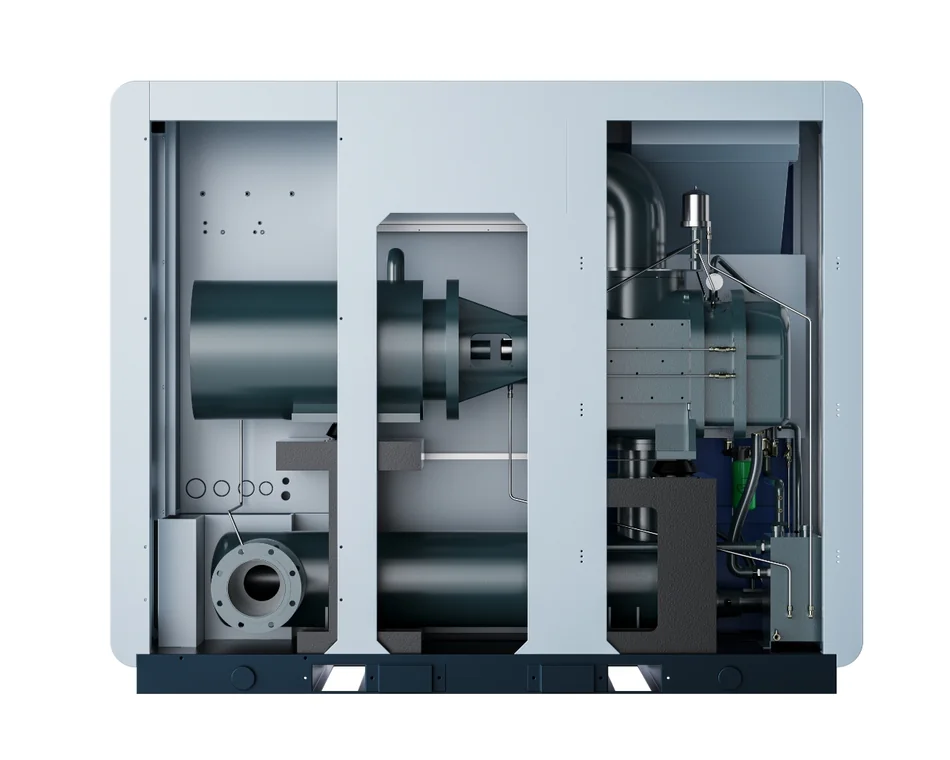
A roots blower is rarely the only option. The real decision is usually between four technologies, each with a different balance of pressure range, efficiency, oil-free capability and capital cost. The table below compares them on the criteria that most often decide industrial purchases.
| Criterion | Roots Blower | Oil-Free Screw Blower | Magnetic Levitation Blower | Gear Centrifugal |
|---|---|---|---|---|
| Compression principle | Positive displacement, no internal compression | Positive displacement, internal compression | Centrifugal, high-speed impeller | Centrifugal, multi-stage |
| Typical pressure band | Low (around 0.3–1 bar) | Low to moderate (0.4–2 bar) | Low (0.3–1.2 bar) | Higher (1.5–16 bar) |
| Part-load efficiency | Modest | Good | Excellent | Good at design point |
| Oil-free air | Nominally oil-free | Fully oil-free | Fully oil-free | Oil-free options |
| Noise & pulsation | High | Low | Very low | Moderate |
| Turn-down range | Limited | Wide (about 60–100%) | Very wide | Narrower |
The most common upgrade path for a wastewater plant is from a roots machine to either an oil-free screw blower or a magnetic levitation blower. Both deliver internal compression and a much wider efficient operating range. Where the process needs significantly higher pressure, a gear centrifugal air compressor occupies a different part of the map entirely and should be evaluated on its own terms.
How to Select a Roots Blower
Selecting a blower is a system exercise, not a catalog lookup. Start with the process, not the machine. The following sequence keeps the specification honest and prevents the two most common errors: buying on nominal flow alone, and ignoring the pressure actually needed at the point of use.
Define flow + pressure at the point of use
               |
               v
Is oil-free, low-noise, wide turn-down needed?
      /                         \
    yes                          no
     v                            v
Screw / magnetic levig.      Roots acceptable
blower evaluation            for steady duty
               |
               v
Check pipe losses, silencers, elevation, ambient
               |
               v
Confirm ISO 1217 rating basis -> size motor -> add 10-15% margin
| Selection Step | What to Confirm |
|---|---|
| 1. Duty flow | Normal and maximum flow, in m³/min or cfm, at site conditions |
| 2. Discharge pressure | Total pressure including pipe, filter and diffuser losses |
| 3. Air quality | Whether oil-free air or a specific cleanliness class is required |
| 4. Load profile | Steady baseload or widely varying demand across the day |
| 5. Site conditions | Ambient temperature, altitude, humidity, inlet air quality |
| 6. Utility costs | Local electricity tariff and expected running hours |
| 7. Space & noise | Footprint, ventilation and allowable sound level |
One practical point: published performance figures are only comparable when they share a rating basis. Reputable suppliers state their capacity to ISO 1217, so insist on seeing that reference. You can also consult the Compressed Air and Gas Institute for background on testing and terminology before comparing data sheets.
Sizing and Performance Calculations
Exact selection requires the manufacturer’s curve for the specific model, but the underlying relationships are simple enough to understand. Displaced flow is roughly the swept volume per revolution multiplied by speed. Because a roots blower is a fixed-displacement machine, flow rises almost linearly with speed and falls only slightly as discharge pressure increases, largely due to slip back through the clearances.
Power is where external compression hurts. The ideal isothermal power to move a gas rises with the logarithm of the pressure ratio, but the real shaft power of a roots blower includes the energy lost in backflow equalization. A useful way to think about it is: power is approximately proportional to the volume flow multiplied by the pressure rise, divided by an efficiency that decreases as pressure climb. That falling efficiency is why a machine that looks economical at 0.3 bar can become expensive at 0.9 bar.
Always apply a sensible design margin, commonly in the region of ten to fifteen percent, for filter loading and future demand, but avoid an oversized machine that spends most of its life throttled. Where demand varies, the efficiency saved by variable-speed control often repays the extra cost quickly. The methods in our guide to low-pressure air compressor energy saving apply directly to blower systems.
Installation and Piping Best Practices
Good installation protects clearances, reduces noise and makes maintenance realistic. Poor installation can destroy a perfectly specification-correct machine within a season.
Foundation, Inlet and Discharge
Mount the unit on a level, rigid base with adequate mass to absorb vibration, and use flexible connectors to isolate the pipework. Keep the inlet in a cool, clean, dry location; hot or dusty inlet air reduces capacity and accelerates wear. Size pipes generously to limit pressure drop, because every unnecessary millibar adds directly to power consumption. Fit a non-return valve to prevent reverse rotation on shutdown and a relief valve to protect against blockage.
Ventilation and Water Management
Even nominally air-cooled blowers reject substantial heat into the room. Provide controlled ventilation or an external duct to carry hot air outside. On water-cooled units, treat the cooling circuit properly and monitor it for scaling. Where the compressed air will be used for instrumentation or process contact, add suitable drying and filtration downstream; a correctly sized refrigerated air dryer prevents condensation in the distribution network.
Air Quality, Filtration and Moisture Control
Roots blowers do not add oil to the air stream, but that does not make the delivered air automatically clean or dry. Ambient air carries dust, pollen and water vapor, and compression raises its temperature and relative humidity changes as it cools downstream. In an aeration basin this may be irrelevant, but in pneumatic conveying of hygroscopic powders or in a process that contacts a product, moisture and particulates can spoil the material. The air quality specification should therefore be written before the blower is chosen, not after.
Filtration is the first line of defense. Coarse pre-filters remove bulk dust, while finer elements protect the tight rotor clearances from abrasive particles that would otherwise score the casing. Because pressure drop rises as a filter loads, the selected blower must be able to maintain flow at the dirty-filter pressure, not just at the clean-filter value. That is why specifying a margin of roughly ten to fifteen percent, as noted earlier, is prudent. Remember that a blocked filter is one of the most common causes of both low flow and overheating, so differential-pressure monitoring is a low-cost safeguard.
Downstream drying depends on the application. Where condensate would cause caking, corrosion or bacterial growth, aftercooling followed by a suitable dryer and a drain trap is standard practice. In such systems the blower’s discharge temperature becomes an important input to dryer sizing. Rather than guessing, measure the actual temperature at the point where air enters the treatment equipment and size the downstream components from that figure. Documenting these assumptions at the design stage prevents the common situation in which the blower performs correctly but the process still fails.
Operation, Maintenance and Troubleshooting
Roots blowers are mechanically simple, but they run hot and at close tolerances, so disciplined maintenance pays. The schedule below is a starting point; always follow the specific machine manual for intervals and lubricants.
- Check gear oil level and condition at start-up and at regular intervals; change on schedule.
- Inspect and replace inlet filters before they load up and starve the machine.
- Listen for changes in the characteristic pulse or the onset of rubbing and knocking.
- Monitor bearing temperature and vibration where sensors are fitted.
- Verify belt tension or coupling alignment after the first weeks of service and periodically thereafter.
- Confirm that relief and non-return valves operate freely and that silencers are not blocked.
Common symptoms point to specific causes. A drop in delivered flow usually means a clogged inlet filter, excessive slip from worn rotors, or a speed problem. Rising noise and vibration often indicate timing gear wear, bearing failure or lobe contact. Overheating points to high discharge pressure, poor ventilation, blocked coolers or an incorrect lubricant. Catching these early avoids the far higher cost of a rotor or casing replacement.
Energy Efficiency: Where Roots Blowers Lose Power
For any continuously operated blower, electricity dominates lifetime cost. Understanding where the losses occur makes it easier to judge whether a retrofit makes financial sense. In a roots machine, the largest losses come from external compression, pulsation, slip through clearances, and the fixed-speed throttling used to match variable demand.
Consider a typical aeration duty where airflow must track changing oxygen demand. A fixed-speed roots blower must spill surplus air through a bypass valve or intake throttle, so a large share of the electrical input is wasted during low-demand hours. A machine with internal compression and wide turndown can instead slow down and deliver only what the process needs. Because the relationship between speed and power is strongly nonlinear for centrifugal-style machines, even modest speed reduction can produce meaningful savings. Electricity price data published by the U.S. Energy Information Administration can help you translate consumed kilowatt-hours into a local currency figure for your own site.
When to Upgrade from a Roots Blower
No machine lasts forever, and the best moment to replace a roots blower is often before a costly failure rather than after one. Several conditions make a modern alternative attractive: high running hours, a tariff that keeps rising, the need for oil-free air, strict noise limits, or a process whose demand changes significantly through the day.
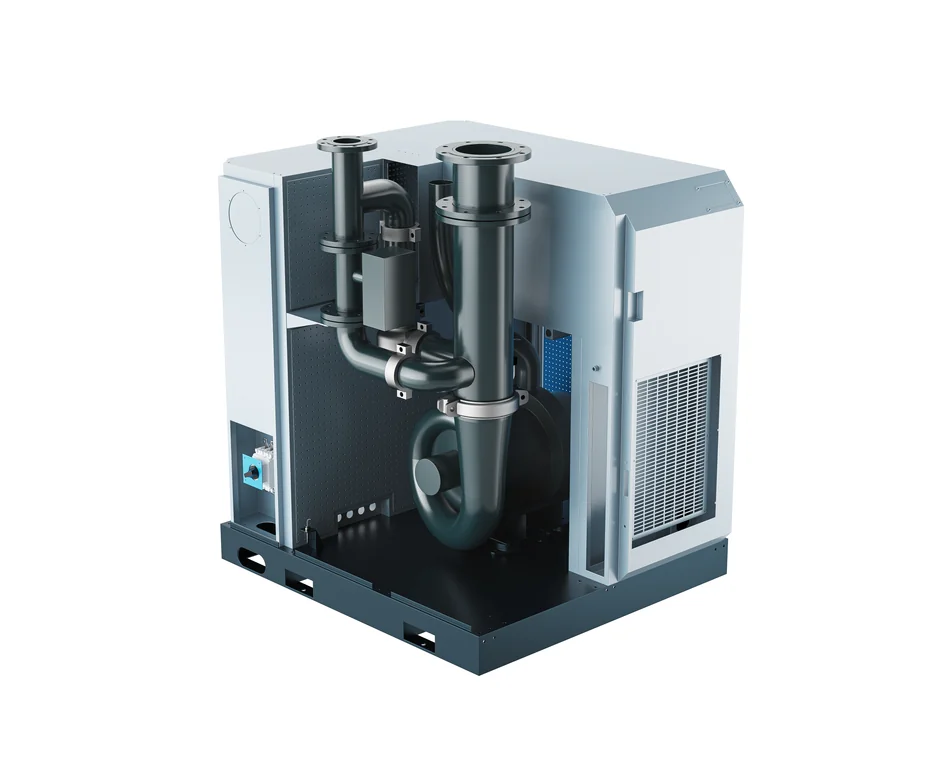
A magnetic levitation blower uses a high-speed impeller on active magnetic bearings, with no oil in the air path and no mechanical bearing contact. The result is very high efficiency, extremely low noise and a wide operating range. SEIZE AIR’s PC series, for example, covers a power range of 22–400 kW and a working pressure window of roughly 0.3–1.2 bar, with a three-stage inlet filter, two-stage compression with intercooling and aftercooling, and active magnetic bearings with five-axis control. Those features address almost every weakness of a traditional roots machine in low-pressure service.
If you want to weigh the decision in more detail, our article on why choose magnetic levitation centrifugal blowers sets out the engineering case, while the magnetic levitation air compressor range shows how the same bearing technology extends into higher-pressure duties.
Oil-Free Alternatives for Sensitive Processes
Although a roots blower keeps gear oil out of the air stream, it is only nominally oil-free, and worn seals can allow contamination. Food, beverage, pharmaceutical and fine chemical processes often require certified oil-free air. In those cases an oil-free screw blower is the natural step up.
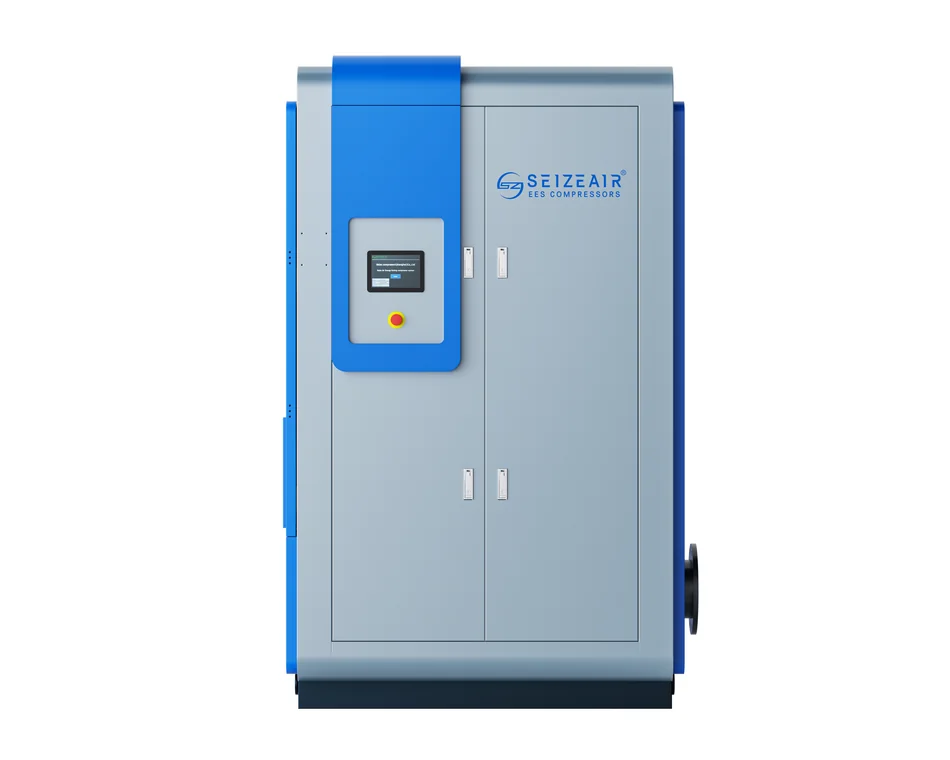
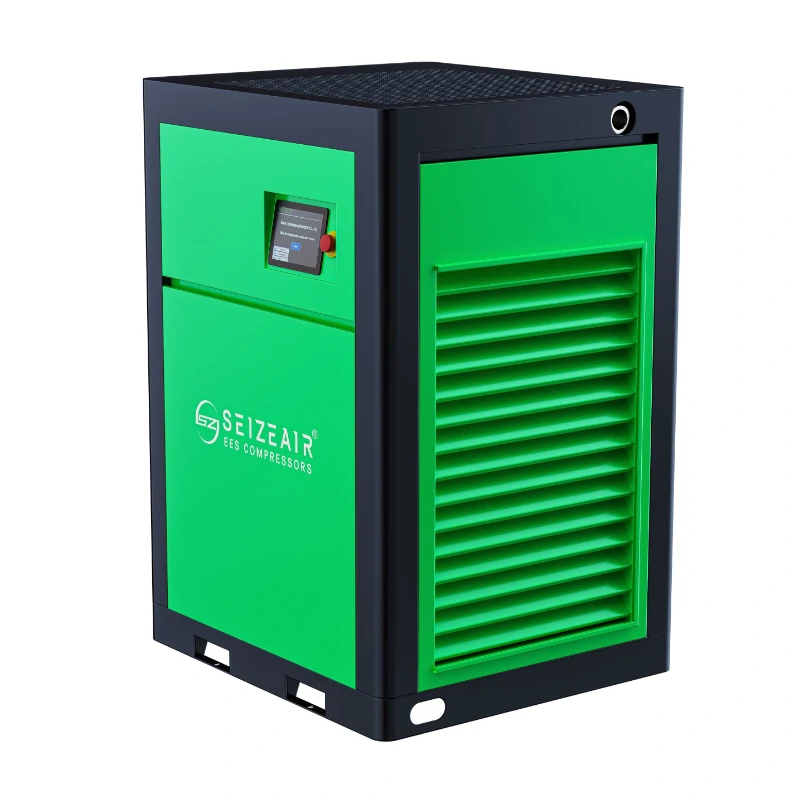
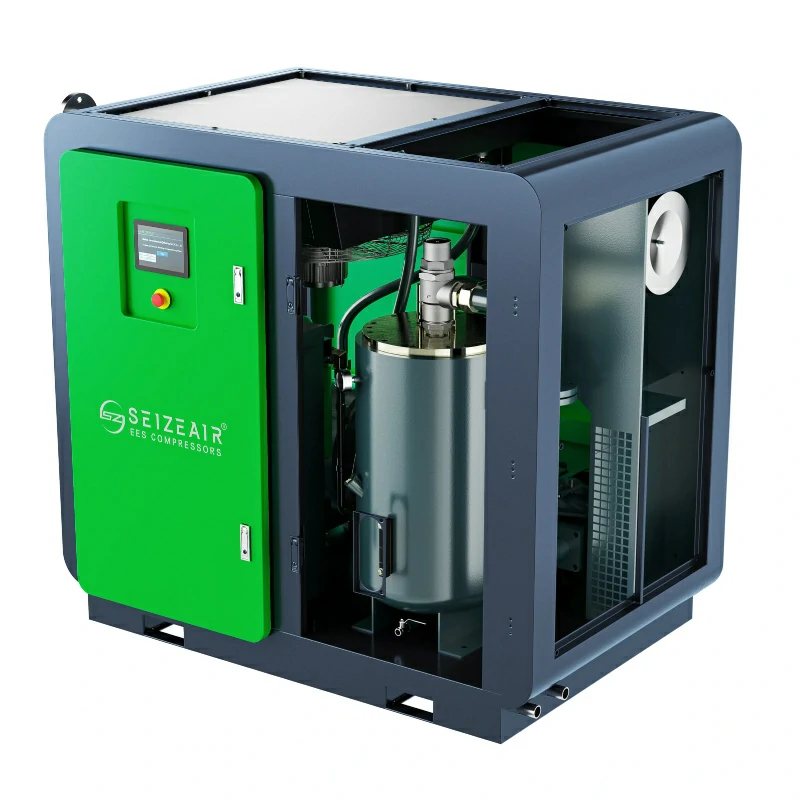
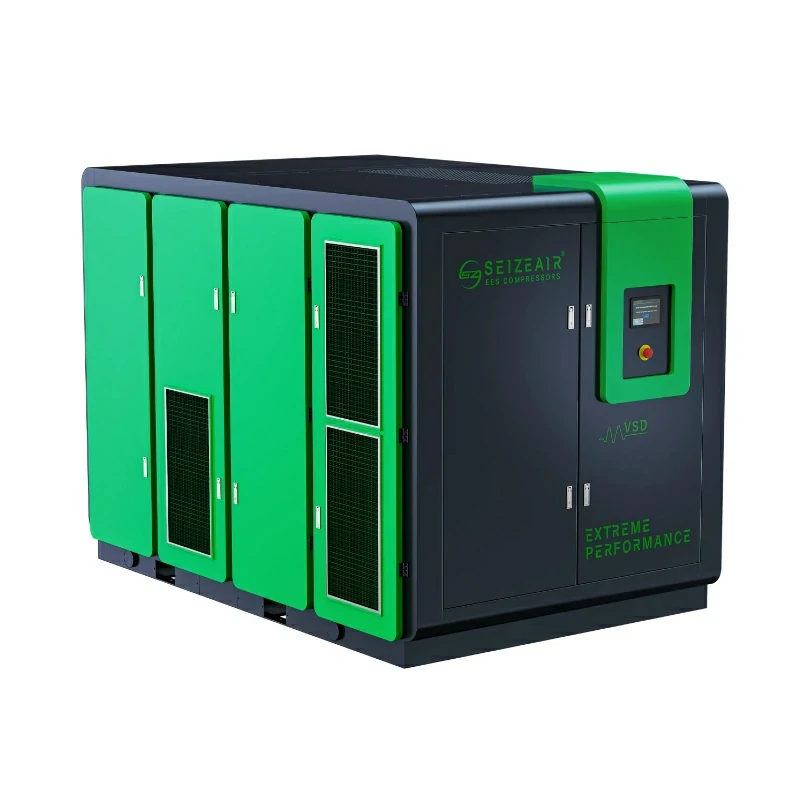
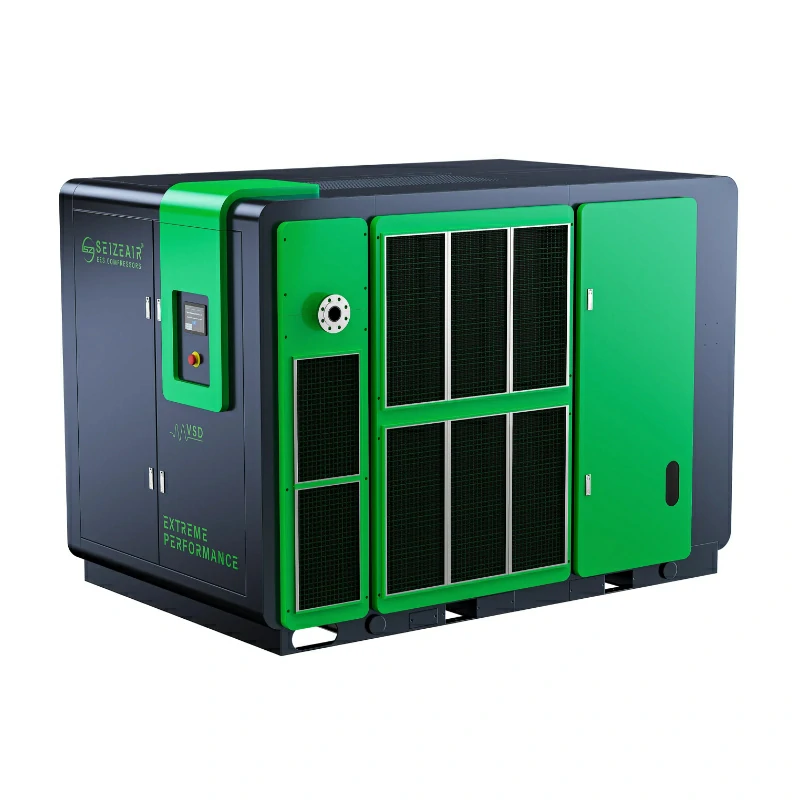
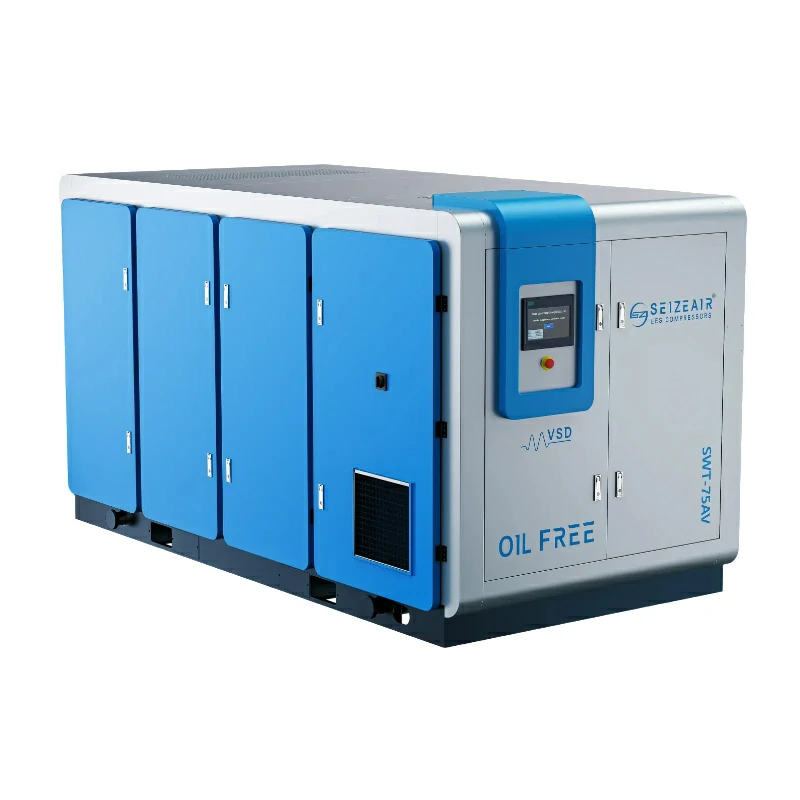
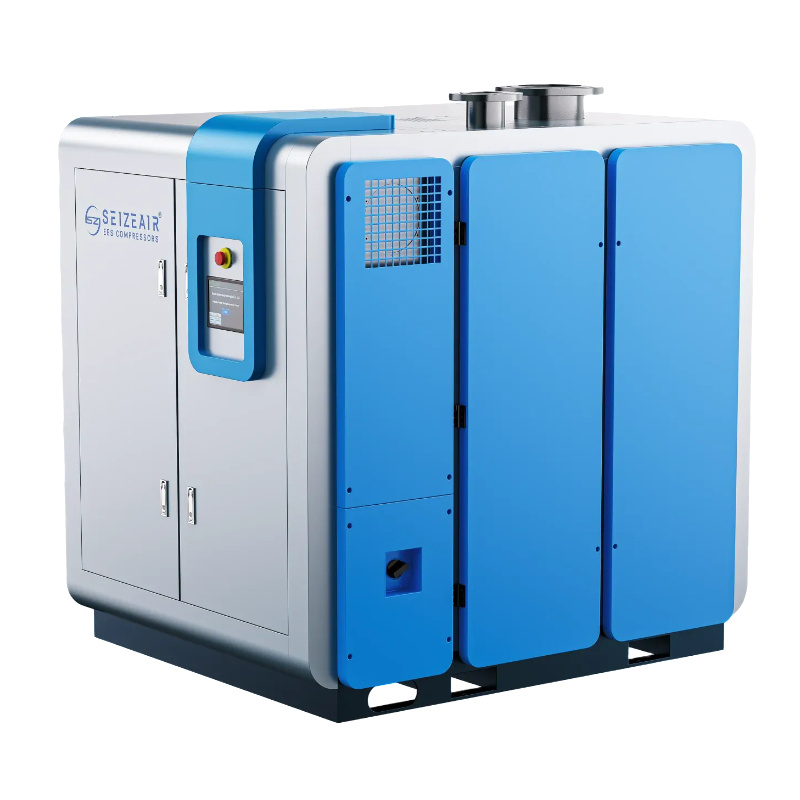
The SPVC oil-free screw blower range from SEIZE AIR spans 22–250 kW and 0.4–2.0 bar, using a 3×5 screw rotor profile, a permanent-magnet motor with independent cooling and stepless speed control from about 60 to 100 percent. Capacity is rated to ISO 1217 Annex C at 1 bar and 20 °C. Because compression happens inside the rotors, the machine uses less power than a roots blower at the same duty and delivers air with no oil injection at all. You can review the wider oil-free air compressor range to see how screw, scroll and centrifugal technologies cover different purity and flow requirements.
Total Cost of Ownership
Capital price is only the visible part of a blower decision. Over a ten-year life, energy can account for the majority of total cost, especially in continuous aeration or conveying. A lower-efficiency machine that was cheaper to buy can easily cost far more to run than a well-specified high-efficiency unit.
A sensible ownership model includes the purchase and installation price, expected electricity consumption at real operating hours, routine maintenance and consumables, the probability and cost of unplanned downtime, and residual value. When you apply realistic running hours and your actual tariff, the gap between a throttled roots blower and a variable-speed, internally compressing machine often becomes decisive. If you would like the numbers worked through for your own duty, our engineers can build a comparison using your measured flow and pressure data; simply contact our engineering team.
Frequently Asked Questions
Is a roots blower a compressor?
Technically it is a blower, because it produces a modest pressure rise and has no internal compression. The distinction from a compressor is about pressure ratio and compression mechanism, not simply a name. Machines delivering much higher pressures are normally called compressors.
Why is my roots blower so loud?
The pulsating discharge and the rapid opening of trapped pockets create strong low-frequency noise. Two-lobe machines are noisier than three-lobe designs. Inlet and outlet silencers, flexible mounts and acoustic enclosures help, but a screw or magnetic levitation blower is intrinsically much quieter.
Does a roots blower deliver oil-free air?
It delivers nominally oil-free air because the timing gears and lubricants are isolated from the gas stream. However, seal wear can introduce trace oil, so processes needing guaranteed oil-free air should specify a certified oil-free screw or centrifugal machine.
How long does a roots blower last?
With clean inlet air, correct lubrication, controlled temperature and disciplined maintenance, a well-built unit can run for many thousands of hours. Heat, contamination and neglected filters are the usual shorteners of life, not the basic design.
Can a roots blower be used for wastewater aeration?
Yes, and it remains one of the most common applications. The high flow at low pressure suits diffused aeration well. The trade-off is efficiency at variable load, which is why many plants now compare roots machines against magnetic levitation or oil-free screw blowers before a replacement.
What maintenance interval should a roots blower follow?
Intervals depend on duty, inlet air quality and the manufacturer’s design, so the machine manual always takes precedence. In practice, the tasks that matter most are checking gear oil, replacing inlet filters before they load up, confirming that relief and non-return valves move freely, and watching for any change in noise or vibration. In a dusty environment or a continuous aeration plant, inspections may be needed every few weeks; in a clean, intermittent installation the period can be longer. Keeping a simple log of oil condition, filter changes, discharge temperature and vibration readings turns maintenance from a guessing game into a predictable schedule, and it makes warranty discussions far easier if a component fails prematurely.
Final Thoughts
The roots blower endures because it is simple, robust and well suited to moving large volumes of air at low pressure. For a steady duty with modest pressure requirements and tight capital budget, it remains a reasonable choice. But if your operation runs long hours, faces rising electricity costs, needs guaranteed oil-free air or demands quiet, flexible control, the external-compression design has clear limits. Compare technologies on total cost using your real duty data, verify that performance is rated to a recognized standard such as ISO 1217, and choose the machine that fits the whole operating profile rather than a single catalog figure. A short conversation with an application engineer can turn that comparison into a confident, numbers-based decision.