

When you’re in the market for a screw air compressor, the “stage” debate is often where things get complicated. You’ll hear sales reps throwing around terms like “isothermal efficiency” and “compression ratios,” but for most facility managers, it boils down to two things: upfront cost vs. long-term power savings.
Is the extra investment in a two-stage unit actually worth it, or is a modern single-stage machine enough for your application? Let’s dive into the mechanics, the math, and the real-world performance of these workhorses.

What is the difference between a single-stage and a two-stage screw air compressor?
To understand the efficiency gap, we must look at the physics of how these machines handle atmospheric air and convert it into high-pressure energy.
Single-Stage Screw Compressors
In a single-stage setup, the air is taken from the inlet filter and compressed to the final discharge pressure in one continuous movement through a single set of male and female rotors. While simple and reliable, this process is subject to the laws of thermodynamics: as you compress air, it gets hot.
In a single-stage screw air compressor, the compression ratio (the ratio of absolute discharge pressure to absolute inlet pressure) is high—often around 8:1 or 9:1. Compressing air to 100 PSI in one go creates a massive temperature spike. Hot air is less dense and harder to compress, meaning the motor has to work harder to “shove” that air through the discharge port.
Two-Stage Screw Compressors
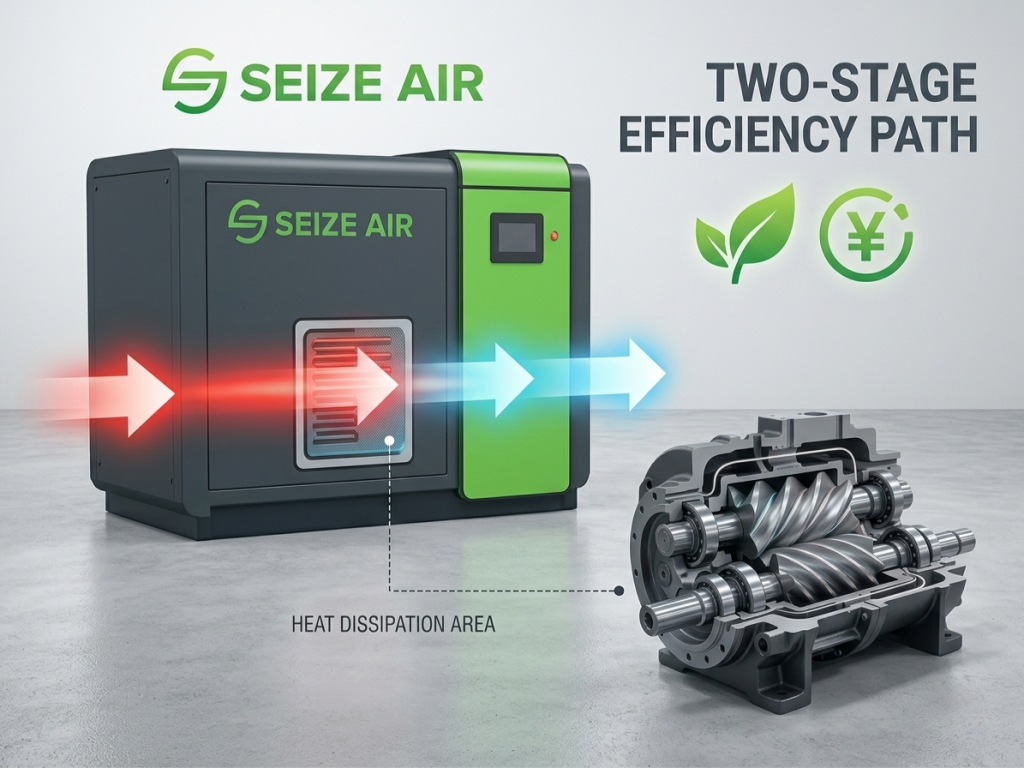
A two-stage screw air compressor splits the workload into two distinct phases:
- The First Stage: Air enters a large set of rotors and is compressed to a “midpoint” pressure (usually around 30-40 PSI).
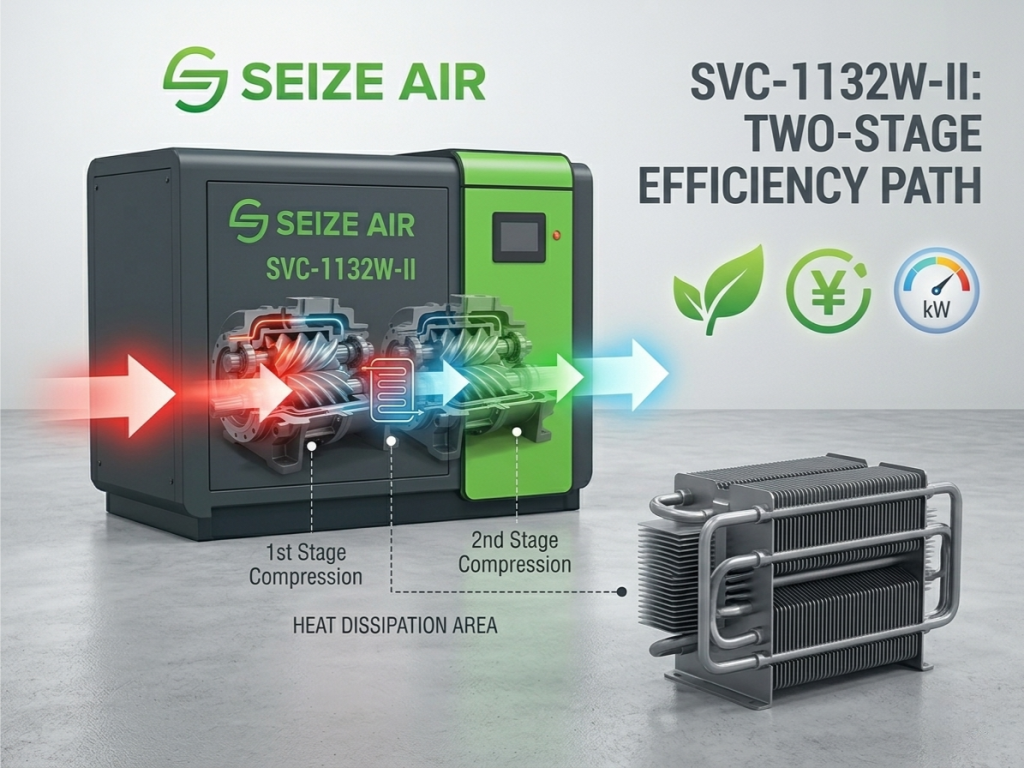
- Inter-stage Cooling: This is the magic. Before the air hits the second stage, it is injected with cool oil. This drops the air temperature significantly.
- The Second Stage: The now-cooled, denser air enters a smaller set of rotors to be compressed to the final target pressure (e.g., 100 or 125 PSI).
Because the second stage is working with cooler air, it requires significantly less brake horsepower (BHP) to achieve the same output. This is why you see brands like Seize achieving significantly higher CFM (Cubic Feet per Minute) ratings for the same electrical input.
Why is a two-stage screw compressor more energy efficient?
The “secret sauce” of the two-stage design isn’t just about cooling; it’s about reducing internal leakage, often called “blow-by,” and approaching the “Isothermal Ideal.”
Volumetric Efficiency and Pressure Differentials
Every screw air compressor has tiny clearances between the rotors and the housing. Air naturally wants to leak from the high-pressure discharge side back to the low-pressure intake side.
- Single-Stage: The pressure difference is huge (0 to 125 PSI), leading to more leakage across the rotor tips and through the “blow-hole” between the rotors.
- Two-Stage: The pressure “jump” in each stage is much smaller. Stage one might go from 0 to 35 PSI, and stage two from 35 to 125 PSI. Lower pressure differentials mean significantly less leakage, resulting in higher volumetric efficiency.
Approaching Isothermal Compression
Physics tells us that the most energy-efficient way to compress gas is “isothermal” compression (compression at a constant temperature). A single-stage machine is closer to “adiabatic” compression (where heat is retained). By using two stages with inter-stage cooling, the compression process follows a “step” pattern that mimics isothermal cooling. This brings the process closer to the thermodynamic ideal, saving massive amounts of energy.
| Technical Metric | Single-Stage | Two-Stage | Difference |
| Compression Ratio | 8.0 – 10.0 | 2.5 – 3.5 (Per Stage) | ~65% Lower per stage |
| Internal Leakage (Blow-by) | 8% – 15% | 3% – 5% | Massive efficiency gain |
| Specific Power (kW/m³/min) | 6.8 – 7.8 | 5.5 – 6.2 | 10-15% Improvement |
| Rotor Tip Speed | High | Low/Optimized | Reduced friction and noise |
Does a two-stage compressor produce more CFM than a single-stage?
One of the most frequent questions from plant engineers is: “If the horsepower is the same, why is the flow different?”
The answer lies in Power Density. In a 100 HP single-stage screw air compressor, a large portion of that 100 HP is being wasted on overcoming the resistance of hot, expanding air. In a two-stage unit, that same 100 HP is used more effectively because the second stage is compressing “shrunk” (cooled) air.
Free Air Delivery (FAD) Comparison
- 100 HP Single-Stage: Typically delivers ~440-450 CFM.
- 100 HP Two-Stage: Typically delivers ~500-520 CFM.
You are effectively getting 60-80 CFM “for free.” In a factory setting, that extra air could power an entire additional production line or several heavy-duty pneumatic tools without adding a cent to your base electrical capacity.
Do two-stage air compressors last longer and require less maintenance?
This is a critical PAA query for maintenance managers. The mechanical advantages of a two-stage screw air compressor extend far beyond the electricity bill:
Reduced Bearing Loads: Bearing life is mathematically linked to the pressure differential across the rotors. Because two-stage units split the pressure, the axial and radial forces on the bearings are drastically lower. This often results in an air-end life that is double that of a single-stage unit.
Lower Thermal Stress: Heat causes metals to expand and oil to degrade. By keeping the internal temperature lower (often by $20^\circ\text{C}$ to $35^\circ\text{C}$), the internal components stay within their optimal material properties, and the risk of “seizing” due to thermal expansion is minimized.
Slower RPMs: To hit specific flow targets, single-stage rotors often have to spin at very high speeds. Two-stage rotors can achieve the same flow at lower RPMs, reducing vibration and noise pollution on the factory floor.
Reliability is the hallmark of the Seize engineering philosophy. By spreading the mechanical stress across two stages, the system avoids the “thermal fatigue” that often plagues single-stage units in 24/7 high-pressure environments.
How do you calculate the ROI of a two-stage screw compressor?
Let’s talk numbers. A two-stage screw air compressor has a higher purchase price—often 25% to 40% more than a single-stage unit.
The 10-Year Lifecycle Reality
To see if it’s worth it, you must look beyond the sticker price (CAPEX). Over a 10-year lifespan, the purchase price is only about 10-12% of the total cost; electricity accounts for nearly 75-80%.
| Cost Category | Single-Stage (10 Years) | Two-Stage (10 Years) |
| Initial Purchase | $25,000 | $35,000 |
| Maintenance/Parts | $15,000 | $18,000 |
| Electricity Cost | $450,000 | $396,000 |
| Total Cost (TCO) | $490,000 | $449,000 |
In this scenario (based on a 75kW machine running 6,000 hours/year), the two-stage unit saves $41,000 over its life. The “payback” for the $10,000 price difference happens in less than 18 months.
Is a two-stage compressor more complex to service than a single-stage?
Does more stages mean more headaches? It’s a valid concern.
- Inter-stage Systems: Two-stage units use an oil-injection curtain between stages. This system is largely maintenance-free, but it does require you to keep your oil coolers clean. If the inter-stage cooling efficiency drops, the power savings drop with it.
- Simplified Serviceability: Modern designs from Seize use a “tandem” air-end configuration. While there are two sets of rotors, they are often housed in a way that allows them to be serviced similarly to a single-stage unit.
- Oil Quality: High-efficiency machines require high-efficiency lubricants. Using “bargain” oil in a two-stage machine will lead to carbon buildup on the second-stage rotors, negating your energy gains.
How does a VSD affect the efficiency of a two-stage compressor?
While a fixed-speed two-stage compressor is efficient at 100% load, the ultimate “energy-saving beast” is the Two-Stage VSD Screw Air Compressor.
In many factories, air demand fluctuates throughout the day. A VSD allows the motor to slow down during low demand. When you combine VSD with a two-stage air-end, you are attacking energy waste from two directions:
- The Two-Stage Air-End reduces the energy needed per unit of air produced.
- The VSD ensures you only produce the exact amount of air you need.
This combination can result in total energy savings of up to 35% to 50% compared to an old-fashioned, fixed-speed single-stage unit.
When should I choose a single-stage vs. a two-stage compressor?
| Selection Criteria | Choose Single-Stage | Choose Two-Stage |
| Annual Run Time | Under 2,500 Hours | Over 3,000 Hours |
| Application | Light manufacturing, Auto shops | 24/7 Industrial, Textile, Food & Bev |
| Budget Focus | Low upfront cost (CAPEX) | Low operating cost (OPEX) |
| Pressure Req. | 90 – 110 PSI | 115 – 190 PSI |
| Local Power Cost | Low ($<0.08 / kWh$) | High ($>0.12 / kWh$) |
What is the environmental impact of switching to two-stage compression?
In the modern era, “green” manufacturing isn’t just a PR move; it’s a regulatory requirement. A two-stage screw air compressor significantly reduces the carbon footprint of a facility. By consuming less electricity to perform the same amount of work, a 100 HP two-stage unit can prevent several tons of $CO_2$ emissions annually compared to a single-stage unit.
For companies striving for ISO 50001 (Energy Management) certification, the two-stage air-end is often the first recommendation from energy auditors.
The Verdict
In the modern industrial landscape, “efficiency” is the only way to protect your margins. While the single-stage screw air compressor remains a reliable and affordable entry point for many businesses, the shift toward two-stage technology is the logical progression for any operation looking to scale.
By integrating advanced inter-cooling technology, high-precision rotor profiles, and robust housing designs, Seize provides a range of compression solutions that redefine what “power density” looks like. If your goal is to maximize your CFM per dollar spent on the utility bill, the two-stage route is the undisputed winner for the long haul.