

Finding the right diesel air compressor for sale comes down to one fundamental decision that directly impacts your jobsite efficiency: choosing between a single-stage and a two-stage compression unit. Selecting the wrong compression stage can lead to underpowered air tools, unexpected thermal shutdowns, excessive fuel consumption, and costly project downtime.
What Is a Diesel Air Compressor and How Does It Work?
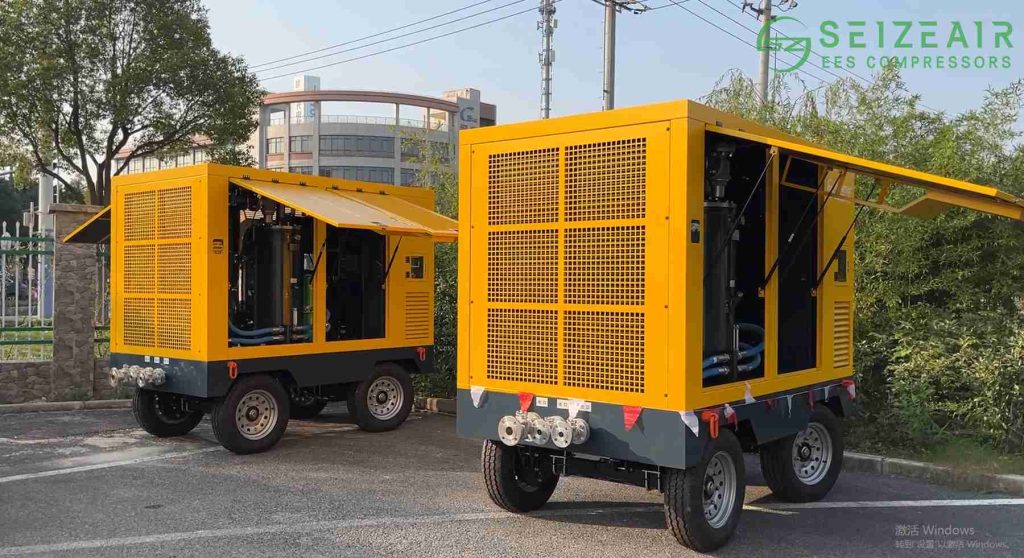
A diesel air compressor is an independent, heavy-duty pneumatic power system that relies on a diesel internal combustion engine—rather than grid electricity or a gasoline motor—to drive a reciprocating piston pump or rotary screw air end. Because diesel engines produce high low-end torque and offer superior thermal efficiency compared to gasoline engines, a diesel engine air compressor for sale is the industry standard for rugged, off-grid jobsite operations.
These commercial units convert fuel energy into mechanical force to store compressed air inside an steel receiver tank or pump it directly into high-flow air lines. You will commonly find skid-mounted units on service truck beds, towable mobile packages on highway construction sites, and standalone stations in remote mining and agricultural operations where reliable utility power is unavailable.
How Does a Single-Stage Diesel Air Compressor Work?
In a single-stage reciprocating diesel air compressor, atmospheric air enters through an intake filter and moves directly into the pump’s cylinder. A heavy-duty piston driven by the diesel engine crank sweeps downward to draw air in and then sweeps upward to compress it in a single continuous stroke. Once compressed to its final pressure, the air forces open a reed discharge valve and travels straight into the air receiver tank.
On a single-stage pump with multiple cylinders, every cylinder is identical in diameter. Each cylinder performs the exact same compression process independently. Adding extra cylinders to a single-stage pump increases the total volume of air generated (measured in CFM) but does not increase the maximum pressure capability (measured in PSI).
- Maximum Operating Pressure: Typically caps out between 90 PSI and 135 PSI.
- Duty Cycle Expectation: Generally engineered for 50% to 70% duty cycles (requiring resting intervals to shed accumulated heat).
- Core Advantage: Mechanically straightforward design, lower initial purchase cost, fewer moving components, and simple field repairs.
How Does a Two-Stage Diesel Air Compressor Work?
A two-stage diesel air compressor compresses air in two sequential steps to achieve much higher operating pressures while keeping internal temperatures manageable. Air passes into a large, low-pressure cylinder for initial compression. Instead of sending this hot, partially compressed air straight into the storage tank, the pump routes it through a finned copper or aluminum intercooler tube where ambient air cools it down.
Once cooled, the air enters a second, noticeably smaller high-pressure cylinder. The second piston compresses this air a second time, boosting its pressure up to final output levels before sending it to the storage tank.
- Maximum Operating Pressure: Delivers continuous pressure ranging from 175 PSI to 250+ PSI.
- Duty Cycle Expectation: Built for heavy continuous demands with 80% to 100% duty cycle ratings.
- Core Advantage: High thermal efficiency under heavy continuous load, significantly cooler discharge air, reduced oil carryover, and longer overall pump lifespans.
What Is the Difference Between Single-Stage and Two-Stage Diesel Compressors?
Choosing between a single-stage and a two-stage commercial diesel air compressor for sale requires evaluating five core technical performance metrics: operating pressure, airflow volume, thermal efficiency, fuel consumption, and total cost of ownership.
1. Pressure Capabilities (PSI)
Single-stage units are designed for standard pneumatic applications that operate near 90 PSI, such as framing nailers, small impact wrenches, grease guns, and light utility pneumatic tools. Two-stage units easily maintain 175 PSI continuously, which is required for heavy equipment repair, large 1-inch impact sockets, commercial tire bead seating, rock drilling, and long-distance pipe testing.
2. Air Volume Output (CFM)
Cubic Feet per Minute (CFM) measures the actual volume of air a unit delivers to your tools. While single-stage models can generate impressive CFM numbers for brief bursts, two-stage compressors sustain high CFM output at elevated pressures without overheating or suffering volumetric efficiency drops.
3. Thermal Management and Duty Cycle
Compressing air creates significant heat energy. Single-stage pumps trap all created heat in one compression stroke, causing thermal buildup when pushed past their intended duty cycle. Two-stage units disperse heat mid-cycle through interstage cooling tubes, which lowers operating temperatures, slows down oil degradation, cuts moisture condensation in the receiver tank, and prevents premature valve wear.
4. Technical Comparison Summary
| Technical Feature / Performance Metric | Single-Stage Diesel Air Compressor | Two-Stage Diesel Air Compressor |
| Maximum Pressure Output | 90 PSI to 135 PSI | 175 PSI to 250+ PSI |
| Recommended Duty Cycle | 50% – 70% (Intermittent Operation) | 80% – 100% (Continuous Operation) |
| Compression Strokes | 1 pass per piston cylinder | 2 sequential passes with interstage cooling |
| Cylinder Bore Sizing | Equal diameter across all cylinders | Asymmetric (Large Low-Pressure / Small High-Pressure) |
| Air Discharge Temperature | Higher discharge air temperatures | Cooler discharge air due to intercooler |
| Primary Jobsite Applications | Fencing, light construction, roadside tire fills | Media blasting, heavy machinery repair, rock drilling |
| Upfront Equipment Investment | Lower initial purchase price | Higher initial purchase price |
| Long-Term Operating Life | Best for periodic, short-burst tool use | Engineered for continuous heavy-duty industrial work |
Reliable equipment manufacturers like Seize Air design single-stage and two-stage diesel compressors with heavy-duty cast iron pumps and efficient cooling systems to ensure dependable performance in harsh environments.
How Do I Calculate CFM and PSI Requirements for a Diesel Air Compressor?
Before investing in a portable diesel air compressor for sale, you must accurately size your jobsite pneumatic load to avoid underpowering your crew or overspending on unneeded equipment.
Step 1: Identify the Highest Required Tool PSI
Determine the single tool that demands the highest operating pressure.
- If your highest pressure tool operates between 90 PSI and 110 PSI, a single-stage compressor is sufficient.
- If any tool requires 140 PSI to 175 PSI or higher, you must select a two-stage compressor.
Step 2: Calculate Combined CFM Consumption
Add together the rated CFM needs of all air tools that will run at the exact same time:
Total Required CFM = Tool A CFM + Tool B CFM + Tool C CFM
- 1/2-Inch Pneumatic Impact Wrench: 5 CFM
- 1-Inch Heavy Duty Fleet Impact Wrench: 12 CFM
- Dual-Action Orbital Auto Body Sander: 15 CFM
- Continuous Sandblasting Nozzle (1/4-inch orifice): 80 – 100 CFM
Step 3: Apply the Duty Cycle Safety Margin
To keep your diesel engine and compressor pump from running at maximum capacity constantly, add a safety buffer factor:
Single-Stage Target Rating = Total Tool CFM * 1.35
Two-Stage Target Rating    = Total Tool CFM * 1.25
If your service crew runs tools requiring 30 CFM simultaneously:
- Single-Stage Compressor Target: 30 * 1.35 = 40.5 CFM minimum pump output
- Two-Stage Compressor Target: 30 * 1.25 = 37.5 CFM minimum pump output
Should I Buy a Single-Stage or Two-Stage Portable Diesel Air Compressor?
Selecting the right compression stage depends on the exact demands of your daily field operations and equipment setup.
Choose a Single-Stage Diesel Air Compressor If:
- Mobile Field Repairs: Your utility truck performs light roadside service, tire pressure top-offs, and powers small air tools.
- Agricultural & Fencing Contractors: Your crew runs framing nailers, fence staplers, and intermittent air tools across remote farm properties.
- Budget-Focused Buyers: You need a reliable small diesel air compressor for sale for lighter duties without paying extra for multi-stage technology you do not need.
Choose a Two-Stage Diesel Air Compressor If:
- Heavy Fleet & Field Mechanics: You regularly operate continuous 1-inch impact guns, track press tools, and heavy pneumatic wrenches.
- Abrasive Blasting & Painting: Your work involves continuous media blasting, bead blasting, and high-volume industrial spraying above 125 PSI.
- High Pressure Applications: You need a high pressure diesel air compressor for sale capable of maintaining 175 to 250 PSI for pipeline pressure testing or deep rock drilling.
For heavy industrial applications, Seize Air offers engineered two-stage diesel compressors built to deliver uninterrupted pressure while minimizing fuel consumption.
What Factors Should You Consider When Looking for a Diesel Air Compressor for Sale?
Beyond evaluating compression stages, look at these key design features when shopping for a heavy duty diesel engine driven air compressor for sale:
1. Engine Quality and Serviceability
Prioritize units built with trusted tier-compliant diesel engines from established brands like Kubota, Perkins, Yanmar, or Cummins. Ensure the engine includes cold-weather glow plugs, automatic low-oil shutdown sensors, high-coolant temperature safety cuts, and easy-to-reach fuel/water separators.
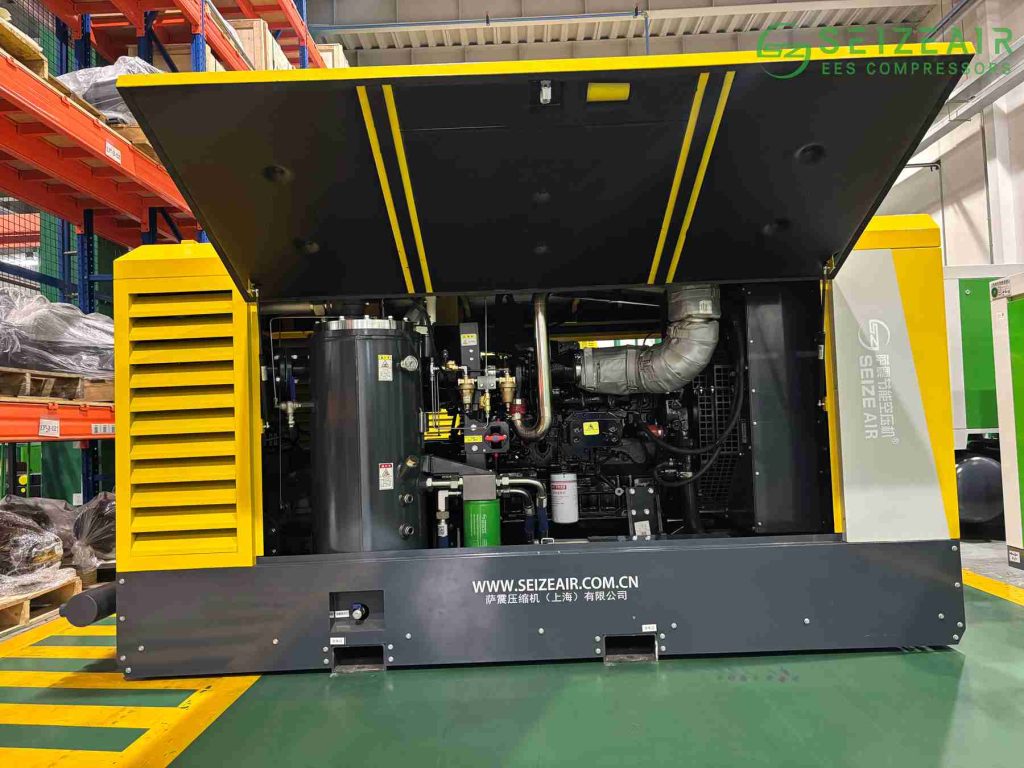
2. Trailer Towable vs. Utility Skid Mounting
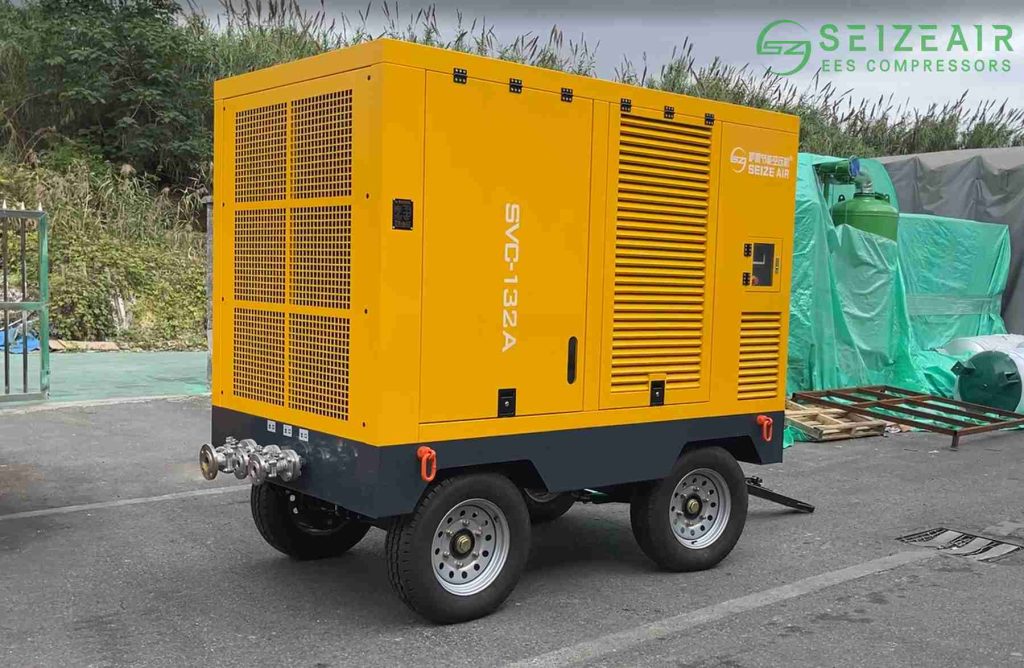
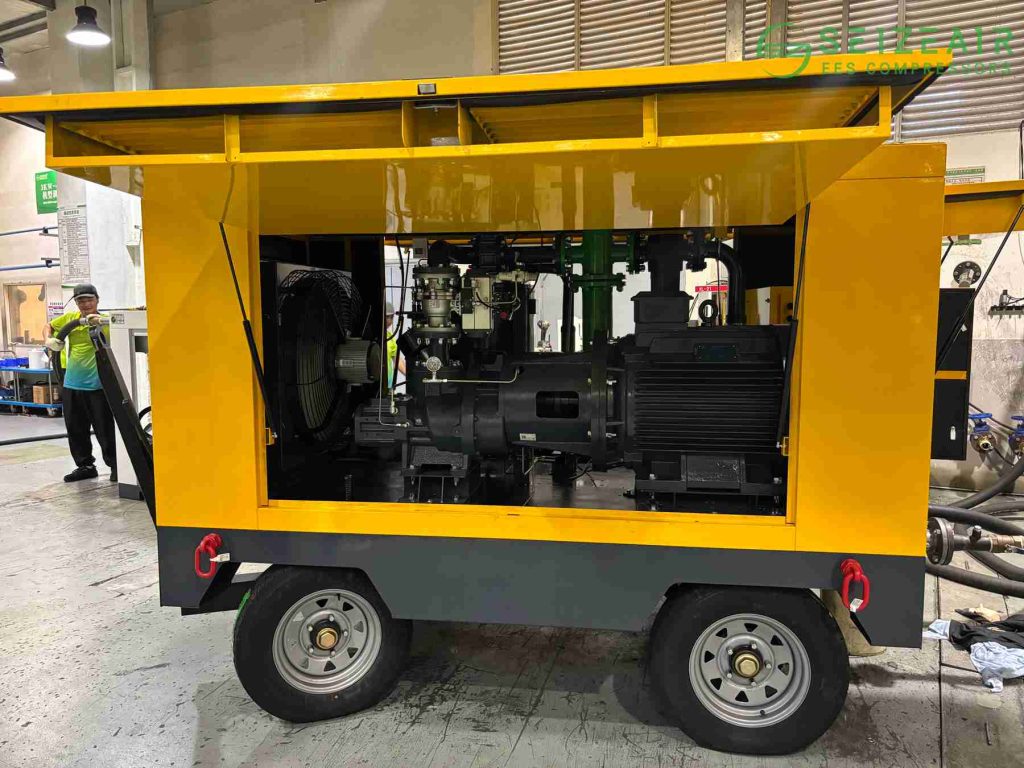
- Towable Diesel Air Compressor for Sale: Features heavy-duty torsion axles, highway tires, electric brakes, and a protective enclosure. Ideal for road construction crews moving between sites.
- Utility Truck Mounted / Skid Package: Compact footprint designed to bolt onto field mechanic service truck beds or stationary concrete pads.
3. Fuel Tank Sizing and Shift Economy
Review the fuel burn rate (GPH) at full operational load. A properly sized diesel compressor should provide at least 8 to 12 hours of continuous runtime on a single fuel tank so your field crew can complete full work shifts without fueling interruptions.
4. Air Receiver Tank Capacity
Receiver tanks ranging from 30 gallons on service truck models up to 120+ gallons on stationary units act as energy cushions. Larger air tanks store pressurized air to smooth out demand spikes, preventing the engine from ramping up constantly and reducing fuel wear.
How Do You Maintain a Heavy-Duty Diesel Air Compressor on the Job Site?
Following a disciplined preventative maintenance routine protects your investment and prevents unexpected field breakdowns:
Daily Pre-Shift Maintenance
- Open tank drain valves to purge accumulated moisture and condensation.
- Check engine oil levels, compressor crankcase sight glass, and engine coolant.
- Inspect the air filter restriction indicators and clear ambient dust from intake screens.
- Visually check air lines and fittings for leaks or wear.
Interval Maintenance (Every 250 to 500 Operating Hours)
- Drain and replace diesel engine crankcase oil and replace lube filters.
- Swap out compressor pump oil with clean synthetic compressor fluid.
- Inspect, tension, or replace engine drive belts and check coupling alignments.
- Clean external fins on two-stage intercooler tubes to maintain optimal heat dissipation.
By choosing heavy-duty units like those from Seize Air, operators benefit from accessible maintenance access points that simplify routine servicing on remote jobsites.
Frequently Asked Questions
What is the main difference between single-stage and two-stage diesel compressors?
A single-stage compressor squeezes air once up to roughly 125–135 PSI. A two-stage compressor squeezes air twice—cooling it between passes—to reach 175–250 PSI with better thermal efficiency and continuous duty cycle ratings.
Is a two-stage diesel air compressor always better than a single-stage model?
Not always. Two-stage models cost more upfront. If your air tools require less than 120 PSI and run intermittently, a single-stage unit delivers full capability at a lower initial investment.
Can a single-stage diesel air compressor run continuously all day long?
Single-stage piston compressors usually carry a 50% to 70% duty cycle rating and require periodic cool-down periods during heavy use. For uninterrupted 100% continuous air output, choose a two-stage unit or a diesel rotary screw compressor.
Should I choose a reciprocating piston or rotary screw diesel compressor?
Reciprocating piston diesel compressors (single or two-stage) excel at intermittent air delivery up to 35 CFM on service trucks. For massive continuous airflow (70 to 400+ CFM) required in commercial sandblasting or rock drilling, a diesel rotary screw compressor is the preferred choice.
Should I consider a used diesel air compressor for sale near me?
Buying a used diesel air compressor for sale near me can save upfront money, but make sure to carefully inspect engine hour meters, pump oil cleanliness, tank corrosion levels, and service records. For critical field work, a new unit with full manufacturer warranty coverage often offers better long-term reliability.
Ready to Upgrade Your Jobsite Air Equipment?
Selecting the ideal diesel air compressor requires matching your peak PSI and CFM demands to the right engine and pump configuration. Getting this balance right ensures your tools run at peak power while keeping fuel costs under control.
Whether you need a compact single-stage unit for light service work or a heavy-duty two-stage machine for continuous field operations, Seize Air provides industrial-grade diesel air compressors built for tough real-world conditions. Contact our technical experts today to discuss your jobsite requirements, receive detailed equipment specs, and get a factory-direct quote.