

Air compressor food grade requirements decide whether the compressed air in your plant can safely touch food, packaging or clean surfaces — or whether it quietly becomes a contamination risk. This guide explains what “food grade” actually means for compressed air, which standards and certificates carry weight in an audit, and how to select an oil-free air compressor that matches your duties. It is written for plant managers, quality managers and process engineers in food and beverage production who need air they can document, not just air that seems to work.
What “Food Grade” Means for Compressed Air
There is no single certificate called “food grade air”. In practice, the phrase describes compressed air that is clean enough for the specific way your plant uses it: dry enough, low in particles, and — above all — free of compressor oil. Regulators do not approve compressors. They expect you to demonstrate that air quality at each point of use is identified, specified and controlled. That reframing matters, because food grade is a property of your whole air system, from the compressor inlet filter to the point where air meets product.
Direct Contact vs Indirect Contact
Not every air use carries the same risk. Compressed air has direct contact when it touches, moves or is mixed into the food itself: sparging and agitation in fermentation and blending, product conveying, air knives over open product, and blow-off before filling or weighing. It has indirect contact when it touches packaging, clean surfaces or equipment close to open product: forming and sealing film, cleaning and drying containers, actuating valves and instruments inside hygiene zones, and clearing dust from conveyors over which product passes exposed.
The practical consequence is simple. Direct-contact air needs the strictest oil classification — in practice Class 0 — together with drying and filtration that match your hazard analysis. Indirect-contact air still needs documented quality, because a puff of oil aerosol over a filler bowl or a sealing jaw contaminates product just as effectively as a direct line does. When you map the plant, label every use point as direct, indirect or utility air. That map becomes the backbone of your air compressor food grade specification, of your monitoring plan, and of the file you hand to an auditor.
The map also decides how deep your records go. For a filling line, direct-contact points might be the air knife over open jars, the sparger in a blending tank and the blow-off before capping; indirect points might be the film sealer and the conveyor actuators; utility points might be the workshop ring main. Granularity costs nothing at design time and saves rework later, because treatment and monitoring attach to points, not to the compressor.
The Contaminants That Matter Beyond Oil
Oil is the headline risk, but it is not the only one. Particles arrive from the ambient intake, from rust and scale inside ageing pipework, and from wear inside components. Water follows: compressed air holds moisture that condenses inside cool pipes, feeding corrosion and giving microorganisms the film they need to persist. Microbial risk deserves specific attention wherever air blows over open product, because a damp dead-leg can turn into a reservoir that no downstream filter can fix.
Temperature drives several of these risks at once. Hot compressor rooms raise the moisture load the dryer must remove; cold spots in pipework condense it back out; and both extremes shorten filter life. Pipe routing matters too: dead legs, oversized storage vessels and corroded pipework all change how much water and debris the air carries to the point of use. None of this is exotic — it is ordinary engineering — but it decides whether the class you wrote on paper is the class the product actually sees.
A food grade system therefore manages four things together: oil, particles, water and microbes. Oil-free compression eliminates the first at its source. Drying handles water. Filtration handles particles. Microbial control comes from dry air, hygienic pipework and point-of-use treatment. No single component covers all four, which is why a serious specification names a class for each.
The Standards That Define Food Grade Air
Two families of standards shape a food grade air specification: compressed air purity standards, which define what “clean” means, and food safety management frameworks, which define what evidence looks like. Knowing what each family does — and what it deliberately leaves to you — keeps a specification credible. Industry guidance from the Compressed Air & Gas Institute is a useful supplement when your team starts writing internal air quality targets.
ISO 8573-1 and the Class 0 Oil Band
The international reference for compressed air purity is ISO 8573-1, which classifies air by particle, water and oil content. For oil, the classification descends from the tightest band to heavily contaminated air. Class 0 sits above Class 1 as the strictest oil designation. It is only meaningful when an independent body has tested the machine and certified the measured total oil content against that class — which is exactly what a Class 0 certificate documents.
This distinction matters when you read datasheets. A compressor described as “oil-free” by design is not the same thing as a compressor whose delivered air has been tested and certified to a class. Design intent is engineering; certification is evidence. For audit purposes, the second is what converts a claim into something a quality manager can file.
It is equally important to know what ISO 8573-1 does not do. The standard defines purity classes; it does not tell a food plant which class each use point needs, and it does not address food safety management. Pairing it with your HACCP plan is what turns a class table into a working specification.

What SEIZE AIR Class 0 Certificates Cover
SEIZE AIR — Seize Compressor (Shanghai) Co., Ltd., founded in 2009 and based in Shanghai — holds Class 0 oil-content certification for its oil-free ranges from GC (Hefei General Machinery Product Certification Co., Ltd.). The dry oil-free screw range, SWT, is certified against ISO 8573-1:2010, ISO 8573-2:2018 and ISO 8573-5:2001 under certificate 08823P10001, issued on 5 January 2023 and valid to 4 January 2028. A separate certificate, GC24009009000223, covers the water-injected single-screw range against the same standards and carries the same expiry date.
Around the machines themselves, the company holds ISO 9001 and ISO 45001 management system certificates, and the oil-free catalogue references TÜV Class 0 certification for the oil-free series. The SWT range is catalogued from 37 to 450 kW at 4.5 to 10.5 bar, which makes it the natural workhorse for central plant rooms in food and beverage factories.
Reading a Certificate Like an Auditor
A certificate is only as useful as the fields it pins down. When you file one, record four things: the certification body, because it tells you the test was independent; the standards cited, because they fix the test method and the class definitions; the covered model list, because a certificate for one size does not silently extend to a whole series; and the expiry date, because certification lives on surveillance and dies quietly afterwards. Certificates with model lists — like the two GC certificates above, which enumerate the covered SWT and water-injected models — give you a clean answer when an auditor asks exactly which machines the class applies to.
How Food Safety Audits Treat Compressed Air
Food safety frameworks such as HACCP, the US Food Safety Modernization Act and retailer standards like BRCGS and IFS do not certify compressors. They require you to identify hazards, set critical limits and keep records wherever compressed air touches food or food-contact surfaces. The audit questions are predictable: where does air touch product, what quality do you specify at each point, how do you verify it, and what happens when a filter clogs or a dryer faults?
A Class 0 certified, oil-free compressor answers the first question cleanly, because there is no compressor oil to carry over at all. The rest — verification, alarms, records — is system design, and it is where most findings happen. A useful rehearsal is to walk your own line as an auditor would. Start at the point where air touches product and ask backwards: which filter is last, when was it changed, what proves the dew point held during last summer’s peak, and which alarm would have told you if it had not? If any answer is a shrug, you have found the finding before the auditor does. For a closer look at how Class 0 units behave in daily production, see our article on Class 0 compressors in food and beverage plants.
Why Oil-Free Compression Is the Starting Point
Filtration can strip oil aerosol from an oil-injected compressor’s air, up to a point. But every added filter is a consumable, a pressure drop and a failure mode waiting for a delayed maintenance round. For direct food contact, most quality teams conclude that removing oil from the compression chamber itself is simpler to defend, simpler to verify and harder to get wrong.
Where Oil Contamination Comes From in a Lubricated Machine
In an oil-injected screw compressor, oil is deliberately sprayed into the compression chamber to seal, cool and lubricate. Most of it is removed downstream by the separator, but a fine aerosol always remains in the delivered air. Carryover grows as separators age, as oil degrades under heat, and as service intervals slip. High ambient temperatures, marginal oil quality and overdue separator changes are the classic triggers.
None of this makes oil-injected machines poor general-purpose compressors — our oil-injected versus oil-free comparison explains the trade-offs in cost and maintenance honestly. It does mean the delivered air can never be guaranteed oil-free by design. In a food plant, that gap has to be closed with filtration and periodic testing indefinitely, and re-documented after every oil change. An oil-free machine removes the source instead of paying to treat the symptom.

The Cost Side of the Oil-Free Decision
Oil-free machines cost more at purchase, and it is fair to ask what the premium buys. The answer is a shorter chain of trust. With an oil-injected system, food-grade air depends on separator health, then on coalescing filters, then on carbon stages, then on testing to prove the chain still works. Each layer adds consumables, pressure drop and a monitoring duty.
With an oil-free compressor, the first and largest hazard is gone by design, so treatment can be sized for particles, water and microbes rather than for rescuing the air from compressor oil. There is also a lifecycle angle that has nothing to do with audits. Filter stages consume power as pressure drop for as long as they are installed, and their elements are bought, stocked and changed forever. Removing a hazard at the source instead of filtering it downstream removes that recurring cost from every year of the plant’s life. The premium on the compressor is paid once; the filtration it displaces is paid continuously.
Dry Screw, Water-Lubricated and Scroll Architectures
Oil-free is not one design. Three architectures cover most food plant duties, and they divide neatly by flow, pressure and proximity to the point of use.
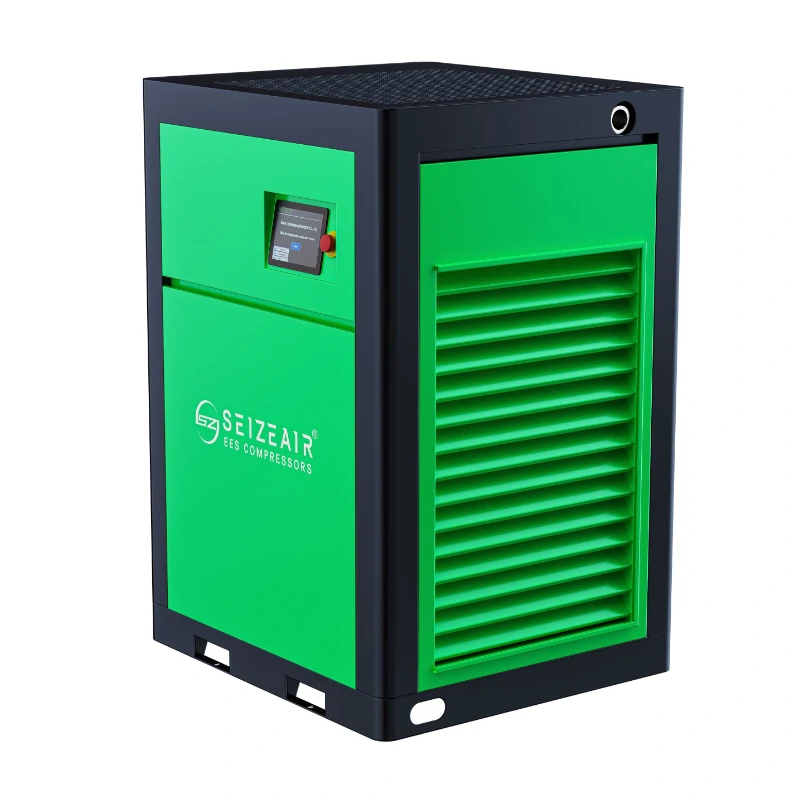
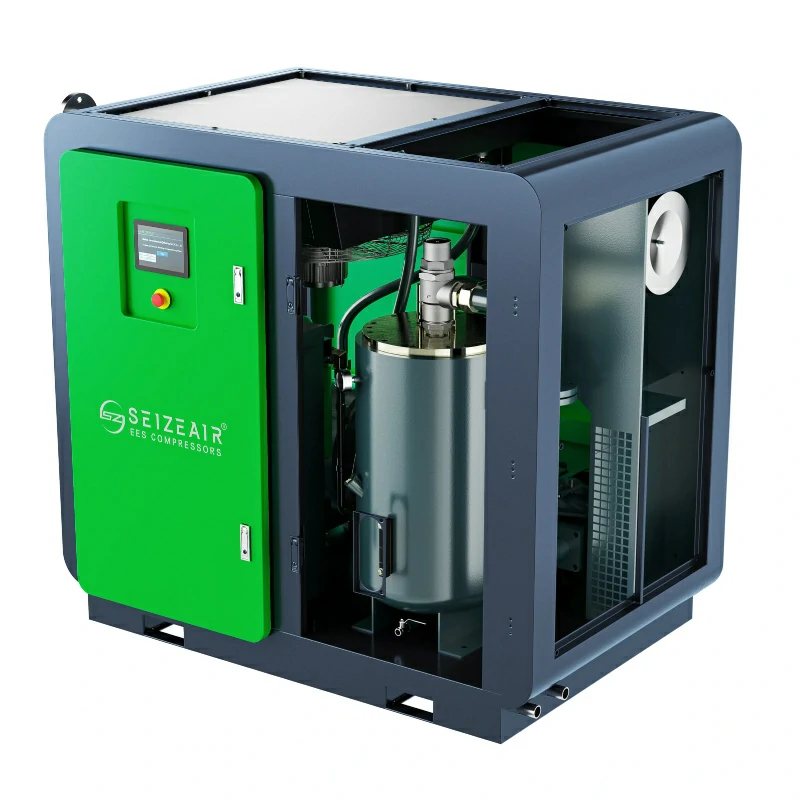
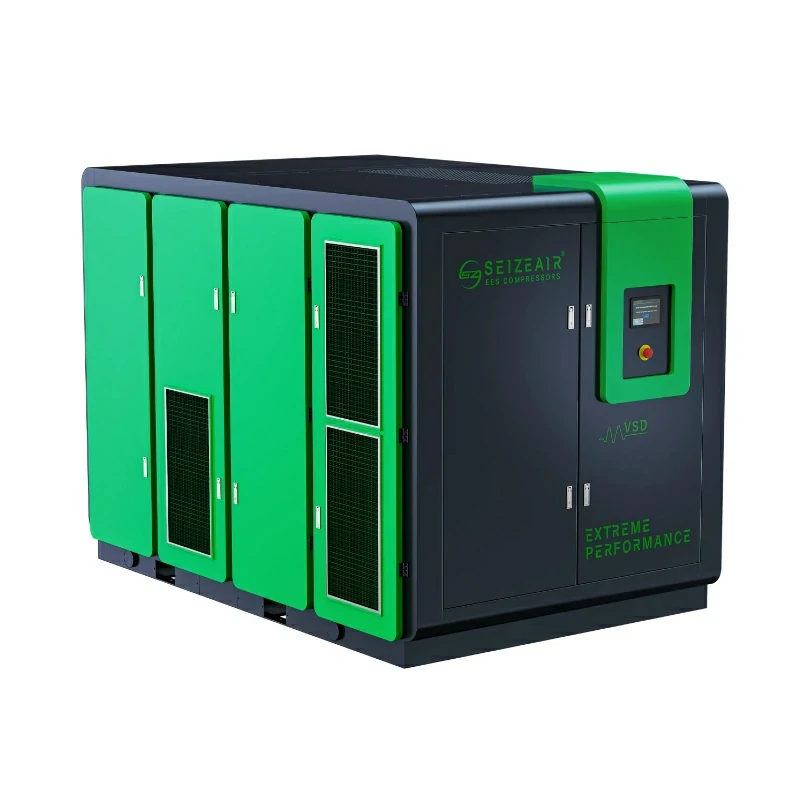
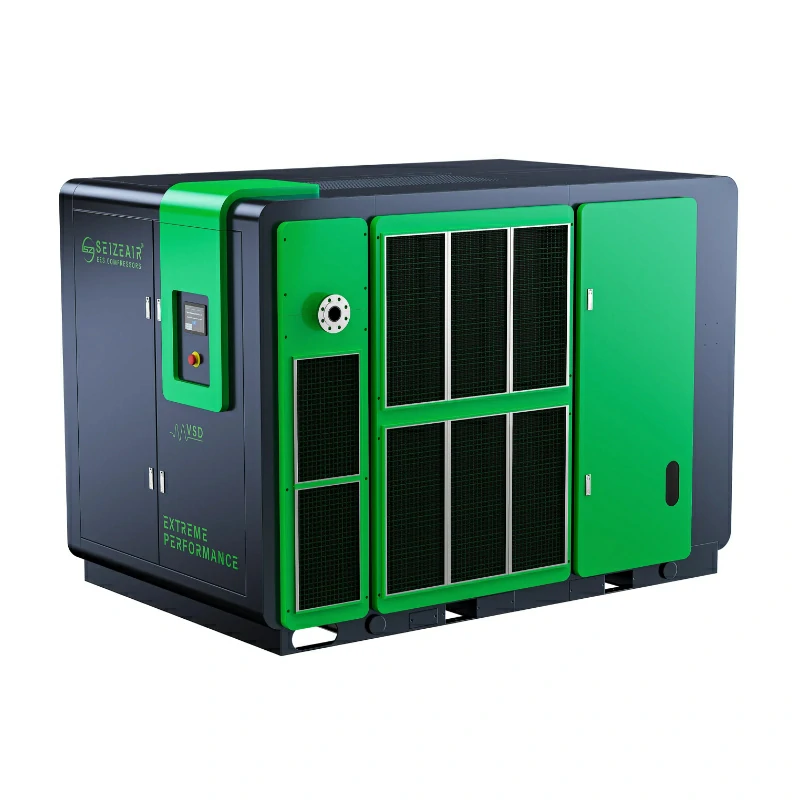
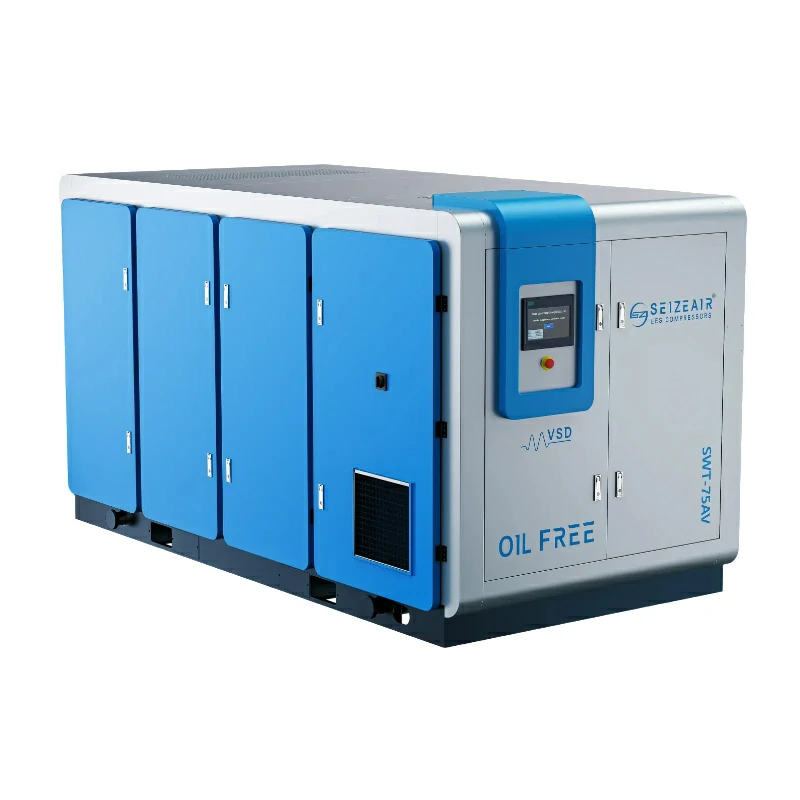
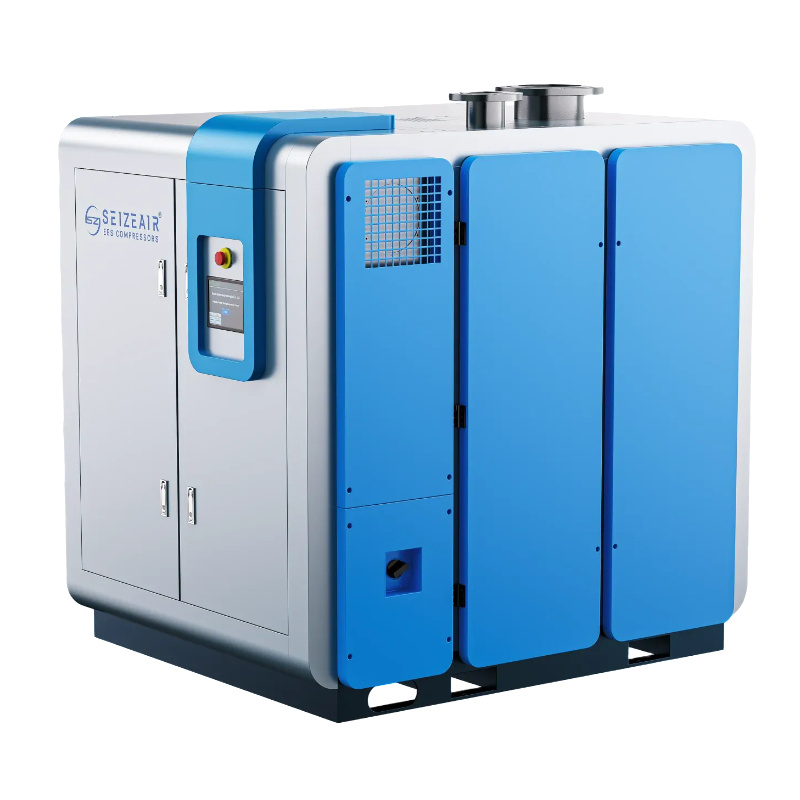
Dry oil-free screw compressors keep the compression chamber completely oil-free, with synchronised rotors and separate cooling. The SEIZE AIR SWT dry oil-free screw compressors cover 37 to 450 kW at 4.5 to 10.5 bar, which suits central plant rooms serving packaging, filling and conveying at once. Two- and three-stage designs exist within the range, so pressure selection does not force you back toward lubricated machines.
Water-lubricated (water-injected) single-screw compressors use injected water for sealing and cooling, then separate and recirculate it. There is no compressor oil in the air path at all. See the water-lubricated oil-free screw compressor for the current range, and read our detailed comparison of Class 0 water-lubricated versus dry oil-free compressors before you choose between the two.
Oil-free scroll compressors serve the small end: compact, quiet and simple to install close to the work. The SWO oil-free scroll air compressors span 7.5 to 37 kW, delivering 0.8 to 4.0 m³/min at up to 8 bar, with sound levels around 55 to 64 dB(A). Choosing between the three architectures is mostly about three questions: how much air you need, at what pressure, and how close to open product the machine will live. Central plant rooms with mixed duties tend to land on dry screw technology; sites where hygiene dominates everything often prefer water-lubricated designs; small, scattered or noise-sensitive duties go to scroll. Getting this division right early prevents the classic mistake of buying one large machine and then filtering your way out of a purity problem.

Matching the Compressor to the Food Plant Duty
The fastest way to overspend or underspecify is to buy one machine for a plant full of different duties. Splitting the demand by duty lets each zone get the air quality it actually needs — and no more treatment than it can justify.
Packaging, Filling and Direct Product Contact
Packaging and filling lines combine high flow with direct or near-direct product exposure: film forming and sealing, container rinsing and drying, air knives over open product, and blow-off before checkweighers. These duties usually justify a central dry oil-free screw compressor with zoned downstream treatment, because flow is large and stable enough to amortise it. Plan the zones before the machine arrives. Packaging air rarely needs one class everywhere: the sealer and actuator ring can sit at a moderate dew point, while air knives over open product need the strictest treatment and their own point-of-use verification. Zoning keeps treatment sized to the risk instead of gold-plating every cubic metre. The packaging-specific decisions — actuator air, sealing air, and blow-off distances over open product — are covered in our guide to choosing a safe air compressor for food industry packaging.
Small Lines, Kitchens and Point-of-Use Air
Not every food operation needs a central plant room. Bakeries, small processing lines, quality laboratories and packaging stations often need a compact, quiet machine that can sit near the work and run on simple services. This is where scroll technology fits: oil-free by design, low in noise, and quick to commission. A scroll unit feeding a short ring main with local drying and filtration can be the simplest food grade air system to document, because the whole chain is short, visible and easy to test end to end. Compact systems also change the maintenance conversation. With one machine, one dryer and a handful of filters, a small team can genuinely understand every component — which makes records honest and alarms meaningful. That simplicity is a food safety asset in its own right, and it is often the reason a small site passes an audit that a larger plant struggles with.

Low-Pressure Aeration and Wastewater Treatment
Food plants also consume large volumes of low-pressure air that never touches product directly: aeration in wastewater treatment, agitation in tanks, and low-pressure conveying. This is the natural territory of the oil-free screw blower. The SPVC oil-free screw blower covers 22 to 250 kW at 0.4 to 2.0 bar with a variable-speed permanent-magnet motor, rated to ISO 1217 Annex C.
Aeration loads run for long hours at steady flow, which is why variable speed matters: matching blower output to the tank’s actual demand avoids throttling losses around the clock. Keeping the blower oil-free still matters here, because that air ends up in water the plant must discharge responsibly, and discharge permits apply at exactly that point; the Water Environment Federation publishes aeration system guidance for treatment designers. For the largest aeration loads, magnetic levitation blowers push efficiency further, but for most food plant duties the oil-free screw blower is the practical workhorse.

Sizing the System Before You Quote
Size from demand, not from habit. Collect the flow and pressure of every consumer from its data sheet, note the duty cycle, and add a realistic allowance for leakage and planned lines. Prefer measuring an existing plant with data loggers over estimating from the compressor nameplate: nameplates describe the machine, not the demand. Pressure deserves its own decision. Compressing to a higher pressure than the plant needs wastes energy every hour of every shift, and it changes which machines are candidates. If one or two consumers demand high pressure, consider serving them separately rather than lifting the whole network.
Decide early between a central and a distributed layout. A central plant room amortises one large machine and one treatment chain, but it couples every consumer to the same system and turns pipework into part of the air quality chain. Distributed machines shorten the chain per zone and isolate failures, at the cost of more units to maintain. Redundancy belongs in the same decision: a single compressor feeding a filling line is a single point of failure for both production and the hygiene story, while a two-unit arrangement lets maintenance happen without suspending the monitoring plan. Our broader overview of choosing an air compressor for the food industry walks through these choices in their wider context.
What an Air Compressor Food Grade Specification Should Include
Before you collect quotations, write the specification down. A clear specification turns vendor conversations from marketing into engineering, and it becomes the reference document for audits, maintenance and any future line extension. Two checklists cover most of it: one for choosing the system, one for signing it off.
Selection Checklist Before You Buy
- Map every point of use and label it direct contact, indirect contact or utility air.
- Define the required air quality per point of use, referencing ISO 8573-1 classes for particles, moisture and oil.
- Take flow and pressure from equipment data sheets rather than rules of thumb, and add a realistic allowance for leakage and planned extensions.
- Choose the oil-free architecture that matches the duty: dry screw for central plant rooms, water-lubricated screw where oil-free-by-design is the priority, scroll for small point-of-use duties.
- Require third-party certification, and file the certificate number, the cited standards, the covered models and the expiry date.
- Plan downstream treatment per zone: drying to the target dew point, particulate and coalescing filtration, plus sterile or activated-carbon stages where the hazard analysis calls for them.
- Confirm the monitoring plan before purchase: dew point instruments, differential pressure gauges across filters, and scheduled point-of-use air quality testing.
Commissioning and Sign-Off Checklist
- Verify the installation against the manufacturer’s manual: ventilation, clearances, intake quality and ambient limits.
- Run a baseline air quality test at every critical point of use and file the laboratory report with the project documents.
- Record filter and dryer settings, then set alarms for dew point and differential pressure with clear escalation routes.
- Train operators on what each alarm means, who responds, and what to stop when an alarm persists.
- Schedule the first re-test in the maintenance calendar before the project closes, so the baseline never becomes a one-off.
Installation and Validation in a Food Plant
Compressor Room and Site Basics
An oil-free compressor still needs a suitable home. The installation manual defines the limits that matter: ambient temperature and humidity ranges, altitude, and the ventilation needed to shed heat. Keep the room dry and free of dust, keep the intake air as clean as the environment allows, and never starve the machine of cooling air — recirculating hot exhaust back into the intake shortens component life and destabilises the air output.
In a food plant, hygiene zoning also decides location. Keep the compressor room away from open product areas, both to protect the product and to keep compressor noise and service traffic out of hygiene zones. Plan the room so service access is easy; a machine that is awkward to service is a machine whose service gets deferred.

Ambient and Seasonal Risks
Seasonal change is the quiet variable in compressed air. Summer humidity multiplies the moisture load the dryer sees; winter cold moves condensation into unexpected places and can freeze unprotected condensate drains. Sites in coastal or dusty regions load the intake filter faster than inland ones. None of these factors change the specification, but they change how hard the system must work to hold it. Review dryer performance and filter condition across seasons, and treat any class drift at the point of use as a signal to investigate rather than a number to re-file.
Downstream Treatment Still Matters
Oil-free compression removes compressor oil from the equation, but it does nothing about ambient particles, water vapour or microbes. Downstream treatment does that work: a dryer sized for your dew point target, particulate and coalescing filtration, and sterile or activated-carbon stages where the hazard analysis requires them. Point-of-use filtration at critical locations is your insurance against an upstream fault, because it is the last device the air passes before product. Remember that every filter is also a pressure drop, so specify them for real flow, monitor differential pressure, and change elements on evidence rather than on the calendar alone.
Common Mistakes That Show Up in Audits
- Specifying air quality per compressor instead of per point of use, leaving critical users protected only by coincidence.
- Treating an “oil-free” datasheet claim as certification, then having no certificate to show when asked.
- Leaving dew point unmonitored, so a dryer fault surfaces as condensation at a filler weeks later.
- Installing filter bypasses or undersized elements during a hurry, silently defeating the treatment chain.
- Keeping test reports that exist but cannot be found; the auditor concludes the system is uncontrolled even when it is not.
Keeping Records for Audits
Documentation is what converts good engineering into a pass. Keep the use-point map, the air quality specification per point, machine and treatment datasheets, the Class 0 and management system certificates with their expiry dates, baseline and periodic test reports, and the filter change logs. When an auditor asks how you control compressed air, the file should answer within minutes; if assembling it takes a week, the gap is system design, not paperwork.
Two habits keep the file alive. First, store records where the team that needs them actually works, not only in a quality folder nobody opens. Second, review the file at the same rhythm as the tests themselves, so gaps surface while they are still cheap to fix.
Frequently Asked Questions
What does “food grade” mean for compressed air?
Food grade describes compressed air that is clean enough for its intended contact with food: free of compressor oil, low in particles and moisture, and controlled for microbial risk where air touches open product. No single certificate labels air “food grade”. Plants demonstrate it with ISO 8573-1 class targets, certified oil-free compression, matched treatment and testing records.
Is an oil-free compressor mandatory for food grade air?
For air that directly touches food, oil-free compression is the defensible baseline, because it removes the main contamination source by design rather than by filtration. Oil-injected machines with heavy filtration are sometimes accepted for utility and some indirect duties, but every filter is a consumable that can fail without visible warning. Most food safety teams specify oil-free for direct contact and reserve filtered oil-injected air for genuinely non-critical uses.
What is Class 0 and how do I verify a supplier’s claim?
Class 0 is the strictest oil band under ISO 8573-1. Verify it from the certificate, not the datasheet: check the certification body, the cited standards, the covered model list and the expiry date. SEIZE AIR’s SWT dry screw and water-injected single-screw ranges carry GC Class 0 certificates valid to January 2028, and the oil-free catalogue also references TÜV Class 0 certification.
Can one compressor serve both food contact and utility air?
Technically yes, and many smaller plants do with zoned treatment. The trade-off is dependency: your most critical air then relies on every upstream device staying healthy. Larger plants often separate the central oil-free supply for critical zones from dedicated blowers or scroll units for utility tasks, which simplifies monitoring and makes failures easier to isolate.
How often should compressed air be tested in a food plant?
Test at commissioning to set the baseline, then re-test on the schedule your HACCP plan sets — commonly annually, and after any major change to compressors, treatment or pipework. Many quality teams also re-test at critical points after filter change-outs. The right frequency is the one your food safety plan documents and follows, not a universal number.
How much does a food grade air system cost?
Costs depend on flow, pressure, treatment scope and monitoring, so ask for a system quotation rather than a compressor price. The honest cost drivers are the oil-free machine itself, drying and filtration sized to your target classes, hygienic pipework in hygiene zones, testing, and spare filter elements. A quotation that covers only the compressor leaves half the system out — and the missing half is usually where audit findings come from.
Key Takeaways
Food grade compressed air is a property of the whole system, not a compressor feature. Start from the map of where air touches food, packaging or clean surfaces. Specify ISO 8573-1 classes per point of use. Buy compression that removes oil at the source and back it with a certificate — filed, dated and tracked to expiry. SEIZE AIR’s oil-free ranges hold GC Class 0 certificates valid to January 2028, and the current models are listed on the oil-free air compressor range page.
If you are planning a new line or upgrading an existing plant, contact SEIZE AIR with your flow, pressure and use-point map, and ask for the Class 0 certificates alongside the quotation. An air compressor food grade specification you can defend in an audit is mostly about evidence — start collecting it on day one.