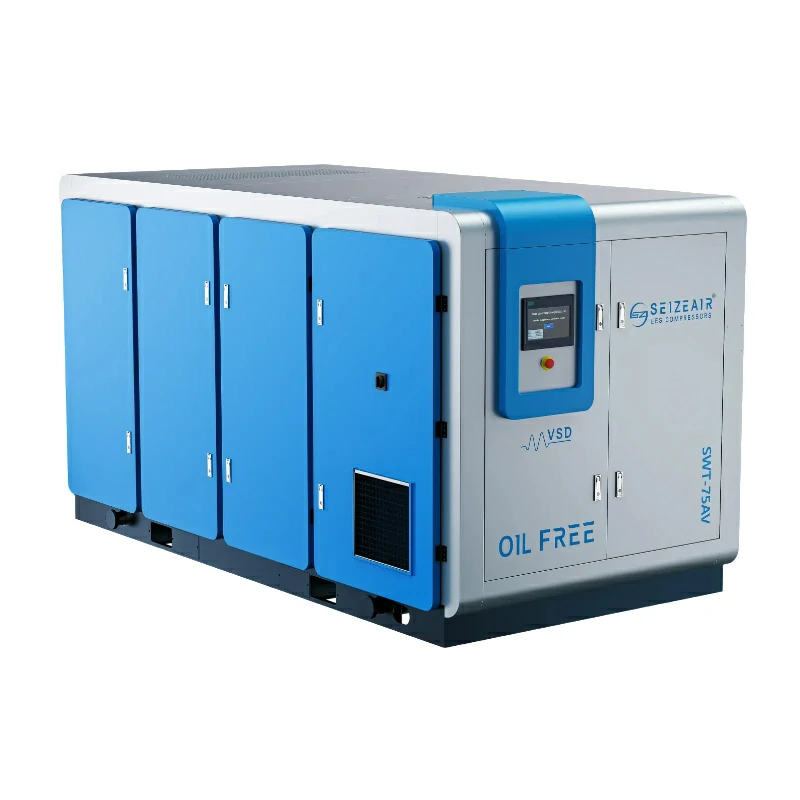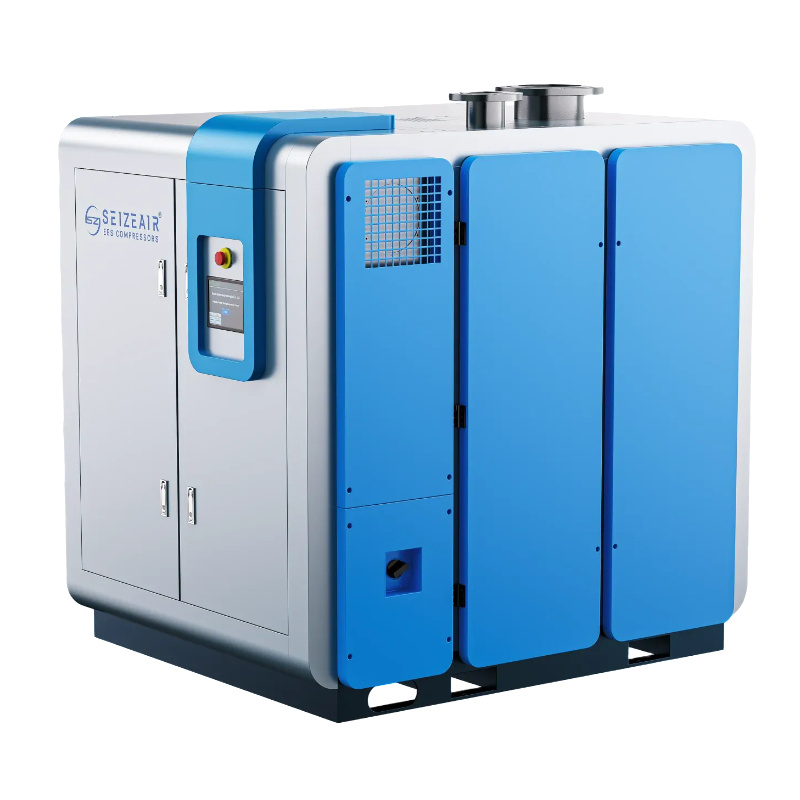


Compressor airend performance is the single biggest factor behind the reliability, efficiency and service life of a screw air compressor. Also called the air end, compressor block or screw element, the airend is the precision-machined core that actually draws in atmospheric air and squeezes it into pressurised air. The motor, the variable speed drive, the cooler, the separator and the controller all exist to serve this one assembly. Whether you are sizing a new machine, comparing two supplier quotations or weighing a rebuild against a replacement, understanding the airend is the fastest way to tell a genuinely engineered offer from a polished cabinet. This guide explains what an airend is, how it works, the main types, how to read efficiency figures, how to select the right unit, and how to keep it running for years. For the broader machine context, start with our overview of the industrial screw compressor and how it works.
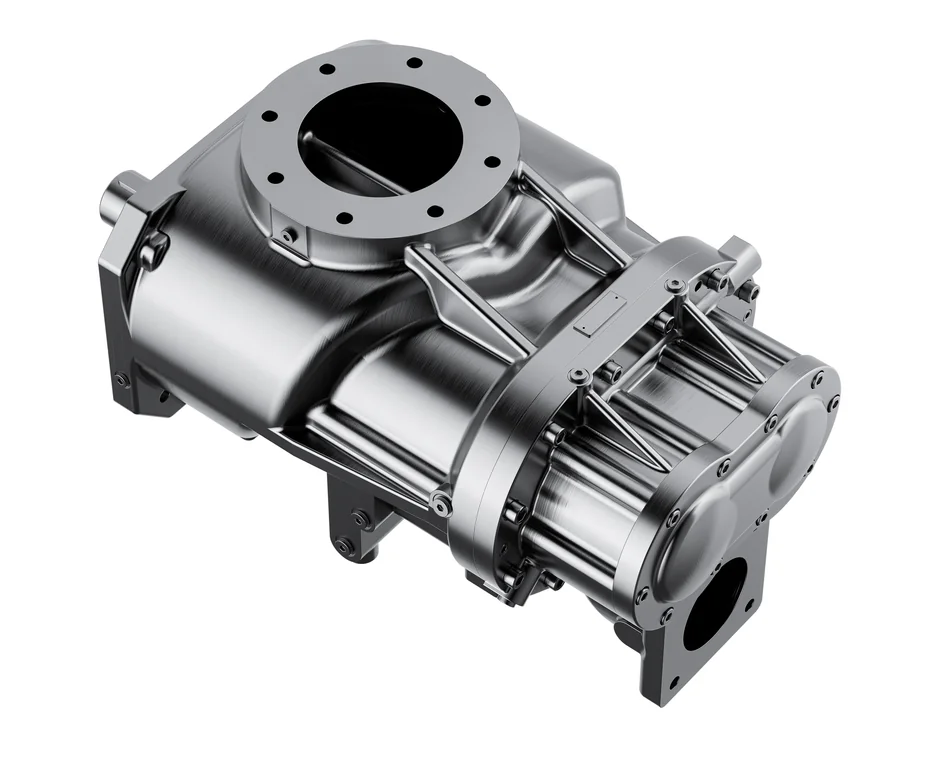
What Is a Compressor Airend?
An airend is the positive-displacement pumping element of a rotary screw compressor. Inside a cast housing sit two intermeshing helical rotors — a male rotor with convex lobes and a female rotor with concave flutes. As the rotors turn, the space between them and the housing wall traps a pocket of air, shrinks that pocket as it moves along the rotor axis, and pushes the compressed air out through a discharge port. That is the whole compression event, repeated thousands of times per minute. Everything upstream (air intake, filtration, inlet valve) and downstream (oil separation, cooling, pressure regulation) supports this mechanism.
The term matters commercially as well as technically. When a supplier quotes a machine, the airend is the component that defines its duty point, its specific power and its maintenance interval. Two compressors with identical motor ratings can deliver very different amounts of air because their airends differ in rotor profile, rotor length, manufacturing tolerance and speed. Buyers who compare only kilowatts and cabinet size routinely overpay for air or discover too late that the machine cannot hold pressure on a hot day. Reading the airend specification is how you avoid that outcome.
Airends are generally sold in one of two forms. A bare airend is supplied to original equipment manufacturers who build the motor, frame, cooling and controls around it. An integrated airend package arrives as a complete block with a matched motor and often a built-in separator and cooler, ready to be bolted into a system. Most end users buy the complete compressor, but understanding which airend sits inside it — and who made it — tells you a great deal about the machine’s likely longevity. Our oil-injected screw compressor range is built around airends selected for continuous industrial duty.
How Does a Screw Compressor Airend Work?
The screw compression cycle has three phases: intake, compression and discharge. At the suction end of the airend, air enters through an inlet port and fills the expanding grooves between the two rotors. The rotors are driven by a timing gear arrangement so they mesh without metal-to-metal contact. As they rotate, trapped air is carried along the length of the rotors while the volume of the pocket steadily decreases. By the time the pocket reaches the discharge end, the air has been compressed to the target pressure and is pushed out into the separator or the discharge line.
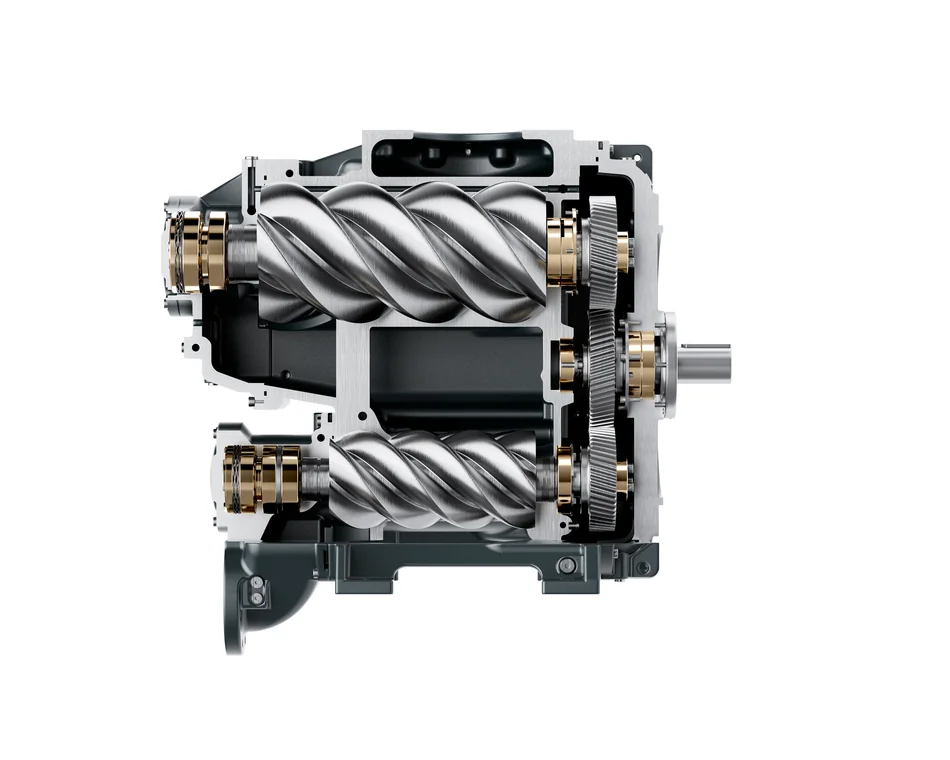
In an oil-injected airend, oil is deliberately injected into the compression chamber. It performs three jobs at once: it seals the tiny clearance between the rotors and the housing, it absorbs a large share of the heat of compression, and it lubricates the rotor contact surfaces. This is why an oil-injected machine can approach near-isothermal compression in a single stage and why oil quality is so tightly linked to airend life. In an oil-free airend, the rotors do not touch and no oil enters the air stream; instead, precision timing gears keep the rotors synchronised and external cooling removes the heat. The two designs require very different materials, clearances and maintenance disciplines.
Rotor speed is the other half of the story. Airends are positive-displacement devices, so output volume is roughly proportional to rotational speed at a given pressure. Drive the airend faster and you get more air from the same rotor length; slow it down and you get less. This relationship is the reason a variable speed drive can match air supply to demand so effectively, a point explored in more detail in our guide to VSD screw compressor benefits. It also sets a hard ceiling: every airend has a maximum permissible speed and a minimum speed below which oil sealing or cooling breaks down.
Main Components Inside an Airend
Beyond the two rotors, a handful of components determine how long an airend lasts. The rotor profile is the starting point. Modern asymmetric profiles move more air per revolution and lose less through internal leakage than older symmetric designs, and the difference compounds over thousands of operating hours. Rotor manufacturing is equally important: the lobes are ground to micron-level accuracy, and any deviation shows up as increased leakage, higher discharge temperature and eventually contact between the rotors.
Bearings locate the rotors radially and axially and absorb the pressure load pushing them apart. Because the pressure differential across an airend is significant, bearing selection and lubrication are not minor details — bearing failure is one of the most common reasons an airend needs a rebuild. Timing gears synchronise the two rotors so they never touch, and they carry their own lubrication and alignment requirements. Mechanical shaft seals keep oil in and air out at the drive end; a worn seal shows up as oil loss, contamination or a drop in delivered pressure.
The housing itself is a precision casting with inlet and discharge ports, oil injection galleries and cooling passages. Cooling design deserves special attention because the heat of compression has to leave somewhere. Some airends rely on oil circulation and an external cooler, others use an integral water jacket, and integrated packages may combine both. Getting the cooling circuit wrong is a frequent cause of premature airend failure in hot plants, a topic we return to in the maintenance section below.
Rotor Profile and Manufacturing Precision
The helical rotor is the heart of the airend, and its profile is the result of decades of refinement. Early machines used symmetrical profiles in which the male and female lobes were mirror images. Modern designs are asymmetric: the male rotor has fewer, broader lobes while the female has more, deeper flutes, and the combining line between them is shaped to minimise leakage. The practical effect is more swept volume per revolution and less air slipping back from the high-pressure side to the low-pressure side. That leakage term is what separates an efficient airend from a wasteful one at the same speed.
Precision is what makes the profile work. Rotors are machined and then ground to tolerances measured in microns, because the clearance between the two rotors and between each rotor and the housing must be small enough to seal yet large enough to avoid contact as parts expand under heat. Too generous a clearance and compressed air leaks backward, lowering output and raising specific power. Too tight a clearance and the rotors score, overheat or seize. This is why the reputation of the manufacturer and the quality of its machining equipment matter as much as the published flow figure.
Rotor length is the third variable. A longer rotor gives more displacement at a given diameter, but it also needs stiffer shafts and better support to control deflection under pressure load. A short, fat rotor and a long, slim rotor can produce the same flow yet behave differently in terms of efficiency, maximum speed and tolerance to contaminated air. When a supplier quotes a small airend delivering an unusually high flow, ask what speed it needs to achieve that figure — an impressive number obtained only at the top of the speed range may come with a cost in bearing life.
Surface finish and materials complete the picture. Smooth rotor surfaces reduce friction and improve sealing, while the choice of alloy and heat treatment determines how the rotors respond to thermal cycling and to the small amount of debris that even good filtration cannot remove. These details are invisible in a brochure photograph, yet they explain why two airends that look identical on the outside can diverge in efficiency and reliability over a long service life. Ask for the manufacturing standard and the quality controls behind any airend you are considering.
Single-Stage vs Two-Stage Airends
A single-stage airend compresses air from ambient to the final discharge pressure in one pass through the rotors. It is the standard choice for the common 7 to 10 bar industrial range and offers the simplest layout, the lowest initial cost and straightforward maintenance. For higher pressures, or where efficiency at a sustained high duty matters, a two-stage design splits the work across two airends in series, with an intercooler between them. Cooling the air between stages reduces the work required for the second stage and lowers the discharge temperature.
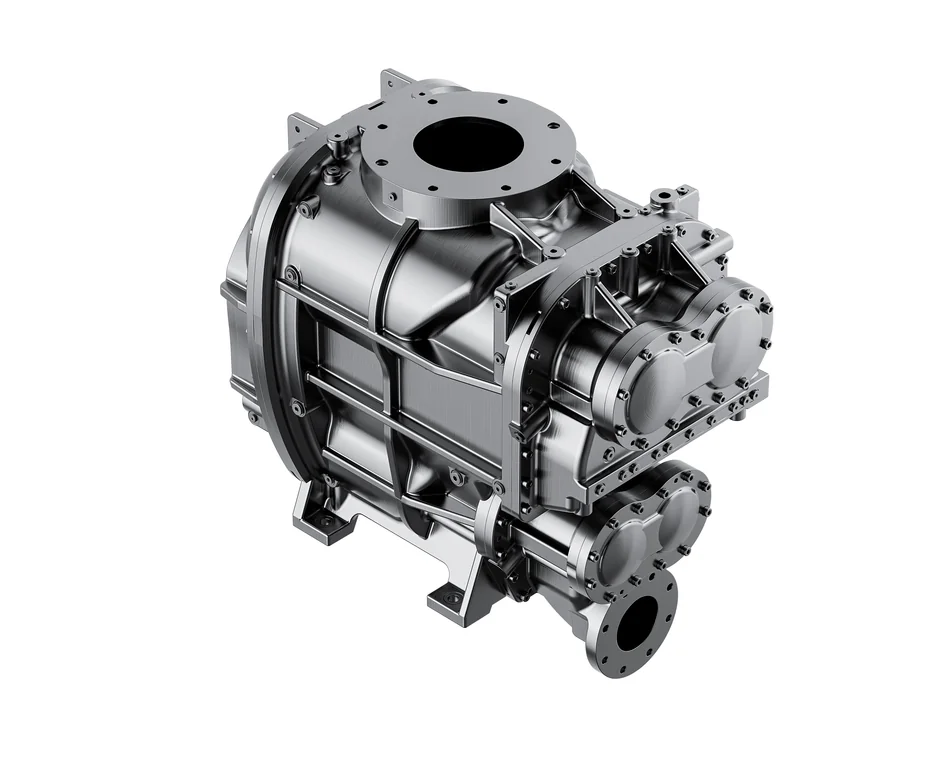
The trade-off is complexity. A two-stage machine carries more rotors, more bearings, an intercooler and a more involved control sequence, so it costs more to buy and to service. It earns that premium when the application genuinely spends most of its life at high pressure. Plants that only occasionally need high pressure are often better served by a correctly sized single-stage unit running at a sensible duty cycle. Our comparison of single-stage versus two-stage compressors walks through the decision with worked scenarios, and our two-stage screw compressor range shows how the stages are packaged in practice.
One more distinction is worth flagging here. Two-stage screw compression should not be confused with two-stage centrifugal compression, a different machine family used for very high flow rates. The centrifugal air compressor line follows a different operating principle and selection logic entirely; mixing the two up at the specification stage leads to badly mismatched equipment.
Oil-Injected vs Oil-Free Airends
The presence or absence of oil in the compression chamber is the deepest split in airend design. Oil-injected airends dominate general industry because oil gives excellent sealing and cooling, allowing a compact single-stage machine with good efficiency and a long service interval when the correct oil and filtration are used. The price is that the delivered air carries oil aerosol, which must be removed by separators and filters before the air reaches sensitive processes.
Oil-free airends eliminate oil from the air stream entirely, which is mandatory in food, beverage, pharmaceutical and many electronics applications. Within that category, dry screw machines use timing gears and very tight clearances with no liquid in the chamber, while water-lubricated or water-injected designs use water for sealing and cooling. Each has a distinct operating envelope: dry screw units tolerate higher discharge temperatures but need precise filtration and careful moisture management, while water-lubricated units need controlled water quality and a separation stage. Our dry oil-free screw compressors and water-lubricated oil-free compressors illustrate the two approaches, and the oil-free compressor category brings them together.
Do not assume an oil-free airend is automatically more efficient or more reliable. Without oil to seal clearances, it is more sensitive to wear and to inlet air contamination, and it typically needs more frequent attention to filtration. The right question is not which type is better in the abstract, but which one matches your air-quality requirement and your maintenance capability. If your process tolerates filtered oil-injected air, forcing an oil-free machine on it usually raises both capital and running cost for no practical benefit.
Integrated Airend Packages and Bare Airends
A bare airend is a component; an integrated package is a system. An integrated airend block typically combines the screw element with a matched electric motor, a belt or direct coupling, an oil separator tank, a cooler and the inlet controls on a single frame. The advantage is fit: the manufacturer has already matched rotor speed, motor power and cooling capacity, so the risk of a mismatched assembly is removed. For plant teams with limited in-house engineering, that integration is worth paying for.
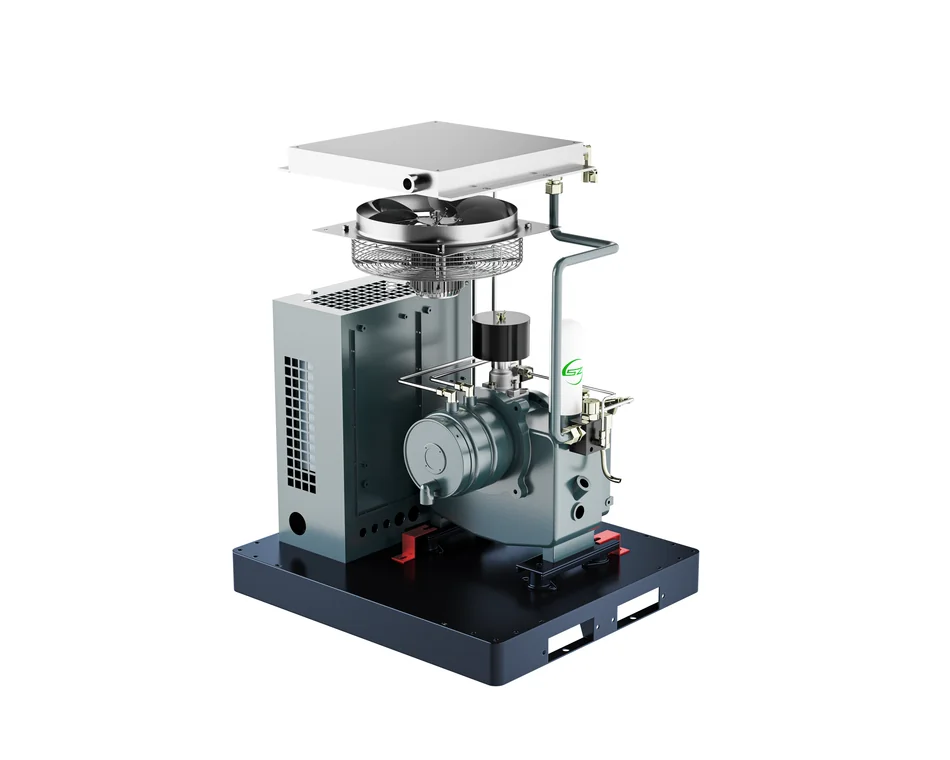
Bare airends make sense for OEMs and for specialist rebuilders who already have the surrounding system and want to specify the compression element themselves. They also appear in retrofit projects where the frame, motor and controls are sound and only the worn airend needs replacing. In that situation the critical task is matching the replacement airend’s flow, pressure and drive ratio to the existing machine. A unit that physically fits but delivers the wrong volume at the required pressure will either trip on overload or fail to hold pressure under load.
Integrated designs have also expanded into compact all-in-one blocks that include a receiver and after-treatment on one skid. These are attractive where floor space is tight and installation simplicity matters. Whatever the format, ask the supplier which airend is fitted, what its design duty point is, and what speed range it is approved for — these three answers tell you more than the marketing brochure.
Reading Airend Efficiency and Specific Power
Specific power is the standard way to compare compressor efficiency: the electrical input required to deliver a unit volume of air, usually expressed in kW per cubic metre per minute. A lower number means more air for the same electricity. Because energy is the largest lifetime cost of an industrial compressor, a small difference in specific power can outweigh the purchase price difference between two machines within a couple of years of continuous operation.
Be careful about the conditions behind any efficiency figure. A specific power value is only meaningful when the reference pressure, intake conditions and measurement standard are stated. Reputable suppliers test to a defined standard such as ISO 1217 and publish the intake temperature and pressure used. As a concrete reference point from verified test documentation, one 75 kW two-stage oil-injected model tested to ISO 1217:2009 at 0.8 MPa recorded a whole-machine input power of 90.44 kW at 15.32 m³/min, giving a specific power of 5.90 kW/(m³/min). That is a complete-package figure under stated test conditions — not a universal airend value, and not a promise for every site.
When comparing bids, insist that every specific power figure is quoted at the same pressure and to the same standard. A number measured at a lower discharge pressure will look flattering but cannot be reproduced at your plant’s required pressure. If a supplier will not state the test basis, treat the figure as marketing rather than engineering. It is also worth asking how the airend performs at part load: a machine that is efficient only at 100% flow will waste energy in a plant whose demand swings through the day, which is where speed control earns its keep.
Matching the Airend to Motor and Drive
An airend never works alone. Its performance depends on how well the motor, transmission and control system are matched to it. Start with power: the motor must be able to deliver the shaft power the airend needs at the worst-case duty point, with enough margin for hot days and slightly dirty filters. Undersizing causes the motor to trip or overheat; gross oversizing wastes capital and often leads to poor part-load behaviour. The nameplate kilowatts alone do not settle the question — the airend’s required shaft power at your discharge pressure does.
The transmission matters just as much. Direct-coupled airends offer high efficiency and low maintenance because there are no belts to tension or replace. Belt-driven units are more flexible in how the speed ratio is set, which is useful when matching a standard motor to a desired airend speed, but belts introduce slip, require alignment and need periodic attention. Gear-driven arrangements are common in two-stage machines and in higher-speed designs, and they bring their own lubrication and noise considerations. Each option is valid; the mistake is choosing one without understanding its effect on delivered flow.
Speed control changes the matching calculation. A variable speed drive lets the airend slow down when demand falls, which reduces power draw and avoids the waste of unloading a fixed-speed machine. However, the drive must be sized and programmed for the airend’s permitted speed window, and the motor must be rated for inverter duty. A drive that holds the airend too close to its minimum speed for long periods can undermine oil sealing and cooling. Our range of permanent-magnet variable speed screw compressors shows how motor and airend can be optimised together rather than selected separately.
Finally, consider the control strategy across the whole installation. A single airend with a well-tuned drive may serve a plant with steady demand, while a plant with wide swings is often better served by several smaller machines sequenced so that each runs near its efficient point. Matching is therefore not only a mechanical exercise but an operational one: the best combination is the one that keeps each airend working in the band where it was designed to be efficient.
How to Select the Right Compressor Airend
Selection starts with demand, not with hardware. Establish the peak flow your plant needs, the normal flow, and the pressure at the point of use — then add realistic allowances for leakage and for future additions. peak and average demand together determine whether a fixed-speed machine, a speed-controlled machine, or a staged multiple-compressor installation is the right shape. A detailed method is covered in our screw compressor sizing guide.
Next, fix the air-quality requirement. If the air touches food, pharmaceutical product or sensitive instrumentation, an oil-free airend becomes non-negotiable and the rest of the specification follows from that choice. If the air is for general plant use, power tools and pneumatic conveyors, a well-filtered oil-injected airend is usually the economical answer. Define the required purity in terms your supplier can answer, not just as “clean air”.
Then examine the operating environment. Ambient temperature, altitude, humidity and cooling-air quality all change what an airend can deliver. A unit sized for a cool, clean, sea-level plant will struggle in a hot, dusty, high-altitude one unless it is derated or given additional cooling. Ask explicitly whether the quoted flow is at your site conditions or at standard reference conditions. Finally, weigh the service network: an excellent airend with no local spare parts or trained technician can cost more in downtime than a slightly less efficient machine with strong support. Our guide to choosing an air compressor spare parts manufacturer explains what to check before you commit.
Common Airend Failures and How to Prevent Them
Most airend failures are not sudden. They develop over hundreds or thousands of hours and give warning signs that a disciplined maintenance programme picks up early. Bearing wear is the classic example: as bearings degrade, rotor clearance grows, efficiency falls and discharge temperature climbs before anything actually seizes. Vibration monitoring and regular temperature trending catch this pattern while the repair is still a contained rebuild rather than a catastrophic rotor write-off.
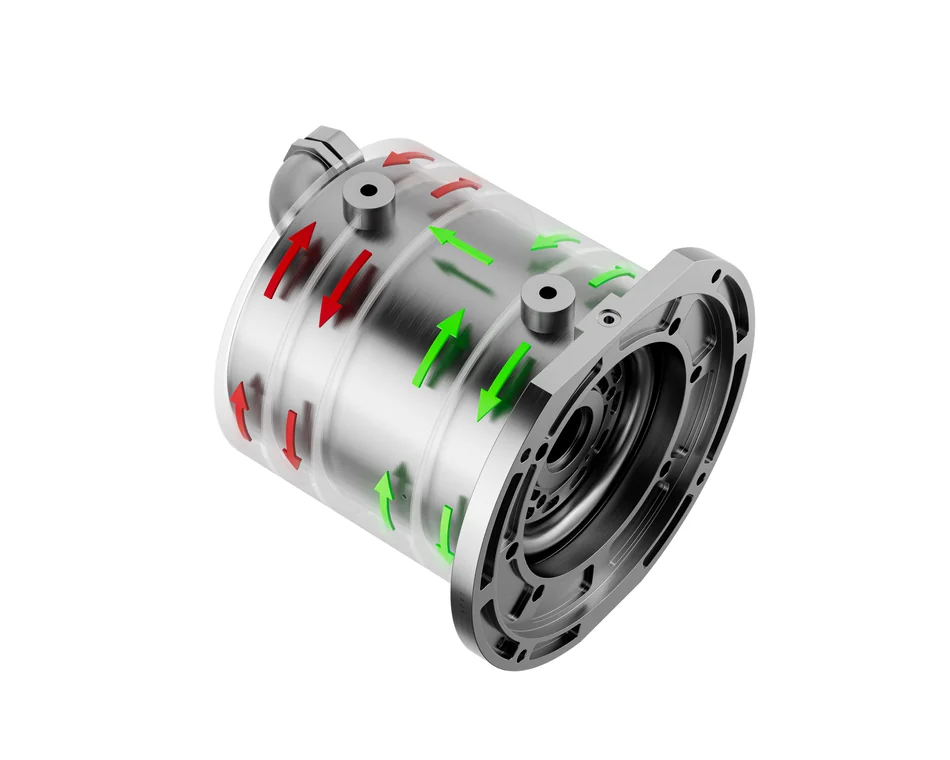
Oil-related problems are the other major category. In an oil-injected airend, oil that is contaminated, degraded or of the wrong grade loses its sealing and cooling ability, accelerating wear on rotors and bearings. Water ingress, often from a failed cooler or from condensation in a humid plant, is especially damaging. Keep to the oil change interval specified for the actual operating environment, replace filters on schedule, and analyse oil condition rather than trusting the calendar alone. Poor inlet filtration is a third route to damage: dust that passes the filter becomes an abrasive paste inside the airend.
Overheating ties these themes together. High discharge temperature can stem from a clogged cooler, restricted ventilation, low oil level, a faulty thermostat or an airend working well beyond its design pressure. The immediate response is to reduce load and restore cooling, but the underlying cause must be found — running an airend hot shortens oil life and expansion clears tolerances, which then reduce efficiency further. Two external references are useful when building a safe maintenance regime: the US Environmental Protection Agency publishes guidance on compressed-air system efficiency and leak reduction, and the National Fire Protection Association provides safety codes relevant to compressed-air equipment rooms.
Airend Maintenance Best Practices
Good maintenance is mostly about consistency. Record discharge temperature, motor current and delivered flow at fixed intervals so that gradual drift becomes visible. Check the inlet air filter and replace it before restriction becomes severe — a clogged filter starves the airend and can push it toward overheating. Inspect the oil separator, drain condensate from the receiver and coolers, and verify that the cooling fans or water circuit are working at full capacity.
Lubrication deserves a rule of its own: use exactly the oil grade the airend manufacturer specifies, and do not extend intervals on the assumption that a premium oil makes the schedule irrelevant. If you operate in a dirty or hot environment, shorten intervals rather than lengthen them. Keep a simple log of oil changes, filter changes and any alarm events; when a rebuild decision eventually arises, that history is the evidence that shows whether the failure was gradual wear or a specific event.
For plants running speed-controlled machines, review the control settings periodically. A drive configured with the wrong pressure band or an overly aggressive ramp can cycle the airend unnecessarily, adding wear for no gain. The same applies to multiple-compressor installations: sequence the machines so that no single airend carries the entire load every day. Small adjustments here extend airend life more effectively than any additive.
Rebuild or Replace? Making the Decision
When an airend loses efficiency or fails, the choice is between a rebuild, a replacement airend, or a complete new machine. A rebuild makes sense when the housing and rotors are sound and the damage is confined to bearings, seals and minor wear; it is typically the lowest-cost route and can restore near-original performance if done by a competent specialist. A replacement airend is preferable when rotor profiles are badly worn, the housing is scored, or the machine is otherwise in good condition and you want a fresh warranty on the compression element.
Going further, a complete new compressor becomes the better economics when the rest of the package is old: a tired motor, an inefficient drive, a corroded cooler and outdated controls all keep costing money after the airend is fixed. Before deciding, compare three things side by side: the quoted rebuild cost and expected remaining life, the replacement airend cost plus installation, and the whole-life cost of a new machine including energy. Include the efficiency gap in that comparison — an older airend that consumes noticeably more power per cubic metre can erase the apparent saving of a rebuild within a few years.
Who performs the work matters as much as what is replaced. Ask whether the rebuilder uses genuine rotors and bearings, what tolerances are restored, and what warranty is offered on the rebuilt unit. A cheap rebuild that fails after a few thousand hours is the most expensive option of all. If you are evaluating suppliers for parts or rebuild services, check their track record and their ability to support the specific airend model you run.
Frequently Asked Questions About Compressor Airends
What exactly is the difference between an airend and a compressor?
The compressor is the complete machine; the airend is the compression element inside it. The airend does the air squeezing, while the motor supplies power and the cooler, separator, filters and controls make the machine usable and safe. When someone quotes a “compressor” but discusses only motor power, ask which airend is fitted.
How long does a screw airend last?
There is no single number. Service life depends on oil quality and change intervals, inlet filtration, operating temperature, duty cycle and correct sizing. A well-maintained airend in a clean, correctly specified installation can run for many thousands of hours before a rebuild is needed; the same unit in a hot, dusty plant with neglected filters can fail far earlier. Maintenance records matter more than brand claims.
Can I run an airend faster to get more air?
Only within the manufacturer’s approved speed range. Higher speed does increase output, but it also raises bearing load, rotor temperature and wear, and it can push the airend past its efficient operating window. Speed changes should be made by a speed-controlled drive configured by the supplier, not by swapping pulleys arbitrarily.
Is a two-stage airend always more efficient?
No. Two-stage compression shines at sustained high discharge pressures, where intercooling reduces the work of the second stage. At lower pressures, the extra airend, intercooler and control complexity may deliver no meaningful efficiency gain and can cost more to maintain. Match the configuration to your real duty point.
Why is my airend discharge temperature rising?
Common causes include a restricted cooler, blocked inlet filter, low or degraded oil, a faulty cooling thermostat, inadequate room ventilation, or operation above the design pressure. Treat rising temperature as an early warning, reduce load if necessary, and investigate the cooling and oil circuits before continuing at full duty.
Can an oil-free airend be used on an oil-injected system?
Not simply by swapping units. Oil-free and oil-injected airends differ in rotor clearances, sealing, drive arrangement and cooling. A conversion requires matching the whole system, and it is rarely economical. If your process needs oil-free air, specify a complete oil-free machine rather than retrofitting an element.
Does a bigger airend always mean more air?
Not by itself. Delivered flow depends on rotor displacement, rotational speed and internal leakage together. A larger airend turning slowly may produce the same flow as a smaller one turning quickly, but the two will differ in efficiency, footprint, maximum pressure and cost. Judge the unit by its flow at your required pressure and its specific power, not by its physical size.
What information should I ask a supplier about the airend?
Ask which airend model is fitted, its rated flow and pressure, the design speed range, the test standard behind the published efficiency, the approved lubricants, and the recommended service intervals. Also ask what spares and technical support are available locally. A supplier who answers these questions directly is usually a safer partner than one who only quotes total motor power.
Final Thoughts: Treat the Airend as the Asset
A compressed-air system is easy to judge by its cabinet and its price tag, but the airend is what actually determines whether it delivers cheap, reliable air for years or becomes a recurring source of downtime. Specify it on flow, pressure, air quality and efficiency at real site conditions. Insist on transparent test data, choose the right single-stage, two-stage, oil-injected or oil-free configuration for your duty, and protect it with disciplined filtration, lubrication and monitoring. Do those things and the rest of the system tends to take care of itself.
If you are comparing quotations or planning a rebuild and want a second opinion on the airend specification, our technical team can help you read the duty point and the efficiency figures. Reach us through the contact page with your flow, pressure and air-quality requirements, and we will respond with a practical recommendation.