

Air compressors for dairy industry duties have to do more than keep valves moving: they must deliver dry, stable, low-contamination air into a plant that is washed down frequently, runs cold and warm zones side by side, and treats product quality as a daily audit item. This guide walks through where air is used, how to specify purity and pressure, which compressor architectures fit different dairy lines, and how to size, install and document the system so it stays reliable.
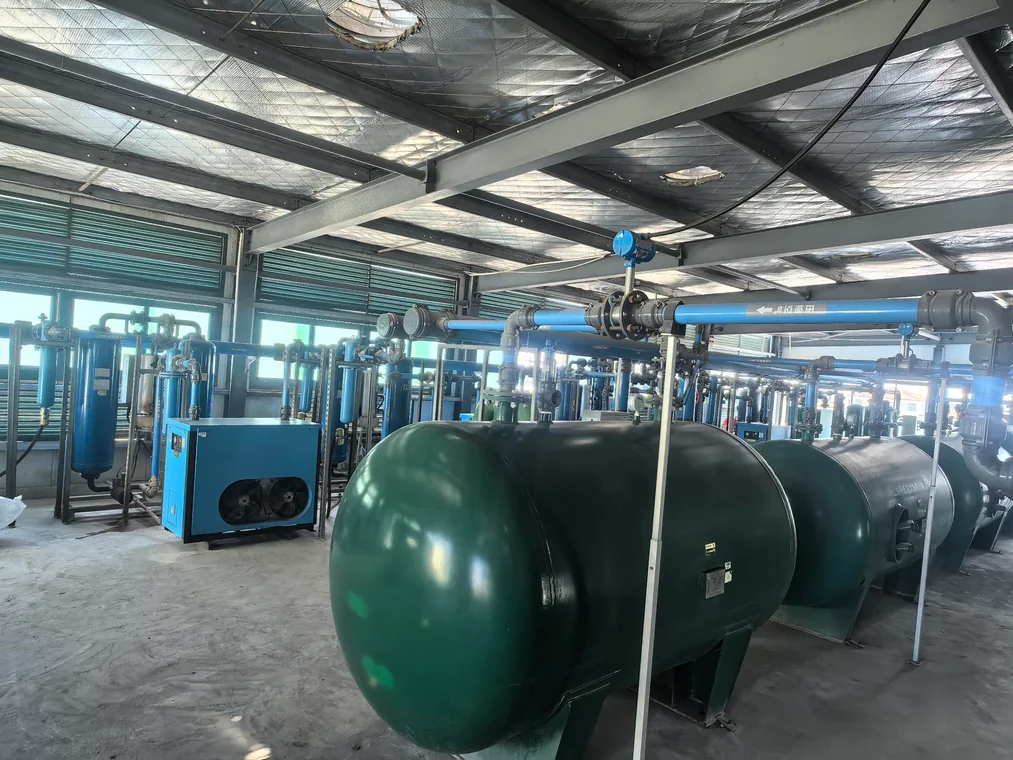
Where compressed air is used in a dairy plant
Compressed air is a plant utility, not a single machine. In a dairy, the same header may serve instrument valves, pneumatic conveyors, filling heads, cleaning systems and packaging equipment. Each point of use has a different tolerance for water, particles and oil aerosol. Mapping those demands before selecting a compressor prevents the common error of buying capacity that is correct on paper but wrong at the point of use.
Milk reception, separation and homogenisation
Reception bays, silo valve islands and separator controls usually need clean, dry instrument air. The air may not touch milk directly, yet it still lives in the same hygienic environment as the process. If the air is wet, condensate can collect in low points of the distribution piping and carry rust or microbial growth downstream. If it carries oil aerosol, that contamination can migrate into valve actuators and into the plant atmosphere around open product handling.
Homogenisers and pasteurisers add another layer: they run in cycles, so air demand can change quickly when valves actuate together. A compressor that is sized only from a nameplate flow figure will often cycle hard during these peaks. Start with the equipment list and record what actually moves on air, when it moves, and at what pressure it must arrive.
Cleaning-in-place and sanitation air
Cleaning-in-place systems rely on valves, pumps and control panels that may use plant air. During a CIP cycle, demand can rise while the plant is simultaneously washing down surrounding areas, which is when intake humidity is highest. That combination explains why a system that performs well during normal production can show water-related faults during cleaning windows.
Treat the cleaning schedule as part of the load profile. Record which air users operate during CIP, whether they overlap with filling preparation, and how long the air system runs at partial load. If the compressor is oversized for production but cycling during cleaning, variable speed control or a smaller dedicated package may solve the problem more effectively than adding another dryer.
Sanitation also affects maintenance practice. Filters and drains sit in areas that are hosed down, so housings must be accessible and protected from direct spray. Write drain checks into the cleaning checklist rather than leaving them to an annual service visit. A small amount of water carried from a neglected drain can travel a long way through a dairy air network.
Cultured products, cheese and whey handling
Yogurt and cheese lines use air for dosing heads, cutting and moulding stations, pressing fixtures and packaging hand-offs. Curing and culture areas are sensitive to both moisture and airborne contamination, so a wet compressed-air leak is more than an energy loss. It changes the local environment. Filter placement, drain management and regular point-of-use checks matter as much as the compressor itself.
Milk powder, spray drying and conveying
Spray drying and powder handling may include air for atomising systems, fluid beds, valve actuation and pneumatic conveying, depending on the process design supplied by the equipment manufacturer. Low-pressure duties and plant air duties should not be lumped into one specification. Confirm the required pressure, flow and air quality at each nozzle or conveyor before setting the header pressure; otherwise the whole plant is forced to run at the needs of the most demanding user.
Filling, cartoning and cold storage
Fillers, cappers, labellers, cartoners and palletisers create a steady base load with short peaks. Cold-store door actuators and packaging lines add a moisture problem: when cold surfaces meet humid air, condensation forms quickly. Dry distribution air reduces the chance that condensate appears inside a control cabinet or at a filling head during a temperature transition.
| Dairy area | Typical air duty | Main quality risk | Design response |
|---|---|---|---|
| Reception and silos | Valve islands, instrument air | Wet piping, corrosion | Dry header, sloped drops, drains |
| Pasteurisation and homogenisation | Cyclic actuator demand | Pressure dips at peak flow | Receiver buffer, correct sizing |
| Culture and cheese | Dosing, cutting, moulding | Aerosol and moisture near product | Point-of-use filtration, oil-free supply |
| Powder and conveying | Nozzle and conveying air | Wrong pressure class | Separate low-pressure and plant air |
| Filling and cold store | Packaging, doors, labels | Condensation on cold surfaces | Dew-point control, dry distribution |
For a broader food-plant perspective on where air touches packaging, see this guide to safe compressed air for food packaging. The dairy-specific questions below narrow that general framework to milk, cultured products and powder.
Why air quality becomes a dairy product-quality issue
In a dairy plant, air quality is not an abstract laboratory number. Oil aerosol, water droplets and particle contamination can reach product zones through direct air contact, through pneumatic equipment, or through the general plant environment. Even where the process is closed, a leak above a filling line can introduce contamination that an audit team will ask about.
Direct contact and indirect contact are different risks
Direct contact means compressed air can enter the product or contact a food-contact surface. Indirect contact covers air used around the process, such as actuator air in a hygienic room. The first case demands the strongest documented air-quality package. The second still needs control, because leaks and exhaust from pneumatic devices discharge into the same room as exposed product. Define both cases in the specification rather than assuming one grade fits every user.
Washdown humidity changes the air treatment job
Dairy plants wash equipment and rooms frequently. That adds moisture to the intake air and to the distribution network, especially when compressor intakes sit close to washdown areas. A dryer selected from a generic industrial assumption may be undersized for the real moisture load. Record where intake air comes from, how humid the room becomes during cleaning, and whether the compressor room itself is air-conditioned or ventilated.
Oil presence is the other half of the question. A lubricated compressor can still be paired with filtration, but the plant then depends on filter integrity and maintenance discipline. An oil-free compression chamber removes that oil source from the process chain. The decision should be based on the point-of-use risk and the evidence you can show, not on marketing language alone.
This Class 0 compressor explanation for food and beverage plants covers the general reasoning; the next section focuses on what a certificate actually covers in a dairy specification.
Class 0 and ISO 8573-1: specify the whole air package
ISO 8573-1 defines purity classes for compressed air. Class 0 for oil is often requested in food applications because it indicates oil not detected above the limit of the specified test method. It does not mean the air is sterile, and it does not replace separate limits for water and solid particles. A useful dairy specification states the required oil, water and particle classes at the point of use, together with the test method and sampling location.
Read the certificate scope, not just the logo
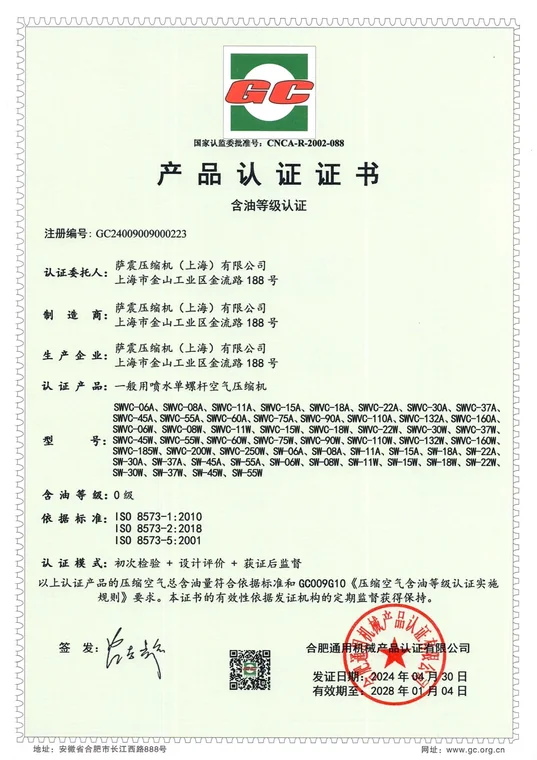
Ask for the certificate number, issuing body, validity date and covered model list. As documented examples, the GC Class 0 certificate for the dry screw range, number 08823P10001, is valid to 2028-01-04 and lists SWT models from SWT-37W to SWT-355W and SWT-37A to SWT-250A. The water-lubricated certificate, number GC24009009000223, is also valid to 2028-01-04 and covers SWVC-06A through SW-55W. Those ranges are certificate scopes, not blanket claims for every machine a supplier sells.
Dry Class 0 and water-lubricated Class 0 are not interchangeable
Both approaches can achieve oil-free compression, but the plant consequences differ. Dry oil-free screw machines avoid oil in the compression chamber and need no process water for compression. Water-lubricated machines use water in the compression process and therefore require attention to water quality, separation and treatment. Choose on the basis of available utilities, maintenance capability and the exact model covered by the certificate. This comparison of water-injected and dry Class 0 compressors explains the trade-offs in more detail.
Choosing the compressor architecture for dairy duties
There is no single best machine for every dairy. The right architecture depends on plant size, load pattern, available utilities and how close the equipment sits to product zones. Separate central plant air from small point-of-use packages where the duty genuinely differs. That division usually gives better pressure stability and simpler maintenance than forcing one large machine to serve everything.
Dry oil-free screw compressors for central dairy air
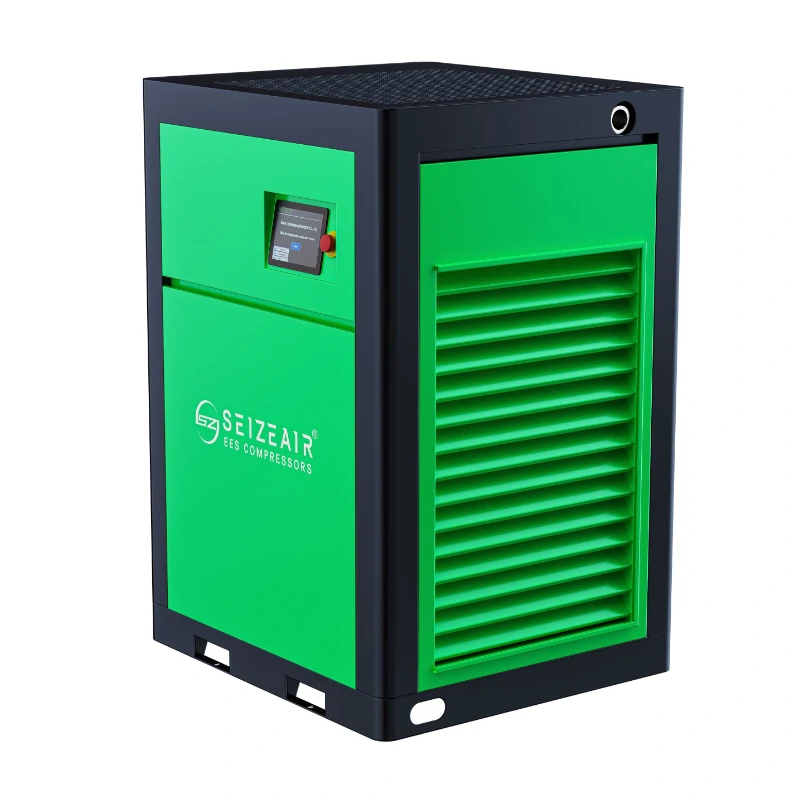
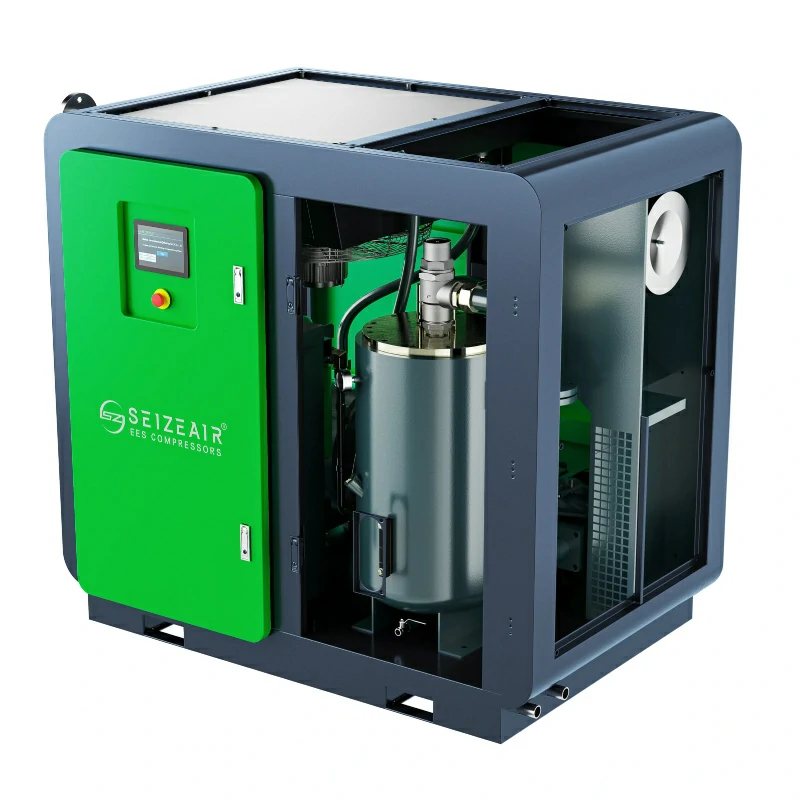
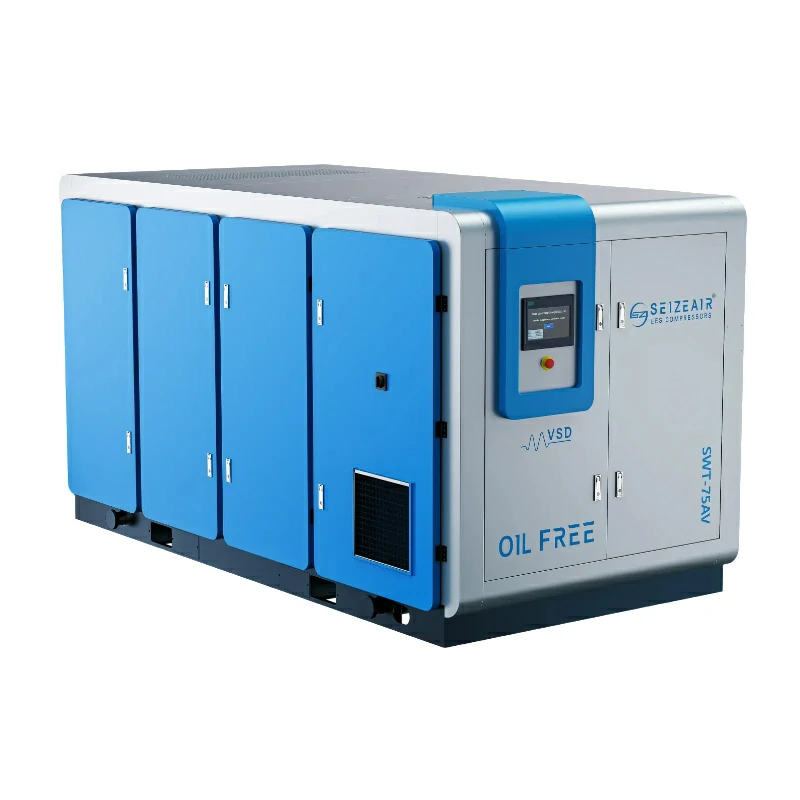
Dry oil-free screw compressors are a common choice for a central dairy utility room. The English product catalogue for the SWT range lists 37–450 kW and 4.5–10.5 bar, with ISO 1217 Annex C used as the rating basis. Treat those as series-level catalogue ranges, then confirm the exact model at the required pressure from the current datasheet. Variable speed control is worth evaluating where shifts, washdowns and packaging runs create a changing load.
Sizing the airend correctly matters more than buying the largest frame. Running far below the design point can be as inefficient as running at the edge of capacity, so review the load profile and the manufacturer’s performance data together. Explore the dry oil-free screw compressor range when the plant needs a central, oil-free supply.

Water-lubricated screw compressors where water is managed well
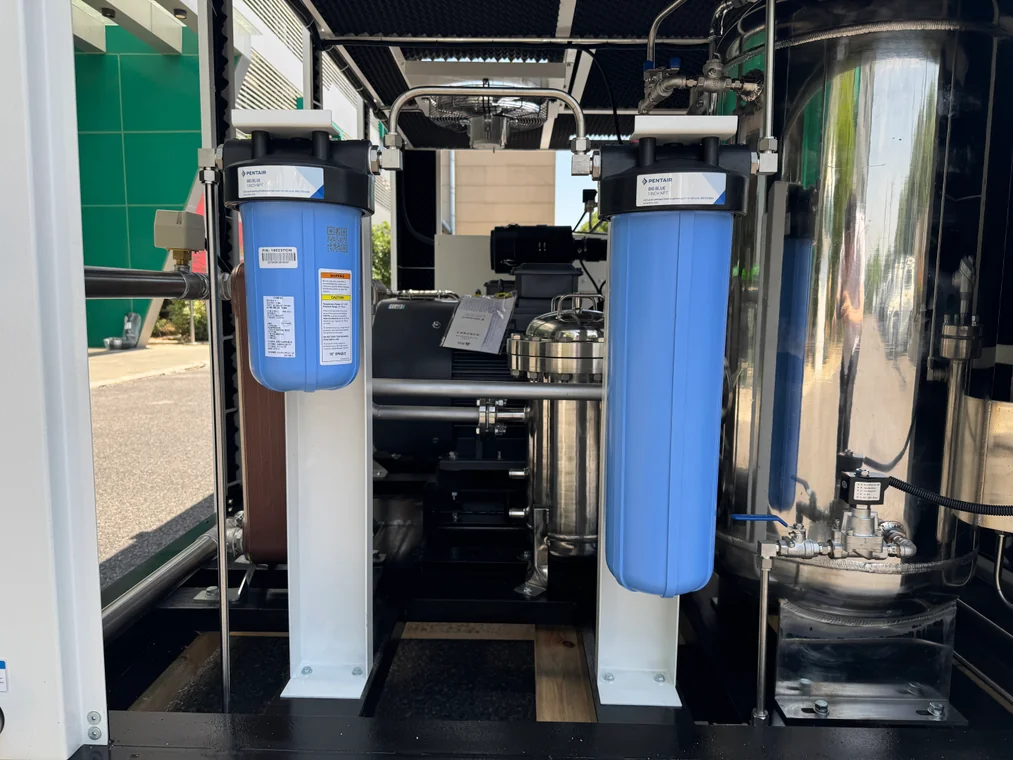
Water-lubricated screw compressors are another oil-free route. They can fit plants that already have a disciplined water-treatment programme and want oil-free air without oil in the compression chamber. The trade-off is additional attention to feed water quality, separation, condensate handling and corrosion control. Confirm which machine is covered by the relevant Class 0 certificate before writing the requirement into a tender.
Water management belongs in the operating plan, not in a footnote. Track treatment consumption, separator condition and drain behaviour as routine checks. General EPA water and environmental resources can help plant teams frame a water-management review, while the machine-specific limits must come from the supplier manual. Review the water-lubricated oil-free compressor option against those site utilities.
Oil-free scroll units for small lines and laboratories
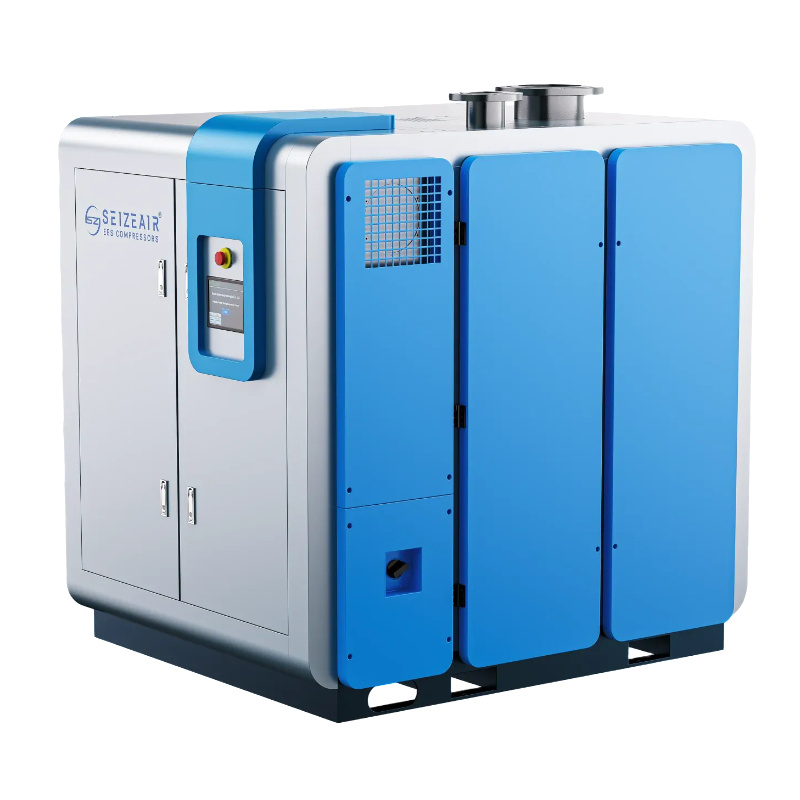
Not every dairy needs a large central station. Pilot plants, quality laboratories, small creameries and remote packaging cells may be better served by a compact scroll unit. The SWO series specification lists seven models from 7.5 kW to 37 kW, with free air delivery from 0.8 to 4.0 m³/min, maximum discharge pressure of 8 bar and sound levels in the 55–64 dB(A) range. Verify the exact model and local voltage before ordering.
A smaller oil-free unit also needs a defined maintenance owner. Quiet operation and a touchscreen controller do not remove the need for filter changes, drain checks and air-quality sampling. See the oil-free scroll compressor series for point-of-use applications.
Drying, filtration and condensate: the underestimated part
Most dairy air-quality complaints start downstream of the compressor. A wet intake, an overloaded dryer, a failed drain or a dead-leg in the piping can undo a good compressor selection. Treat the compressor, dryer, filters, receiver and distribution network as one system with one acceptance test.
| Stage | Where it fits | What to check at dairy sites |
|---|---|---|
| Refrigerated dryer | General plant and instrument air | Inlet temperature, load, drain operation |
| Adsorption dryer | Low-dew-point or cold-zone users | Purge behaviour, inlet moisture, monitor calibration |
| Coalescing and particle filters | Downstream of dryer, before users | Differential pressure, element change record |
| Point-of-use filter | Filling heads and critical valves | Sample location, hygiene of housing and drain |
Match the dryer to the real moisture load
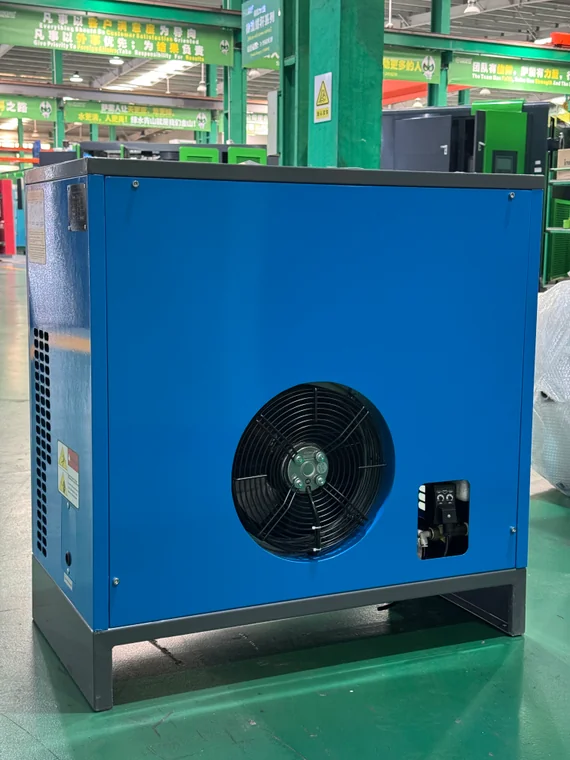
A refrigerated dryer is often sufficient for general plant air where the required dew point is modest and the room is controlled. An adsorption dryer becomes relevant when the process or cold storage environment needs a lower dew point. Do not select from a catalogue rating alone: record maximum ambient temperature, inlet air temperature, peak flow and the humidity introduced during washdown. Then confirm the dryer’s stated performance at those conditions.
Compare the refrigerated air dryer options with adsorption dryers for lower dew-point duties only after the point-of-use requirement is written down. A lower dew point costs energy; buy it only where the process needs it.
Drains and dead legs decide whether the system stays dry
Install drains at receivers, dryers, filters and low points of the distribution network. Check that condensate is treated and disposed of according to site rules. Avoid long unused branches that trap wet air; they are the classic dead legs that engineers find during a hygiene investigation. A point-of-use sample taken after a long idle branch can look very different from a sample at the dryer outlet.
Sizing a dairy air system without guesswork
Sizing starts with demand, not with a compressor catalogue. Build a load profile from actual equipment data, then add measured leakage and a reasoned allowance for growth. The goal is a system that holds pressure during a filling or CIP valve sequence without cycling excessively during a quiet shift.
Build the load profile in five steps
First, list every air user and its duty cycle. Second, record the minimum pressure each user needs at its own connection. Third, convert the demand to a common reference flow using the supplier’s stated basis. Fourth, add leakage measured during a no-production period. Fifth, apply diversity and reserve after reviewing criticality, not as a blanket percentage copied from a previous project.
| Worksheet field | Where the value comes from | Why it matters |
|---|---|---|
| Peak simultaneous flow | Equipment data and plant observations | Sets compressor capacity |
| Minimum point-of-use pressure | OEM requirement for each machine | Prevents over-pressurising the header |
| Measured leakage | No-production test or survey | Avoids sizing to waste |
| Reserve philosophy | Production criticality and service plan | Decides N+1 or standby capacity |
Use storage to absorb short peaks
A receiver smooths short actuator bursts and reduces compressor cycling. Its size should follow the observed peak pattern and the pressure band the plant can accept. Do not use storage to mask a persistent leak or an undersized compressor: a receiver fills eventually, and the pressure problem returns at the worst possible moment.
point-of-use demand + measured leakage -> diversity -> receiver buffer -> compressor capacity -> reserve policy
Separate pressure levels where the process needs them
Powder conveying, packaging and instrument air may not share the same pressure requirement. Where a low-pressure duty exists, evaluate a dedicated low-pressure supply instead of throttling a high-pressure header. Running everything at one pressure wastes energy at every throttling point and makes leak losses larger than they need to be.
Layout and hygiene considerations for the compressor room
The compressor room is part of the dairy utility network. Its location affects intake air quality, maintenance safety and how quickly a small fault becomes a production stop. Plan the room with washdown routines and service access in mind.
Keep intake air away from contamination sources
Locate intakes away from exhausts, chemical storage, powder dust and washdown spray. Ventilation should remove heat without pulling moist air across the intake. Where the plant uses caustic or acidic cleaning agents, review the corrosion risk for exposed pipework and supports. Keep the oil-free system physically separate from any lubricated compressor serving other duties, and label each header clearly.
Design the distribution network for drainage
Use sloped branches and accessible drain points rather than relying on the dryer alone. Stainless-steel or suitable corrosion-resistant piping is often preferred in hygienic areas, subject to site standards. Keep sample points near critical users so air quality can be verified where it is consumed. Leave space around filters and dryers for element changes; a tight installation invites shortcuts during maintenance.
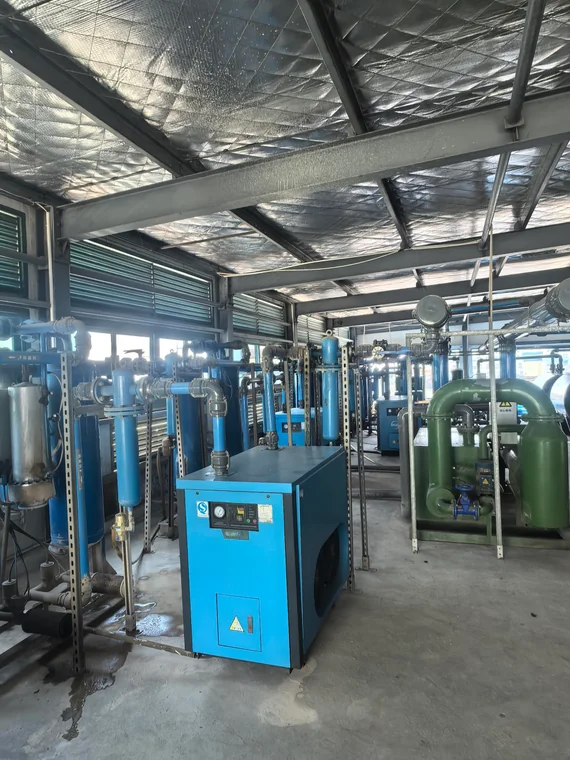
Energy cost: calculate it with your own numbers
Compressed air is expensive because most of the electrical input eventually becomes heat. The only defensible way to compare options is to use your own tariff, operating hours and measured load profile. A simple worksheet is: annual energy cost = input power in kW × operating hours × tariff per kWh. Add maintenance and filter costs separately, and keep the two figures visible in the business case.
Where variable speed helps in a dairy
A variable speed drive is most useful where demand varies across shifts, washing cycles or seasonal production. It is less valuable on a steady baseload. Compare specific power at the pressure and flow where the machine will actually run, not only at a catalogue reference point. Review this VSD guidance for food and beverage plants alongside your load profile.
Check heat and ventilation before finalising the room
Compressed-air systems reject a large share of their input energy as heat. In a dairy utility room, that heat may be useful for water preheating if a recovery package is specified and the site can use the heat at the right time. It may also be a problem if the room already receives heat from pasteurisation or nearby process equipment. Measure the room conditions before deciding.
Ventilation must protect both the compressor and the people working nearby. Follow the installation limits in the manual for the exact machine, including ambient temperature and air movement, rather than assuming an industrial room is suitable. A cooler intake generally helps capacity and reliability, but it must not draw in washdown mist or chemical aerosols from cleaning operations.
Use published energy data for the tariff, not anecdotes
Tariffs differ by region, contract and time of use. Official energy statistics, such as the EIA electricity data, can support a national-level comparison, but the plant invoice remains the source for a purchase decision. Leak repair usually delivers savings without changing production, so include a measured leakage allowance before approving new capacity.
Controls, redundancy and monitoring
Dairy production rarely forgives an unplanned air failure. The control strategy should be understandable to the people on shift, not just to the supplier who commissioned it. Sequence multiple compressors by demand, rotate the lead unit to balance running hours, and alarm on conditions that indicate a developing quality problem.
Decide reserve capacity from criticality
An N+1 arrangement is justified where an air outage stops filling, pasteurisation control or a cold-store door system. A smaller plant with flexible production may accept a standby unit without full redundancy. Document the decision, including what happens during service and which users are shed first if pressure falls.
Monitor the right signals
Pressure trends show capacity and leakage problems. Dew-point trends show dryer performance. Differential pressure across filters shows when maintenance is due. Log these values at the header and at critical points of use, then review them during hygiene and maintenance meetings. Alarms should trigger action, not merely fill a historian with data.
Commissioning and audit-ready records
Commissioning is where a specification becomes evidence. Record what was installed, how it was tested, and who is responsible for keeping the records current. Good documentation shortens investigations and makes maintenance predictable.
- Record model numbers, serial numbers and certificate scope for each compressor.
- Confirm installation conditions against the current manual for the exact model.
- Leak-test the distribution network before final acceptance.
- Verify dryer and drain operation at representative load.
- Sample air quality at defined points of use and record the method, date and result.
- Train operators on filter changes, drain checks and alarm response.
Air-quality testing should be repeated at a frequency agreed with your quality team and based on process risk. Any statement about compliance must refer to the measured point, method and date; avoid generic claims that cannot be reproduced.
Plan spares and service around production windows
An oil-free dairy air station has consumables that cannot be ignored indefinitely: filter elements, drain components, dryer parts and controller spares. Agree the holding level with the supplier based on the exact models installed and the lead time for each item. Store them in a clean, dry place so a replacement element does not become a contamination source during an urgent change.
Schedule intrusive work around production and cleaning windows. A filter change performed in the middle of a filling run creates avoidable risk; the same task during a planned pause is straightforward. Record the date, the person responsible and any pressure or dew-point readings taken before and after the work. Those records turn routine maintenance into evidence that the system remained controlled.
Mistakes that shorten dairy compressed-air uptime
Most failures are system failures rather than single-machine failures. The table below captures issues seen repeatedly in hygienic plants and the practical correction for each.
| Mistake | Symptom | Correction |
|---|---|---|
| Sizing from nameplate flow only | Pressure dips during valve sequences | Build a point-of-use load profile |
| Ignoring washdown humidity | Wet filters and unreliable dew point | Recheck dryer at real inlet conditions |
| Buying Class 0 by brand claim | Audit cannot verify model coverage | File certificate number, scope and date |
| No drain access in piping | Corrosion and intermittent contamination | Add sloped drops and accessible drains |
| One header for every pressure | Throttling losses and unstable users | Separate low-pressure and plant air |
Air compressors for dairy industry: common questions
What type of air compressor is best for a dairy plant?
For a central supply, a dry oil-free screw compressor is often the starting point because it removes oil from the compression chamber and covers a wide duty range. Where water treatment is well controlled, a water-lubricated oil-free machine may also be suitable. Small laboratories and remote packaging cells can use oil-free scroll units. The final choice depends on point-of-use quality, load pattern and maintenance capability.
Is oil-free air required for every dairy application?
Not every air user has the same risk. Direct product contact and air near exposed product should be treated as oil-free duties with documented quality. Non-contact utility users may be specified differently, provided contamination cannot migrate into hygienic zones. Define each user in writing and apply a single, auditable specification to the shared header where they connect.
How do I know whether compressed air is food-grade?
Food-grade air is a verified condition at the point of use, not a label on a machine. Record the required oil, water and particle classes, sample at defined locations, and keep the results with the maintenance records. A certificate for a compressor range supports the specification but does not replace point-of-use testing after drying, filtration and distribution.
What dew point do dairy lines need?
The answer depends on the user and the environment. General instrument air may tolerate a higher dew point than a cold-store packaging head or a low-dew-point process. Set the value from the equipment requirement and the risk of condensation at the point of use, then select the dryer and verify performance at operating conditions. Avoid copying a dew point from an unrelated plant.
Can water-lubricated compressors be used in dairy plants?
Yes, where the exact model is covered by the required oil-free certification and the site can manage feed water, separation and condensate. Water-lubricated systems are not maintenance-free. They need a clear water-quality specification and routine checks. If the plant lacks that discipline, a dry oil-free system may be the lower-risk choice.
How often should dairy compressed air be tested?
Set the interval with your quality team based on product contact risk, history of moisture problems and change control. Test after commissioning, after major maintenance and whenever a dryer or filter change could affect the supply. Keep the sampling location and method consistent so results can be compared over time.
Final checks before you issue the enquiry
Write the point-of-use requirements first. Attach the load profile, the dryer and filtration specification, the certificate scope you expect, and the commissioning tests you will witness. Then compare machines on measured performance at your operating pressure, not on headline capacity. A clear enquiry produces comparable offers and a system that can be validated after installation.
If you want to review a dairy air specification against your actual line layout, reach the Seize Air engineering team with your equipment list, duty pattern and required point-of-use conditions. That is enough to start a practical sizing discussion without inventing numbers.