

Compressed air filter selection decides whether the air reaching your tools, instruments and products is clean enough to do its job. A correctly specified filtration train removes particles, water, oil and microbes, protects downstream equipment and keeps pressure loss under control; a poorly matched one causes contamination, downtime and wasted energy. This guide gives plant engineers, maintenance teams and industrial buyers a practical way to understand filter types, read specifications, size elements and maintain a treatment train that holds air quality over time.
What Does a Compressed Air Filter Remove?
Air leaving a compressor is never clean. It carries dust drawn from the atmosphere, condensate formed during cooling, lubricant carried over from the compressor, and in some environments live microorganisms. Each contaminant behaves differently, so no single element removes them all. Understanding the contaminant is the first step to choosing a filter.
Particles and dust
Atmospheric dust enters with every intake stroke and survives compression as fine solid matter. Piping scale, rust and seal debris join it downstream. Even small particles abrade pneumatic cylinders, clog small orifices and spoil paint or coating finishes. A particulate element captures these solids by size, and its rating states which particle sizes it retains at a stated efficiency.
Water and condensate
Compressing air concentrates the water vapour it contains. As the air cools after compression, that vapour turns into liquid condensate. Left in the line, water washes away lubricant, corrodes pipework, freezes in outdoor lines and ruins moisture-sensitive processes. A separator removes bulk liquid, while a dryer handles the remaining vapour. Filtration and drying solve different parts of the same problem.
Oil aerosols and vapour
Oil-injected compressors release lubricant as an aerosol and, to a lesser degree, as vapour. Oil in the air stream marks products, contaminates food and pharmaceutical processes, and breaks down rubber seals. Coalescing filters collect aerosol droplets; activated carbon is used where oil vapour and odour must be reduced. The two require different media and should not be treated as interchangeable.
Microorganisms
In food, beverage, pharmaceutical and clinical applications, viable bacteria and spores in compressed air are a direct product risk. Sterile air filters use a fine membrane rated to retain microorganisms, and they are validated and tested differently from ordinary industrial elements. Where air touches a product, a sterile grade is normally specified at the point of use.
The Main Types of Compressed Air Filter
Filters are grouped by what they remove and where they sit in the treatment train. Most systems combine several grades in sequence, because each grade protects the next and the process at the end. The table below is a practical map of the common grades.
| Filter grade | Primary target | Typical location |
|---|---|---|
| Particulate / dust | Solid particles | Intake side, before other elements |
| Coalescing | Oil and water aerosols | After compressor, before or after dryer |
| Activated carbon | Oil vapour, odour | Polishing stage, before point of use |
| Sterile / microbial | Bacteria and spores | Final point of use in sensitive processes |
| Water separator | Bulk liquid water | Immediately after the compressor or cooler |
Particulate filters
These are the workhorse pre-filters. They use fibre media to trap solid particles and are usually the first element after the compressor or a coarse separator. By removing the bulk of the dust, they extend the life of the finer, more expensive coalescing and carbon stages downstream. Selecting a grade that matches the plant environment keeps change-outs predictable.
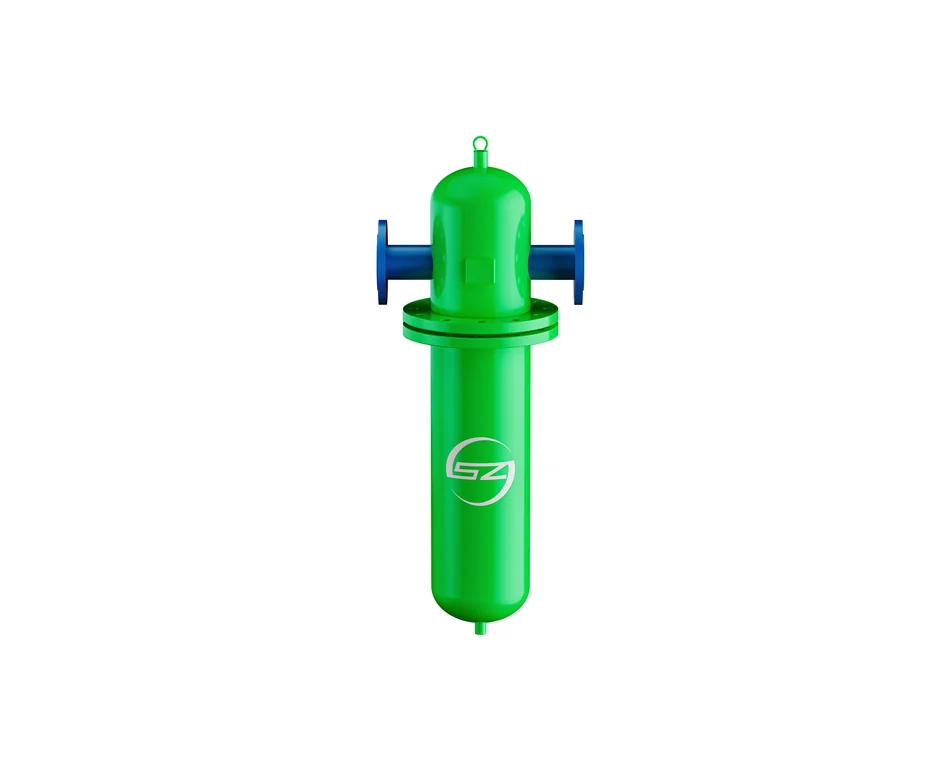
Coalescing filters
Coalescing media forces tiny oil and water droplets to merge into larger drops that drain away. They are the most widely used precision grade in industrial air systems and are normally paired with a dryer. Where pressure drop and element life matter, review the precision filter product page to see the grades available for a given duty.
Activated carbon filters
A carbon bed adsorbs oil vapour and odour that a coalescing element cannot catch. Carbon elements are fragile, saturate over time and are damaged by liquid water, so they must be preceded by a working coalescing stage. They are specified for breathing air, food contact and any process where smell or taste is unacceptable.
Sterile filters
Sterile grades use a membrane with a defined pore structure and are integrity-tested before use. They belong at the last point before air contacts a product, after drying and all upstream filtration. Because they protect product safety, they are changed on a validated schedule and after any event that could compromise the seal.
How Compressed Air Filters Work
Filter performance comes from a few physical mechanisms acting together. Air is forced through a fibrous or porous medium; contaminants are captured on fibres, in depths of the medium, or on a membrane surface. The aim is high capture at the lowest practical resistance.
Separation mechanisms
Larger particles are stopped by direct interception when they cannot follow air around a fibre. Heavier particles continue straight and impact a fibre by inertia. The smallest particles move randomly and are caught by diffusion. A well-designed medium balances all three so that efficiency stays high across a range of particle sizes, rather than only at one convenient point.
Depth versus surface filtration
Depth media hold dirt throughout their thickness and typically offer longer service life for general particulates. Surface or membrane media trap contaminants on a thin layer and give a sharper cut-off, which is why sterile grades use them. The trade-off is that surface media can blind faster when upstream air is dirty, so pre-filtration matters.
Pressure drop and why it matters
Air loses pressure as it passes through any element. Clean elements have a low starting loss; as dirt loads the medium, the difference between inlet and outlet rises. A rising differential pressure is the clearest signal that an element needs attention, and it is also an energy cost, because the compressor must work harder to deliver the same downstream pressure.
A Simple Way to Picture a Treatment Train
The order of components explains what each one protects. A typical industrial arrangement looks like this:
compressor -> separator -> particulate -> coalescing -> dryer -> carbon -> (sterile) -> point of use
     |              |            |             |          |         |            |            |
   bulk water    liquid       solids       aerosols    vapour    odour        microbes     clean air
Not every plant needs every stage. An oil-free compressor serving general factory tools may need only particulate filtration and drying. A food line may add carbon and a sterile point-of-use grade. Build the train backwards from the air quality the process actually requires, then remove stages that have no defined job.
Read a Compressed Air Filter Specification Correctly
Filter datasheets use a handful of terms that are easy to misread. Getting them right prevents ordering an element that fits the housing but fails the duty.
Micron rating and efficiency
A micron rating states the particle size an element targets, but the number alone is incomplete without an efficiency figure and a test basis. A “1 micron” filter that captures a modest share of one-micron particles behaves very differently from one with a high stated efficiency at the same size. Compare grades on efficiency and test standard, not on the headline micron number.
Air purity classes
ISO 8573-1 expresses air quality as separate classes for solid particles, water and oil. Specifying the required class for each contaminant is more useful than asking for “clean air” in general. The framework is summarised below; a supplier should confirm which class a proposed train achieves at your operating conditions.
| Contaminant | Class describes | Controlled mainly by |
|---|---|---|
| Solid particles | Number and size of particles | Particulate and coalescing filters |
| Water | Pressure dew point | Refrigerated or desiccant dryer |
| Oil | Total oil including aerosol and vapour | Coalescing and carbon filters |
Flow, pressure and temperature correction
A filter’s rated flow is stated at reference conditions. Real flow capacity changes with operating pressure, temperature and the allowable pressure drop. A housing that looks generous on a catalogue can be undersized at low pressure or high temperature. Ask the supplier to state capacity at your actual conditions rather than converting a catalogue figure yourself.
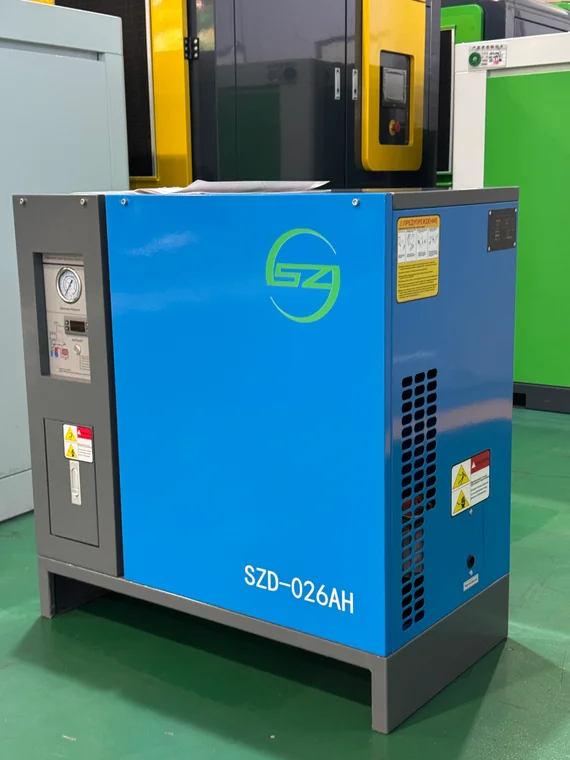
Where Filters Sit in a Compressed Air Treatment Train
Placement determines both performance and element life. The same grade performs differently before and after a dryer, and point-of-use grades protect processes that central filtration cannot reach.
Pre-filters and after-filters
A pre-filter placed ahead of a dryer removes solids and oil that would foul the dryer’s heat exchangers or desiccant. An after-filter downstream catches particles shed by the dryer itself. Skipping either stage can shorten dryer life or reintroduce contamination at the last moment. For guidance on selecting the drying stage, see the compressed air dryer selection guide.
Working with refrigerated dryers
Refrigerated dryers cool air to condense water and suit many general applications. They work best with a coalescing pre-filter that removes oil, which would otherwise coat the heat exchanger. Review the refrigerated air dryer product page when defining that part of the train. The dryer sets the water class; the filters handle solids and oil.
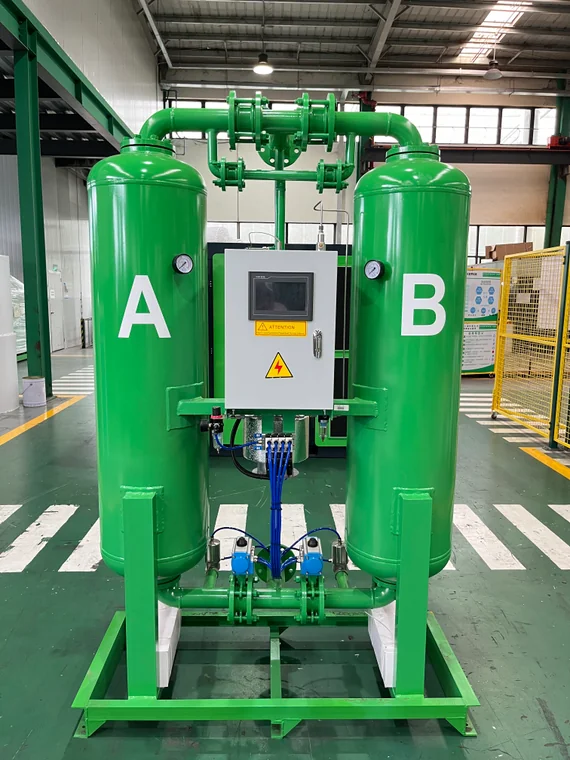
Working with desiccant dryers
Desiccant dryers reach lower dew points for outdoor lines, cold environments and sensitive processes. Desiccant beads are easily blinded by oil, so a high-efficiency coalescing pre-filter is essential. An after-filter catches desiccant dust. Compare the heatless and low-heat adsorption dryer options and the blast heat regeneration adsorption dryer when a low dew point is required.
Point-of-use filtration
Central treatment delivers good air to the header; a point-of-use grade protects a specific machine or process. This matters where one sensitive tool shares a line with general users, or where product contact demands a sterile grade. Local filtration is shorter, easier to validate and cheaper than upgrading the whole plant for one application.
Choose the Right Compressed Air Filter for Your Application
Selection is a sequence of decisions, not a single catalogue pick. Work through the steps below in order so that each choice constrains the next.
Start from the required air quality
Ask the process owner what purity the product or machine needs, and at which point. Express it as particle, water and oil classes where possible. If no written requirement exists, treat that as an open item rather than assuming a grade. The refrigerated versus desiccant dryer comparison helps frame the water-quality decision that usually accompanies filter selection.
Match the filter grade to the compressor
Oil-injected machines produce more oil aerosol and need a stronger coalescing stage than oil-free machines. An oil-free screw compressor still needs particulate and drying stages, but may not need carbon. Match the train to the compressor type before choosing element grades. When sizing the compressor itself alongside treatment, the screw compressor sizing guide provides useful background.
Size for flow, not pipe diameter
A housing should be selected for the flow it must pass at your pressure and allowable pressure drop, not to match the pipe it happens to sit in. Undersized elements create persistent pressure loss and short life. Use a worksheet like the one below to collect the inputs a supplier needs.
| Input to collect | Why it is needed |
|---|---|
| Maximum and normal air flow | Sizes the housing and sets pressure drop |
| Operating pressure and temperature | Corrects rated capacity to site conditions |
| Required purity class | Determines the grade sequence |
| Compressor type (oiled or oil-free) | Sets the oil-removal duty |
| Ambient and intake conditions | Informs pre-filtration and dust load |
Account for pressure drop and energy
Every element adds resistance, and a dirty element adds more. Include the expected clean and loaded pressure drop in the specification, and set a replacement trigger before the loss grows. Compressed air is an energy-intensive utility, so avoiding unnecessary pressure loss is a genuine operating saving; the U.S. Energy Information Administration electricity data provides context for the cost side of that decision.
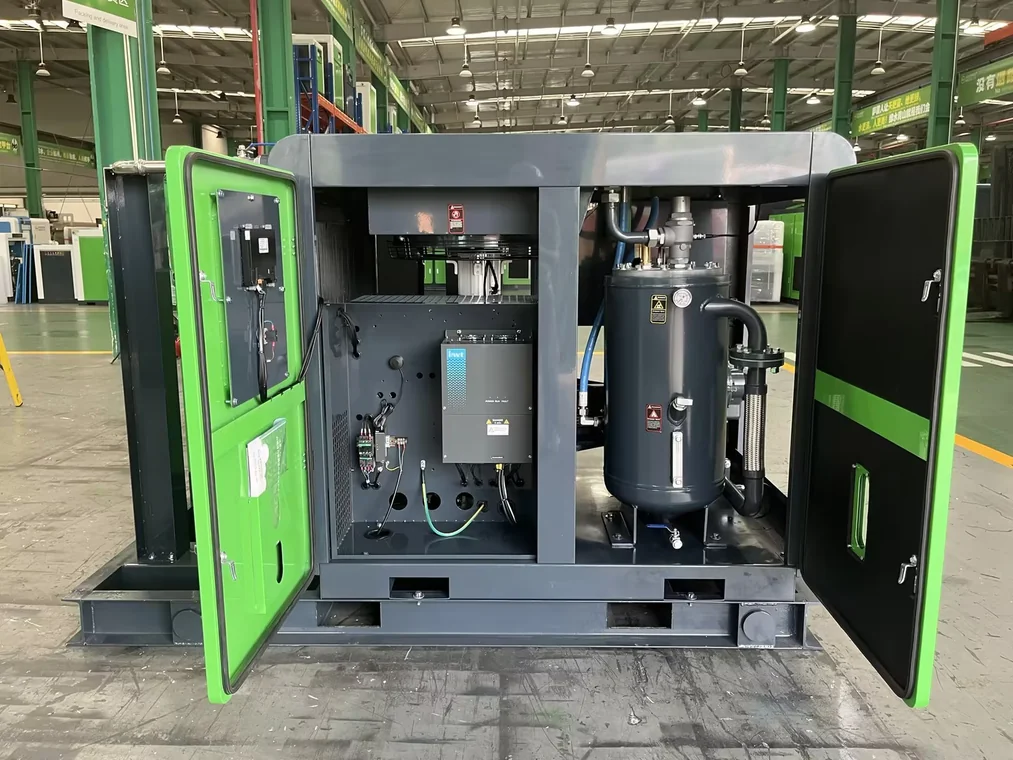
Special Cases: Food, Pharma, Electronics and Oil-Free Air
Some applications raise the filtration requirement well above general industry. Recognising them early avoids a system that works technically but fails an audit.
Oil-free and Class 0 systems
Where an oil-free compressor serves a critical process, filter choices should preserve that advantage rather than reintroduce oil from poor downstream components. Class 0 concepts and oil-free system design are explored in the oil-free purity standards guide. Carbon and sterile grades are common final stages in these arrangements.
Food and beverage plants
Food contact air must control oil, water and microbes, and the treatment train must be cleanable and verifiable. Product area requirements are covered in the food industry packaging air compressor guide. Condensate from these systems also needs correct handling rather than being discharged untreated.
Pharmaceutical and electronics
Pharmaceutical processes validate air quality at the point of use, often with sterile filtration and documented integrity tests. Electronics and instrument air focus on particles and moisture that could damage fine components or drift instruments. In both cases, filtration is part of a documented quality system, and element changes are recorded rather than improvised.
Where condensate contains oil, environmental rules govern how it is separated and disposed of before water is released. The U.S. Environmental Protection Agency publishes guidance relevant to managing oily wastewater and discharges; confirm local requirements with the site’s environmental team, since rules vary by region.

Install a Compressed Air Filter Correctly
A good element installed badly will not protect the process. A few checks at installation prevent most early-life failures.
Flow direction and orientation
Filters have a marked flow direction. Reversing an element damages the media and defeats separation, so confirm the arrow against the actual airflow before tightening connections. Mount housings in the orientation specified by the manufacturer, with enough clearance to withdraw the element during a change-out.
Drain and condensate management
Most filters collect liquid that must leave the housing. Check that the drain or automatic drain is fitted, correctly oriented and routed to a suitable collection point. A blocked drain refills the bowl and re-entrains water into the air stream, which looks like a filter failure but is really a maintenance issue.
Isolation, bypass and access
Provide isolation valves and a bypass where the process cannot be interrupted, so an element can be changed without a full shutdown. Fit differential pressure gauges or ports if they are not supplied; without a way to read pressure drop, element changes rely on guesswork. Leave clear access for gauges, drains and element removal.
Maintain and Replace Filter Elements
Filtration is a consumable process. Elements load with dirt and saturate with oil over time, and a replacement plan keeps air quality stable rather than letting it drift between services.
Monitor differential pressure
Differential pressure is the most useful condition signal. Record it at commissioning and at regular intervals, then change the element when it reaches the supplier’s recommended limit or when air quality tests begin to drift. The pattern of rise is informative: a slow, steady climb is normal loading, while a sudden jump suggests a process upset or an upstream failure.
Intervals: condition over calendar
Fixed calendars are a fallback, not a substitute for measurement. Dusty environments, long running hours and high humidity shorten element life; clean, lightly loaded systems last longer. Use differential pressure and air quality results to set intervals, with a maximum time limit for grades that degrade with age, such as carbon and sterile membranes.
Genuine parts and records
Replacement elements should match the grade and housing they were designed for. Look-alike parts may fit physically but fail on efficiency or pressure drop. Keep a record of element type, change date and pressure drop at change-out; the broader air compressor maintenance guide shows how filtration fits into a wider service plan. Sourcing through a documented air compressor parts supply route also helps keep grades consistent between changes.
Verify That Your Filtration Is Actually Working
A filter can look correct on paper and still underperform in service. Verification closes the loop between the specification you bought and the air the process actually receives.
Test at the point of use
Air quality should be confirmed where it enters the process, not only at the compressor room. Central treatment can deliver acceptable air to the header while a dirty branch line or a leaking connection degrades it before the tool. Take samples at the point of use defined in the requirement, and repeat after any change to the train, the pipework or the production layout.
Particles, dew point and oil
Different contaminants need different measurements. Particle counters quantify solids against the relevant class, dew point instruments confirm the drying stage, and oil tests detect aerosol and vapour that a visual check will miss. Choose the method that matches the purity class you specified, and use the same sampling conditions each time so results stay comparable.
Microbial checks when required
Where sterile filtration protects a product, microbial testing and filter integrity checks form part of a validated quality system. These are normally defined by the site’s quality team and applicable industry rules rather than by a generic schedule. Keep records of each test, the element involved and the result, so a drift in air quality can be traced to a specific change.
Set a baseline and watch the trend
The first clean readings after commissioning become your baseline. Log differential pressure alongside quality results so the two can be read together. A gradual rise in pressure drop with stable quality is normal loading; a change in quality while pressure drop stays flat points to a damaged element, a bypassed stage or a downstream problem. Trends are more useful than any single reading.
Plan Filter Changes Without Unplanned Downtime
Air filtration rarely fails without warning, but a replacement discovered at the wrong moment can stop production. A little planning turns element changes into a controlled, short task.
Stock the correct elements
Keep the grades you actually use on site, identified by housing and grade rather than by appearance. Elements from different stages can look similar but perform very differently. Record the part number, grade and quantity in the maintenance system, and check stock against the change history so a saturated carbon stage or a sterile membrane is never left until the last week.
Use a repeatable change-out procedure
Write a short procedure for each housing: isolate, depressurise, confirm flow direction, remove, inspect the bowl, fit the new element and restore service. Note the differential pressure at removal, since it says a great deal about the loading between changes. Where the process cannot stop, use the bypass or isolation provision fitted during installation rather than improvising.
Handle and dispose of elements safely
Used elements and collected condensate can contain oil and concentrated contamination. Handle them with the site’s normal precautions and route condensate to the correct collection system instead of a storm drain. Confirm disposal requirements with the environmental team, as rules differ by region and by the contaminants involved.
Common Compressed Air Filter Problems and Fixes
Most filtration complaints fall into a few patterns. Match the symptom to a likely cause before replacing parts, so the fix addresses the real problem.
| Symptom | Likely cause | First check |
|---|---|---|
| Rising pressure drop | Loaded element or blocked drain | Read differential pressure, inspect drain |
| Water at point of use | Dryer fault or failed separator | Check dew point and drain operation |
| Oil smell or marks | Saturated carbon or damaged coalescer | Inspect upstream coalescing stage |
| Rapid element clogging | Poor pre-filtration or intake dust | Inspect intake and pre-filter grade |
High pressure drop
Confirm the reading with a calibrated gauge at the correct ports. If the rise is genuine, check the drain first, then the element. If a new element also shows high loss, the housing may be undersized for the actual flow. An undersized filter should be resized, not changed more often.
Water carryover
Water downstream usually points to the dryer or separator rather than the filter itself. Verify the dryer is operating, the automatic drain is clear and the after-filter is not saturated. Where a refrigerated dryer cannot reach the required dew point, the discussion moves to dryer capacity, not filter grade.
Oil carryover and odour
Oil reaching the point of use means the coalescing stage is overloaded, damaged or missing, or that carbon has saturated. Work upstream: fix the coalescer first, because carbon exposed to liquid oil fails quickly. In oil-injected systems, also confirm the compressor’s own oil separation is within specification.
Frequent element plugging
If elements plug far earlier than expected, look at the air entering the train. A worn intake filter, a leak drawing in dusty air or an undersized pre-filter will overload every downstream grade. Solving the source is cheaper and more reliable than accelerating replacement schedules indefinitely.
Frequently Asked Questions About Compressed Air Filters
How often should a compressed air filter be replaced?
Replace elements based on differential pressure and air quality results rather than a fixed interval alone. Use the supplier’s recommended pressure-drop limit as the trigger, and set a maximum service life for grades that age, such as activated carbon and sterile membranes. Dusty or humid sites usually need more frequent changes.
What is the difference between a particulate and a coalescing filter?
A particulate filter captures solid dust particles by size. A coalescing filter merges tiny liquid droplets of oil and water into larger drops that drain away. They target different contaminants, so a coalescing grade does not replace a particulate pre-filter, and vice versa.
What micron rating do I need for my application?
The right rating depends on the air quality class your process requires and the contaminants present. General factory tools tolerate coarser filtration than instrument air, food contact or painting. Ask the supplier to state efficiency at a stated test condition, and choose the grade from the required outcome rather than from the smallest number on a datasheet.
Does a compressed air filter remove water?
A separator and coalescing filter remove liquid water droplets, but neither removes water vapour. Vapour is reduced by lowering the air’s dew point with a refrigerated or desiccant dryer. For most applications, filtration and drying are complementary stages in the same train, not alternatives.
Can a filter remove oil vapour and smell?
Activated carbon is used to reduce oil vapour and odour, but only after a working coalescing filter has removed aerosol and liquid oil. Carbon saturates over time and must be replaced on a defined schedule. If oil smell appears, inspect the upstream coalescing stage before changing carbon.
Do I need a filter with an oil-free compressor?
Yes. Oil-free compressors eliminate compressor oil from the air stream, but intake dust, water vapour and microbes remain. These systems still need particulate filtration and drying, and sensitive processes add carbon or sterile grades. Oil-free air reduces the filtration load; it does not remove the need for filtration.
Can I install a larger housing to lower pressure drop?
Often yes, provided it is selected for the flow and pressure at your site. A larger housing holds more media and usually starts with a lower pressure drop and a longer element life. Confirm the rating at your operating conditions and keep the grade sequence intact when changing housing size.
Should central or point-of-use filtration be prioritised?
They serve different purposes, and most plants need both. Central filtration protects the whole network and the compressor’s downstream equipment, while point-of-use grades protect an individual process that needs cleaner air than the rest of the plant. Start with a sound central train sized for total demand, then add local grades only where a specific requirement justifies them. This avoids over-specifying the whole system for one sensitive user.
Does a dirty filter always mean air quality has failed?
Not necessarily. A loaded element usually shows a rising pressure drop before quality declines, which is why differential pressure is such a useful early warning. Some media continue to capture contaminants effectively as they load, while others release them near the end of life. Treat pressure drop and quality tests as complementary signals, and follow the supplier’s guidance for the specific grade in use.
Turn Air Quality Requirements into a Clear Filter Specification
A reliable compressed air filter system starts with a written air quality requirement, followed by a grade sequence chosen to meet it and a maintenance plan that keeps it there. Work from the process backwards, match grades to the compressor and dryer, and monitor differential pressure so changes are based on evidence. SEIZE AIR supplies precision filtration as part of a complete treatment train, and the product range can be reviewed when defining a duty. The result is clean air, stable pressure and predictable operating cost.
To discuss a filter grade for a specific compressor, flow or purity class, send SEIZE AIR your air quality requirement and operating conditions. Include the compressor type, required purity class and point-of-use details so the proposal covers the complete treatment duty.